
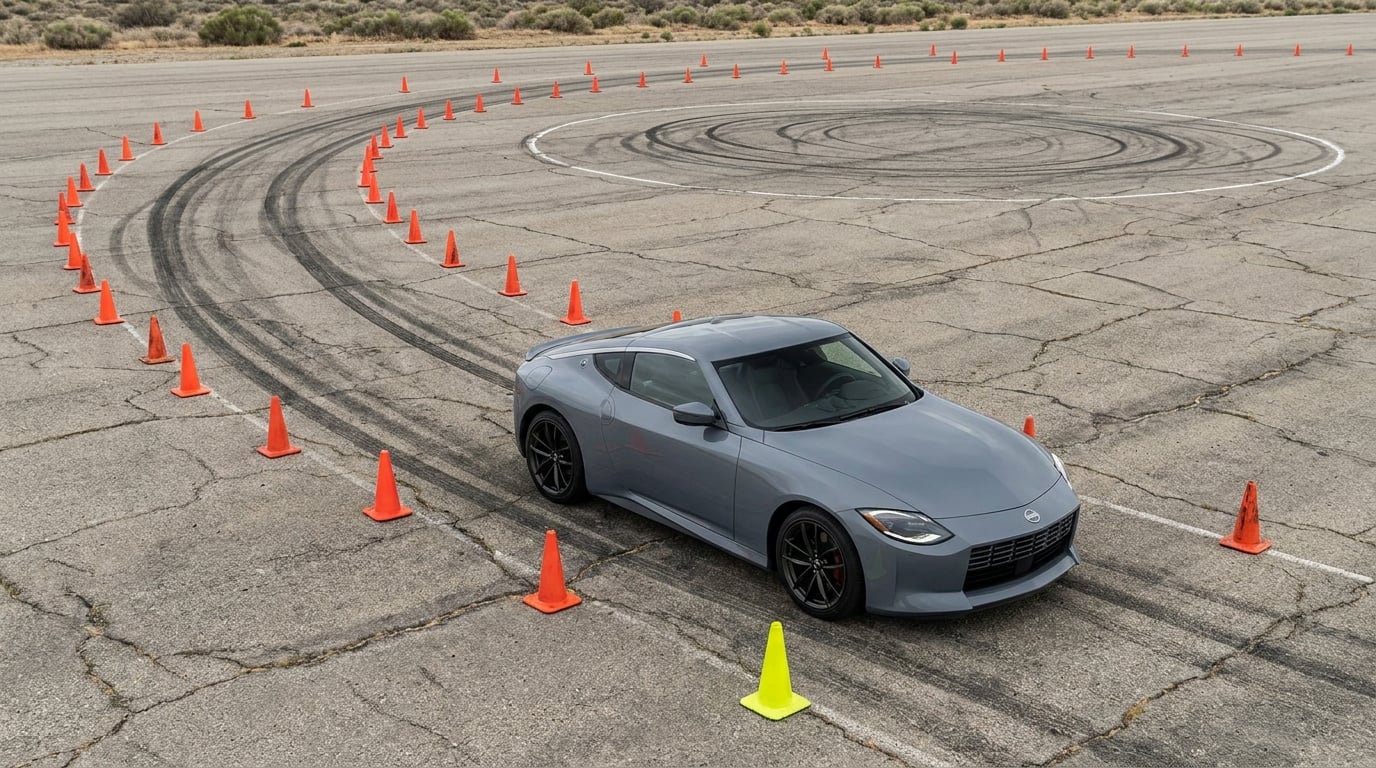
A car control clinic is a one-day, instructor-led course where you practise the handling skills most drivers never get taught: threshold braking, slalom cones, skidpad control and emergency avoidance, usually in your own car with an instructor in the passenger seat. Here is what you learn, how the day runs, and how the skills carry over to wet roads, ice and sudden emergencies.
Most people arrive nervous that they will be asked to spin the car on purpose. Almost nobody leaves that way. The day is built around small, repeatable drills at moderate speed, with an instructor calling corrections over the radio or from the passenger seat.
Updated for 2026. Schedules, formats and eligibility rules vary by provider, so check the specific event page before you sign up.
Table of Contents
- What Is a Car Control Clinic?
- What Skills Do You Learn in a Car Control Clinic?
- How Do You Learn Threshold Braking and Cornering?
- How Does a Clinic Teach Vehicle Dynamics?
- What Emergency Handling Skills Are Practiced?
- How Useful Is a Car Control Clinic for Everyday Driving?
- What Should You Expect During a Car Control Clinic?
- Frequently Asked Questions
- Do I need prior driving experience for a car control clinic?
- Is a car control clinic suitable for complete beginners?
- What car can I bring to a car control clinic?
- Will a car control clinic help me in the rain and snow?
- How is a car control clinic different from a track day?
- What should I do if my car starts to skid?
- How to Get the Most From a Car Control Clinic
What Is a Car Control Clinic?
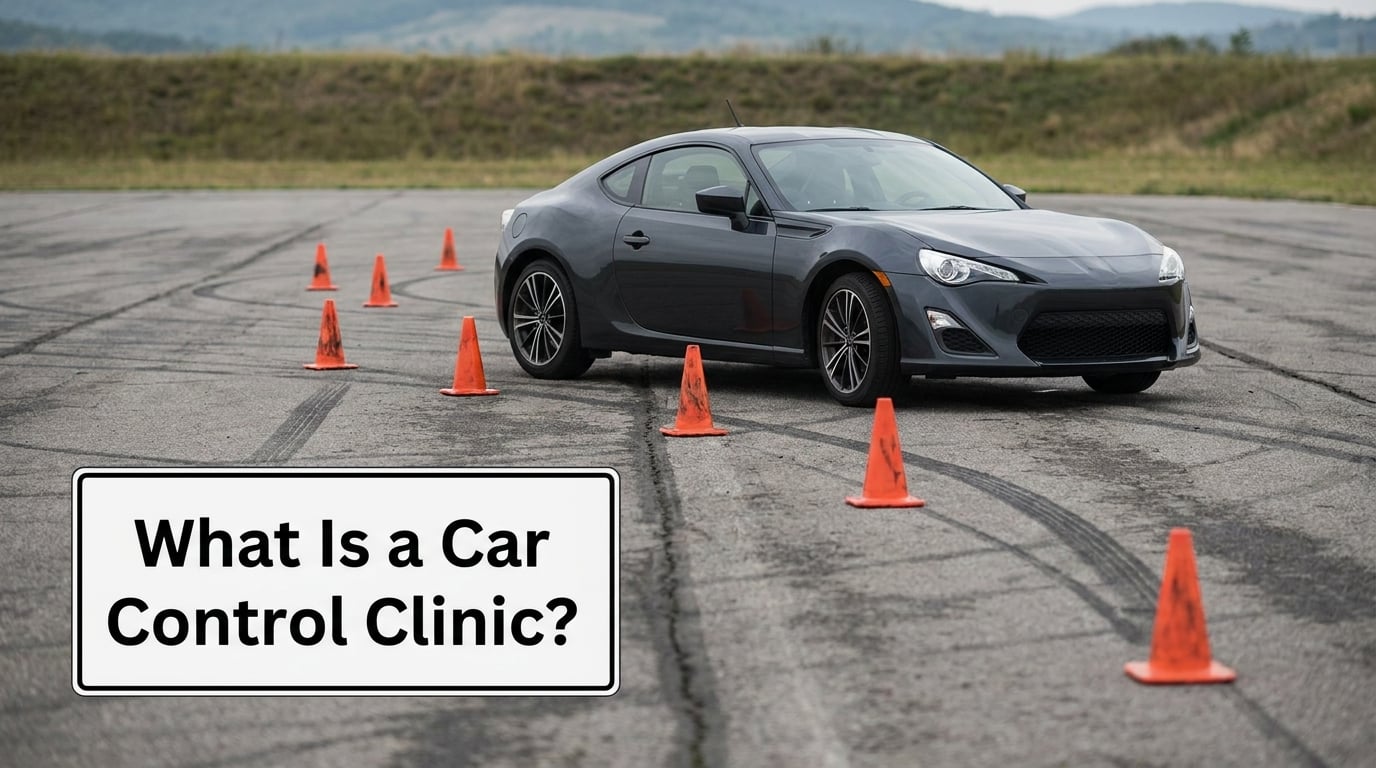
A car control clinic is a hands-on driving course held on a closed course, a skidpad or a large empty lot. Its purpose is to teach the mechanical skills of car control: how the steering wheel, brakes and throttle work together, and how to balance a car’s weight across four tires for braking, turning and acceleration.
The stated goal from most organizers is disarmingly simple: minimize panic reactions and replace them with rational car control. That framing comes straight from the program descriptions used by BMW CCA chapters and independent schools like Total Vehicle Control, and it separates a clinic from track-day instruction in a useful way.
It is aimed at several groups. New drivers who want technique instead of just habit. Owners of powerful or unfamiliar cars who have never driven hard. Winter and mountain-region commuters. And drivers who plan to move on to an HPDE day or an autocross school. Most programs say no prior performance driving experience is needed, though you do need a valid licence.
It is not a paid driving lesson for learning to parallel park, and it is not a track day. Nothing about the day is about lap times. The last section of this guide covers how to pick an instructor and get the most out of the hours you paid for.
What Skills Do You Learn in a Car Control Clinic?
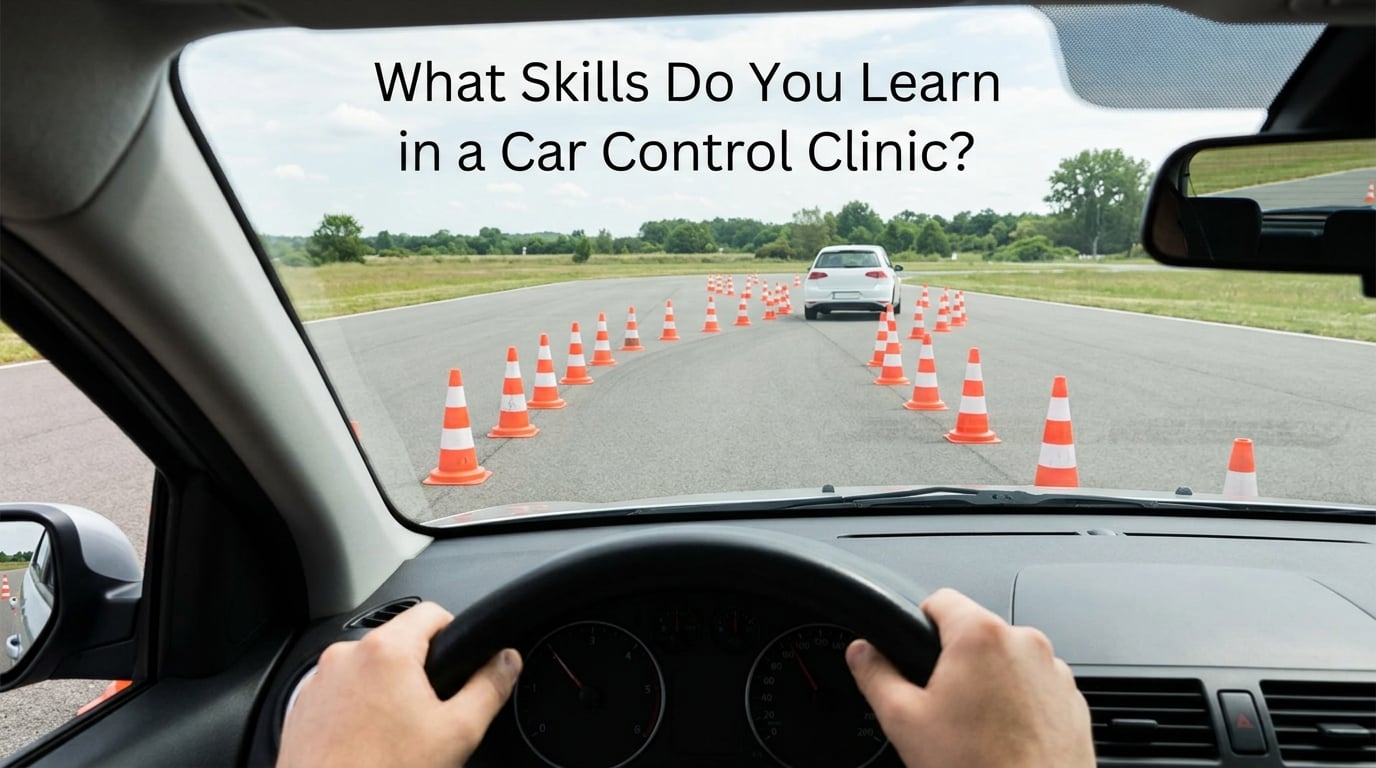
The core curriculum is usually four or five stations. You rotate through them, then repeat each one several times until the input feels repeatable rather than surprising. Here is what each one is actually for.
Skidpad and skid control
A skidpad is a painted or coned circle you drive around at increasing speed. The point is to feel the moment the car transitions from grip to slide, and to learn how to hold a steady state at the limit rather than falling off it. Most first-timers find the limit far higher than they expected and far less dramatic than they feared.
The recovery sequence instructors drill is simple: look where you want to go, ease off the throttle, and add a small amount of countersteer. Not a dramatic correction, a small one. If the car starts to rotate, steering harder into the skid makes it worse.
Slalom
Cones set at intervals, driven in a straight line, tightening each lap. The slalom teaches hand position, smooth steering input and the discipline of not over-correcting. It is the cheapest station to set up and the one most likely to be in the group, because it works with almost any car.
What carries over is the ability to make small corrections without sawing at the wheel. On a wet road that means you can correct a drift without upsetting the car further.
Braking stations
Usually straight-line braking to a marked point, then braking while turning. Straight-line work teaches threshold braking and how ABS feels when it activates. Braking in a turn teaches the effect of weight transfer, which is the most counter-intuitive lesson of the day for new drivers.
Reaction braking, where a coach calls for braking at a random moment, is the station attendees most often single out afterwards as the one that applies to daily driving.
Emergency avoidance
Cones or soft obstacles placed in your path, with the instruction to swerve to avoid and then recover the line. This is the emergency avoidance maneuver: brake, steer decisively but smoothly, straighten, then brake again. The coaching emphasis is on smooth steering inputs, because panic produces abrupt ones.
How skills build from one clinic to the next
Most organizations that run these regularly offer a ladder: an introductory clinic, an advanced clinic, a teen-focused version, and a wet skidpad clinic run on a soaked handling oval. The intro day covers the mechanics. The advanced day works closer to the limit. The wet day repeats everything with much less grip available, which is where instructors say the real learning happens.
How Do You Learn Threshold Braking and Cornering?
Three kinds of braking show up, and instructors like to separate them clearly because they teach different things.
Ordinary braking is stopping from a normal driving speed on a dry surface. You do it several dozen times a day without thinking about it. The clinic version is the baseline measurement, because instructors record where the stopping point lands and then compare it to everything after.
ABS braking is maximum pedal pressure on a slippery surface, with the pedal pulsing under your foot as the system modulates. The lesson is that you hold the brake down and steer, rather than pumping the pedal or stabbing it. Most drivers who have never had ABS activate do not recognise it and either lift off or pump, which lengthens the stop.
Threshold braking is the technique just below the ABS trigger point: enough pressure to use nearly all the available grip without locking the wheels. On a closed course you can find it, because past that point the pedal goes soft and the car stops turning. On a public road you would never hunt for it deliberately, which is worth saying out loud.
Cornering gets the same treatment through trail braking, where brake pressure is applied as you enter and gradually reduced through the turn, keeping the front tires loaded. That keeps the car balanced rather than diving under braking. The instructor calls the entry speed, you brake, you turn, you unwind the brake, and you feel the weight move across the four tires.
The progression is deliberate. Instructors start at moderate speed, repeat a drill until it is clean, and only then add speed or complexity. Skidpad and slalom come before anything involving deliberate rotation.
How Does a Clinic Teach Vehicle Dynamics?
Vehicle dynamics sounds academic, but the version taught in a clinic is four ideas you can feel from the driver’s seat.
Weight transfer is the big one. Braking loads the front tires and unloads the rear, which is why a car pitches forward under braking and why a rear-drive car can step out under power mid-corner. Cornering shifts load to the outside tires, which is why you brake in a straight line, then turn. Students who can feel this stop fighting the car.
Grip and the adhesion limit are taught as a budget. Every tire has a finite amount of grip, and braking, turning and accelerating all spend from the same budget. Exceed it and the car slides. Good instructors make you cross that line on purpose, once, in a controlled circle, so you know what it feels like before it happens to you on ice.
Steering input matters as much as pedal pressure. Small, smooth inputs get the most out of a tire. Large, abrupt inputs waste grip and can provoke a slide on a car that was otherwise fine.
Understeer and oversteer are usually demonstrated rather than drilled at the beginner level. Understeer means the front tires give up first and the car pushes wide, which is a manageable condition. Oversteer means the rear steps out and the car rotates, which is catchable with countersteer and throttle. Knowing which one you are in is the difference between a correction and a spin.
Alongside the mechanics, clinics spend time on visual driving. Looking into the corner rather than at the nose of the car, using peripheral vision for cone placement, and seeing early are all coachable habits, and they are the ones that help most in bad weather.
What Emergency Handling Skills Are Practiced?
The emergency stations exist to replace one reflex with a sequence. The reflex is panic: either freeze on the brake or swerve abruptly. The sequence is brake, decide, steer, straighten, brake again.
Evasive steering and swerve to avoid is drilled with cones and, in some programs, with soft padding. You approach at a set speed, avoid the obstacle, and return to the original line. Instructors push hard on smooth inputs, because a sudden stab of the wheel is what puts a car into a spin on a wet road.
Straight-line emergency braking is drilled on both dry and damp surfaces so you learn how much the stopping distance changes. That difference is the number people remember: the same car, the same speed, an enormous gap in distance once the surface is wet.
Slide recovery is the station that sounds most alarming and is usually the most reassuring. The instructor, from the passenger seat, provokes a rotation deliberately, and you hold it. Attendees repeatedly describe this as the defining moment of their day. A BMW enthusiast forum thread on the clinic frames it plainly as a confidence and safety investment rather than a track prerequisite.
Obstacle avoidance and reversing round it out. Some programs include backing and parallel parking in a controlled cone box, which sounds mundane but trains the low-speed precision that gets scratched on crowded streets.
One boundary matters here. None of this is a licence to practise emergency maneuvers on public roads. The skills are for recognizing a loss of grip early and responding with a controlled, repeatable correction, not for testing a slide where other people are driving.
How Useful Is a Car Control Clinic for Everyday Driving?
For most attendees, the day pays off in the three situations they are least equipped to handle alone: low grip, low visibility and a sudden stop.
On wet roads, a driver who has felt the adhesion limit deliberately will approach a puddle or a painted road marking with a different expectation. Knowing what the tires sound and feel like when they are about to let go is the difference between correcting early and correcting late.
In winter conditions, the same principle applies and gets amplified, because the margin is much smaller. Tire choice matters here as much as technique. Our guides on what tire pressure to run in winter and whether tire siping actually helps on snow and ice cover the hardware side. No amount of technique substitutes for tires that are too worn or a pressure that dropped overnight.
On mountain roads and in towing, the weight transfer lesson pays off directly. Braking downhill with a trailer behind you, or entering a tight bend with extra load, are textbook cases of a car being asked to do something with its weight distribution changed. Drivers who understand why the rear steps out handle it earlier and more gently.
For defensive driving, the emergency avoidance station is the one that transfers most directly. Reaction braking and swerve-to-avoid are exactly the maneuvers you hope to perform once, calmly, in the second a deer steps out in front of you at dusk.
On unfamiliar cars, the day explains why a car with a rear-engine layout, a very high center of gravity or an all-wheel-drive system behaves differently from what you learned in the car you grew up with. That is a real problem for anyone who shares a vehicle with another driver.
What a clinic is not is a substitute for formal track instruction. Track days, HPDE and autocross schools build on these skills and take them further. Clinics sit before them.
What Should You Expect During a Car Control Clinic?
A typical day starts with a short morning lecture covering vehicle dynamics, weight transfer, the braking physics and the station layout. Then the groups split, usually one instructor per car, and you rotate through the stations with a run group and a list of who is next.
The feedback is continuous and conversational. An instructor in the passenger seat or in a lead car over the radio will call your braking zone, tell you the steering input was too large, and note when the line improves. The one-on-one coaching is the element that BMW and enthusiast forum participants cite most often when they recommend the clinic.
Vehicle requirements are where most first-timers get stuck. Most providers run a tech inspection at sign-in, covering tire condition and pressure, brake pad and fluid condition, fluid leaks and general safety. Rules are usually strict about tire tread, and many organizations exclude SUVs and other high-center-of-gravity vehicles from skidpad work. Some ask drivers to disable traction and stability control or to avoid bringing cars with intrusive stability-control systems, because those systems will cut throttle and steering input mid-exercise and prevent you from learning the correction. A worn tire that feathers unevenly under hard cornering also gets flagged. If you want to know what to look at before the day, see what tire feathering is and what causes it.
Expect roughly a full day, sometimes a half day. Bring a valid licence, proof of insurance, closed-toe shoes with a flat sole, water, sun protection and a hat. Open collars and sunglasses that can fly off are common exclusions. If you share the car with a partner, be clear about who is driving and who is instructing, because the exercise is much less useful with two people trying to coach at once.
Frequently Asked Questions
Do I need prior driving experience for a car control clinic?
No performance driving experience is required at the introductory level. You need a valid licence and enough ordinary driving experience to handle a car at moderate speed on a closed course. Owners of powerful cars often arrive with no track time at all, and that is the normal case. Advanced and wet skidpad clinics do assume you have taken an intro clinic or driven on track before, so check the event page before booking a higher tier.
Is a car control clinic suitable for complete beginners?
It is closer to a controlled skills course than to driver education. There is no classroom theory block beyond a short morning lecture, and the exercises are physical from the first hour. A complete beginner with a licence can usually attend an intro clinic, though driving schools that teach emergency braking and skid recovery in depth are the better first step if you have never been taught what to do when a car starts to slide.
What car can I bring to a car control clinic?
Usually your own road car in good condition, with good tires, sound brakes and no warning lights on the dash. Most providers run a tech inspection at check-in and can refuse a car that fails it. Rules commonly exclude SUVs and other tall vehicles from skidpad exercises, and some programs ask you to disable traction and stability control or discourage cars with intrusive stability systems. Check the provider’s vehicle requirements before you commit.
Will a car control clinic help me in the rain and snow?
Yes, and that is where instructors say the skills matter most, because the technique is the same and only the grip changes. Learning to feel the adhesion limit deliberately means you recognize a slide forming earlier, when there is still time to make a small correction. A wet skidpad clinic repeats the same drills with far less grip available, which is the closest practice you can get to winter conditions without an actual ice surface.
How is a car control clinic different from a track day?
A track day is about lap time, so cars are limited, run in groups at speed, and you are usually on your own with no instructor. A clinic is about technique, run at moderate speed in a closed lot or on a skidpad, with an instructor in the passenger seat giving you feedback on every input. A clinic comes first in the progression, then autocross school, then HPDE, and a track day if you want one.
What should I do if my car starts to skid?
Look where you want the car to go, take your foot off the accelerator, and apply a small amount of countersteer in the direction of the slide. Do not add more power, do not brake hard, and do not grip the wheel tightly. On a slippery surface, brake firmly in a straight line rather than turning, and if the car has ABS keep your foot firmly on the pedal. Practising that sequence is exactly what the skidpad station is for.
How to Get the Most From a Car Control Clinic
Pick the instructor before you pick the date. Credentials matter more than the venue here, and anyone who has raced or run HPDE will teach a noticeably different clinic than a driving instructor working from a manual. BMW and Porsche veterans and SCCA-level instructors come up repeatedly in reviews, and so does the small class size.
Then confirm the format and the vehicle rules. Ask whether your car is eligible for every station, whether you need to disable stability control, and what the tech inspection covers. Turning up with a tall crossover and being told the skidpad is off-limits ruins half the day.
On the day itself, the thing that separates people who improve from people who just ride along is attention. Track your own inputs without staring at them. When the instructor says your steering was too big, do the next corner smaller. Aim for repeatable corrections rather than faster laps, because repeatability is the entire product.
And go in expecting to feel the limit sooner than you thought. That is the part almost nobody warns you about, and it is why people describe the day in terms of confidence rather than skill points.