
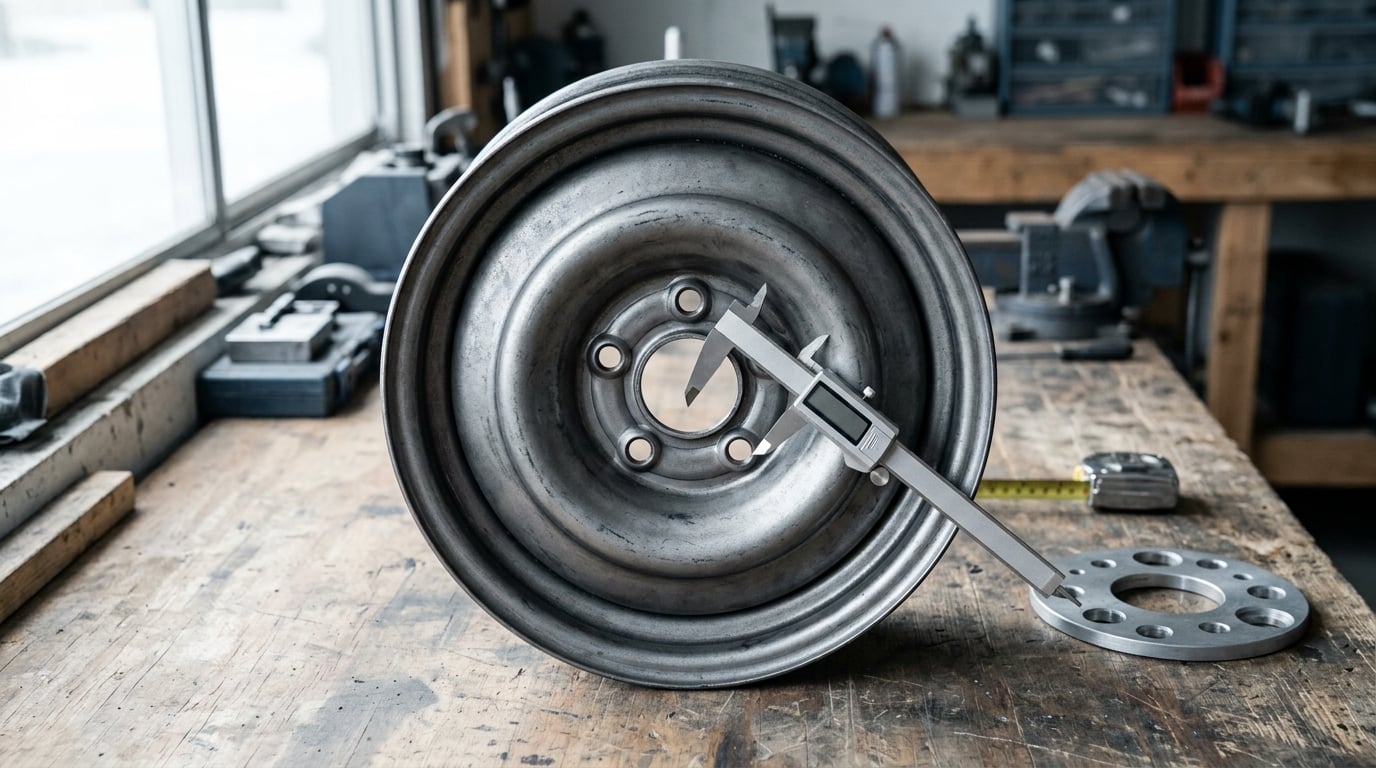
Bolt pattern is the number of lug holes on a wheel plus the diameter of the circle those holes sit on, written as 5×114.3 or 4×100. To measure it at home, put a caliper or tape measure on the centers of two opposite lug holes for an even lug count, or double the center-bore-to-lug-hole distance for any wheel including five-lug. Most patterns take under five minutes.
The part that catches people out is five-lug wheels, where a straight measurement between two holes gives you a number that is not the bolt circle. Get that wrong and you order a set of wheels that will not bolt on, or worse, one that hangs on loose. Here is how to measure it properly, plus the other five specs that decide whether a wheel actually fits.
Table of Contents
What You Need
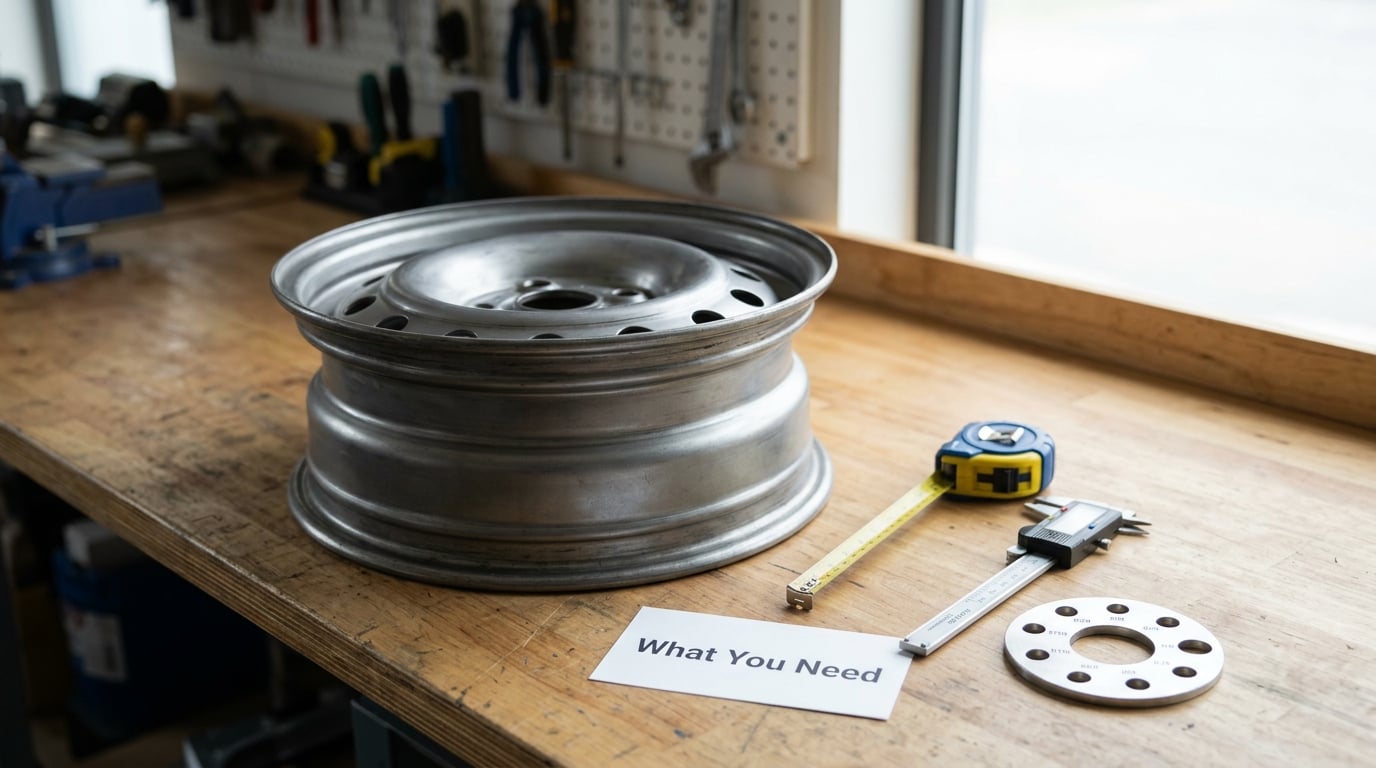
You need three things: a way to measure, a way to find the center, and the vehicle specification to check your answer against. The measuring part is the easy half.
- A tape measure or rule works for 4, 6 and 8-lug wheels, which is most small cars and trucks. Accuracy to about 1 mm is fine.
- A digital caliper is the tool I would buy first. It reads hundredths of a millimeter, so a 114.3 mm circle lands almost dead on, and it makes the pilot-hole method a non-issue.
- A lug-hole gauge or template is a round plate with holes drilled at the common patterns. You drop it on the wheel and the matching one lines up with the lug holes. Cheap ones work fine.
- Cleaning supplies and a soft cloth. Brake dust and rust in the holes throw a tape measure out by several millimeters.
- The vehicle specification for your exact year, make, model and trim. The driver’s door jamb sticker is the fastest source, and the owner’s manual is the backup.
Set the wheel face up on a bench or clean towel. A wheel in your hands is a wheel you will drop, and a scuffed face is a wheel you will not want to show anyone.
Step-by-Step: How to Measure Bolt Pattern on Wheels
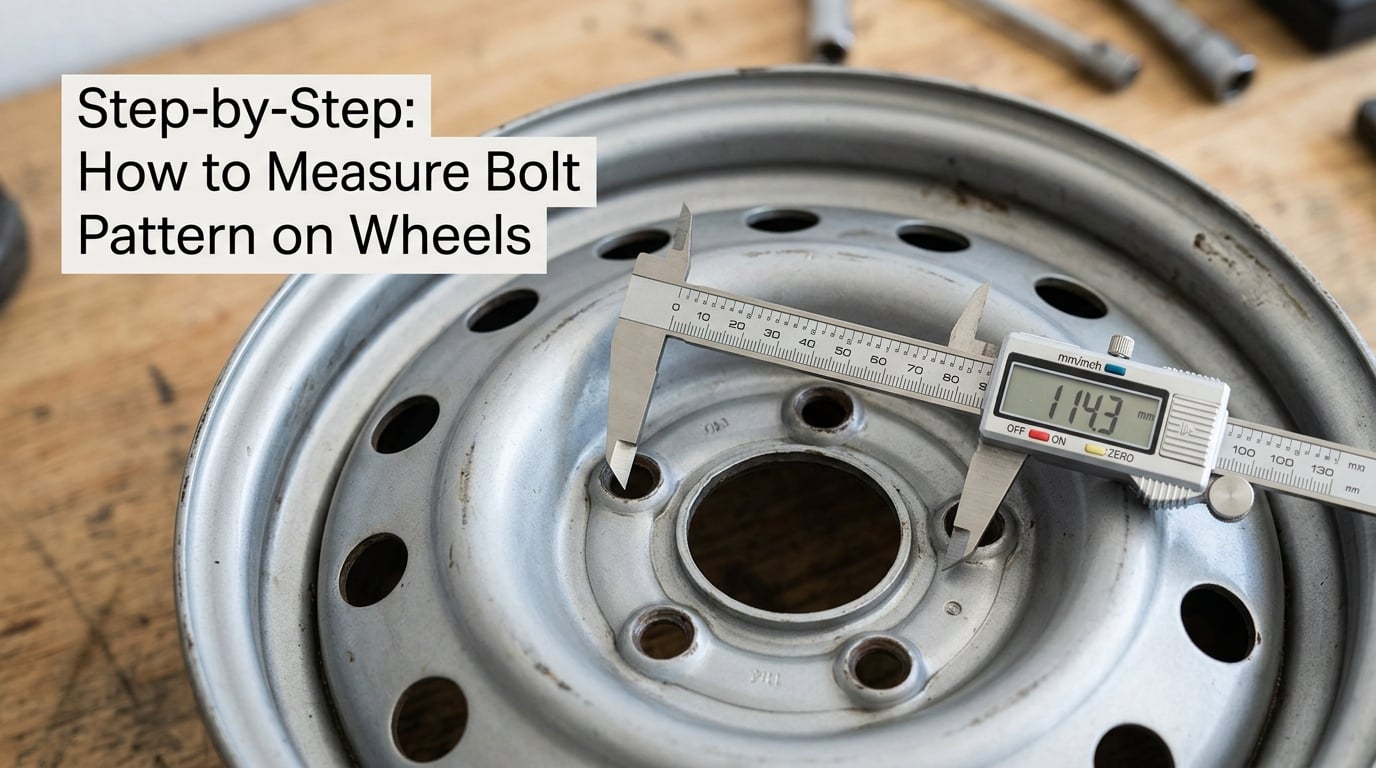
Start by counting the lug holes. That count is the first number in the code, and it decides which method below you should use.
Method 1: Measure Across the Stud Holes
For wheels with an even number of lugs, 4, 6 or 8, measure straight across the center from the middle of one lug hole to the middle of the hole directly opposite it, then divide by two.
That gives you the pitch circle diameter, the PCD. A four-lug car that measures 200 mm across the two opposite holes has a 4×100 bolt pattern. A six-lug truck measuring 279.4 mm across has a 6×139.7 pattern.
Two things matter for accuracy. Put the caliper or tape on the hole centers, not the near edges of the holes, and measure a second pair of holes to confirm. A bent wheel or a sloppy reading shows up as two different numbers from two different pairs.
You can also measure the pattern on the hub itself while the wheel is still mounted. Measure across two opposite lug studs, clear of the wheel, and you have the factory PCD for that vehicle, which is useful to know before you start shopping.
Method 2: Use the Pilot-Hole Circle
Measure from the center of the wheel’s pilot hole to the center of any lug hole, then double that number. This works on any lug count, five included, and it is the most accurate method when you have a caliper.
On a 5×114.3 wheel, the pilot hole center to a lug hole center should read 57.15 mm. Double it and you have your answer. On a 5×120 wheel the same reading is 60 mm, and on a 4×100 wheel it is 50 mm. Learn to eyeball those halves and you can identify most passenger car wheels in a couple of seconds.
The one caveat is that the pilot hole itself has to be centered. On cheap wheels and on steel wheels with a large hub bore, the bore is sometimes drilled slightly off. Check the same distance to two different lug holes. If they disagree, move to Method 1 or 3.
Method 3: Use a Lug-Hole Gauge or Template
Put the gauge plate flat on the wheel face with the pilot hole centered on the pilot hole, then see which set of gauge holes lines up with your lug holes. The marking next to that hole group is your bolt pattern.
This is the fastest method and the least precise, which is why it is a good first pass and a poor final word. A cheap stamped gauge can be off by a couple of millimeters, so use it to narrow a wheel down to one or two candidates, then confirm with a caliper or with the manufacturer spec.
A printed template cut from card stock works the same way if you do not want to buy a gauge. Print a full-size 4, 5 and 6-lug layout, punch the holes, and check that the print came out at actual size before you trust it.
Method 4: Read the Wheel Stamping or Manufacturer Specifications
Most alloy wheels have a marking cast or etched on the back spoke or the pad between the mounting pad and the rim, something like 5×114.3 or 7Jx17 ET35. The first number before the x is the lug count and the number after it is the PCD in millimeters.
Older American wheels and steel wheels often use inches instead. A 5×4.5 stamping means five lugs on a 4.5 inch circle, which is the same wheel as 5×114.3. The conversion is simple: divide millimeters by 25.4 to get inches, and multiply inches by 25.4 to get millimeters.
| Stamping | Lugs | PCD (mm) | PCD (inches) | Usually found on |
|---|---|---|---|---|
| 4×100 | 4 | 100 | 3.94 | Subcompact cars, small SUVs |
| 4×10⁸ | 4 | 108 | 4.25 | Hyundai and Kia models, some Fords |
| 4×114.3 | 4 | 114.3 | 4.5 | Toyota, Lexus, Nissan |
| 5×100 | 5 | 100 | 3.94 | Older compact and midsize cars |
| 5×10⁸ | 5 | 108 | 4.25 | Volvo, Saab, some Ford and Chrysler |
| 5×112 | 5 | 112 | 4.41 | VW group, Audi, Mercedes, some Ford |
| 5×114.3 | 5 | 114.3 | 4.5 | Most Japanese and Korean sedans and crossovers |
| 5×120 | 5 | 120 | 4.72 | Chevy, GMC, many American trucks and SUVs |
| 5×127 | 5 | 127 | 5.0 | Chevy and GMC full-size trucks |
| 6×114.3 | 6 | 114.3 | 4.5 | Toyota and Nissan 4×4 trucks |
| 6×139.7 | 6 | 139.7 | 5.5 | Chevy, GMC, Ram full-size trucks and SUVs |
| 8×165.1 | 8 | 165.1 | 6.5 | Heavy-duty trucks, commercial vans |
Two near-misses cause most of the ordering errors here. A 5×112 wheel will not go on a 5×114.3 hub, and 5×127 is not 5×120. The gap between some of these is under 3 mm, which is far less than the error in a stretched tape measure.
How to Measure Odd-Numbered Bolt Patterns
On a five-lug wheel, there is no hole directly opposite another hole, so a straight measurement across the wheel is a chord of the bolt circle, not the diameter. It always reads short, and by a fixed amount.
The chord from one lug hole to the hole two positions away, skipping one in between, is 95.1 percent of the PCD. Divide your measurement by 0.951 to get the real number.
- A 5×120 wheel measures 114.1 mm across that chord. 114.1 divided by 0.951 gives 120.
- A 5×114.3 wheel measures 108.7 mm across the chord. 108.7 divided by 0.951 gives 114.3.
That is a real method and it works, but the arithmetic compounds whatever error your tape already had. If you are off 1 mm on the chord, you are off about 1 mm on the PCD. For most buyers that is acceptable; for anyone fitting larger wheels, it is not.
There is a second chord shortcut. Measure from the outer edge of one lug hole to the outer edge of the hole two positions away, then subtract the diameter of one lug hole. For example, a 5×114.3 wheel with 20 mm lug holes measures 128.7 mm edge to edge, and 128.7 minus 20 is 108.7. Same chord, different starting point.
My honest preference for a five-lug wheel is the pilot-hole circle in Method 2, with a caliper, or a gauge. It is the one measurement on a wheel where a cheap tool is not good enough, and it is the number people get wrong most often.
Common Measurement Mistakes and How to Fix Them
Measuring hole edges instead of hole centers. On a 4-lug wheel this quietly adds the full lug hole diameter to your number, which on a 4×100 pattern is about 18 mm of error. Put the caliper jaws inside the hole and touch them to opposite walls, or measure the tapers center to center.
Using the chord on a five-lug wheel without dividing. A raw 108.7 mm reading on a five-lug wheel is a chord. Divide by 0.951 before you compare it to anything.
Measuring the outer rim diameter. A 17 inch wheel is 17 inches across the tread, not across the lug holes. Rim size, tire size and PCD are three separate numbers and mixing them up sends people looking for a 17×5.5 pattern that does not exist.
Measuring a dirty or damaged wheel. Brake dust packed in the hole and rust on the lip will both skew a tape measure. Clean the face, and if the rim is bent or has a crack near a lug hole, do not trust any measurement from it.
Mixed units. A tape measure marked in inches and a caliper set to millimeters is a bad combination. Write the unit next to the number the moment you read it, before you put the tool down.
Trusting a single reading. Measure two pairs of holes, or the same pair twice, and compare. Two different answers mean something is off with the wheel, the tool, or your technique.
Ignoring spacers and adapters. Spacers do not change bolt pattern, but adapters and hub-centric rings change what you are measuring. If the wheel is already bolted to a spacer, measure the wheel itself, not the spacer.
Reading a dual-drill wheel as a single pattern. Some wheels are drilled for two patterns at once, and the two groups are often a small number of millimeters apart. Measure both sets and use the one that matches your hub.
One more that is not a measuring error but a shopping error: assuming every wheel from a given brand fits every vehicle from that brand. Model years, trims and markets shift patterns, so check your specific vehicle.
Check the Wheel Fits Before Ordering
Bolt pattern is necessary and nowhere near sufficient. Before you order, run through the rest of the fitment list, because a wheel can match on PCD and still be wrong in four other ways.
- Width. Wider than stock can mean rubbing on the fender liner or eating inner tire clearance. A common rule is about 1 inch wider per side over stock, but the bodywork decides.
- Offset (ET). This is the distance in millimeters between the wheel’s mounting pad and its centerline, and it decides whether the wheel sits too far out or too far in. Zero offset puts the mounting face flush with the wheel centerline; positive offset tucks the wheel under the fender.
- Center bore. The hole in the middle of the wheel that fits over the hub. A bore smaller than the hub needs correct centering and, on many cars, hub-centric plastic rings to center the wheel on the studs rather than on the nuts.
- Brake clearance. Big wheels need caliper clearance. The lip has to clear the caliper at full steering lock, and the mounting face has to clear the rotor hat on some vehicles.
- Load rating. The wheel has to carry the vehicle’s weight over the axle, plus a margin. A passenger car wheel is not a truck wheel, regardless of diameter.
- Tire size. The tire has to fit the rim width without stretching or pinching, and the overall diameter has to stay close to the factory size for the speedometer and ABS to read correctly.
Once the wheels are on, torque matters as much as fitment. A wheel that is not seated against the hub puts uneven load on the studs, and over-torquing a stretch-to-yield bolt or a two-piece wheel is a genuinely common way to warp a rim. If you want to know what a problem fastener sounds and feels like, read about the signs a bolt is stretch to yield before you torque anything.
Use the vehicle’s spec as the final check, not as a starting point. Measure first, then confirm the number you measured against the door jamb sticker and the manufacturer fitment chart for your exact year and trim. These steps have not changed much in 2026, and they are the same ones a fitment shop runs before it mounts anything.
Frequently Asked Questions
Is 114.3 the same as 4.5 bolt pattern?
Yes. A 5×114.3 pattern and a 5×4.5 pattern are the same wheel. Metric wheels are stamped in millimeters, 114.3 mm, and American wheels are stamped in inches, 4.5 in, and 4.5 multiplied by 25.4 equals 114.3. Both describe five lug holes on a bolt circle of that diameter.
How do I measure a 4-lug bolt pattern?
Measure the distance center to center between two lug holes that sit directly opposite each other, then divide that number by two. The result is the pitch circle diameter. A four-lug wheel measuring 200 mm across opposite holes is a 4×100 pattern. Measure a second pair of holes to confirm your reading.
How do I measure a 5-lug bolt pattern?
Measure from the center of the pilot hole to the center of any lug hole and double it, or use a lug-hole gauge. A tape measure alone is risky because no two holes sit opposite each other on a five-lug wheel. The chord shortcut also works: measure hole to hole skipping one, then divide by 0.951.
How can I tell what bolt pattern a rim is without a gauge?
Look for a cast or etched marking on the back of the wheel, usually between the mounting pad and the rim, in a format like 5×114.3. The number before the x is the lug count and the number after it is the PCD. If the wheel carries no marking, measure the pilot hole to a lug hole center and double it.
Is 5×5 the same as 5×5.5 bolt pattern?
No. They are different wheels, 127 mm and 139.7 mm apart, and 5×5.5 is normally a six-lug pattern on trucks. A 5×5 bolt circle fits a 5×127 mounting face only. Always check the lug count as well as the diameter, because the same number appears in both columns of a fitment chart.
Can you change a wheel’s bolt pattern?
Not on the wheel itself. Bolt holes are drilled at the factory, and spacing them differently weakens the rim. Adapters and conversion hardware do change the pattern your studs use, but they push the wheel outboard, change the effective offset, and add a joint that has to be torqued correctly every time.
Conclusion
Count the lug holes, then use the pilot-hole circle with a caliper for the number you can trust, or the center-to-center method across opposite holes on a 4, 6 or 8-lug wheel. Write the result down with its unit, measure a second time, and check it against the vehicle’s spec before anything else.
Bolt pattern is the first gate, not the last one. Confirm the PCD, then confirm width, offset, center bore, brake clearance and load rating for your exact year, make, model and trim, and you will not be the person ordering a second set of wheels.