
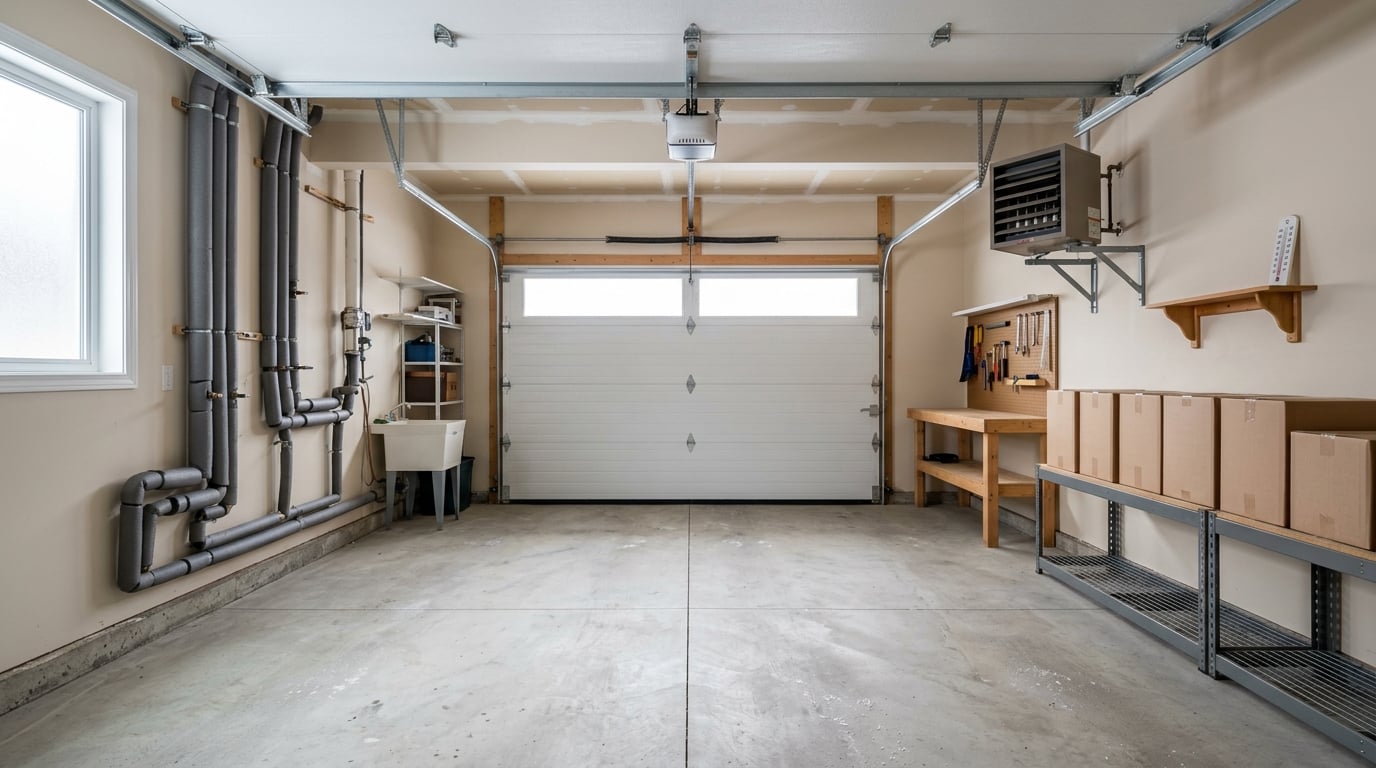
To keep a garage from freezing in winter, you cut the heat loss first and add heat second: seal the gaps around the garage door, insulate the door and ceiling, then run a garage-rated heater set near 40 degrees Fahrenheit. An unheated garage loses most of its warmth through the door and the daylight around it, so heating before sealing is paying to warm outdoor air. Most of this is a weekend of work, and none of it needs a contractor unless you want permanent insulation or a new heater circuit.
Updated October 2026. The order below matters more than the products, and there are a few places where getting it wrong is genuinely dangerous.
Table of Contents
- What You Need
- How to Keep a Garage From Freezing in Winter: Step-by-Step
- 1. Find the Coldest Areas and Heat Leaks
- 2. Seal Gaps Around the Garage Door to Keep the Garage From Freezing
- 3. Seal Cracks and Openings in the Garage
- 4. Insulate the Garage Door and Vulnerable Pipes
- 5. Maintain a Safe Temperature Without Creating Hazards
- 6. Protect Vehicles, Batteries, and Stored Items
- 7. Check Conditions During Cold Weather
- Common Mistakes
- Frequently Asked Questions
- How to Keep a Garage From Freezing in Winter: Start With These Steps
What You Need
The short answer is that you need very little to get most of the benefit. A basic thermometer, a tube of sealant, a roll of weatherstripping, and a door sweep will take care of the biggest leaks in an afternoon.
- A cheap thermometer that shows a minimum and maximum reading, so you can find the cold spots instead of guessing at them.
- Weatherstripping for the top and sides of the door opening, plus a bottom threshold seal or door sweep sized to your opening.
- Caulk or polyurethane sealant for cracks in wall and floor joints, and for gaps around pipe penetrations.
- A removable draft stopper for the gap under an interior door, if the garage shares a wall with the house.
- Insulation for the door panels: a garage door insulation kit, rigid foam board, or reflective panels that fit between the door sections.
- Pipe insulation or heat tape for any water line, valve, or hose that runs through the garage.
- A garage-rated heater and a thermostat, if you plan to hold the space above freezing.
- Smoke and carbon monoxide detectors, plus a working flashlight and a charged phone.
- Basic hand tools: a screwdriver, a utility knife, a tape measure, a putty knife, and a pair of safety glasses.
A few items are optional. Foam board, bubble wrap, and reflective insulation are weekend fixes, not permanent answers, and they work best on the ceiling. A propane or kerosene heater is not on this list on purpose; those belong outdoors or in a well-ventilated space, never in a garage you plan to close up for the night.
If you rent, check with your landlord before touching weatherstripping, running new electrical, or changing the door hardware. Sealing and weatherstripping are usually fine. Anything involving wiring, gas lines, or a permanently installed heater is your landlord’s call.
How to Keep a Garage From Freezing in Winter: Step-by-Step
The sequence below runs from cheapest and most effective to most expensive. Do the first three before you buy any heat.
1. Find the Coldest Areas and Heat Leaks
Start by finding out where the cold actually is. Set the thermometer on the floor near the garage door, then up on a wall, then near the ceiling, and leave it for an hour with the door shut. Cold air pools low, so the floor by the door is usually the first thing to fix.
Then do the daylight test. With the interior lights off and the door closed, look for daylight around the top, sides, and bottom of the door. Any light you can see is air you are heating. Also check the wall-to-floor joint along the side walls, the corners, and every place a pipe, wire, or outlet box passes through the wall.
You will usually find the same three offenders: a worn bottom seal, daylight down the sides of the door, and gaps where framing meets the slab. A frozen patch of condensation or frost on a wall in the morning is the same information in a different form.
2. Seal Gaps Around the Garage Door to Keep the Garage From Freezing
The garage door is usually the largest opening in the building, and the bottom seal is where most of the moving air gets in. Pull the door down by hand, wipe the old seal clean with a damp cloth, and check for daylight along the whole width. If the seal is crushed, cracked, or has a visible gap at either end, replace it.
Measure the opening width and height, buy a vinyl or rubber threshold seal that matches, and fit it so the closed door presses evenly into it. Test it by looking for daylight again, then by running your hand along the seam while the opener moves the door. A little daylight at a single spot is a five-minute fix; a seal that is loose along its whole length is a door-geometry problem, and that is a job for a door technician.
The top and side seals matter just as much. The header seal sits against the wall above the door, and the side seals run down the jambs. Work in daylight with the door closed, replace any strip that is torn or has lost its shape, and be patient with the corners, where most failures hide.
Do not adjust the door springs yourself. They are under enormous tension, and the balance adjustment belongs to a technician.
3. Seal Cracks and Openings in the Garage
Now work around the rest of the envelope. Put sealant in the wall-to-floor joint, in gaps where studs meet the slab, and around the small openings where a hose bib, a conduit, or an outlet box penetrates the wall. Gaps in a rim-joist area are worth a closer look because they often connect to an uninsulated space above.
Use the right material for the job. Flexible sealant and polyurethane caulk handle small moving cracks in drywall and framing. A foam gasket handles a steady leak of air through a flat gap. A removable draft stopper is better than caulk for the gap under an interior door, because you will not have to cut it out to get through.
One warning that matters more than the rest of this list: do not seal anything that ventilation depends on. If a water heater, furnace, or gas-fired appliance is in or adjacent to the garage, its combustion air and exhaust venting must stay open. A carbon monoxide alarm is the last line of defense, not the plan.
4. Insulate the Garage Door and Vulnerable Pipes
Insulating the door is the single highest-impact project for most garages. A panel-style kit is the easiest option: rigid foam board or reflective insulation cut to fit between the door sections and held in place with retainer tape or friction fit. Follow the kit instructions, and keep any retainer strips clear of the track so the door still rolls.
After adding insulation, test the balance. Close the door, pull the release cord, and lift the door to waist height. Let go: it should stay roughly where you left it, or drift down slowly. If it slams or jumps up hard, the added weight has thrown the balance off and a technician should re-tension it. This check takes a minute and catches the most common complaint about insulated doors.
Next, look at pipes. Any water line, drain line, valve, or outdoor hose that runs through the garage gets pipe insulation or an approved heat tape. Put valves and fittings under insulation too, since they are usually the first thing to freeze. Keep electrical boxes, junction boxes, and any exposed wiring clear of condensation, and do not run heat tape over a wet or damaged section.
On a tight budget, do the ceiling first, then the wall facing away from the sun, then the remaining walls. Heat rises, and the ceiling is the biggest heat loss in a one-car garage with unfinished walls.
5. Maintain a Safe Temperature Without Creating Hazards
Once the envelope is sealed and insulated, adding heat starts to make sense. Set the thermostat high enough to stay comfortably above the freeze line and low enough that you are not wasting fuel. About 40 degrees Fahrenheit protects water lines and most stored household items while costing a fraction of what a comfortable shop temperature costs.
| Setpoint | What it protects |
|---|---|
| 32 degrees or below | Nothing. Water lines, car batteries, and stored paint all fail at or above this. |
| 40 degrees | Water lines, valves, car batteries, and most stored garage goods. The standard freeze-protection setpoint. |
| 45 to 50 degrees | Adds margin for a power outage or a cold snap, and keeps paint and adhesives workable. |
| 60 to 64 degrees | A working shop temperature. Not needed for freeze protection, and noticeably more expensive to hold. |
Now the safety part, which is not optional. Use a heater rated for garage use, mounted per the manufacturer’s instructions, with its required clearance from anything combustible. Do not use a household space heater as a primary garage heat source. If you install a gas-fired unit, have it done by a licensed technician and confirm the venting is correct. If you are still weighing how to keep a garage from freezing in winter on a tight budget, sealing and insulating the envelope first buys more than a bigger heater ever will.
Have a working smoke detector and a carbon monoxide detector inside the garage, with a working alarm on every level of the house. Never run a combustion heater overnight unattended. Keep the path from the door to the house exit clear of stored items at all times, and keep a flashlight and a charged phone near that exit.
One more thing that gets missed: heating an uninsulated garage can melt the snow off the roof and refreeze it at the overhang, backing meltwater under the shingles. If you plan to heat the space, insulate the ceiling first.
6. Protect Vehicles, Batteries, and Stored Items
Cold is hard on batteries far more than it is on metal. Lead-acid car batteries lose capacity as the temperature drops, and a vehicle that sits for weeks can be weak enough not to turn the engine over. A battery maintainer is the cheap fix; connecting it before a long cold stretch means you do not find out in the morning.
Tires lose pressure as air contracts, roughly a pound per square inch for every 10 degrees of drop. If a vehicle will sit for a long time, check the pressures when the tires are cold, and don’t inflate them while the car is warm.
Store anything that hates moisture on a shelf, off the concrete floor. Cardboard, drywall compound, electronics, paper, and fabric all pick up floor moisture in a cold garage and can end up with mold or rust-stained rings. Keep chemicals and paints in a spot above freezing, and never store fuel or propane containers in an attached garage.
Move vehicles in before an extreme cold snap rather than during it. If a car is already frozen in, do not idle it inside the garage to warm up, with the door closed, for any reason.
7. Check Conditions During Cold Weather
Set a weekly reminder for the first cold month. Walk the space, read the thermometer, and look at the bottom of the door for a new gap or an ice ridge where the seal meets the slab. A door that gets stiff overnight is usually lubricant, not a broken spring.
Check the pipe insulation for tears, look for condensation on the back wall, and confirm the heater’s clearances are still clear. After a storm or a sharp temperature drop, walk the property and look at the roofline for an ice ridge forming along the overhang.
Stop and act immediately if you see ice forming near any wiring or an outlet, if you smell propane or gas, if a carbon monoxide detector sounds, or if you see a propane flame go out in an enclosed space. All of those mean shut the heater off, get everyone out, and ventilate from outside.
There is one more cold-weather behavior worth knowing. A door that ran smoothly all summer can get slow and heavy in winter because the lubricant on the rollers and track thickens with cold. That is normal. Use a silicone-based lubricant on the rollers and tracks, lithium grease on the opener’s gears, and graphite on exterior lock cylinders.
Common Mistakes
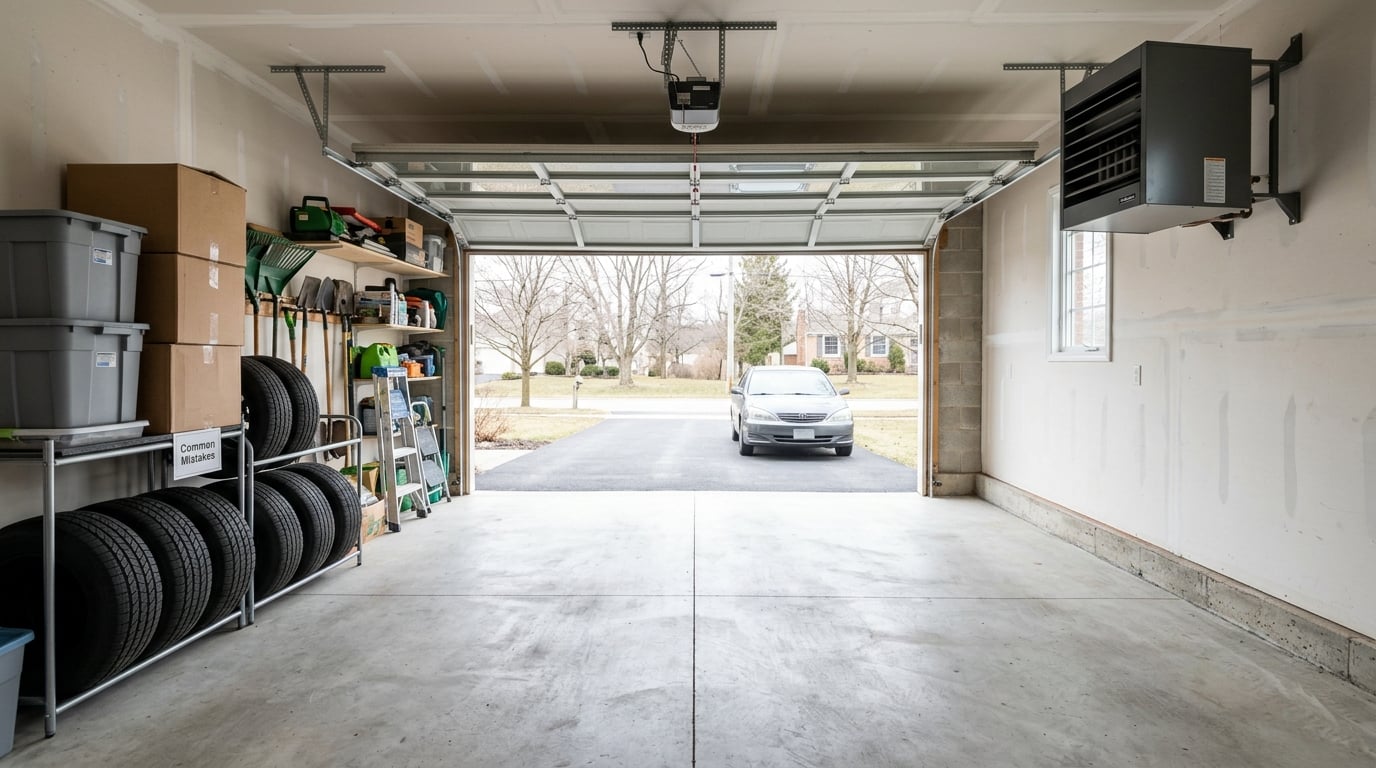
Most garage heating mistakes are a good idea applied to the wrong space. Here are the ones that come up again and again, and the fix for each.
- Using a household space heater as the main heat source. These are built for a small room with an outlet, not for a garage floor, and several models are not rated for that use at all. Fix: a garage-rated heater on its own circuit, sized to the space.
- Sealing the combustion ventilation. Blocking a flue or a combustion air intake in the name of warmth is how carbon monoxide gets into a house. Fix: leave every vent the appliance needs, and confirm placement with a technician.
- Tucking combustible insulation against a heater. Foam board and paper-faced batts near a hot surface is a fire waiting for a bad night. Fix: keep the manufacturer’s stated clearance on all sides.
- Blocking the exit path. A garage full of stored items with one narrow lane to the door is a problem the night the battery alarm goes off. Fix: keep the door-to-house route clear year round, not just in winter.
- Wrapping heat tape around a line with no insulation over it. Tape alone radiates most of its heat away. Fix: follow the tape’s instructions, and put pipe insulation over the taped section.
- Assuming a new bottom seal fixed it. A sealed door with uninsulated walls and a bare concrete floor can still be the coldest room in the house. Fix: seal first, then insulate the door, then the ceiling, then judge whether you need heat.
If you only do one thing, replace or fit the bottom threshold seal. It is the cheapest item on the list and it closes the largest gap.
Frequently Asked Questions
What temperature should a garage stay at in winter?
About 40 degrees Fahrenheit is the standard freeze-protection setpoint, because it sits a comfortable margin above the 32 degree freeze line and protects water lines, valves, car batteries and most stored goods. Many homeowners with sensitive contents set 45 to 50 degrees instead, which is worth it if a power outage or a deep cold snap is common where you live. Around 60 to 64 degrees is a working shop temperature, not a freeze-protection one, and costs noticeably more to hold.
Do I need to insulate my garage if it is unheated?
It depends what you are storing. An unheated, uninsulated garage usually tracks the outdoor temperature closely, so anything freeze-sensitive in there needs either insulation or a heat source. If the garage is attached to the house and the temperature is more comfortable than outside, sealing leaks and insulating the door is still the cheapest improvement you can make. Insulating an unheated garage does not warm it; it just slows how fast it changes.
What is the safest way to heat a garage?
A garage-rated heater mounted per the manufacturer’s instructions, on the correct electrical circuit, with its required clearance from anything combustible, and only after the envelope is sealed. Use a thermostat so it cycles instead of running constantly. Never use a household space heater as primary heat, and never run a combustion heater overnight unattended. Have working smoke and carbon monoxide detectors in the garage and on every level of the house, and have any gas-fired unit installed by a licensed technician.
How do I keep garage pipes from freezing?
Start by keeping the space above freezing, then protect the vulnerable parts. Insulate or trace any water line, drain line, valve, or hose that runs through the garage, including the fittings, which are usually the first to freeze. A hose bib in an unheated garage should be drained and disconnected in late fall. Pipes running close to the garage door are the most common freeze location, because that is the coldest spot in the space, so pay extra attention there.
Is it safe to store a car in a freezing garage?
Storing a car in a cold garage is safe for the car itself. Metal, tires, and fluids are all designed for far colder conditions than a garage reaches. The two things to manage are the battery, which loses capacity as it gets colder, and moisture, which causes rust if a car sits in a damp space. A battery maintainer, a check of tire pressure while the tires are cold, and a space that stays reasonably dry handle both. Avoid starting the car and idling it in a closed garage to warm it up.
When should I call a professional instead of DIY garage work?
Call a technician for anything touching the door springs or the cable, for a heater installation or any new electrical circuit, for gas or combustion venting, and for structural framing changes. These are safety systems, and the consequences of getting them wrong are not adjustable. Sealing gaps, replacing weatherstripping, fitting door insulation panels, insulating pipes, and adding a battery maintainer are all reasonable weekend projects if you are comfortable with basic tools. If you are unsure which category a task falls into, that is the moment to call.
How to Keep a Garage From Freezing in Winter: Start With These Steps
To keep a garage from freezing in winter, start at the door and work outward. Find where the cold comes in with a thermometer and the daylight test, then fix the bottom threshold seal and the side and header weatherstripping. Seal the cracks around pipes, outlets, and the wall-to-floor joint, without blocking any combustion ventilation.
Insulate the door, then the ceiling, then the walls, in that order when money is tight. Only then add heat, and hold the space around 40 degrees Fahrenheit with a garage-rated heater on its own circuit and a working carbon monoxide detector nearby. If you remember nothing else, remember the sequence: seal, insulate, heat, protect.