
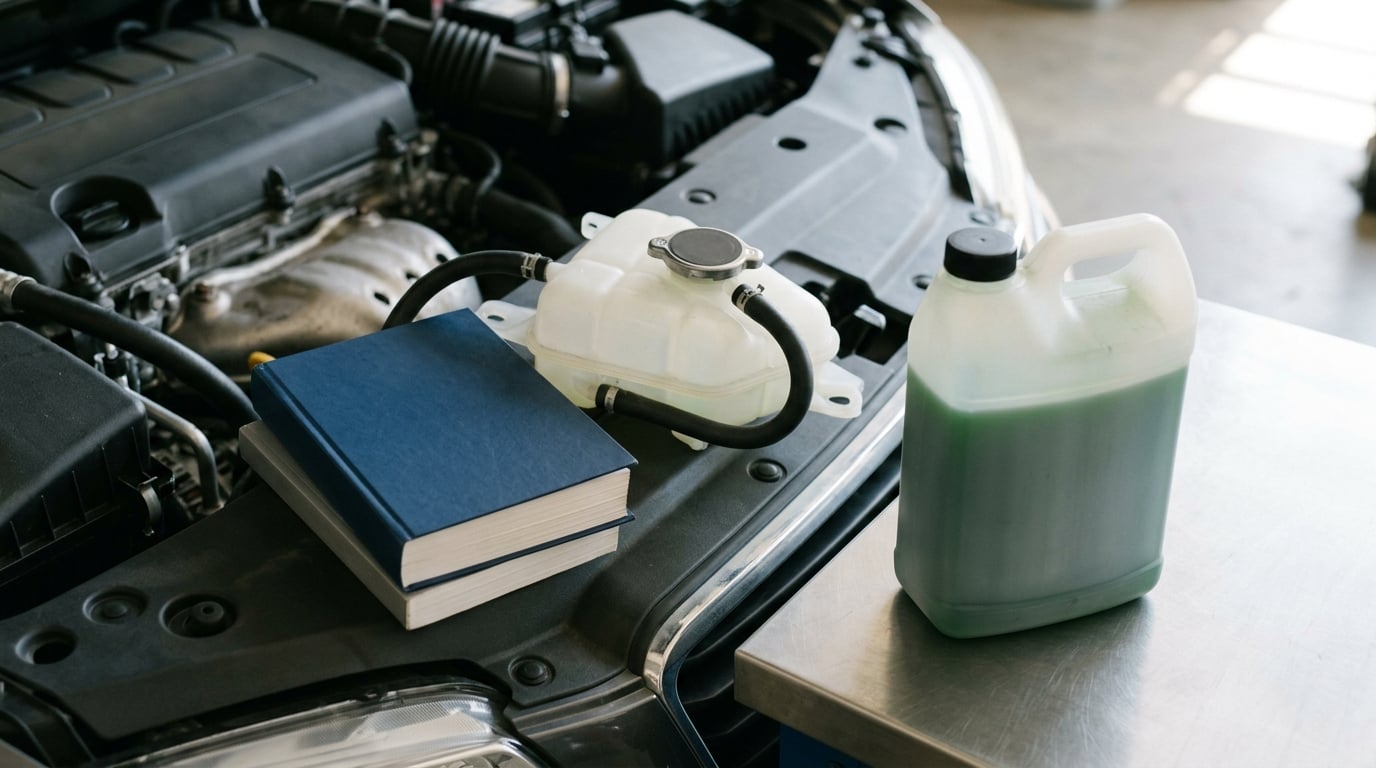
What coolant type does my car need is answered by one document: the coolant section of your owner’s manual for that exact model year. Color in the reservoir is a hint at best, never proof. Before you buy a gallon, check the manual, then the labels on the expansion tank and radiator cap, then the service history.
That answer matters more than most people expect. Coolant is not one product with different labels. It is ethylene glycol and water plus a corrosion inhibitor package engineered for the metals, seals and gasket materials in a particular engine. Get the package wrong and the system does not fail politely. Gel, precipitate, plugged heater cores and overheated cylinder heads come next, and a gallon of the wrong antifreeze costs a fraction of what that repair costs.
Most of the guessing happens because the bottle tells you the color and the chemistry acronym but not your car. Here is how to close that gap, plus where BMW owners get tripped up and what to do if you have already topped off with the wrong jug.
Table of Contents
- What Coolant Type Does My Car Need? Where to Look
- What Coolant Specifications Do Common Cars Use?
- BMW Coolant Types and Specifications
- Why Coolant Color Is Not Enough to Identify the Type
- Can You Mix Different Coolant Types?
- How to Choose the Right Coolant for a Replacement
- Safety When Handling Engine Coolant
- Frequently Asked Questions
What Coolant Type Does My Car Need? Where to Look
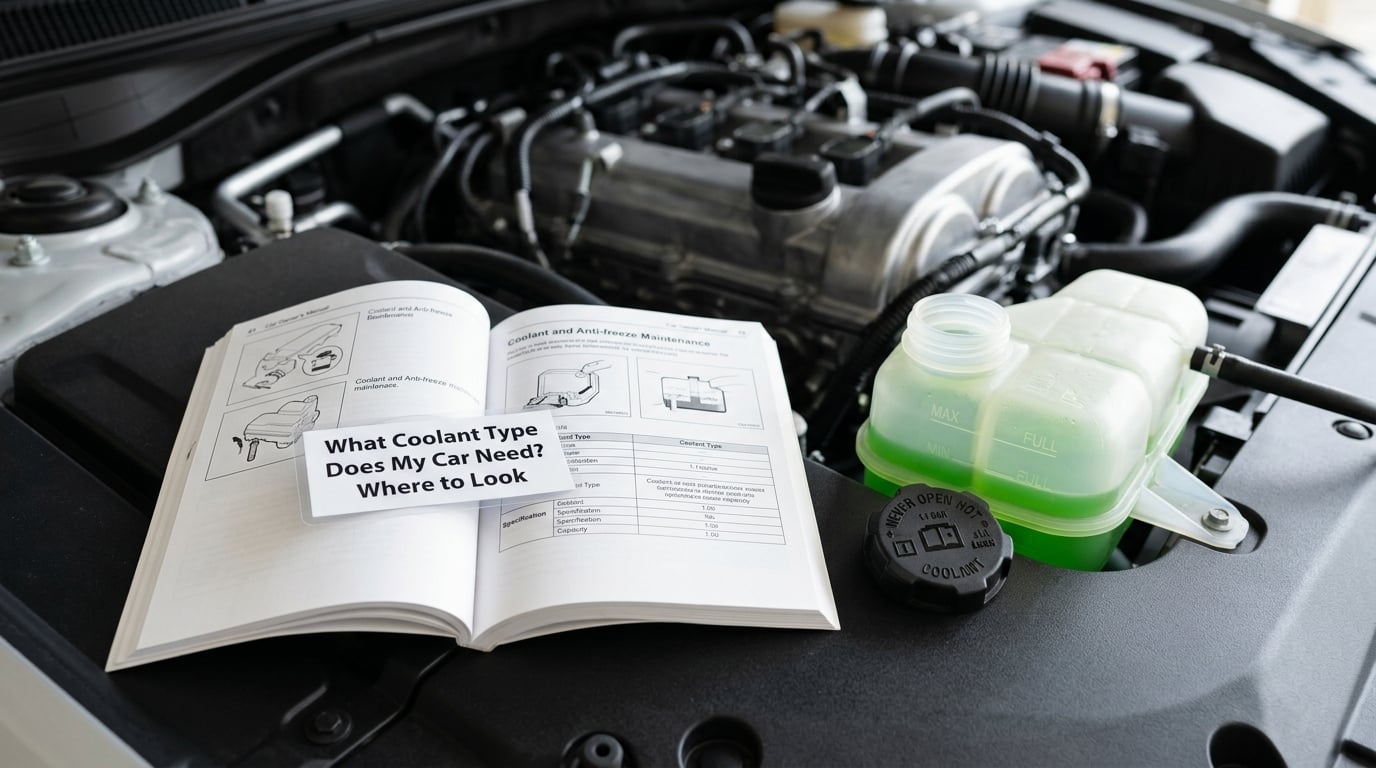
There are four places to look, in order of authority. The manual beats everything, the under-hood labels are usually a copy of it, service records confirm what was actually done, and a dealer or parts counter is the fallback when the paperwork is gone.
Step 1: Read the coolant section of the owner’s manual
This is where the manual tells you what coolant type does my car need, and it usually names both the chemistry and the approval standard. Look under Engine Coolant, Cooling System, or in the fluids and capacities chart at the back. Manuals routinely print something like “use a coolant meeting specification XXX, or an approved alternative.” That approval list is the part that matters, because it tells you which substitute products the manufacturer has actually tested.
Digital manuals are searchable. In the PDF viewer, search for coolant, antifreeze, or the brand’s own spec code. If your car is recent enough, the same information sits in the owner’s manual app.
Step 2: Read the tank and cap labels
Some manufacturers print the required specification on the expansion tank or on a sticker near the radiator. The pressure cap sometimes carries a warning about the coolant type as well as the pressure rating, which is worth understanding on its own, so our guide to what a radiator cap does explains how the cap and the coolant work together.
Step 3: Check the service records and the bottle back-label
Service history tells you what a previous owner actually put in, which is not always what the manual asked for. A sticker on the filler neck or a dated invoice often names the product. When you buy replacement coolant, read the back of the container rather than the front: the back is where the approval numbers and the vehicle compatibility list live, and it is the only place that tells you whether the product is approved for your car.
What coolant type does my car need when the paperwork is gone?
Start with the VIN. The VIN plate on the door jamb, the build sticker on the glovebox lid, and the engine bay sticker all let a dealer or a coolant manufacturer identify the vehicle and return the exact specification and production date range. Most coolant brands run a lookup tool for this. Several forum regulars on r/AskMechanics and r/MechanicAdvice use exactly this route when they inherit a car with no records.
A parts store counter can also do the lookup by VIN in about a minute. Buy a jug in the owner’s hand if you can, because the wrong jug gets opened on the driveway.
What Coolant Specifications Do Common Cars Use?
Almost every mainstream passenger car runs an ethylene glycol and water base. What separates them is the inhibitor package, and that package falls into four families you will see named on bottles and in manuals.
- IAT (Inorganic Additive Technology) uses inorganic inhibitors such as silicates, phosphates and chromates. Common in older vehicles, traditionally green, and usually specified on a two-year or 50,000 mile interval.
- OAT (Organic Acid Technology) uses organic acids in place of those salts, which is why it lasts far longer without the phosphate and silicate dropout that fouls older systems. Typically orange, yellow or red, and often specified for five years or 100,000 miles.
- HOAT (Hybrid Organic Acid Technology) blends both approaches, usually adding a phosphate or silicate for aluminum protection. Common on many Japanese and European cars.
- POAT (Phosphate-free Organic Acid Technology) is a hybrid without phosphate, and Si-OAT is a hybrid built on silicates. Both exist because some engines and gasket materials react badly with one additive or the other.
Here is the general mapping. Treat it as a starting point, not a substitute for the manual.
| Make | Typical chemistry | Named spec or code | Often seen color |
|---|---|---|---|
| General Motors | OAT | Dex-Cool | Orange |
| Ford (newer) | OAT or HOAT | Motorcraft spec, often orange | Orange |
| Ford (older) | IAT | Conventional green | Green |
| Chrysler, Dodge, Jeep, Ram | OAT, some HOAT | MS9609 type approvals | Orange, pink |
| Toyota, Lexus | HOAT | Toyota long-life super long life | Pink |
| Honda, Acura | OAT | Honda Type 2 | Blue |
| Nissan, Infiniti | OAT or HOAT | Nissan long-life | Blue, green |
| Hyundai, Kia | OAT | Hyundai long life | Pink, green |
| Subaru | OAT | Subaru genuine coolant | Blue, purple |
| Mazda | HOAT | FL22 | Green |
| Volkswagen, Audi | HOAT, silicated or phosphated | G11, G12, G12+, G12++, G12Evo, G13 | Blue, green, purple, pink |
| Mercedes-Benz | HOAT | MB 325 series | Green, purple |
| BMW | HOAT, phosphate-free or phosphated | BMW coolant specifications by model year | Blue, green, purple, red |
One pattern is worth calling out because it catches experienced owners too. The same manufacturer can specify different coolant in different model years, sometimes within the same generation. A Volkswagen built before and after a mid-cycle change takes different G-codes, and a BMW can fall on either side of a specification change partway through a model’s run. Never assume a sibling model takes the same jug.
BMW Coolant Types and Specifications
BMW coolant identification has moved over the years, and the change is the single most common source of wrong-jug purchases in this brand. Newer documentation and the containers themselves use numbered BMW coolant specifications, the LC-series designations, while older service bulletins and manuals refer back to a long-life standard named differently.
| What you may see | What it usually means | What to do |
|---|---|---|
| A numbered LC specification on newer documentation and on the coolant container | BMW’s current approved coolant specifications, the ones used on recent production and for refill after a cooling system repair. Which number applies depends on the engine and production date | Use the one your manual names for your build year |
| An earlier BMW long-life standard named in older manuals and service bulletins | The coolant specified for earlier production of the same models | Use it only when the manual for your build year names it |
| Generic blue or green glycol in a jug with no BMW approval | Usually a universal product, not a BMW specification | Not the default choice for a BMW |
| BMW-approved bottled coolant sold in the parts counter | Genuine specification, correct in nearly every case | Safe default when the manual is missing |
Two practical rules for BMW owners. First, on most modern BMWs the coolant is specified as a genuinely long-life fluid, and putting a short-life universal glycol into it is a downgrade of the inhibitor package rather than a harmless top-up. Second, the fill is not the hard part on many models. Several use an electric pump and a bleed procedure at specific open points, and the volume is specific to the engine, so a full drain-and-refill on those cars is a job worth handing to a shop that owns the service tools.
Our guide to how to top off coolant correctly covers the routine case where the level drops slightly between services, which is a different job from a full refill and needs far less care to do well.
Why Coolant Color Is Not Enough to Identify the Type
Color is a pigment added at the factory, not a specification. A dye in the glycol tells you almost nothing about the inhibitor package, and the same spec code has been sold in more than one color over the years. Two different IAT coolants can be green and blue. An OAT can be orange, yellow or red. Honda’s blue long-life coolant and a European blue silicated hybrid are not the same chemistry at all.
The reverse also happens constantly. Owners on r/Cartalk describe being told a green color meant a specific Mazda specification, only to find the fluid was whatever the previous owner poured in. Green in the radiator is not proof of IAT, and orange is not proof of OAT. Treat color as a way to notice that something changed, then confirm with the manual or the cap label.
There is one thing color is genuinely good for: spotting a mismatch. If you open the cap expecting a pale blue and find something bright green, that is a reason to investigate, not a reason to top up and drive.
Can You Mix Different Coolant Types?
Yes, in some combinations, and a small accidental top-off is not the disaster people fear online. The problem is not that two colors touch. It is that two different inhibitor systems end up sharing one pot, and each one’s ingredients are there to hold the other’s back.
| Combination | Verdict | What happens |
|---|---|---|
| Two OAT products, both approved for your car | Fine | Same inhibitor chemistry, no reaction to worry about |
| Two HOAT products of the same flavour | Usually fine | Match the variant: phosphate with phosphate, silicated with silicated |
| IAT into OAT | Acceptable for an emergency small top-off, then plan a flush | Silicate from the IAT can drop out as gel or precipitate, especially in an aluminum system |
| OAT into IAT | Same problem in reverse | Reduced buffering, deposits in the radiator and heater core |
| Phosphate-based into phosphate-free system | Avoid | Phosphate precipitates with the metals in some engines |
| Short-life universal into a long-life system | Poor value even when it works | The long-life interval no longer applies; you inherit the short schedule |
The forum consensus on r/F30 and r/MechanicAdvice matches that: a small same-family or single-flavour mismatch is survivable, and a full mix of unrelated chemistries means a drain, flush and refill. One detail that circulates in those discussions and is worth repeating here is that when two chemistries are blended in roughly equal measure, neither one’s inhibitor package works as designed, so the protection you think you have is largely gone.
If you already mixed the wrong coolant
Stop topping it up first. Then decide, rather than driving and hoping.
- Check the fluid for gel, cloudy sediment or a brownish sludge, and check the radiator and radiator cap for the same. Gel at the filler neck is the clearest sign something has reacted.
- Run the engine to full operating temperature with the heater on high. No heat from the cabin means flow problems, which in a contaminated system usually points at the heater core or radiator being partly blocked.
- If the fluid is clear and clean, and the wrong coolant is a small fraction of a large system, many owners drive to a shop and get a proper flush rather than removing anything themselves. That is cheaper than tearing into a cooling system in a driveway.
- If you see gel, sludge or a blocked heater, stop driving and drain the system. Once deposits set, a flush may not clear them and the components get replaced anyway.
Never mix a drain-and-refill job with a hot engine. A hot cooling system is pressurized, and opening it is how people get burned.
How to Choose the Right Coolant for a Replacement
Match the specification before anything else. Buy the product the manual names, and if you are choosing a substitute, confirm your year, make and model appear in the compatibility list on the back of the container. A universal or all-vehicle product is a fallback for a car whose manual you have already read and decided against a specific coolant, not a shortcut around reading it.
Concentrate or premixed is a convenience and storage decision, not a specification decision. Premixed 50/50 arrives at the correct glycol concentration and is worth it if you want zero measuring. Concentrate lets you set the glycol percentage for your climate, and it stores well, but it needs distilled or deionised water. Ordinary tap water brings minerals that scale the system over years, so use distilled water and mix in a clean container rather than the bottle.
Quantity matters for the result. A typical passenger car cooling system holds around a gallon plus a bit, and topping off with a half gallon in a system that has lost most of its coolant leaves you underfilled. Check the level at operating temperature on level ground against the reservoir’s MIN and MAX marks, and if the reservoir is empty on a cold start, treat that as a leak to find rather than a topping job.
Match the service interval to the car, too. Roughly two years and 25,000 miles is a traditional short-life schedule, while many extended-life fluids are rated for five years or 100,000 miles and some well beyond that. Follow the interval in your manual for your fluid, and treat coolant condition testing at service visits as useful even on long-life cars.
Safety When Handling Engine Coolant
Engine coolant is toxic, sweet-tasting and attractive to animals. Dogs and cats are the ones we see at emergency vets after licking spilled antifreeze from a driveway, and the taste is the reason. Store containers closed, off the floor and away from pets, and never pour a used container into a storm drain, a garden bed or a waterway. Take it to a household hazardous waste facility or an auto shop that collects used coolant; many parts stores accept it for free.
Work on a cold engine. The cooling system holds pressure once it is hot, and the cap can still be under pressure hours after a drive. Cover the reservoir before removing the cap, open it slowly, and expect a small spill. If the cap does not release easily, stop rather than forcing it.
Wear gloves. Ethylene glycol is absorbed through skin, and the residue on a filler neck is enough for a little contact over time. If you do spill, remember the coolant is nearly half water, so the volume is larger than you expect, and our walkthrough of how to clean up a coolant spill in the driveway covers containment and rinsing without spreading the contamination.
One more driving rule. A low coolant warning is a reason to stop and add coolant at the first safe opportunity, not a reason to keep going. If the reservoir drops between services on its own, you have a leak or a failing cap, and low coolant plus a hot engine is how a small problem turns into a head gasket.
Frequently Asked Questions
Can I use any blue coolant in my BMW?
No. Blue is a pigment, not a specification, and BMW coolants have shipped in blue, green, purple and red over the years. Match the coolant specification your manual names for the model year instead. If the manual is missing, the VIN lookup through a dealer or the coolant manufacturer returns the correct specification and production range.
What coolant does my BMW need?
The coolant named in the coolant section of the owner’s manual for your exact model year, which on most modern BMWs is a BMW-approved long-life coolant specification rather than a generic glycol. Genuine BMW coolant from the parts counter is the safe choice when you cannot confirm the specification. Anything else needs to appear in the compatibility list for your vehicle.
Does coolant color determine the correct type?
No. Color comes from a dye added to the glycol and says nothing about the inhibitor package inside, which is the part that protects the engine. The same specification has been sold in more than one color, and two different chemistries have been sold in the same color. Use color to notice a change, then confirm the specification from the manual or the cap label.
Can I mix green and blue coolant in my car?
It depends on the chemistries, not the colors. Two coolants of the same family are generally fine together. Green IAT into a blue OAT system is survivable as a small emergency top-off, but it can leave gel or precipitate in an aluminum system, so plan a flush rather than continuing to top off. Never mix a phosphated fluid into a phosphate-free system.
Should I use premixed or concentrated coolant?
Premixed 50/50 is already at the right glycol concentration, which removes the measuring step and any risk of a wrong mix. Concentrate lets you set the glycol percentage for your climate and stores indefinitely, but you must dilute it with distilled or deionised water in a clean container. Never mix concentrate with ordinary tap water.
What should I do if I cannot find the coolant specification?
Use the VIN. The plate on the door jamb, the build sticker and the engine bay sticker let a dealer, a coolant manufacturer or a parts counter identify the vehicle and return the required specification with the production date range. A parts store can do the lookup by VIN in a couple of minutes, and buying the jug over the counter avoids the driveway mistake.
Open the manual, find the coolant section for your model year, and write the specification down before you shop. That single line answers what coolant type does my car need, and everything else on this page only matters once you know it. When you buy, match the spec rather than the color, and if a jug is already open and in the car, finish the level, watch for gel or a plugged heater, and plan the flush that puts the system back on the correct chemistry.