
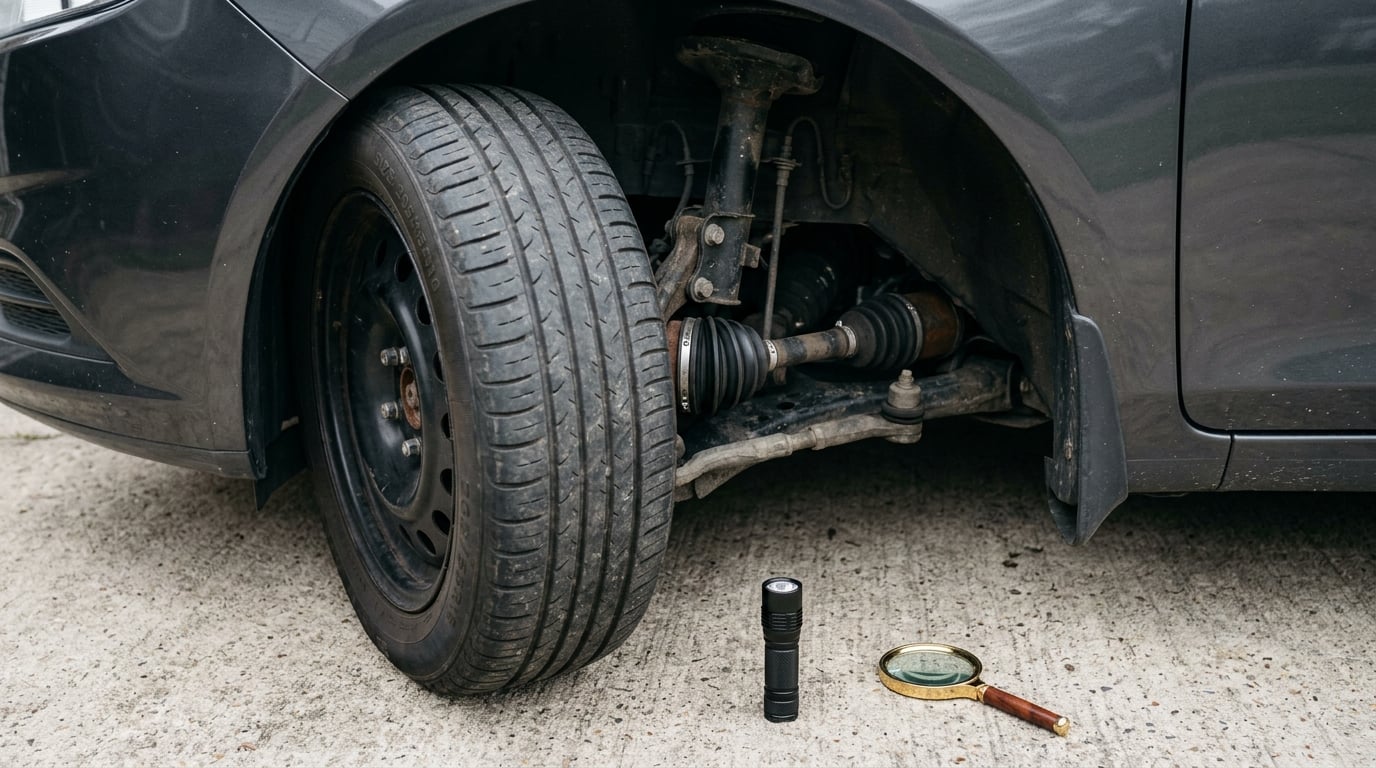
If you are asking what causes a clicking noise when turning, the short answer is metal shifting inside a joint that should be quiet, and the usual suspect is a worn outer CV joint whose rubber boot has torn and let the grease out. Turning loads and articulates the front suspension, so whatever play, dry rubber or missing grease exists in the steering, suspension or drivetrain gets louder exactly when you turn.
Good news: the sound itself is a decent diagnostic tool. A click that speeds up with wheel rotation behaves very differently from a single clunk on a bump or a hum that rises with speed, and the direction you turn in narrows the search further. This guide walks through the causes worth ruling out first and the checks that tell them apart without a lift.
Table of Contents
- Is a Clicking Noise While Turning Safe to Drive?
- What Is Making the Clicking Noise When You Turn?
- Why Does the Clicking Change With Steering Direction?
- Can a Wheel Bearing Cause Clicking While Turning?
- What Else Can Click When the Wheels Turn?
- How to Diagnose a Clicking Noise While Turning
- What Should You Check Before Repairing the Clicking?
- When Should You Replace the Part or See a Mechanic?
- Frequently Asked Questions
- What to Check First
Is a Clicking Noise While Turning Safe to Drive?
Usually yes, if the noise stays low and rhythmic and the car steers normally. A clicking CV joint at low speed is a slow-developing problem, not an instant failure, so driving a few miles to a shop is generally fine.
It is not fine if the car pulls, wanders, the steering feels vague, the wheel has play in it, or the noise turns into grinding or a hard clunk under load. In that case the part is already past the warning stage.
Signs you should slow down and drive carefully
- Clicking that changes to a grinding growl as speed builds
- Visible grease splatter on the wheel or under the car
- A torn or collapsed CV boot
- Fluid leaking under the front end
- A steering wheel that no longer centers easily
Signs you should not drive it and should tow or trailer it
- Loose or missing wheel fasteners, or a wheel that visibly moves
- A tire that looks separated, bulges, or has a tread strip missing
- Steering that goes light, grabs, or stops responding as it did before
- A clunk with every input from the driver, even parking at walking pace
- Any fluid leak large enough to drip as you drive
One behavior matters more than people expect. Adding load, like three passengers and a full tank, or turning at parking speed with the wheel cranked over, changes what the drivetrain is doing far more than highway cruising does. If the noise appears there, treat it as more urgent than the noise-free motorway test.
What Is Making the Clicking Noise When You Turn?
Match the pattern rather than guessing at the part. The table below is the quickest way to narrow a clicking noise down before you order anything.
| What you hear or feel | Likely source | Confirming clue |
|---|---|---|
| Rapid rhythmic click that speeds up with wheel speed | Outer CV joint or inner tripod joint | Click rises and falls with the steering input; grease on the boot or under the car |
| Steering wheel clicks in sync with the front wheels | Steering column coupler or clock spring | Click continues at a standstill with the wheel turned, sometimes with the engine off |
| Low hum or growl that changes pitch with speed | Wheel bearing | Noise follows the road more than the steering; worse on curves and rough surfaces |
| One clunk on a bump or when the wheel loads up | Ball joint, tie rod end, sway bar link or bushing | Play in the wheel; clunk tied to bumps and joint articulation, not to wheel speed |
| Tick at the very end of the turn, both directions | Loose steering rack internal, wheel-well shield or brake hardware | Constant while the wheel is held over, not rhythmic |
| Tick with no steering at all, wheels spinning or road texture changing | ABS sensor or tone ring, or debris in the tread | Changes with speed and surface, independent of the steering angle |
| Click plus squeal at startup or at full lock | Power steering belt, pump or low fluid | Squeal and fluid level on the reservoir; noise tracks pump speed |
A worn CV axle is the first thing most people check, and often correctly. The other candidates share a symptom with it, which is why direction, speed and load are worth testing before buying parts.
How to Tell a CV Axle Click From Other Noises
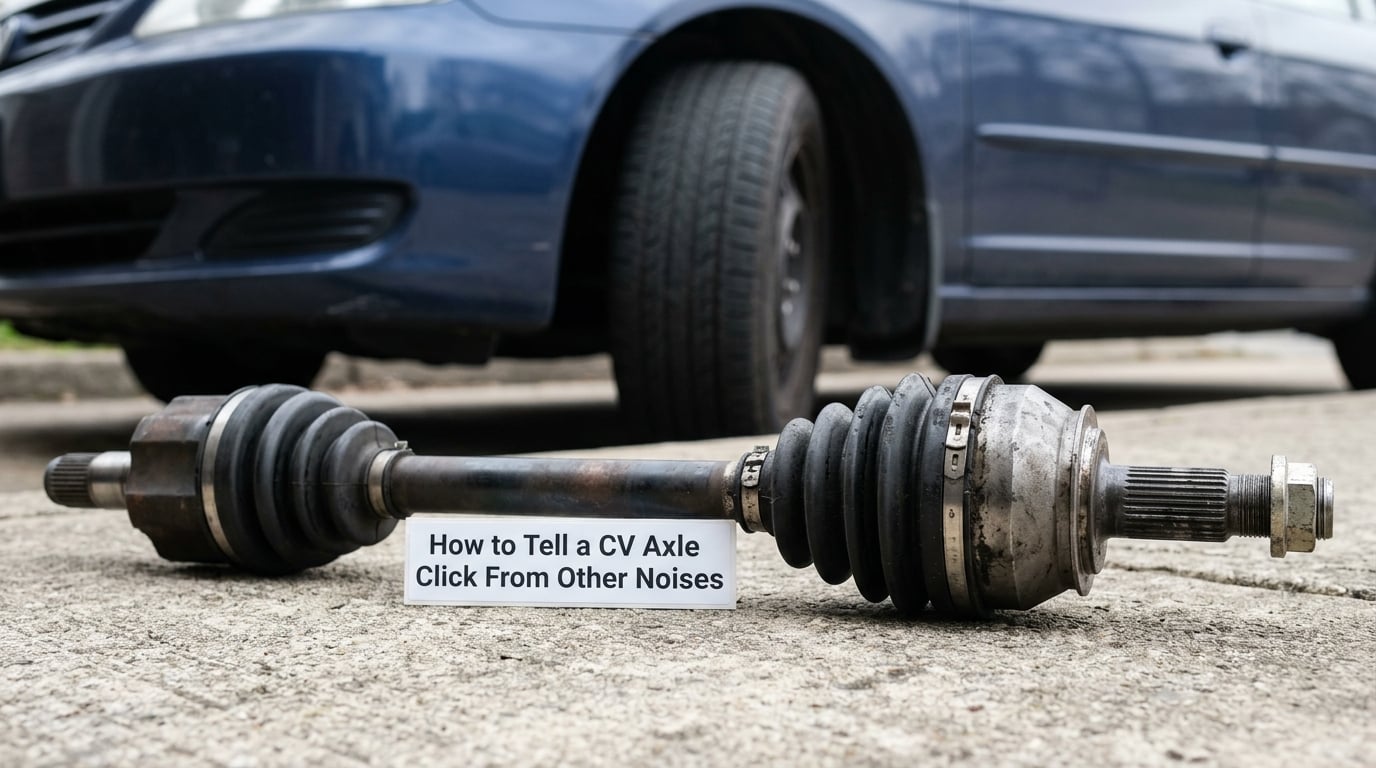
A CV joint has ball bearings held in grease inside a flexible rubber boot. Once the boot splits, grease escapes and grit gets in, and the bearings start to skip. Skip and you get that dry, metallic click, once per bearing revolution.
The distinguishing trait is that the click follows the axle angle. A straight-line coast makes a quiet joint louder, and a tight turn articulates the outer joint through a big angle, so the click rate rises and falls as you steer rather than staying constant.
Common companions: a vibration through the floor or pedals at highway speed, a shudder that feels like the car is running out of road, and sometimes a rhythmic rumble if the inner tripod joint is involved. A torn boot is the giveaway, and you may find fresh black grease sprayed on the wheel, the fender liner, or the underside of the car.
Boots intact does not clear the CV axle. Owners on mechanic forums often rule it out because the rubber looks fine, when the inner joint or tripod can be worn or the axle can have axial play with the boot still seated. If the click is still rhythmic and speed-linked, have the axle checked with the vehicle unloaded.
Why Does the Clicking Change With Steering Direction?
Turning left puts more load through the right front wheel and the left rear, because the outside of the corner carries most of the weight and the tire that is tight on the arc is the loaded one. A worn outer CV joint clicks hardest when it is under load with the sharpest articulation.
That produces the pattern people describe as clicking in only one direction. Turn toward the bad side and the outside joint on the other side is loaded and articulating, so it complains. Turn the other way and the same joint is unloaded and much quieter.
It is not a perfect rule. Weight transfer changes with speed, so a fast right-hand sweeper can sound like a slow left-hand one. Small differences in ride height, tire pressure and load also shift things, which is why the noise can seem inconsistent from one drive to the next.
One forum example is a driver with a tick at the end of every turn on both sides. Direction ruled out the CV axle for them, because a joint that clicks in both directions is usually not being isolated by load, and their search ended up somewhere in the steering or brake hardware instead.
Can a Wheel Bearing Cause Clicking While Turning?
Yes, though it is more often a hum than a click. A bearing lets in water and dirt, its grease breaks down, and the rollers start to skid, producing a low drone that changes pitch with road speed.
Curve sensitivity is the giveaway. On a long banked curve, the loaded outer bearing can raise its pitch, and the noise often gets louder over rough pavement because more impact energy reaches the worn surface.
Clicking from a bearing usually shows up when you brake, coast or drive over washboard, so the sound changes with the load on that wheel rather than with the steering angle. Play in the wheel and a humming noise that rises with speed point the same way.
A wheel bearing that has started to skip is a different animal, and a driver who described grinding that turned silent after a few hundred feet of driving had a bearing that seized and stopped moving, not one that fixed itself. Silence after grinding is not a good sign.
What Else Can Click When the Wheels Turn?
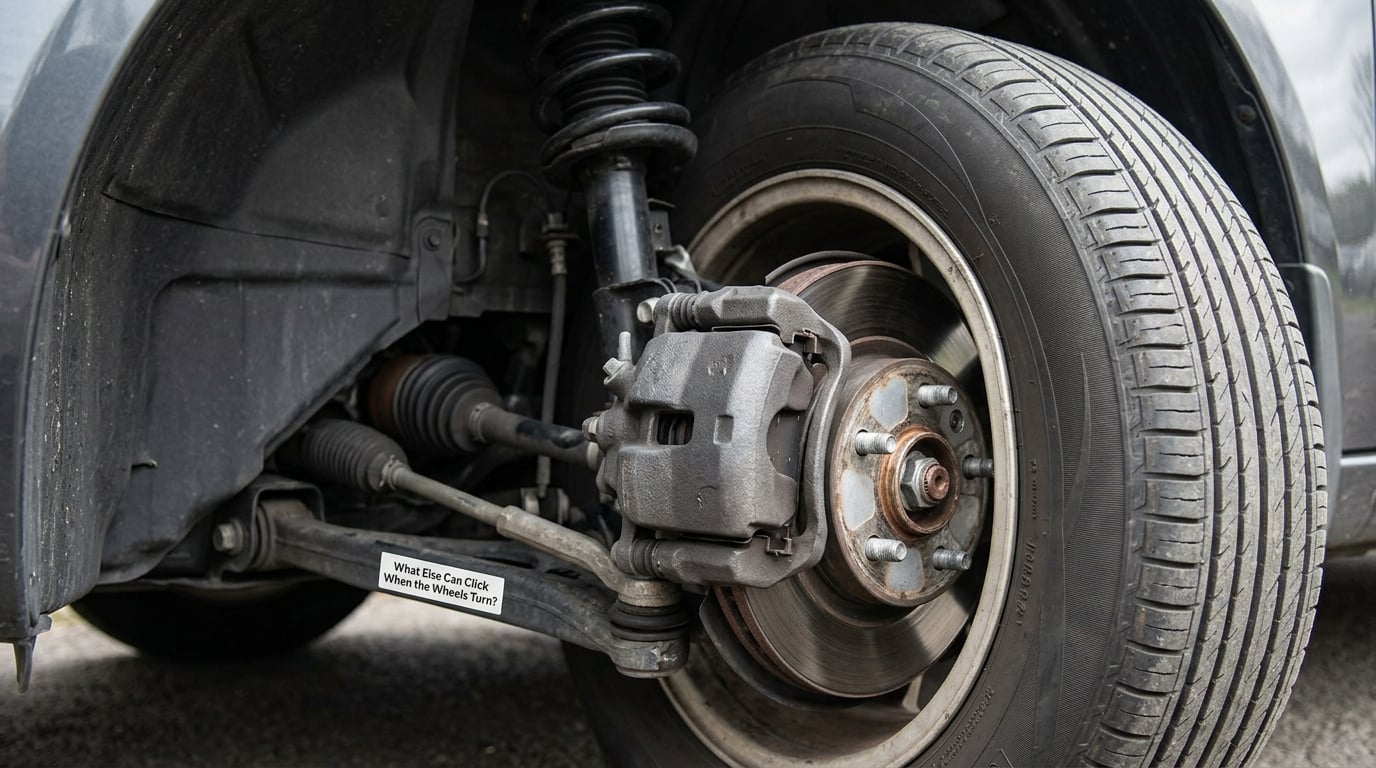
Cheap causes are worth clearing before expensive ones. Start with a pebble or a piece of gravel wedged in the tread blocks, which mimics a CV click almost perfectly and is the most commonly missed item in these threads. A loose wheel cover, a brake dust shield tapping the knuckle, and a wheel fastener that has backed off all produce convincing clicks too.
On the steering side, the rack and pinion can develop internal play that ticks at the end of the turn, and the column coupler or clock spring behind the steering wheel can click on every input, even with the car parked and the engine off. Power steering noise usually comes with something else: a squeal at startup, a groan that changes with pump speed, or fluid aerated and foaming in the reservoir.
ABS sensors and tone rings come and go, and the sound tracks the wheels rather than the steering, changing with speed and road surface. Tires matter too, since uneven wear or a pressure problem changes how the wheel hangs on its joint. If the tread is feathered on one side, the suspension behind it is moving, and there is a separate explanation in our guide to what tire feathering means and what causes it.
Brakes contribute more than most guides admit. Sticking caliper hardware and pad abutment noise turn up in cars that sit outside, which is the subject of our piece on why brakes rust when a car sits, and a rotor that has shifted on its studs is explained in what a floating brake rotor is.
How to Diagnose a Clicking Noise While Turning
Reproduce the noise before you look for parts. A click you cannot trigger on demand is a click a shop cannot confirm, and that is why so many people end up with parts replaced and no fix.
Take a quiet level road or an empty lot, and make slow equal-radius turns in each direction. Note whether the click is on the inside of the turn, the outside, or unchanged, and whether it keeps going after the wheel is held at full lock.
Then change one variable at a time. Try the same turn unloaded and again with passengers or cargo, compare low speed against highway speed, and try the same corner on smooth pavement and rough pavement. Load and surface will tell you whether the source is driveline, steering, or a worn tire contacting the road.
With the car on the ground, turn the wheel side to side and then hold it, and look rather than only listen. Check the CV boots for splits or a collapsed shape, the wheel and fender liner for fresh grease, and the brake dust shield for a visible rub line. If you lift the car, use jack stands on a hard surface, never a jack alone, and chock the wheel that stays on the ground.
From underneath, a lot separates in seconds. Watch the outer CV joint and axle while an assistant slowly turns the wheel through lock, look for a gap between the axle and the wheel hub, and check the tie rod and sway bar links for looseness with a pry bar. Rotate the wheel and listen for a scraping or rasping sound that says the brake is applied.
Intermittent noise deserves one more trick before you buy anything. Try a second road, a different time of day, and a shorter route, and record the sound on your phone from inside the cabin and under the car. A recording takes thirty seconds and saves a lot of guessing.
What Should You Check Before Repairing the Clicking?
Run the cheap list first. Tire pressure on all four, plus tread depth and even wear across the pattern, then wheel fastener torque, a loose wheel cover or lug nut cap, and any debris in the tread blocks. None of that costs anything to check.
After that, look at the CV boots and the wheel area for grease, check for fluid under the car including power steering fluid, and inspect the brake hardware for anything rubbing or seized. A bent wheel or visible sidewall damage ends the drive.
Follow your vehicle service manual for any part you take off, and use the manufacturer torque specifications for the wheel fasteners. People have ruined a good repair by tightening fasteners by feel, and if a steering or suspension component gets replaced, a wheel alignment belongs on the same invoice.
When Should You Replace the Part or See a Mechanic?
Book an inspection when the noise persists through the checks above, when it is getting louder, or when you cannot reproduce it yourself and the car still makes the sound. An intermittent noise is harder to diagnose than a constant one, and a technician with a lift can often find play that a driveway test will not show.
Stop driving and tow when the wheel fasteners are loose, the steering has gone vague or unresponsive, there is grinding, or a torn boot is flopping where it can strike the tire. A dragged boot is a few dollars of parts, but it is a few dollars only if the debris comes out of the joint first.
Any steering, suspension or drivetrain repair is a job for a qualified technician, and that is not negotiable. Loose steering parts do not warn you politely. If the diagnosis is a ball joint, tie rod end, steering rack or hub bearing, do not plan to do it in a driveway with jack stands and a phone.
Frequently Asked Questions
Can I drive if my car clicks when turning?
Usually yes, if the sound is a low rhythmic click that only shows up at parking speed and the car steers normally. Driving a few miles to a shop is generally fine. Do not drive it if there is grinding, a pull, loose wheel fasteners, a torn boot flopping against the tire, or if the steering feels vague or unresponsive. In those cases the damage is already past the warning stage and towing is the safer call.
Is clicking in only one direction a bad CV joint?
It often is, and it is the single most useful clue you can gather. Turning left loads the right front wheel, so a worn outer CV joint on that side complains hardest in a left turn. It is not a perfect rule, because speed, ride height and load all shift the pattern, but one-direction clicking points to a specific corner to inspect first. Clicking in both directions makes you look at the steering, brakes and wheels instead.
Why does my car click only at low speed while turning?
At low speed the outer CV joint reaches a much larger articulation angle through a tight turn, and the wheel rotation stays slow enough for you to hear each bearing skip. The click rate follows the wheel, so it speeds up as you turn tighter and slows as you straighten. Low-speed-only clicking also rules out the wheel bearing as the main source, because bearing hum tracks road speed rather than steering angle.
How do I tell a CV joint click from a wheel bearing?
A CV click speeds up and slows down with the steering angle, because the joint is articulating more through a tight turn. A wheel bearing hum rises and falls with road speed and gets louder on curves and rough surfaces, where more load reaches the damaged surface. Play in the wheel when you grip it at the 12 and 6 positions also points at the bearing or hub, and a CV click usually comes with grease evidence.
Does an ABS sensor click when the car turns?
Rarely, and that is why it gets missed. A damaged sensor, tone ring or wiring harness can produce a tick that follows wheel rotation rather than the steering angle, so it changes with speed and road surface and seems to come and go. You may also feel ABS or traction control light up on the dash. It does not click louder in one turn direction, which is what separates it from a CV joint.
Why is the clicking louder when I accelerate or brake?
Acceleration and braking change the torque going through the axle. Hard acceleration loads the CV joint and unloads it on the overrun, so a worn joint clicks on both transitions, sometimes with a shudder in the pedal. Braking shifts weight forward and takes drive torque off the axle, so a load-related click usually drops away while you are braking. If the noise grows under load, the joint is further gone than a joint that only ticks at cruise.
What to Check First
Three things, in this order. First, confirm the pattern: does the click follow wheel speed, steering angle, load, or none of them, and does it happen in both directions or only one?
Second, check tire pressure and tread on all four, then look at the CV boots and the wheel area for grease. Third, match the pattern to the source in the table and inspect that component, on stands, with the wheel turned through lock.
That is what causes a clicking noise when turning, in the order worth working through. Worn CV joints sit at the top of the list, but debris in the tread, a loose wheel cover, a rubbing brake shield and a tired sway bar link all sound like the same thing and cost a fraction as much to fix.