
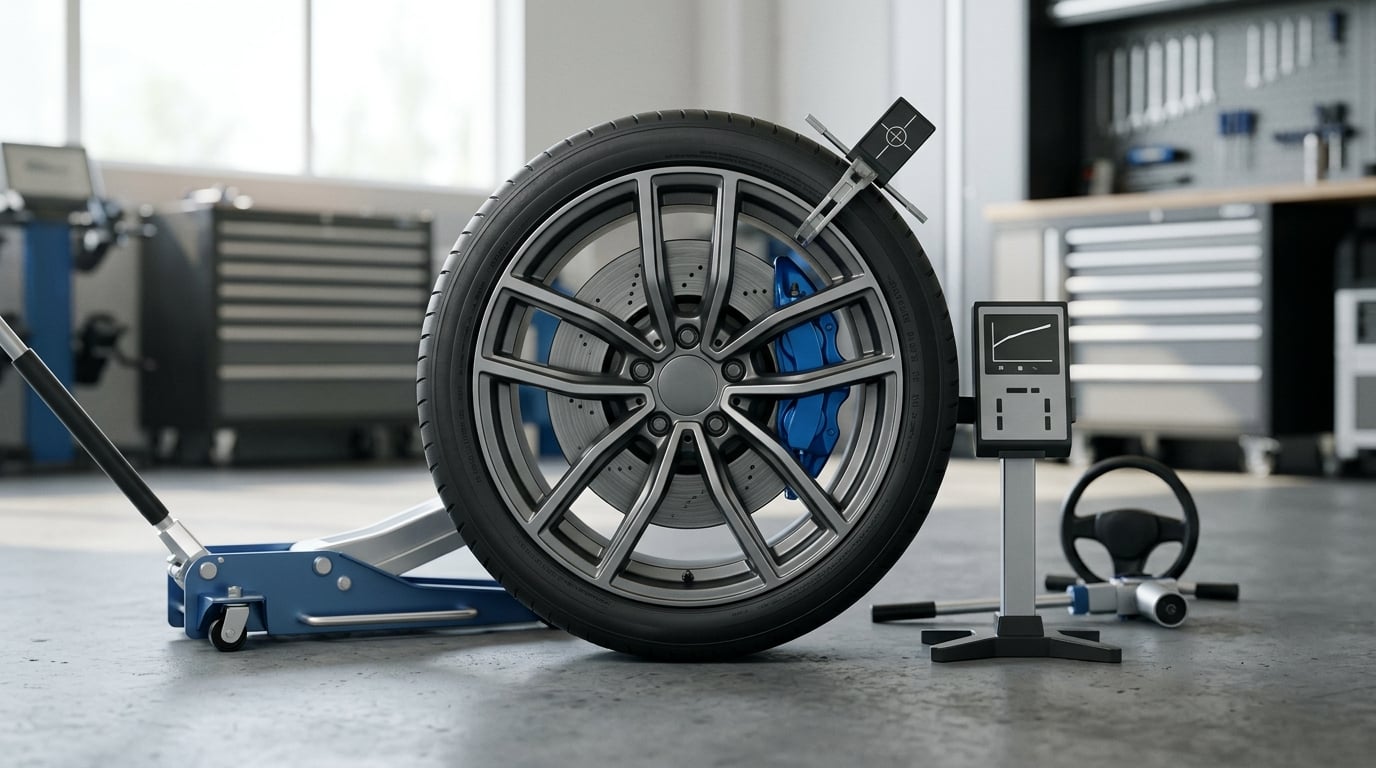
A humming noise that changes with speed comes from a rotating assembly whose vibration frequency rises with road speed. Put simply, something turning at wheel speed is worn, warped, or out of balance. On a BMW the usual suspects are a tire, a wheel bearing, or the final drive.
Speed is the clue that makes this one of the more answerable noises on the road. A hum that pitches up as you gain speed is giving you the rotation rate of the fault, which narrows the search a long way before you touch a spanner.
This guide covers 2026 models, though the physics has not changed in decades. If you only remember three things, remember these: the pitch tells you where the fault is, the turn test tells you which corner, and a hum that survives a bearing replacement was probably never a bearing.
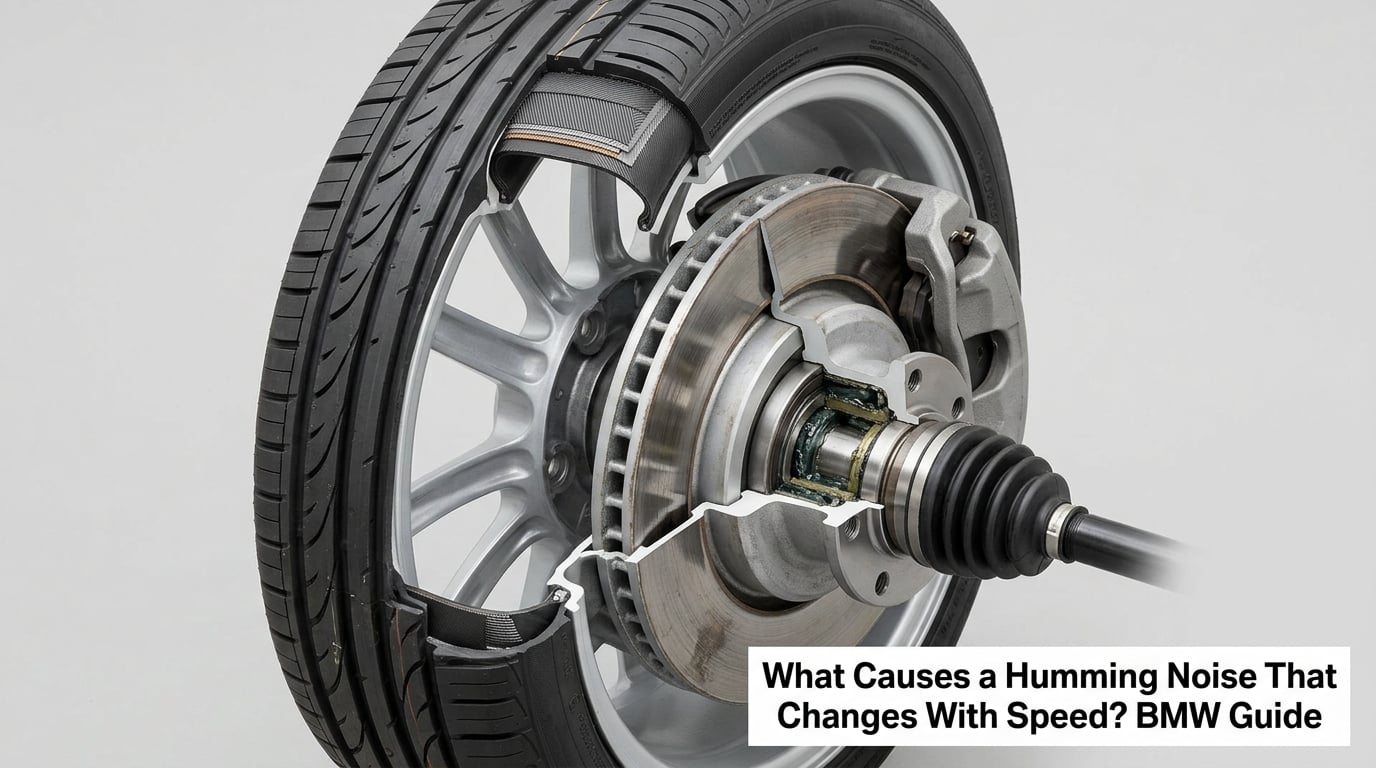
Table of Contents
- What Causes a Humming Noise That Changes With Speed?
- How the Speed Pattern Narrows Down the Cause
- Tire or Wheel Problems That Cause a Hum
- Brake and Axle Noise That Changes With Speed
- Wheel Bearings, Differentials, and Other Drivetrain Sources
- How to Tell a Tire Noise From a Bearing or Brake Noise
- What to Check First on Your BMW
- Frequently Asked Questions
- Why does my car hum only when I accelerate?
- Is it safe to drive if the humming gets louder with speed?
- How do I tell a bad wheel bearing from a tire problem?
- Why does the humming noise go away when I shift to neutral?
- Can low brake fluid cause a humming noise?
- How do I know if the noise is coming from the wheel or the differential?
- Start With the Speed Pattern
What Causes a Humming Noise That Changes With Speed?
Ranked by how often they turn out to be the answer, in this order:
- Unevenly worn tire — hum starts near a set speed, changes character on concrete, and often comes with steering wheel shake.
- Worn wheel bearing or hub — steady drone that rises with road speed and gets louder on the turn toward the affected side.
- Brake rotor surface — rust, scoring, or a pad shim that moves; the sound appears briefly then fades as the pads warm and clean the disc.
- Wheel or tire out of balance — vibration rather than pure sound, felt through the seat or pedals more than heard.
- Differential or final drive — hum from further back, often present on AWD and independent rear layouts where it gets missed.
- CV axle, motor mount, or transmission mount — drivetrain movement that adds a hum or groan under load.
Note what is not on that list. A hum that tracks road speed is almost never a serpentine belt or an alternator, because both of those follow engine RPM. That single distinction saves a lot of wasted money.
How the Speed Pattern Narrows Down the Cause
The behaviour of the noise tells you more than the noise itself. Before you buy anything, log when it appears, when it changes, and what makes it stop.
| What you hear or feel | What it points to | Quick check |
|---|---|---|
| Steady hum, pitch rises with speed, no change with gear or RPM | Tire wear, wheel bearing, or final drive | Coast in neutral; compare pitch to a second gear at the same road speed |
| Hum appears at one speed band then goes quiet above it | Single tire with a localized flat spot or cupping dip | Hand along the tread for a sawtooth or scalloped pattern |
| Louder on one turn, quieter on the other | Wheel bearing or hub on the noisy side | Slow circle parking lot turns at idle |
| Sound appears under braking, fades after the first stop | Rusty or scored rotor, moving pad hardware | Repeat the stop a few times and listen to the second one |
| Present at idle in park with the brake applied, goes with road speed | ABS wheel speed sensor or tone ring | Check for an ABS warning light and sensor damage |
| Vibration through the seat or pedals rather than sound | Wheel or tire imbalance, bent rim | Compare asphalt to a concrete expansion joint |
| Hum from behind the seats, present in both directions | Differential, final drive, driveshaft angle | Check rear tire wear for feathering as a cross-check |
That last row matters more than people expect. A large share of unresolved hums posted on owner forums turn out to be rear end, and AWD BMWs hide the final drive behind bodywork that muffles the sound until the car is loaded up on a highway ramp.
What causes a humming noise that changes with speed?
Because vibration frequency rises with how fast the surface is passing the fault. A bald patch rotating 60 times a second produces a 60 Hz tone; spin it twice as fast and the same patch lands 120 times a second. Nothing about the damage got worse between those two speeds, only the rate at the fault.
That is also why the noise vanishes in neutral on a rear wheel drive car. Disengage the engine, the wheels freewheel, and the pitch drops away. On a front wheel drive car the same trick works on a quiet road because the front wheels are no longer linked to engine speed.
Tire, bearing, brake, and drivetrain problems all reach your ear through the body as vibration, and vibration transmits well through steel, so the four sound nearly identical in a closed cabin. What separates them is not tone, it is behaviour under change.
Tire or Wheel Problems That Cause a Hum
Cupped tires are the most common answer. A wheel that has been out of balance for a long time wears a repeating series of dips across the tread, and every dip thumps the road once per revolution. At highway speed that becomes a hum; at low speed you notice the individual thumps instead. What is tire feathering and what causes it covers the other wear pattern, where the tread blocks shear off unevenly across the width and leave a sawtooth edge that hums on every rotation.
Check pressure first, cold, on a driveway with your own gauge. An underinflated tire flexes more per revolution, generates heat, and makes everything worse. Then run a hand along the tread in both directions: dips feel hollow, feathering feels like a shark fin, and a separated or gouged belt will show as a cord or a bulge.
Wheels can also be bent from a pothole, which shows up as a slow wobble and a hum that changes with the surface. A curb strike and a pothole hit look different, but the fix is the same.
For fasteners, do not guess at the number. Torque each wheel to the figure in your owner’s manual, in a star pattern, and check again after a short drive. A lug that has backed off a quarter turn creates a hum that mimics a bearing beautifully.
Brake and Axle Noise That Changes With Speed
A car that sits in rain or salt gets a thin layer of rust on the rotor edge. The first stop of the day, the pads scrape it off and you hear a brief hum or squeal that then goes away. That single occurrence is normal. Why brakes rust when a car sits explains the chemistry and the cheap fixes.
What is not normal is a hum that never fades, or a noise that returns every single morning and lasts longer each day. That pattern points at pad shims or anti-rattle hardware working loose, a glazed pad face, or a scored rotor groove deep enough that the pad never lays flat. What is a floating brake rotor covers a related case where the hub and rotor design itself can produce a low drone as the design allows.
Axle-related noise shows up as play rather than pitch. With the vehicle on the ground, transmission in neutral and the parking brake released, push the top of the wheel and then the bottom. Any perceptible movement at 12 and 6 o’clock means a worn joint, a worn hub, or a bent axle flange, and it explains a hum that changes as load shifts through a corner.
Wheel Bearings, Differentials, and Other Drivetrain Sources
A ball bearing is a race of steel balls that should never touch. Wear opens a small clearance, the balls start skipping, and the skip frequency scales with wheel rotation. The result is a drone that starts around 30 to 45 mph and climbs steadily from there. Owners report on forums that it often exists with no perceptible play, so a clean play check does not clear the bearing.
A failing CV axle announces itself differently. The outer joint can hum or growl at low speed before it starts clicking, and the inner joint snatches under load with the throttle pressed. A torn boot and dry grease are the usual cause, and you can spot a split boot by jacking the corner and rotating the wheel by hand.
The final drive is the overlooked one. A differential hum sits slightly higher in pitch than a wheel bearing and does not change much when you turn, because both wheels share the gear. Loading the car uphill, in sport mode, or with a full tank tends to make it more obvious, which is why a rear hum that seems to vanish on level ground can still be very real.
Motor and transmission mounts are worth checking when the hum only appears under acceleration and disappears on coast. A sagging driveline changes the angle of the shaft and the position of the exhaust, both of which can hum. And if the sound appears at rest with the brake applied, suspect the ABS tone ring and wheel speed sensor, a failure that also lights the ABS warning and makes the ABS stop working.
How to Tell a Tire Noise From a Bearing or Brake Noise
Six road tests, each with the result that would confirm or clear the suspect. Take them on a quiet stretch at different times of day.
- Neutral coast — at the same road speed, compare the pitch in gear and in neutral. Same pitch means the wheels; different means the engine or a mount.
- Slow turn — at parking lot speed, turn toward one side and then the other. Louder on the outside of the turn on one side means the bearing on the opposite side is making noise. Note the direction carefully and write it down.
- Surface test — roll over a concrete expansion joint and then a smooth asphalt patch at the same speed. Tire and wheel problems change noticeably; bearing and driveline hums stay about the same.
- Brake repeat — make three identical stops from the same speed. Rust noise fades or vanishes by the second stop; rotor scoring and pad hardware do not.
- Tread and pressure — pressure cold, then a hand along the tread in both directions looking for dips, fins, cords, or bulges.
- Wheel play — vehicle supported, neutral, handbrake off, push the wheel at 12 and then at 6 o’clock. Any movement is a red flag, not a test result to argue about.
Stop driving and arrange service if the noise becomes a grinding or rasping sound, if there is any perceptible wheel play, if a hot or burning smell appears after a drive, if the ABS or check engine light comes on, or if the hum increases over days rather than months. A bearing that has gone from hum to growl is a bearing that has gone from metal-on-metal to metal damage.
What to Check First on Your BMW
Work down this list in order, cheapest and most likely first:
- Cold tire pressures, all four, and a full tread hand check.
- Wheel fasteners torqued to the manual figure in a star pattern.
- Visual pass over each rotor edge for rust or scoring, and every visible CV boot for splits.
- Wheel play at 12 and 6 o’clock on each corner.
- A tire balance and a road test on a surface you know is smooth.
- Road test with a technician present so the noise is reproduced under load, off the throttle, and through both turns before the car is disassembled.
One habit saves real money on AWD models. Ask the technician to load the car and take it up a highway on-ramp with the front axle off the power, because a final drive hum hides at rest and appears under load on the ramp. The brief version of the handover: report the speed the hum starts at, which way the pitch moves, what happened on the turn, and whether the surface changed it.
BMW models with a tire-pressure monitoring system can help. A low-pressure warning alongside a hum removes tires from the list, and a saved pressure drop at one corner often explains a hum that appeared after a rotation or an alignment.
Frequently Asked Questions
Why does my car hum only when I accelerate?
A hum that appears only under throttle points at the drivetrain rather than the wheels. Suspect a sagging motor or transmission mount letting the driveline sit at a bad angle, a dry or damaged CV joint that groans under load, or a differential that gets louder as drive torque passes through it. Coast down a hill at the same speed and listen. If the noise drops away, it is a load-driven noise from the drivetrain, not a tire or bearing.
Is it safe to drive if the humming gets louder with speed?
A steady hum that climbs gradually with road speed is usually safe to drive for a short while so you can keep diagnosing it, but treat any change in character as a stop sign. Park and arrange service if the sound turns from hum to grinding or rasping, if you feel play in the wheel, if a hot or burning smell follows a drive, if the ABS or check engine light comes on, or if the hum increases noticeably week to week instead of month to month.
How do I tell a bad wheel bearing from a tire problem?
Both track road speed, so use the other two clues. Turn toward one side and then the other at parking lot speed: a bearing gets louder on the turn toward the affected corner, while tire noise stays the same in both directions. Then compare asphalt to a concrete expansion joint at the same speed: tire and wheel problems change clearly, bearing and driveline hums barely do. Check the tread by hand before anything else, since it is free.
Why does the humming noise go away when I shift to neutral?
Because the wheels are no longer being driven at engine speed. In gear, the engine, transmission, and final drive all turn at a rate tied to engine RPM as well as road speed, so a driveline hum is mixed into the wheel noise. In neutral the engine idles on its own and the wheels freewheel, leaving only the rotating assembly at the front. If the hum vanishes in neutral but is present in two different gears at the same road speed, the tires and bearings are your starting point.
Can low brake fluid cause a humming noise?
Low brake fluid is not a typical source of a hum that changes with speed, though it does affect pedal feel and can add a groaning sound during braking. A speed-linked hum more often comes from the rotor surface, a worn pad, or a bearing. Check the fluid level and condition regardless, because a low or discolored level affects braking performance, and mention it to whoever inspects the brake noise.
How do I know if the noise is coming from the wheel or the differential?
A wheel or hub hum shifts noticeably when you turn at low speed, because a tight turn loads one side heavily and unloads the other. A differential hum changes very little, since both wheels share the same final drive gear. A diff hum also tends to sit slightly higher in pitch and gets more obvious under load, on a highway on-ramp, or in sport mode. Cracking the windows or using a listening rod at the rear can confirm which end it is coming from.
Start With the Speed Pattern
Reproduce the hum safely, write down the speed it starts at, whether the pitch follows road speed or engine RPM, what happened on the turn, and whether the surface changed it. Inspect pressures, tread, wheel fasteners, rotor edges, and CV boots while the details are fresh, then take those notes to the matching system instead of guessing. A tire and bearing job and a final drive job are very different conversations, and the pattern you recorded decides which one you are having.