
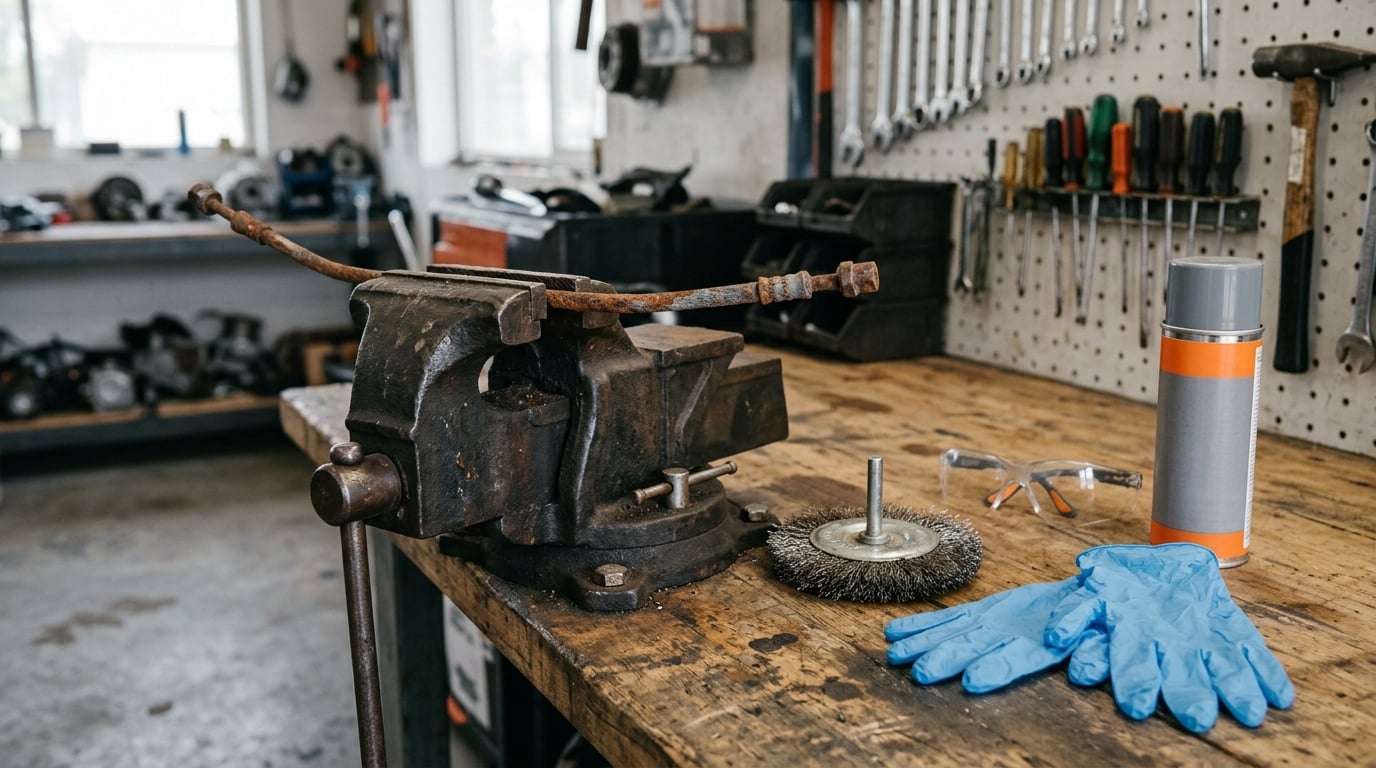
Surface rust on a steel brake line is usually a cleanup job, not a replacement job. How to stop rust on brake lines comes down to four moves: wash the line, neutralize the rust, dry it fully, then seal the clean steel with a proper corrosion inhibitor. The catch is knowing when the rust has gone past the cosmetic stage, because a pitted or cracked line cannot be coated back into safety.
Plan on an afternoon. Most of the time goes into cleaning, drying, and waiting between coats, not scrubbing.
Table of Contents
- What You Need
- Step-by-Step: How to Stop Rust on Brake Lines
- 1. Inspect the brake lines and figure out how much rust is normal
- 2. Clean the line before you treat the rust
- 3. Remove light surface rust from the brake line
- 4. Protect the cleaned steel with a rust inhibitor or coating
- 5. Replace lines that are deeply rusted or weakened
- 6. Prevent future rust on the brake lines
- Common Mistakes
- Frequently Asked Questions
- Conclusion
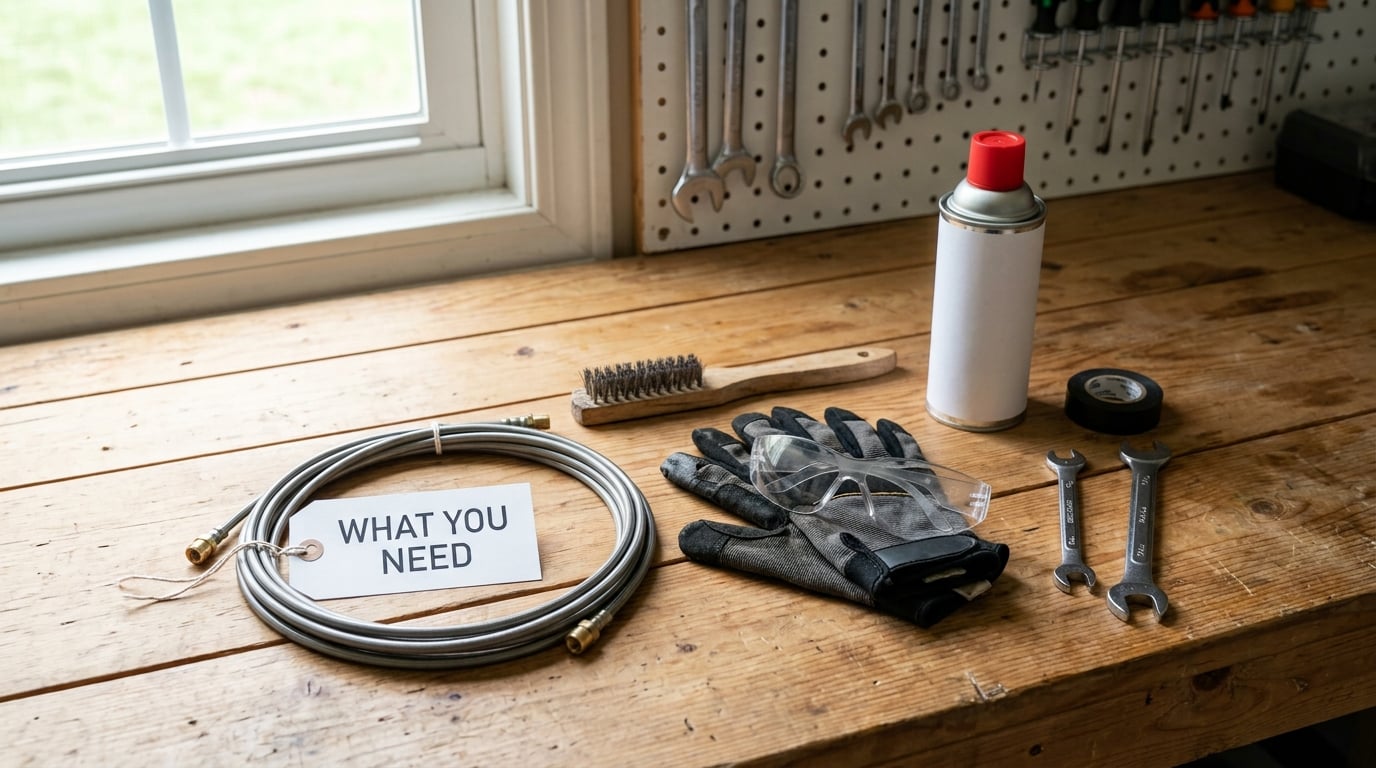
What You Need
Jack stands, a floor jack, wheel chocks, and a flat surface. Never work under a car held up by the jack alone. Add wheel chocks on the downhill side even with stands in place.
Hand tools for the wheel and for whatever clips, shields, or brackets stand in the way. A plastic bristle brush, a degreaser or brake cleaner, a neutralizer, 180 to 400 grit abrasive pad or strip, a stiff wire wheel for a drill, clean lint-free rags, and a drip pan to catch the mess.
Your coating choice matters. Options fall into four families: oil-based undercoat, wax and lanolin products, penetrating rust inhibitors, and zinc-colored coatings. Details on picking one are in step 4.
Safety gear: nitrile gloves, eye protection, and a respirator if you are working in an enclosed garage. Brake dust and neutralizer runoff are both things you do not want on your skin or your floor drain.
Masking material. Low-tack tape and plastic sheeting to shield the rotor faces, wheel wells, exhaust, and the flexible brake hose. Overspray on a rotor face means a rotor that never beds in properly, and coating on a rubber bushing or hose is a part failure waiting to happen.
Before you start, find your vehicle information. You want the underbody layout, the line routing, and whether your car uses flexible braided hoses or rubber hoses at the wheels. Some cars run ABS lines through the same tunnel as the brake lines, and those get treated differently.
Step-by-Step: How to Stop Rust on Brake Lines
1. Inspect the brake lines and figure out how much rust is normal
Most brake line rust is a thin orange-brown film that wipes off on a rag. That is surface rust, and it is genuinely normal on a ten-year-old car in a state that salts its roads. Owners in Alaska, New York, and Maine report cleaning their lines with a wire brush and a coat of spray paint and getting years out of that approach.
Flaking rust that lifts off in scales, with brown flakes on the ground under the car, means the factory e-coating has already failed and corrosion is active. Treatable, as long as the metal underneath is still smooth.
Pitting is the threshold. Pits are small craters where the surface has actually corroded away. If you can see the pit with the naked eye and the wall feels rough or scalloped under a fingernail, metal is gone.
Stop and replace instead of treating if the line is bulging, crimped, kinked, or has a bead of rust that has pushed the wall outward. A weeping stain at a union or flare nut, a soft or spongy feeling in the brake pedal, or a line that is rust-through at a fitting is the same call. If the vehicle has been sitting for months with dampness under it and no road miles to dry things out, you will get the worst rust in the worst places, which is worth knowing before you judge what you are looking at. Why brakes rust when a car sits covers that case in detail.
Run a rag along the length of each line. It should come away with orange dust, not with brown flakes and gritty residue. Also flex the line gently at each mounting clip; a rigid line should not feel soft anywhere.
2. Clean the line before you treat the rust
Rust inhibitor only bonds to clean metal. Skipping the clean step is the single most common DIY mistake, and it is the reason coated lines keep rusting underneath the coating for a season or two before it fails.
Mask first. Cover the rotor faces, the exhaust pipe and heat shields, the wheel wells, and any rubber bushing, accordion boot, or braided flex hose within spray range. If you are using a pump sprayer, a piece of cardboard held behind the line works better than tape on a curved surface.
Degrease the whole line, not just the rusty patch. Brake dust is oily, and oil on the surface stops the coating from wetting the steel. Spray brake cleaner or degreaser, let it run down, and wipe with clean rags until the line feels dry and squeaky rather than slick.
Work in sections on long runs. A 60 inch line takes longer to dry than a 12 inch one, and trapped moisture under a coating is the thing you are trying to avoid.
3. Remove light surface rust from the brake line
For a light film, a plastic bristle brush and a rag will take most of it off. A wire wheel on a drill works faster, but go easy: those lines are often single-wall steel, and grinding through one wall means replacing the line.
Use a 180 grit pad for stubborn film and move to 320 grit only where scale is thick. The goal is bare, smooth, uniform metal, not a mirror finish. Pockmarks you cannot clean out are the point where treatment stops being the right answer.
Neutralize the residue. A phosphoric or tannic acid rust neutralizer converts what is left of the active iron oxide into a stable film that a coating can stick to. Let it dwell for the time the label states, then rinse with clean water and dry immediately.
4. Protect the cleaned steel with a rust inhibitor or coating
Match the product family to the job. This is where most of the conflicting forum advice gets sorted out, because people recommend products for different jobs.
- Oil-based undercoat creeps along the line and into clips, nuts, and brackets, displacing moisture rather than just sealing over it. Shops reach for it by name for hard lines, and it is the best choice for lines that run through salt spray paths. It goes on wet and needs a full drying window, and it is hard to clean off later if you ever need to work on the line again.
- Wax and lanolin products brush or spray on thick and hold well in crevices and around clips. Owners use plain grease or wool wax grease brushed onto the worst high-salt areas as a cheap long-lived fix. A heavy cosmoline-type coating is for lines that will never be cleaned again.
- Penetrating rust inhibitors such as a long-term water displacer or 3-36 style product are the right choice when rust is already flaking and you want it to stop spreading while you work. They clean off easily and are a good first pass before a heavier coat.
- Zinc-colored coatings seal and shed water, and they show you what you covered. One owner revived slightly rusted steel lines with zinc-gray, letting it cure for days before finishing. The downside is cosmetic, not protective.
Aerosol penetrating oils like the original WD-40 formula are a first-response treatment and a decent cleaner. The standard formula is a light lubricant that will eventually dry down and offers limited long-term protection, so for brake lines that see winter brine, use a product sold as a long-term rust inhibitor or undercoat instead. Shop-grade oil-based undercoat on the lines, a wax product in the cavities, and a light penetrating oil for fasteners is a combination that works.
Apply in thin coats with plenty of air movement. Thick coats trap solvent and stay tacky, then flake off in a year. Follow the label for dry and cure times, and give it longer than you think you need. If the temperature drops overnight, cure times stretch with it.
Keep coating off the rotor faces, the wheel hub, the caliper piston seal surfaces, the flex hose, and anything rubber or plastic. If you are running low on rotor material it may be worth understanding what a floating brake rotor is before you get the rotor face dirty.
5. Replace lines that are deeply rusted or weakened
Coating is for bare metal that is still sound. Rust that has pitted, scaled, or thinned the wall cannot be undone by sealing it, and putting a coating over it just hides the evidence you need at your next inspection.
The usual rule: replace the line if you can see a pit, feel a bulge, find a crack, notice a wet stain at a fitting, or cannot get back to clean metal with a wire brush. On a car that rusts all over, replacing the full set rather than one section often makes sense, because the one section you left will be the next failure.
Replacement difficulty depends on the fittings. A line with a threaded fitting and a union nut unbolts and swaps. A line with a double flare, a European cone seat, or an ABS wheel-speed line is a different job, and a double flare needs a flaring tool to match the flare style and diameter exactly.
On safety-critical lines, on ABS lines, or when a rusted line is hard to reach, hand it to a qualified technician. The labor is the expensive part, not the tubing.
If you just installed new lines, coat them before the clips go back on. A new line that has been sitting in a salt brine path for six winters needs the same treatment as an old one that you just cleaned.
6. Prevent future rust on the brake lines
Wash the underbody after road salt. This is the cheapest and most effective prevention step, and road salt users consistently report that it beats any product. A driveway with enough slope to drain, or a self-service wash with an underbody spray, will do it. Salt brine is hygroscopic, so it pulls moisture out of the air and holds it against the steel long after the road looks dry.
Coat cavities and clip areas, not just the exposed runs. The mounting clips and brackets are where the factory coating cracks first and where the line is held against a wet frame rail. Cavity wax and a wax-based inhibitor cover the underside of frame rails, where you cannot brush.
Check the lines on a schedule rather than when something feels odd. Once a year, with a flashlight, after a dry spell. Look at the lines closest to the road wheels, the ones under the rear axle, and any that cross a frame rail through a clip.
Fix the moisture traps you find. A line abraded by a broken clip, or a splash shield pressed against the tubing, will corrode there no matter what you coat. Replace the clip, add a soft protective sleeve where the line passes a bracket, and reroute the line so it no longer rubs.
Watch for weeping fluid near the lines. A caliper that weeps onto a nearby line keeps that line wet all year, and a wet line rusts whether or not you treat it. How to check brake calipers for leaks walks through the check.
Timing depends on climate. In rust belt states that salt every winter, do the wash and inspection in spring after the last big storm, and coat before the first freeze. Coastal and high-humidity areas get the same job on a shorter clock. Dry climates still need annual inspection, mostly on a car that has been parked outside for years.
Do not forget the inside of the line. Brake fluid absorbs moisture from the atmosphere over time, and that moisture corrodes the interior of the line and the wheel cylinder or caliper bore. That is a flush job, not a coating job, and it goes on the same schedule as your fluid change. A rusty line with clean fluid is the good outcome; a coated line with old wet fluid is a delayed failure.
Common Mistakes
Coating over rust that has not been cleaned. This is the big one, and it is repeated constantly in owner forums. Rust under an intact coating keeps its moisture and corrosion rate, and you have now made inspection harder. Clean and neutralize first, every time.
Using a light penetrating oil as a long-term undercoat. A water-displacing spray is a temporary treatment for a seized fitting or a light film. For a line that sees salt every winter, use a product sold as long-term inhibitor, undercoat, or cavity wax.
Coating rubber, plastic, and flex hoses. Never coat a rubber bushing, an accordion boot, a braided flexible hose, or an ABS line sleeve. Material that has to flex will lose its pliability, and a bushing that was never meant to slip can seize there. Mask them off.
Ignoring internal moisture in old brake fluid. The coating on the outside does nothing about water inside the line. If the fluid is dark, has a slightly gelled texture, or has not been changed in several years, flush it.
Covering the rotor faces, exhaust, and heat shields. Overspray on a rotor face keeps pads from bedding in, and a thick coat on an exhaust pipe near a turbo or on a heat shield can hold heat where it should not. Mask generously.
Skipping the second look. Check a treated line again after the first season and after the first winter. Small failures show up as early rust blooms, and catching those in year one is far cheaper than catching them in year three.
Using a drill wire wheel without restraint. The temptation to lean on it is what goes through a wall of a line. Brush first, wheel second, and check the wall with a fingertip afterward.
Frequently Asked Questions
Is it common for brake lines to rust?
On any car that gets road salt or lives in a coastal or high-humidity climate, some surface rust on the steel hard lines is normal after a few winters. What is not normal is flaking scale, visible pitting, a bulge, or a stain at a fitting. Check yours yearly with a flashlight after a dry spell, paying most attention to the lines nearest the wheels and anything running through a clip or a frame rail.
Will WD-40 keep metal from rusting?
Not for long on a brake line, which is the honest answer. A standard aerosol penetrating oil is a cleaner and a short-term water displacer that dries down over time, so it slows rust briefly and then stops doing much. For a line that sees winter brine, use a product sold as a long-term rust inhibitor, a wax or lanolin coating, or an oil-based undercoat, applied over clean metal.
Can I undercoat over rust that is already there?
You can, but you should not, and the reason shows up a year later. A coating over active, dirty rust seals the moisture in, hides the corrosion from your next inspection, and does not stop the corrosion. Clean the line down to bare metal, neutralize the residue, dry it, and then coat. If you cannot get to bare metal, the line needs replacing rather than another coat.
How much rust on a brake line is normal?
A thin orange-brown film that wipes off on a rag is normal surface rust, especially in salt-belt states. Flaking scale with grit on the ground means the factory coating is gone and corrosion is active, which is still treatable. Visible pits, a rough scalloped surface under a fingernail, a bulge, or a weeping stain at a union nut means metal is gone and the line should be replaced.
How can I repair a rusted brake line?
Wash the line with brake cleaner or degreaser, brush off light surface rust, apply a rust neutralizer, rinse, and dry fully. Then coat the clean steel with an oil-based undercoat, a wax and lanolin product, or a long-term penetrating inhibitor, keeping it off the rotors, exhaust, rubber, and any ABS line. If the line is pitted, cracked, bulging, or weeping at a fitting, no coating helps and the section needs replacing.
What time of year should I rustproof my brake lines?
Coat before the first freeze in salt-belt states, which usually means late fall, then wash the underbody in early spring after the last big storm. In coastal and humid areas, treat the underbody annually and touch up any coating that has worn thin. Do the inspection in the same visit, since the spring wash is the easiest time to get under the car with good light and a dry line.
Conclusion
Start with a flashlight and a rag. Run the length of every hard line, and decide which lines carry only surface rust and which carry pitting, scaling, or a bulge.
For the surface rust, the whole job is clean, neutralize, dry, coat, and never coat over dirt or active rust again. Wash the underbody after road salt, coat the clips and cavities, and look at the lines once a year.
For anything pitted, cracked, swollen, or weeping at a fitting, replacement is the only safe answer. Learning how to stop rust on brake lines matters, but knowing where to stop is what keeps the car stopping.