
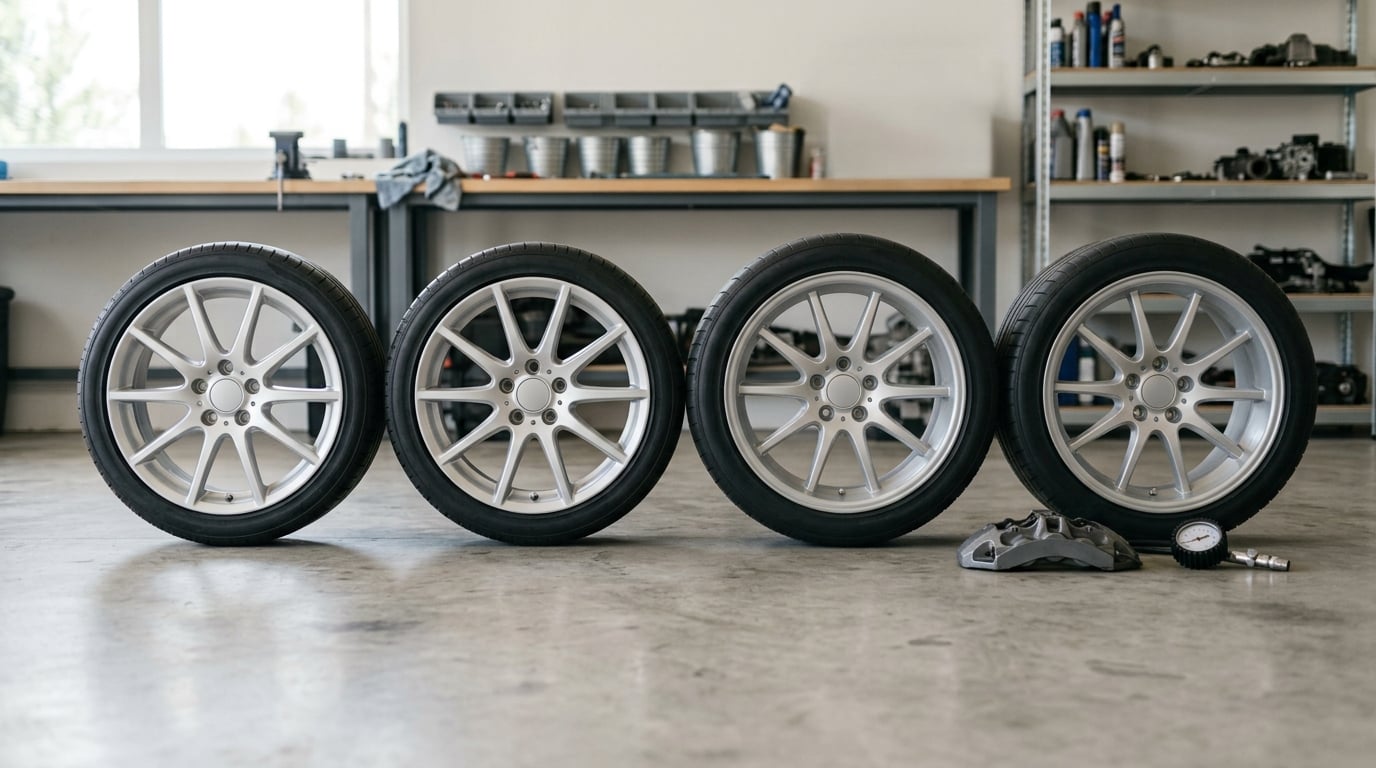
A staggered wheel setup means running different wheel and tire sizes on the front and rear axles, almost always with the wider wheels and tires on the rear axle. You get a bigger contact patch where the car pushes hardest, plus a stance that fills the rear wheel wells, and you give up tire rotation freedom, even wear and the simplicity of one tire size for the whole car. This guide walks through the staggered wheel setup pros and cons, then helps you decide whether the trade makes sense for how you actually drive.
If you are still working out what a staggered setup is in the first place, read the first section below. If you are past that and shopping, jump to the fitment section, because that is where setups go wrong.
Table of Contents
- What Is a Staggered Wheel Setup?
- Staggered Wheel Setup Pros and Cons at a Glance
- Why Use Different Front and Rear Tire Widths?
- Does a Staggered Setup Improve Handling?
- What Are the Main Disadvantages?
- How Tire Size, Wheel Width, and Offset Affect Fitment
- How to Decide Whether a Staggered Setup Is Right for You
- Frequently Asked Questions
- Does a staggered wheel setup cause more tire wear?
- Can I run staggered tires on any car?
- Are staggered wheels better for daily driving or track days?
- Does a wider rear tire improve braking?
- Why does my steering wheel feel different after installing staggered wheels?
- Is a staggered setup safer in wet or snowy conditions?
- Conclusion
What Is a Staggered Wheel Setup?
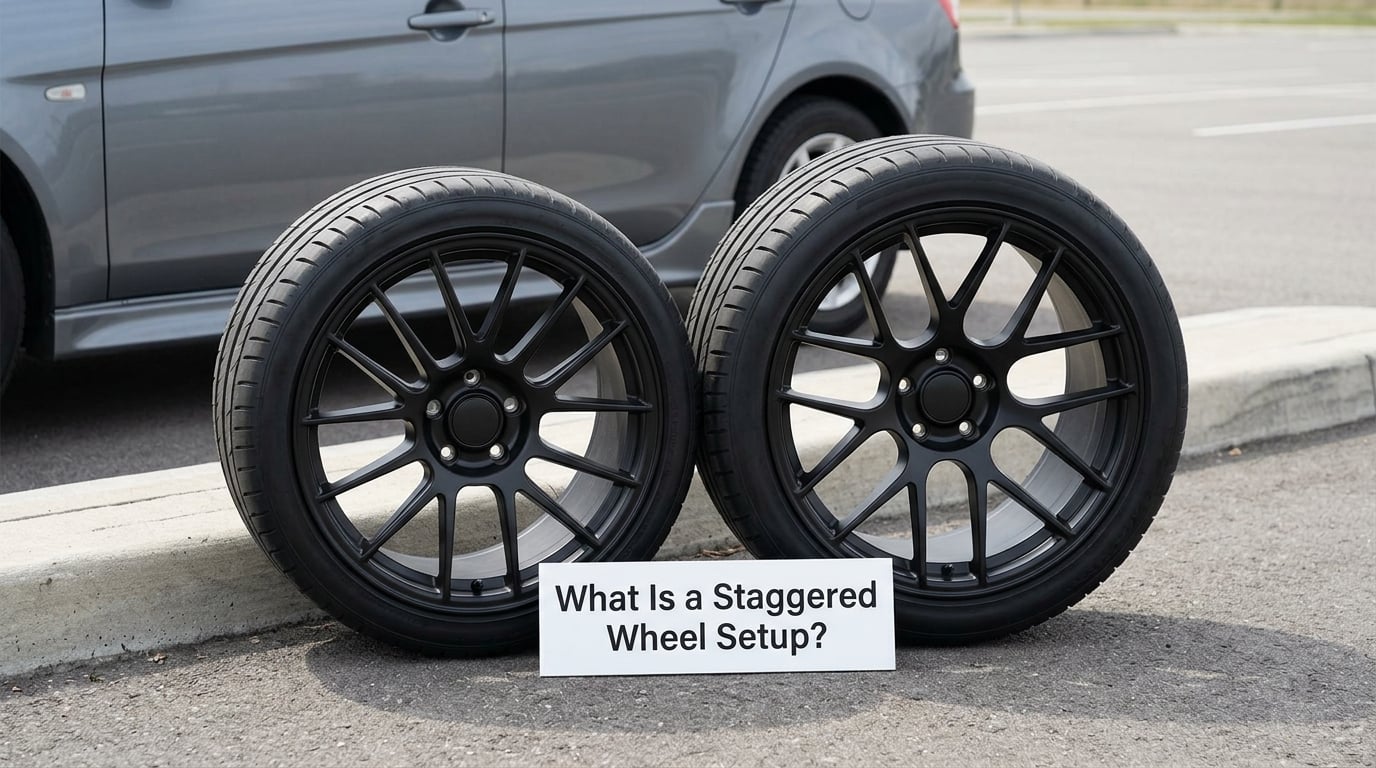
A staggered wheel setup is a fitment where the rear wheels and rear tires are wider than the front pair, usually by an inch or two. A typical example is an 18×9.5-inch wheel with a 275-section tire at the back, against 18×8.5-inch wheels with 245-section tires at the front.
A square setup, by contrast, uses the same wheel and tire size on both axles. That is what most economy cars, family sedans and modern all-wheel-drive crossovers run, and it is the reason rotating tires on them is so easy.
Staggered fitment comes in three flavours. Traditional staggered is the common one: same diameter, wider rear, so 18×8.5 front and 18×9.5 rear. Reverse staggered flips it, with the wider tire up front, which is rare and mostly a thing tuner and show cars do. Double staggered changes both width and diameter, 19-inch wheels in front and 20s in the back, the layout you see on a lot of Corvettes.
Whether it is factory-supported comes down to paperwork. If the car shipped from the factory with wider rears, the suspension, anti-roll bars, half-shafts, brake lines and gearing were all designed around that layout, and the staggered setup is the one the engineers tested. If the car rolled off the line square, bolting on wide rears is an aftermarket change and the clearance checks are on you.
Staggered Wheel Setup Pros and Cons at a Glance
| Factor | Staggered setup | Square setup |
|---|---|---|
| Rear traction on power | Stronger, wider rear contact patch | Modest, shared across the car |
| Steering response | Narrower front tire turns in faster but feels lighter | Heavier, more consistent front end |
| Cornering stability | More planted at the rear, can push wide up front | More neutral, easier to rotate |
| Steering wheel feel | Lighter, thinner, more road texture | Fuller, heavier feedback |
| Tire wear pattern | Rears typically wear far faster | Even across all four |
| Tire rotation | Side-to-side only, if tires allow it | Front-to-rear and side-to-side |
| Unsprung mass | Heavier rear corners if rears are large | Even weight at each corner |
| Purchase and replacement cost | Two tire sets to buy and budget for | One tire set for the whole car |
| Water and snow clearance | Watch for spray hitting the body and less tread to bite into snow | More clearance and more tread on each side |
| All-wheel-drive compatibility | Only with matched rolling circumference | Simplest and safest option |
Read that table as a trade, not a scorecard. Everything in the top half of the list is a real gain if the car is set up for it. Everything in the bottom half is a cost you pay in money, inconvenience and sometimes safety margin.
Why Use Different Front and Rear Tire Widths?
It comes down to where the car puts its weight and where it needs grip. When you accelerate hard, weight moves rearward. A wider rear tire has a larger contact patch sitting under that shifted weight, so it puts power down with less wheelspin and holds the rear end straighter out of a slow corner.
On a rear-wheel-drive car this is straightforward. The rear axle is the driven axle, so extra rear rubber does exactly what you want it to do. Wider rears also add stability when you lift mid-corner, because the rear has more to resist the load moving forward.
On an all-wheel-drive car the logic gets complicated, because all four tires are driven and the front is not a sacrificial axle. A car that came from the factory staggered has a chassis, differential and control strategy designed around those specific sizes. Bolt a wider rear onto a square AWD car and you are changing the equation the drivetrain was built for.
Does a Staggered Setup Improve Handling?
Yes in some ways, no in others, and the honest answer depends on what you mean by handling. Wider rear tires increase rear grip and stability. Narrower front tires reduce front grip. The car ends up with a grip split that makes it stable and predictable but a little less willing to change direction.
Turn-in and steering response
A narrower front tire has less mass to move and less rubber to twist, so the front axle reacts faster to steering input. Turn-in sharpness improves in the first half of the corner. The narrower front tire also rolls slightly faster than a wider one, which is a small efficiency gain on a car that spends its life accelerating.
The catch is that the front end now has less grip to give. On a twisty back road, a fast rear-drive car with narrow fronts will run wide on corner entry before the rear steps in.
Does a staggered setup reduce understeer?
You will find sources claiming both things, so here is the resolution. Some wheel brands say a staggered setup reduces understeer, because the car has more rear grip and feels more planted. Others say it increases understeer, because the front axle now has the least grip on the car.
Both describe the same hardware. The first answer describes a symptom you feel in the body, the second describes the mechanism. Grip is a split, and a staggered setup deliberately puts more of it at the rear, so under a big lateral load the front is the axle that lets go first. A car with more rear grip and a less grippy front will feel stable and will still push wide if you ask more of it than the fronts can hold. On an axle-by-axle basis, narrow front tires are a trade of front grip for rear stability, not a cure for understeer.
Where that trade wins is traction-limited corner exit and stability at speed. Where it loses is slow, tight corners taken at the limit, and that is a habit most people do not have.
What Are the Main Disadvantages?
Uneven tire wear and the rear-only replacement cycle
Rears on a staggered setup take the load of acceleration, weight transfer and the wider patch working against a narrower car, so they wear faster than the fronts. Owners in Mustang and Lexus IS threads report 30,000 to 40,000 miles on staggered rears with no rotation at all, which is not terrible, but it is a number to plan around rather than be surprised by.
Pressure matters more than most people expect here. Owners managing staggered rear wear report running the rears at 33 to 34 psi specifically for that reason, so check the placard on your door jamb and treat it as a starting point, not a suggestion.
Can you rotate tires on a staggered setup?
Usually not. When the front and rear tire widths differ, a front-to-rear rotation is physically impossible, and side-to-side works only with non-directional tires. Directional performance tires add another blocker, because a side-to-side swap puts a left-hand tread pattern on the right side of the car.
There is one exception worth knowing: a mild stagger where the wheel widths are close enough to mount a matching tire on each corner, sometimes identical front and rear wheel widths with different tire sections. In most real staggered builds, plan on replacing the rears as a pair and the fronts as a pair, and treat rotation as off the table.
The cost of buying and running two tire sets
Staggered means two different tire sizes on the car. A shop prices two lines instead of one, and a rear-only replacement is a second, separate purchase later. A Model 3 owner notes that a square 18-inch setup in calm driving style simply lasts longer, which is the arithmetic most daily drivers care about.
Budget for the second set rather than the first. If the rear tires are a specialty size that few shops stock, you also lose the convenience of a same-day swap.
Steering feel, tramlining and unsprung mass
Narrower fronts give the wheel less to talk through, so the car feels lighter and less connected. If you move the other way and run a wider front than stock, expect tramlining, where the tire follows grooves and bumps in the road and yanks the wheel across the lane.
Big rear wheels also add unsprung mass at the rear, which hurts ride quality and can add weight to the rear springs and dampers over time. Sourcing a single replacement rear wheel is another sharp edge, since a damaged rear wheel cannot be swapped with a front spare.
How Tire Size, Wheel Width, and Offset Affect Fitment
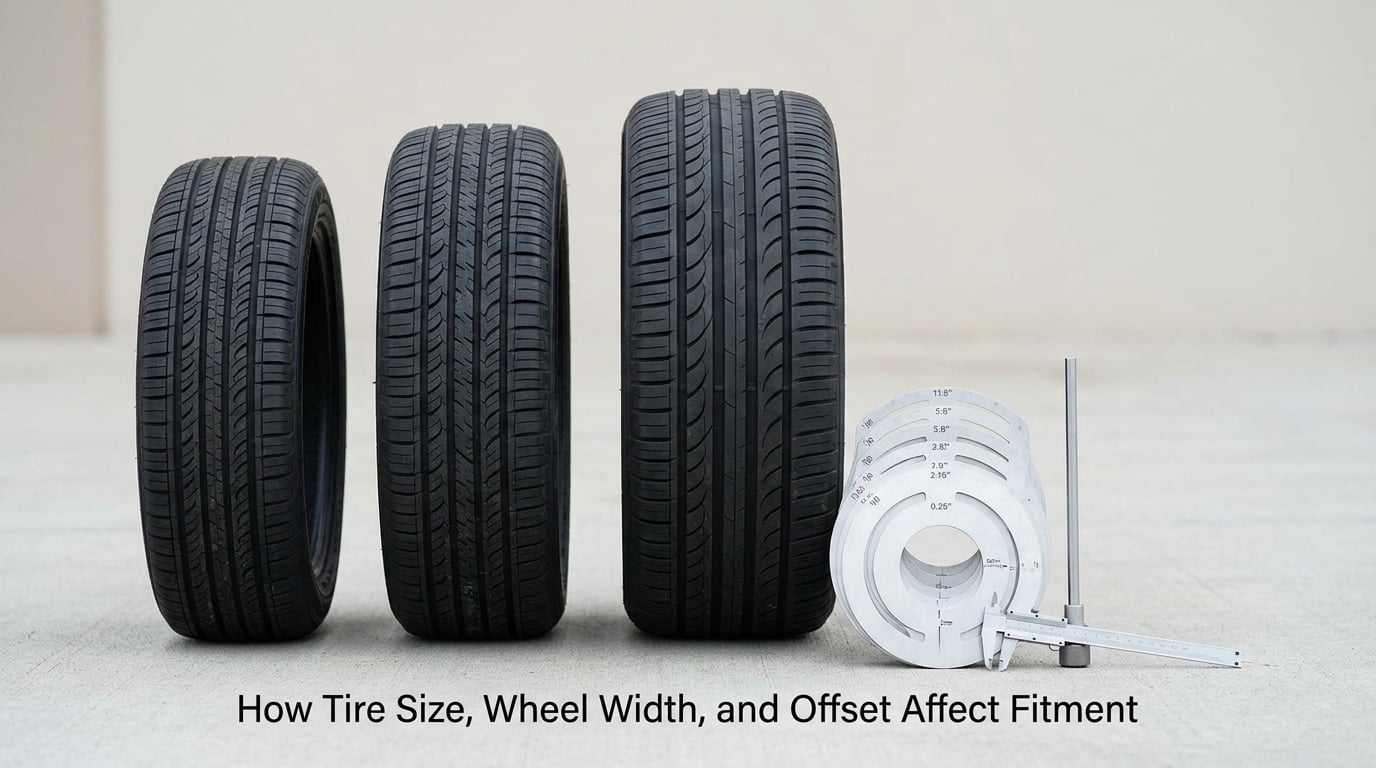
Four numbers decide whether a staggered wheel setup fits and behaves: tire width, aspect ratio, wheel width and offset. Get all four right and the staggered wheel setup pros show up. Get one wrong and you get rubbing, a bent rim or a car that tracks badly.
Match the tire to the wheel width
A wheel is a specific width, written as 18×9.5 for an 18-inch rim that is 9.5 inches wide. A tire is a section width in millimeters, written 275/35ZR19 for 275 mm wide at 35 percent aspect ratio on a 19-inch rim. Tires stretch to fit the rim they sit on, and the further you push that, the more the sidewalls round off. One Lexus IS owner running a square tire size on staggered wheels noticed exactly that, with sidewalls visibly curving from the stretch.
Keep overall diameter close to factory
Overall diameter is what the speedometer and the ABS actually read. A common rule is to stay within about 3 percent of the factory rolling diameter, and to keep front and rear circumference close on all-wheel-drive cars so the front and rear differentials and the center differential are not fighting each other. A car that ships square should stay close to square for this reason.
Set offset for clearance, not for flushness
Offset, marked as ET or backspacing, is the distance in millimeters from the wheel mounting surface to the centerline. Lower ET numbers push the wheel out toward the fender, higher numbers pull it in. On a staggered build the rear often needs a higher offset than the front to keep the wider wheel inside the arch, and that difference in offset between axles is a normal part of the fitment.
Before you commit, check clearance at full lock with the suspension compressed and loaded, not just sitting in the driveway. Watch the inner fender liner, the brake caliper on staggered setups, the tie rod ends, the steering rack travel, and the wheel arch on a compressed strut.
Do not forget the supporting parts
TPMS sensors have to be paired to the new wheel position, or the system will flag a fault. Load index and speed rating need to meet or exceed the factory requirement on every corner. On a car that never shipped staggered, wider rears can also mean longer half-shafts, revised spring and damper rates, and a brake line check.
How to Decide Whether a Staggered Setup Is Right for You
Run through these questions in order. If the first two come back no, the rest does not matter.
- Did the car come from the factory staggered? If yes, you are restoring an engineered setup. If no, you are modifying suspension geometry and drivetrain behavior on your own.
- What drivetrain do you have? Rear-wheel drive handles stagger best. All-wheel drive needs matched circumference. Front-wheel drive gains almost nothing, since the narrow front axle is not carrying the driven load.
- How do you drive? Hard launches, autocross, drag strip and canyon roads reward rear grip. Commuting, long highway stretches and rough winter roads favor a square setup.
- What is your tire budget? Two sets cost roughly double one, and the rear replacement comes sooner. If a second set strains you, choose square.
- What are the winters like? Staggered winter packages are narrower in selection and pricier. Snow-capable rear tires in a staggered size are not always available in every size.
- Do the sizes exist? Check that your target front and rear sizes are stocked locally. Sourcing one odd rear size in a small town is a real headache.
- Can you store four differently sized wheels? Winter and summer sets double the wall space, and the rears stack wider.
Which drivetrain suits which setup
| Drivetrain | Staggered fitment | Square fitment |
|---|---|---|
| Rear-wheel drive | Strong fit if the factory intended it; more traction and stability | Workable, less rear grip on power |
| All-wheel drive | Only with front and rear rolling circumference closely matched | Simplest and safest default |
| Front-wheel drive | Little to gain; drag use is the main exception | The right answer for nearly every commuter |
How much stagger is too much?
Stagger is measured as the total width difference between the front and rear tire, front to rear. Past about two inches of difference you start fighting clearance, scrub radius and steering geometry on every car in the category.
| Tier | Total width difference | Example wheel specs | Example tire sizes |
|---|---|---|---|
| Mild | 0.5 to 1 inch | 18×8 front, 18×8.5 rear | 245/40R18 front, 275/35R18 rear |
| Moderate | 1 to 1.5 inches | 18×8.5 front, 18×10 rear | 245/40R18 front, 295/35R18 rear |
| Aggressive | 1.5 to 2 inches | 19×9 front, 20×11 rear | 255/35R19 front, 305/30R20 rear |
Mild is the sensible starting point for a street car. Moderate is where the traction gains become obvious and the clearance work begins. Aggressive belongs on cars whose chassis were built for it.
Frequently Asked Questions
Does a staggered wheel setup cause more tire wear?
Yes, unevenly. The rear tires carry the load of acceleration and weight transfer through a wider patch, so they typically wear faster than the fronts, and you cannot rotate front to rear when the widths differ. Owners report roughly 30,000 to 40,000 miles on staggered rears with no rotation. Keep pressures at the door placard value, watch the rears more often, and budget for a rear-only replacement as its own purchase.
Can I run staggered tires on any car?
You can physically do it on most cars, but that is not the same as it being supported. A car designed for staggered fitment has suspension rates, anti-roll balance, half-shafts and gearing set up around wider rears. On a square car, wider rears change weight distribution, rolling circumference and clearances. Check overall diameter, offset, arch clearance at full lock, and whether the car is all-wheel drive with a center differential that needs matched circumference.
Are staggered wheels better for daily driving or track days?
Track days and performance driving favor staggered fitment, because the extra rear grip helps traction out of corners and stabilizes the car on exit. Daily driving leans square. You lose tire rotation, pay for two tire sets, and get less front grip in the tight corners most commute driving actually involves. A car driven to work five days a week is usually better served by one tire size, more tread per corner and easier replacement.
Does a wider rear tire improve braking?
A wider rear tire increases the rear contact patch, which helps traction and stability under braking on a rear-wheel-drive car. Braking distance, however, is mostly decided by tire compound, tread depth, surface and total vehicle mass, not rear width alone. A wider rear also resists overheating better under repeated hard stops. Note that on a staggered setup the rears wear faster partly because they do more of the braking work.
Why does my steering wheel feel different after installing staggered wheels?
Narrower front tires have less rubber and less mass to move, so they react faster to steering input and the wheel feels lighter. The same tires deliver less peak front grip, which is why the car can feel both sharper and less planted at the limit. Going the other way, an overly wide front tire causes tramlining, where grooves and bumps pull the wheel across the lane. Wheel alignment and tire pressure both change the feel noticeably.
Is a staggered setup safer in wet or snowy conditions?
Mixed. The wider rear tire resists hydroplaning better on wet pavement and resists overheating under hard braking. In snow and ice, the narrower front tire has less tread biting into the surface, and staggered winter packages are harder to source, so many owners switch to a square winter setup. That switch changes the balance of the car noticeably. A rear-drive owner reported a square winter set felt floaty at the rear compared with the staggered summer tires.
Conclusion
The staggered wheel setup pros are real on a car built for it: more rear traction, more stability on exit, faster turn-in and a stance that looks right. The cons are equally real, mostly fewer rotation options, two tire sets to pay for, faster rear wear and less front grip than you had before.
Start with one check. Find out whether your car shipped from the factory with wider rear tires, and if it did, stay close to those numbers for wheel width, offset and overall diameter. If it did not, treat a staggered build as a project involving clearances, brakes, steering geometry and drivetrain matching, not a weekend bolt-on. Either way, verify the fitment properly before you order anything.
Updated for October 2026. Fitment guidance here is general; your owner’s manual and the tire placard on the door jamb always take priority.