
Premium vs regular gas comes down to a single number: octane. Both fuels start life as the same base unleaded gasoline, and what a higher grade really changes is how hard the air and fuel charge fights to ignite before the spark plug is supposed to fire it. For most cars on the road, regular is the grade the engine was built around, and premium is an expensive way to fill the same tank. A smaller group of engines, mostly turbocharged, high-compression or performance models, genuinely needs that extra knock resistance, and running one of them on regular can quietly cost you timing, power and eventually money.
The confusing part is not the fuel. It is the wording on the sticker. Required, recommended, minimum octane, unleaded minimum. Those phrases decide the whole question, and almost nobody reads them. Let us fix that, then get into what octane actually is.
Table of Contents
- Premium vs Regular Gas at a Glance
- What Is the Difference Between Regular and Premium Gas?
- What Does Octane Rating Mean?
- Does Premium Gas Improve Performance?
- Will Premium Gas Help My Car Run Better or Save Fuel?
- Can Regular Gas Damage My Engine?
- Which Fuel Should You Choose?
- Frequently Asked Questions
- Does premium gas improve performance in a car that takes regular?
- Does premium gas give you better gas mileage?
- What happens if I accidentally put regular gas in a premium car?
- Is 89 octane worth it over 87?
- What octane does my car need, and how do I check?
- Can I mix 89 and 93 octane, and does premium ruin an engine?
- The Bottom Line
Premium vs Regular Gas at a Glance
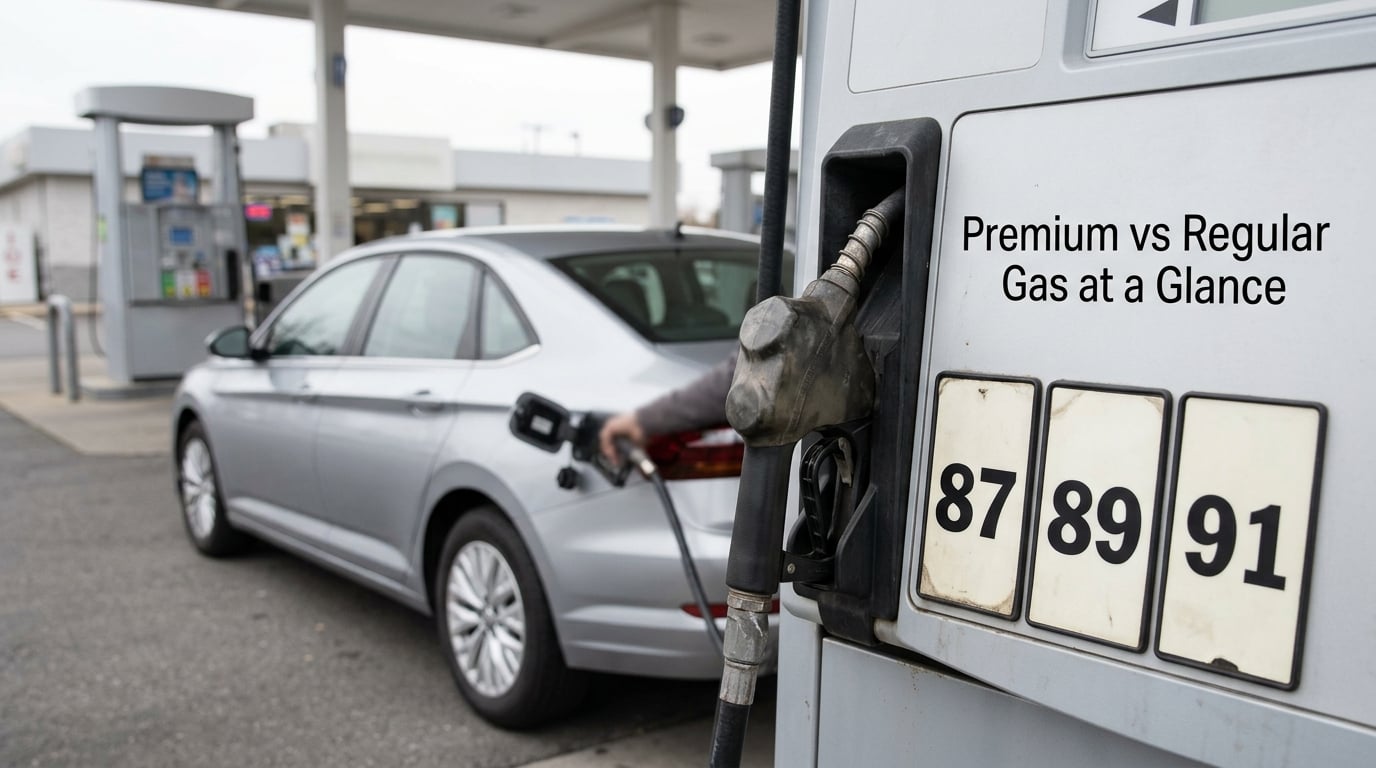
Quick version: all three grades measure the same thing, resistance to engine knock, and none of them carries meaningfully more energy per gallon than the cheapest one. What changes between them is how much compression, heat and boost an engine can absorb before the fuel self-ignites early, and how much extra you pay at the pump for that tolerance.
Regular 87 octane
The baseline for almost every passenger car on sale. Energy content is within a fraction of a percent of premium, and in an engine built for 87 the fuel never gets close to the knock limit, so there is no performance on offer. This is the correct choice for the overwhelming majority of drivers, and it is the baseline everything else is priced against.
Midgrade 89 octane
The middle rung, and the most underrated grade at the pump. It costs a modest step up from regular rather than the full jump to 91 or 93, and on a car rated for 89, or one that knocks occasionally on 87 in hot weather, it settles the problem for a fraction of the premium cost. In an engine already happy on 87, it changes nothing you can measure.
Premium 91 or 93 octane
Typically 20 to 25 percent more per gallon than regular, and the only grade that matters in a high-compression, turbocharged or performance engine. There it lets the engine run its published power figures and its tighter ignition timing. Everywhere else it is a bigger bill for octane the engine cannot spend, although refiners do add a heavier detergent package, which is a genuine if secondary benefit.
That is the whole comparison in three paragraphs. Energy per gallon barely moves between grades, so a gallon of premium does not take you further than a gallon of regular. What a higher octane number buys is tolerance to compression, heat and boost, and only an engine designed around that load can spend it.
Last reviewed October 2026. Detergent standards and manufacturer fuel specs do change, so re-check the sticker when you buy a used car.
What Is the Difference Between Regular and Premium Gas?
The difference between premium and regular gas is the octane rating, and essentially nothing else that matters to you. Regular is 87 on the pump in most of the US, and premium is typically 91 to 93. Octane measures how strongly a fuel resists igniting under compression, which is called engine knock. It does not measure energy content, cleanliness, quality or how expensive the refiner was.
That last part is where most of the marketing lives, and it is worth saying plainly. Both grades are blended to meet the same ASTM fuel standards, so the 87 from the station on the corner and the 87 across town are held to an identical specification. A question that keeps surfacing on r/NoStupidQuestions asks whether one brand of 87 is better fuel than another brand of 87. It is not, unless the blend happens to be off spec, which is exactly what the standard exists to prevent.
Higher octane also does not mean a hotter or cooler burn, a cleaner engine, or longer oil change intervals. Refiners do add more detergent packages to premium, and that is a real effect, but octane itself is the headline number.
What Does Octane Rating Mean?
Octane is resistance to knock, full stop. Knock happens when the end of the compression stroke gets hot and pressured enough that the fuel and air mixture self-ignites a few degrees early. That is detonation, and it is the sound people describe as a ping, a rattle or a metallic clatter under load.
Detonation is not a mild event. It is a pressure spike inside a chamber that was designed for a controlled flame, and repeated cycles of it are the reason higher octane exists at all.
Why high-compression and turbocharged engines need more of it
Compression ratio is the first lever. The more the mixture is squeezed before ignition, the hotter and more pressurized it gets, and the more octane it takes to survive that. A turbocharger is the second lever, because boost raises cylinder pressure and intake temperature well past what the engine sees at idle. Performance engines get a third dose of the same problem through high specific output, high intercooler temperatures and aggressive ignition calibration.
Your engine computer manages this in real time. When it detects knock, it retards spark timing, which protects the metal but costs efficiency and power. When the fuel can take it, the computer is allowed to advance timing for better combustion. That headroom is the only real currency an octane number buys.
What the numbers on the pump actually mean
The number at the pump is an anti-knock index, which is the average of two laboratory tests. A grade labeled 87 corresponds to roughly 91 to 92 on the research octane scale used in Europe, and a 93 label corresponds to about 98 to 99. That is why you see 95 and 98 RON at European pumps and 89 and 91 at American ones. They are the same ladder, measured differently.
Can you mix fuel grades?
Mixing is fine, and blending arithmetic works the way you would hope. Half a tank of 89 topped off with 93 gives you about 91. What you cannot do is average your way above what is in the tank already, so if you are empty you can choose the blend, and if you are not, you are topping up a grade you already have.
Does Premium Gas Improve Performance?
Only in an engine built to use it. Higher octane does not create power by itself. It lifts the ceiling on compression, boost and ignition advance, and an engine calibrated for premium will use that ceiling to make its published horsepower figures and to run tighter timing. In an engine calibrated for regular, the ceiling is never reached, so there is nothing to spend and nothing to gain.
AAA ran a controlled back-to-back comparison of 87 against 93 in the same vehicles and found 2.7 percent better fuel economy and under 3 percent more horsepower. That is a real but tiny result, and it came in cars rated for regular.
What higher octane does not do
It does not clean an engine, add horsepower to a naturally aspirated engine that never asked for it, extend your oil change interval, or make the exhaust feel different. A premium fuel tank is not a tune-up. One regular poster on a Car Talk thread, asked whether mechanics were right to flush premium through an 87-octane car a few times a year, put it plainly: nothing has changed, and there was never a reason to run premium through those cars several times a year.
Why luxury badges ask for premium on a similar engine
Often it really is a harder engine under the same badge. More boost, higher compression, a hotter charge air system, or a power figure quoted at the higher grade. Sometimes it is a deliberate margin, so the car is never operating at its knock limit during a hard tow or a summer highway climb. And sometimes it is marketing, which is exactly what a question on Quora about why a luxury brand’s base engine wants premium while an equivalent mainstream car does not comes down to.
The honest test is the horsepower and torque sticker on the door jamb, or the spec sheet. If the number is footnoted to a specific octane, the octane is doing work.
Will Premium Gas Help My Car Run Better or Save Fuel?
Usually not, and in the cases where you feel a difference, the fuel economy result still tends to lose to the price. AAA measured 2.7 percent better fuel economy for 93 octane in regular-rated cars against a price gap of roughly 20 to 25 percent per gallon. A few percent of range does not close a gap that size.
Real owners tend to land in the same place. A truck owner on r/FordTrucks ran premium in a 2018 2.7L EcoBoost and picked up about 1.5 MPG, then worked out that cost per mile was still worse on premium than on regular. That is the whole argument in one sentence: a small efficiency gain multiplied by a much bigger price increase is still a loss.
There is one real way premium improves things, and it is not a good-news scenario. An engine that is knocking on regular pulls timing back to protect itself, and retarded timing burns more fuel. Correct the knock and the economy comes back. Someone instrumenting a 91-required Acura TL on a Car Talk forum thread found the knock system still retarding timing on 93 octane at sustained high load, and never heard a single audible knock.
Summer heat, a heavy trailer, long grades, a roof box, a dusty engine with carbon, a worn EGR valve or a spark plug gap opened up by age can all push a marginal engine into knock that was not there when it left the factory. If your car pings on a hot climb, a higher octane is a diagnostic step, not a ritual.
Can Regular Gas Damage My Engine?
One tank of the wrong grade is not a disaster. Sustained running below the required octane is. A single misfill in a 91-required car means an afternoon of reduced timing and maybe a stored knock code; drain what you can, refill with the specified grade, and do not drive it hard until the tank is turned over.
Wrong-fuel damage is also the classic claim insurers decline, so the cost of finding out is rarely covered.
What wrong fuel feels and sounds like
Watch for a sharp metallic ping under acceleration or uphill, hesitation or a surge when you are at a steady throttle, power that feels soft or off-threshold, a rough or unsteady idle, and a check-engine light. Stored codes on the scanner may show a knock-sensor circuit fault or a lean or bank-related code such as P0171, P0172 or P0430, since the ECU reacts to what the knock did to combustion.
Why knock sensors are not a free pass
A knock sensor reacts to detonation that has already started. It is a protection system, not a predictor, and it cannot protect an engine from a sustained event it has been told to ignore while it keeps retarding timing. The Car Talk thread makes the point well: knock sensors catch events while they are still sub-audible, which is precisely why owners with required-premium engines can go years without ever hearing knock and still be leaving performance on the table.
The serious downside case in that same thread is an anecdote worth remembering. A poster described a police department that economized by running regular in high-performance patrol cars and eventually burned holes through the tops of the pistons, all of them fitted with knock sensors.
What about premium in a car that only needs regular?
Nothing bad. No harm, no cleaning, no gain, just a bigger bill. The engine never leaves its operating window, so the extra octane simply sits there unused. An owner on r/Cartalk describes a BMW X4 that has run 87 octane for years against a 91-or-higher specification, with no noticeable problems at all. If you want the honest counterweight to that, the same thread’s regular drivers will point out that the car is also not making the power and economy its manufacturer published.
Some cars run leaner on premium than on regular when the lower grade is knocking, and a few drivers notice a seat-of-the-pants difference. Test it on your own car, the way you would test anything else: two full tanks each way on the same route, then look at the trip computer or fill the tank and read the miles.
Which Fuel Should You Choose?
Choose regular when your car requires or recommends it, which is most of the cars on any parking lot. Choose the grade on the fuel filler door. Choose premium when the label says required, when a published power figure is tied to a grade, or when you have a specific reason such as sustained heavy load in sustained heat. Change nothing else on the basis of how the car feels on a Tuesday morning.
How to check what your car needs in about 30 seconds
Look inside the fuel filler door first. Most cars from the last 20 years have a sticker there with the minimum octane, and it uses either a symbol or plain words.
Second, open the owner’s manual to the fuel section and look for required or recommended. The distinction is the whole decision. Required means the engine is not designed to protect itself at the lower grade under all conditions. Recommended means the lower grade is safe but you give up a little performance, a little economy, or both under load.
Third, check the door jamb sticker for the horsepower and torque figures. If a footnote ties them to 91 or 93 octane, treat that as a recommendation with receipts behind it.
High altitude and long, sustained high-load driving are the honest exceptions to a stock sticker. Both add knock margin demand that a road car never sees. If the manual allows it, a tank of 91 in the mountains is reasonable; an octane booster doing the same job for one fill is cheaper.
Where the money is better spent
For a regular-grade car, a detergent standard is usually the smarter purchase than octane. Top Tier Gasoline uses a single industry standard for the additive package designed to keep intake valves and combustion chambers from varnishing, rather than leaving each brand to a different blend of claims. On a forum, the common advice from people who think about this stuff is blunt: run Top Tier and regular, because a car only truly benefits from premium when the horsepower and torque figures carry a disclaimer.
Midgrade is the smart middle buy. It costs a modest step above regular, and on a car rated for 89 or with a knock sensor that occasionally complains, it settles the issue without the premium line item. An octane booster in a can is the cheapest way to protect a specific drive, such as a long grade with a trailer, and it works because it raises octane, which is the only thing that was ever the point.
Frequently Asked Questions
Does premium gas improve performance in a car that takes regular?
No. In an engine rated for 87, the computer never reaches the knock limit that higher octane would allow, so there is no extra timing to advance and no power to unlock. AAA testing found under 3 percent more horsepower in regular-rated cars, which is below what most drivers can detect behind the wheel. You are paying more per gallon for octane the engine cannot spend.
Does premium gas give you better gas mileage?
Barely, and not enough to pay for itself. AAA measured 2.7 percent better fuel economy driving 93 octane against 87 in the same cars, while premium typically runs 20 to 25 percent more per gallon. One truck owner on r/FordTrucks gained about 1.5 MPG on premium in an EcoBoost and still ended up paying more per mile. Premium sometimes improves economy only when the lower grade is knocking and pulling timing.
What happens if I accidentally put regular gas in a premium car?
One tank of it will not wreck anything. You may get reduced power, an audible ping under load, hesitation, or a stored knock-sensor code, and the computer will pull timing to protect the engine. Drive gently, refill with the specified grade as soon as practical to flush the tank, and scan for codes afterward. Repeatedly running under the required octane is a different and more expensive conversation.
Is 89 octane worth it over 87?
Sometimes, and it is the most underrated grade at the pump. Midgrade usually costs much less than the step up to 91 or 93, and on a car rated for 89, or one with an engine that knocks occasionally on 87 in hot weather, it resolves the problem for a fraction of the premium cost. On a car that is completely happy on 87, it does nothing for you either.
What octane does my car need, and how do I check?
Check the sticker inside the fuel filler door, then confirm in the fuel section of the owner’s manual. If the wording is required, use at least that grade. If it says recommended, regular is safe, with a possible small loss of performance and economy under load. Also check the door jamb power sticker: a footnote tying the horsepower figure to a higher octane is a strong hint that the engine can use it.
Can I mix 89 and 93 octane, and does premium ruin an engine?
Mixing is fine. Half a tank of 89 topped with 93 gives you about 91, and you can average your way to any grade between what you have and what you buy. Premium will not ruin an engine that runs on 87; the extra octane simply goes unused, which makes it the most expensive nothing in a fuel tank. Wrong-fuel damage is also the kind of claim insurers commonly decline.
The Bottom Line
Premium vs regular gas is not a quality decision, it is an octane decision, and only some engines can use the extra. Read the fuel filler door, treat required as a floor and recommended as a suggestion, run regular in anything that is happy on 87, and put the money you were going to spend on octane into a midgrade tank or a proper detergent package instead. Then, if the car still pings on a hot climb with a trailer behind it, that is your reason, and now you have one.