
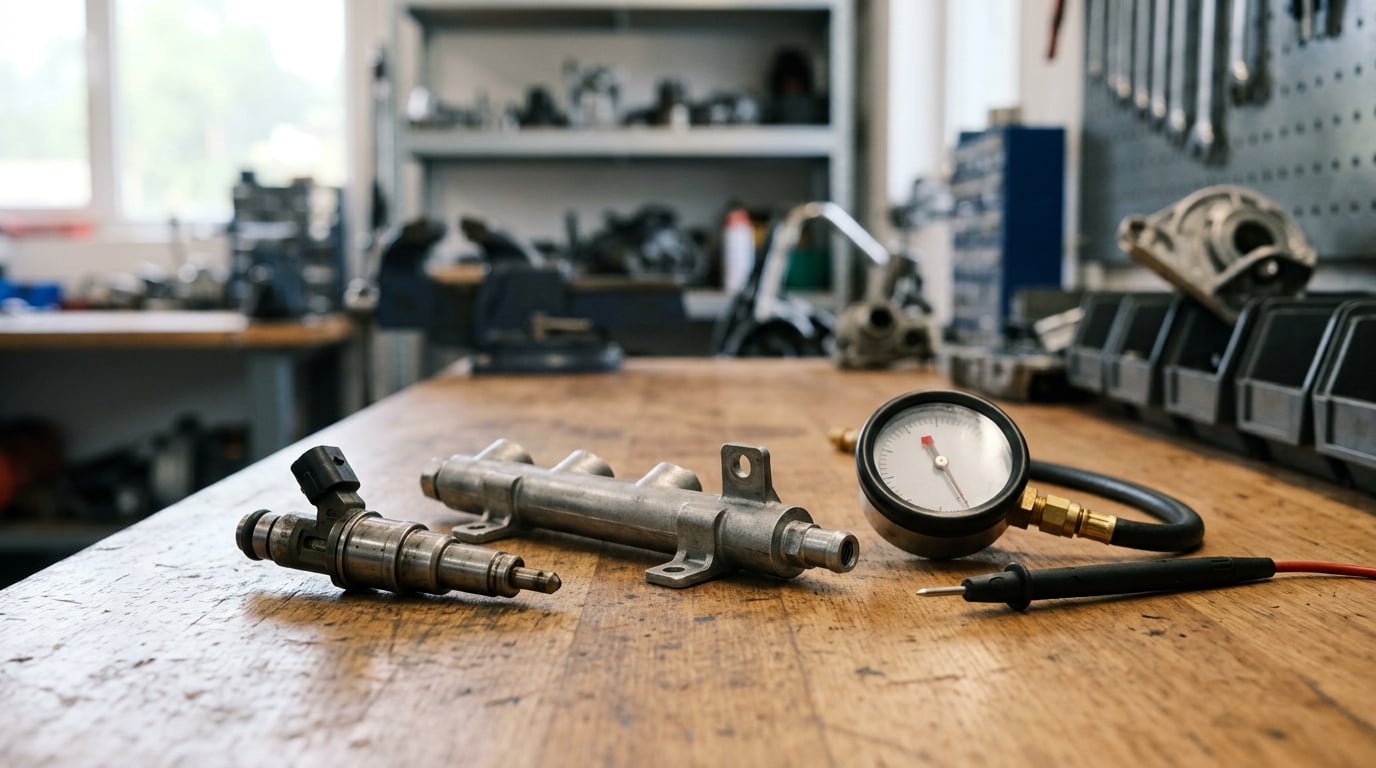
A fuel injector is clogged when carbon deposits or fuel contamination narrow its tiny spray orifices, so it can no longer deliver a full, properly atomized spray into the cylinder. To know how to tell if a fuel injector is clogged for real, watch for a shaking idle, hesitation under acceleration, misfires and worse fuel economy, then confirm it with a pressure test, a listening check and your scan tool instead of guessing.
That confirmation step matters more than the symptom list. A brake booster hose can produce the same shaking idle, a tired ignition coil produces the same misfire, and a weak fuel pump produces the same loss of power under load. Most of the tests below need a hand tool, a scan tool and about an hour. Removing the fuel rail to look at spray patterns takes considerably longer and means dealing with a pressurised fuel system.
Table of Contents
What You Need
Start with the service manual for your specific engine. Pressure specifications, injector resistance values and rail layout are all model-specific, and a generic number will send you down the wrong path.
- Service manual for your vehicle — for fuel pressure specification, injector resistance, firing order and the correct torque figures.
- Scan tool or code reader — a phone app with a Bluetooth OBD2 adapter is enough to read stored codes, live fuel trims and misfire counters. A bidirectional scanner is useful later if you want to command injectors off and on.
- Fuel pressure gauge — a 0 to 100 psi gauge with a proper adapter and a bleed-off tool. A cheap gauge in a squeeze bottle is better than nothing but reads slower.
- Mechanic’s stethoscope — or, failing that, a long screwdriver and a quiet workshop where you can hear the engine without road noise.
- Multimeter — for an injector coil resistance check and for back-probing the injector signal.
- Noid light — a cheap strobe that clips onto the injector plug and flashes with the ECU command. Essential for the electrical test.
- Hand tools, a drip tray and approved cleaning fluid — plus a container rated for fuel if you drain the rail.
Before anything else, read the safety rules for the car. A fuel system holds pressure whether the engine is running or not, and a hot exhaust manifold will burn you. Work outdoors or with strong ventilation, never with a spark source near the filler neck, keep a fire extinguisher within reach, and let the engine cool completely before you remove intake parts.
Step-by-Step
Work down this ladder in order. Each step either rules something out or narrows the fault, and stopping early usually saves you the expensive mistake. If fuel is leaking, a component is hot, or you find no fuel pressure at all, stop and get a professional involved rather than continuing.
How to tell if a fuel injector is clogged by checking the obvious signs
Five symptoms come up again and again. None of them prove a clogged injector on their own, which is why they are a starting point rather than a conclusion.
- A rough, shaking idle. One cylinder is getting an uneven fuel supply, so the engine never fully settles. Mechanically, the starved cylinder fires unevenly and you feel it through the seat.
- Hesitation or stumble when you accelerate. The injector cannot deliver the extra fuel instantly under load, so there’s a delay between pressing the pedal and the engine responding.
- Reduced fuel economy. The ECU sees the lean condition and adds fuel through long-term fuel trims, and you pay for it at the pump.
- Misfires and a check engine light. Codes worth reading first are P0171 and P0174 (system too lean), P0300 through P0304 (misfire detected on a specific cylinder) and P0201 through P0208 (injector circuit problem on a specific cylinder).
- A strong smell of unburned fuel, sometimes with black smoke. Rich exhaust or raw fuel odour points the other way — a leaking or stuck-open injector rather than a restricted one.
Here is the same set of symptoms mapped to what they mean and what else to rule out first, because most of these readings are shared faults:
- Rough or shaking idle — usually uneven fuel delivery to one cylinder, but a vacuum or brake booster hose leak, a worn throttle body or a failing idle control valve produce the same shudder.
- Hesitation under acceleration — an injector unable to supply extra fuel under load, though a restricted fuel filter, a weak fuel pump, a dirty mass air flow sensor or a low tank level look identical.
- Misfire codes P0301 to P0304 — that cylinder is not completing a burn, and a failing spark plug, ignition coil, fouled plug or low compression is just as likely.
- P0171 or P0174 lean code — the ECU is adding fuel to correct a lean reading caused by unmetered air, a dirty MAF, a failing oxygen sensor or genuinely low fuel pressure.
- Black smoke and raw fuel smell — too much fuel, not too little, pointing at a stuck-open or leaking injector or a stuck fuel pressure regulator.
- Long cranking and stalling after start — low fuel volume or pressure from a weak pump, a clogged filter or a bad regulator.
The tachometer needle bouncing at idle, a stumble on hills and worse economy only when the tank is below a quarter are all classic signs of a partially restricted injector. That condition is the hardest to catch, because the engine can behave perfectly at idle and fall apart the moment you ask it for real work.
Test fuel pressure before blaming the injector
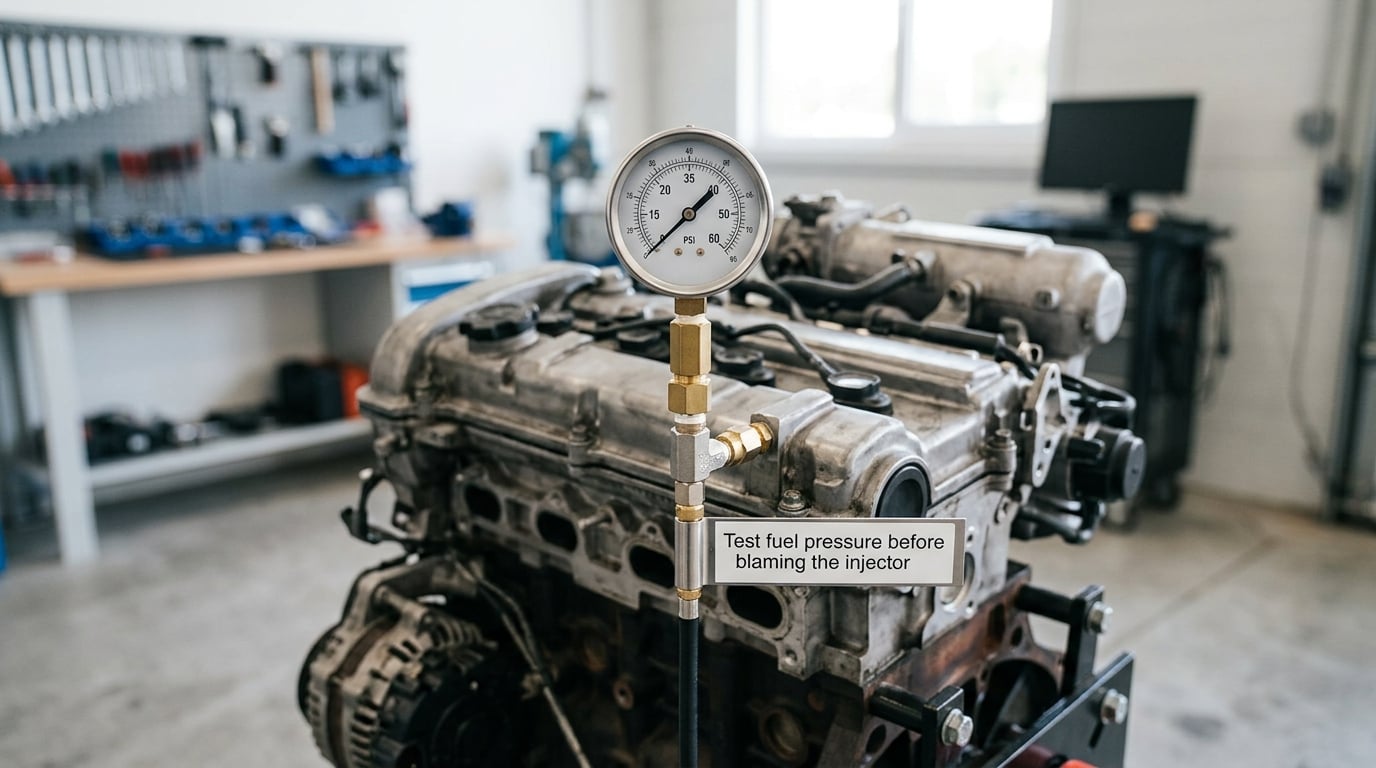
Connect the gauge to the fuel rail per the manual and read pressure with the engine off, then during cranking, then at idle. Compare each number with the manufacturer specification, not with another car.
Normal rail pressure that holds steady at idle tells you the pump, filter and regulator are delivering the volume the injectors expect. From there, if the symptoms are still there, the problem is downstream in the injectors or in the air-fuel measurement.
Pressure that collapses toward zero as you rev, drops after a warm start, or climbs well above spec points to the pump, a clogged filter or a regulator that has stuck. Weak pressure starves every injector at once, which mimics a set of clogged injectors. It is one of the most common misdiagnoses, and it is why the pressure test comes before anyone starts pulling injectors.
Rumbling or pulsing in the line means the pump is fighting a restriction downstream. Silence, or no pressure at all, means stop and check the pump, its relay and the fuse before going further.
Listen for the injector tick
With the engine running at idle, put the stethoscope on the fuel rail or on each injector body in turn. A healthy port injector produces a consistent repetitive tick, and a direct injection solenoid makes a quieter buzz that you can feel with a screwdriver held on the rail.
Compare injectors against each other rather than against your memory. A silent injector in an otherwise chatty set is either electrically open, badly dirty, or mechanically stuck. Inconsistent or missing ticks usually mean a wiring, connector or driver problem rather than a simple blockage.
Keep your hands and loose tools away from belts, fans and pulleys. Never put fingers anywhere near an injector while the engine is running.
Check for a leaking or stuck injector
This is the other half of the diagnosis, and it has the opposite fix. A restricted injector delivers too little; a stuck-open or leaking injector floods the cylinder, washes oil from the piston rings and can eventually let the engine run rich enough to destroy a catalytic converter.
Let the engine cool, disconnect the battery negative, relieve system pressure with the bleed tool, then remove the intake components to reach the rail. Label every connector and vacuum line before it comes off so it goes back where it came from. Inspect each injector body, the O-ring seats and the fuel rail for wetness, dark residue or a film around the lower seal.
With the rail pressurised off the engine, a short low-pressure test can show which one drips. A seal that leaks under low pressure will absolutely leak under full pressure, so this test is worth doing before you pull anything.
Light varnish or black residue on the tip is normal. Pooled liquid, a hard crust around the seal, or corrosion flaking off the O-ring is not.
Use an injector pulse test to confirm electrical operation
This is how you separate an electrical fault from a mechanical one without removing anything. Owners on the Maxima forum run this same order: check injector coil resistance first, then confirm the ECU command at each plug.
Measure the coil resistance across the two terminals of each injector and compare the readings. Injectors on the same engine should be close to each other. A reading that is far off its neighbours points to a failed winding.
Then clip the noid light onto the injector electrical connector, not the fuel side, with the engine cranking or idling. A flashing light means the ECU is commanding that injector. A dark light means the command is not arriving, so the fault is in the wiring, connector, fuse or control module rather than in the injector.
Use the correct wiring diagram for your engine so you know which pins are the control pair. Never probe a high-current circuit, and keep the meter leads clear of the alternator and starter cabling.
If every injector flashes, every injector measures similar resistance, and pressure is correct, then the fault is mechanical flow restriction. That is where the last test comes in.
Clean or replace the injector only after testing
Once you know it is a flow restriction, decide between three routes. A detergent additive in a full tank is the cheapest and the least reliable. Ultrasonic cleaning by a shop that flushes each injector, rebuilds the seals and flow-tests to a rated figure is the middle option. Replacement is the definitive one, and it is what you end up at when an injector is worn out rather than dirty.
Contaminated fuel found in the rail changes the decision. Water, rust particles or a thick gel means the injector has been running in bad fuel, and cleaning it without fixing the cause just reproduces the fault. High mileage, an ohm reading that has drifted or an injector that fails its flow test all point to replacement rather than cleaning.
New injectors still have to match the part number, come with the correct O-rings, and be installed with the specified torque and a clean seat. An injector crushed slightly in the rail will leak, and a leaking injector will put you right back where you started.
If the symptoms persist after all of this, stop testing and get a proper diagnosis. A shop with a flow bench or an injector balance test can measure delivery rate and pulse width per cylinder in a way a home garage cannot.
Common Mistakes
- Diagnosing from a rough idle alone. A cracked brake booster hose or a leak at the intake manifold produces a nearly identical shudder. Check for unmetered air before you buy a single injector.
- Testing a hot or still-pressurised system. You get sprayed fuel at high pressure and burned fingers. Cool the engine and bleed the rail first, every time.
- Swapping injector locations without identifying the fault. Moving injectors around changes the wiring mapping on many engines and makes the data worse. Fix the diagnosis before you reshuffle hardware.
- Damaging O-rings on removal. The old seals are single-use, they stretch as you pull, and they are the reason a perfectly good new injector starts leaking. Replace them and lubricate with the specified product.
- Forcing injectors back into the rail. If it will not seat by hand, something is wrong. Cross-threading or tilting buries the tip, and the damage shows up as a leak weeks later.
- Assuming new injectors fix an unrelated pressure or wiring problem. If the pressure test failed or the noid light stayed dark, new injectors will not change the outcome. That is the expensive parts-cannon trap, and it is the single biggest waste of money in this diagnosis.
A few habits that keep you out of trouble. Change the fuel filter on the schedule in your manual, because a restricted filter starves the rail and makes every injector look bad. Use fuel from a reputable station, and try not to run the tank below a quarter on a car that already idles rough. If you use an additive, add it to a full tank and drive it long enough to reach the injector, not just the fuel rail. Owners on r/Cartalk and r/MechanicAdvice consistently say the same thing: rule out intake and vacuum leaks first, because those get misdiagnosed as fuel problems more often than anything else.
Frequently Asked Questions
Can a clogged fuel injector be cleaned?
It depends how dirty it is and whether the injector is worn. Light carbon on the tip can often be cleared with a detergent additive or by pulling and flushing the injector in the correct solvent. Deposits hardened over years usually need professional ultrasonic cleaning, which flushes the body and tests the flow rate afterwards. An injector that fails the flow test after cleaning, or one with high mileage, is a replacement. Cleaning without first fixing contaminated fuel or a bad filter simply rebuilds the blockage.
What does a clogged fuel injector sound like?
A healthy port injector gives off a steady rhythmic tick, and a direct injection solenoid makes a lower buzz you can feel through the fuel rail. A restricted injector goes quiet, or ticks unevenly compared with its neighbours. That comparison matters, because engines differ so much that there is no universal sound to learn. Use a mechanic’s stethoscope on each injector in turn with the engine idling, and listen for the odd one out rather than for an absolute noise level.
How do I know if it is the fuel pump or an injector?
Check fuel pressure first. If rail pressure sits at the manufacturer specification and holds steady, the pump, filter and regulator are doing their job and a single injector is the likely culprit. If pressure collapses when you rev, drops after warm start or falls far below spec, every injector is being starved and the pump, filter or regulator is the real problem. Additional clues: long cranking and stalling after start point at the pump, while a healthy-pressure engine that shakes at idle points at the injectors.
Does low fuel pressure always mean the injector is clogged?
No, and treating it that way is an expensive mistake. Low pressure is a supply-side problem affecting all cylinders at once, while a clogged injector delivers too little fuel to a single cylinder even when rail pressure is perfect. A clogged filter, a tired pump or a failed pressure regulator will all read as low pressure on your gauge. If pressure is correct and the symptoms remain, only then does the injector become the prime suspect.
What causes fuel injectors to clog?
Most commonly it is carbon buildup from normal combustion residue over high mileage, especially on older direct injection engines where fuel no longer washes the intake valve. Beyond that, contaminated fuel, water or rust in the tank, a failed fuel filter that lets debris through, and long periods of storage all contribute. Ethanol blends that absorb moisture and gum up in the tank add to it. Short trips and idling in heavy traffic also stop the injector from reaching the temperature it needs to stay clean.
Should I replace all injectors at once?
Usually not, and the exception is worth knowing. If one injector is blocked or electrically failed on a healthy fuel system with a clean filter and good pressure, replace that one and keep the rest. If the whole set is old, has never been cleaned, or all of them test unevenly, replacing the full matched set avoids a second teardown soon after. Whatever you do, new injectors still need the correct part number, new O-rings and the specified torque.
Start with the free checks. Read your codes and live fuel trims, listen to each injector with a stethoscope, then put a gauge on the fuel rail before you buy anything. Those three steps tell you whether you are looking at a supply problem, an electrical problem or a genuine flow restriction, and they take an afternoon rather than a weekend.
If pressure is right, every injector ticks and flashes, and the fault still follows one cylinder, then it is time for a flow bench or a shop with an injector balance test. Until then, leave the injectors alone.