
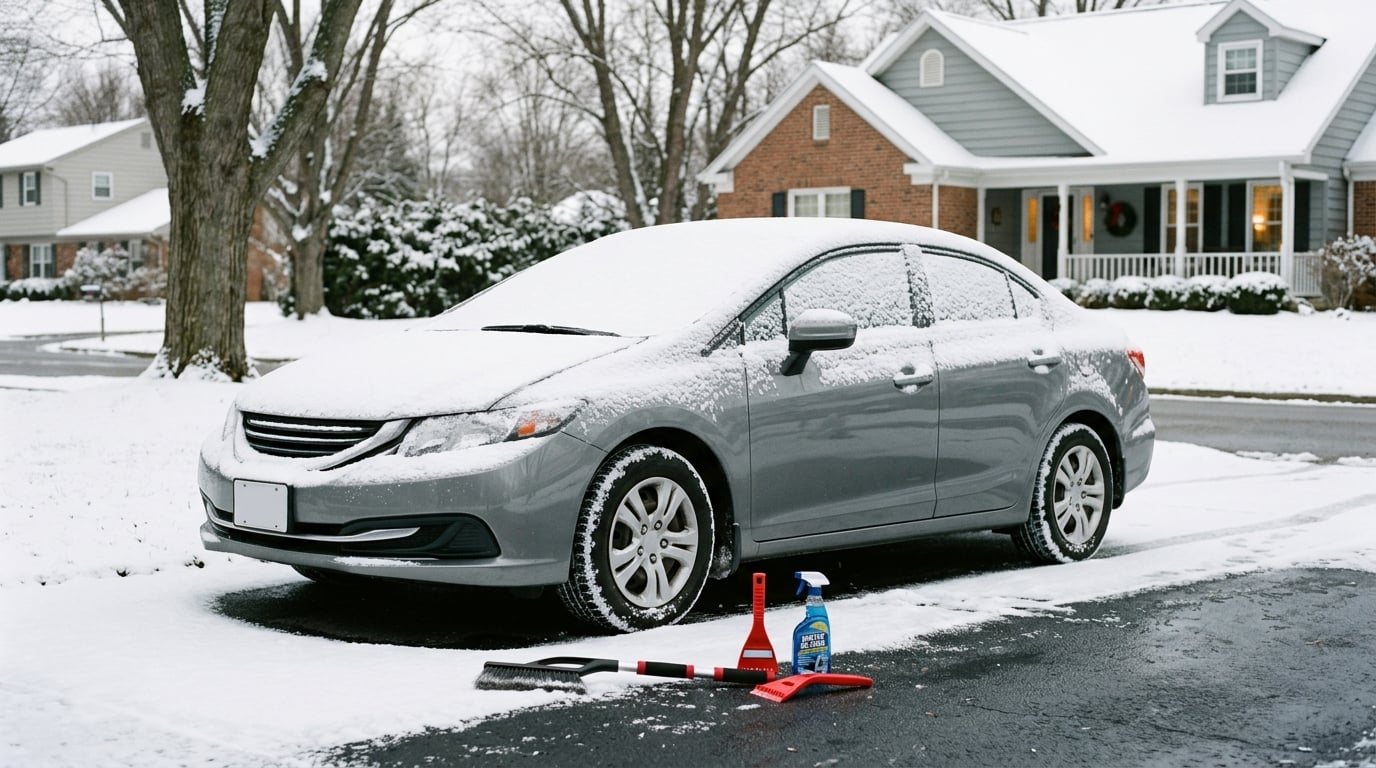
How to remove snow from a car the right way comes down to order and tool choice: brush the roof and body panels first with a soft-bristled snow brush, then break up ice on the glass with a plastic scraper, and never touch the windshield with hot water. Work top to bottom, because snow you push off the roof lands on the glass you just cleared. The whole job takes about ten minutes once you have the right gear on hand.
That last part matters more than people expect. Snow itself is not what ruins a car in winter. Grit, road salt, and sand packed under the snow are, because they act like sandpaper the moment anything drags across the paint. Most of the scratches people blame on winter happen in the ten minutes of clearing, not in the three months of snow sitting still afterward.
So this guide walks through the whole job, from the tools worth owning to the order of operations, then the parts everybody forgets like the tailpipe, the backup camera, and the roof snow that ends up on the car behind you. A couple of habits matter more than the specific product: clearing dry snow before it turns wet, and keeping any scraper off painted surfaces.
One rule up front, because it is the one that costs real money. No hot water, no boiling water, not even from a kettle. A frozen windshield and near-boiling liquid differ by well over 100 degrees Fahrenheit, and glass does not handle that gradient well. Lukewarm water from a tap or a jug warmed with hot water is fine. Boiling water is how people replace windshields in a single January morning.
Table of Contents
- What You Need
- Step-by-Step: How to Remove Snow from a Car the Right Way
- How to Remove Snow Without Scratching the Paint
- When to Use Warm Water or a De-Icer
- Frequently Asked Questions
- What is the safest way to remove snow from a car without scratching the paint?
- Can I use warm water to remove ice from a car windshield?
- Should I start my car while it is still covered in snow?
- How much snow is safe to leave on the roof before driving?
- What is the best way to clear ice without damaging a car window?
- Do I need to remove snow from around sensors and cameras?
What You Need
Six things cover nearly every situation, and you can get through a storm with fewer. The gear list below is ordered by what you will actually reach for first.
A soft-bristled snow brush. Bristle material matters more than brand. Nylon or a soft polyester blend flexes and gives slightly; stiff boar-bristle brushes feel better on old trucks and punish paint. Length matters too, roughly as long as your windshield is wide, so you are not making four passes to do what two should cover. The telescoping handle is worth it more than anything else on the handle.
A plastic or copper-blade ice scraper. Never metal, never a metal shovel, never the edge of a credit card left in the car for a decade. A plastic blade is stiff enough to shift ice and soft enough that a slip across glass costs nothing. Copper-blade scrapers are the traditional choice because copper is softer than the glass it touches and it will not leave black streaks. A scraper with a rubber strip along the back edge is useful because the strip is what shoves slush off the glass while the blade does the ice.
De-icer spray. For the ice that forms while you are clearing the roof, and for thin films on the glass. More on when to use it and when not to further down.
Two microfiber towels. One for glass, one for the painted surfaces. Keep them separate. A towel that has been on a gritty lower door panel does not belong on a windshield, because that is how you build a scratch you can feel with your fingernail in daylight.
A jug of lukewarm water. Mixed roughly half and half with hot tap water, which puts it in the neighborhood of body temperature. This is the fast-melt tool for moderate ice and it carries none of the thermal shock risk of straight hot water.
An ice scraper cover or a car cover, optional. A cover that stays put in wind is worth having. A tarp that flaps into a wing mirror at highway speed is worth taking off your list entirely.
A few safety rules come with the gear. Do not run the engine with the tailpipe buried in snow, since the exhaust needs a clear path. Do not leave a running car unattended, and do not sit inside with it idling in a closed garage. If you start the car to run the defroster, do it before you begin brushing, while the tailpipe is still clear, and never with the garage door shut.
Dealers have a simpler setup than most people expect. A soft brush, a plastic scraper, and a commercial de-icer, and the tech clears the same top-to-bottom order you would. If someone has ever told you a dealership uses a special snow gun or heated water system, that is not standard practice. What a dealer does have that you may not is a spray-on sealant and a clean rinse bay.
Step-by-Step: How to Remove Snow from a Car the Right Way
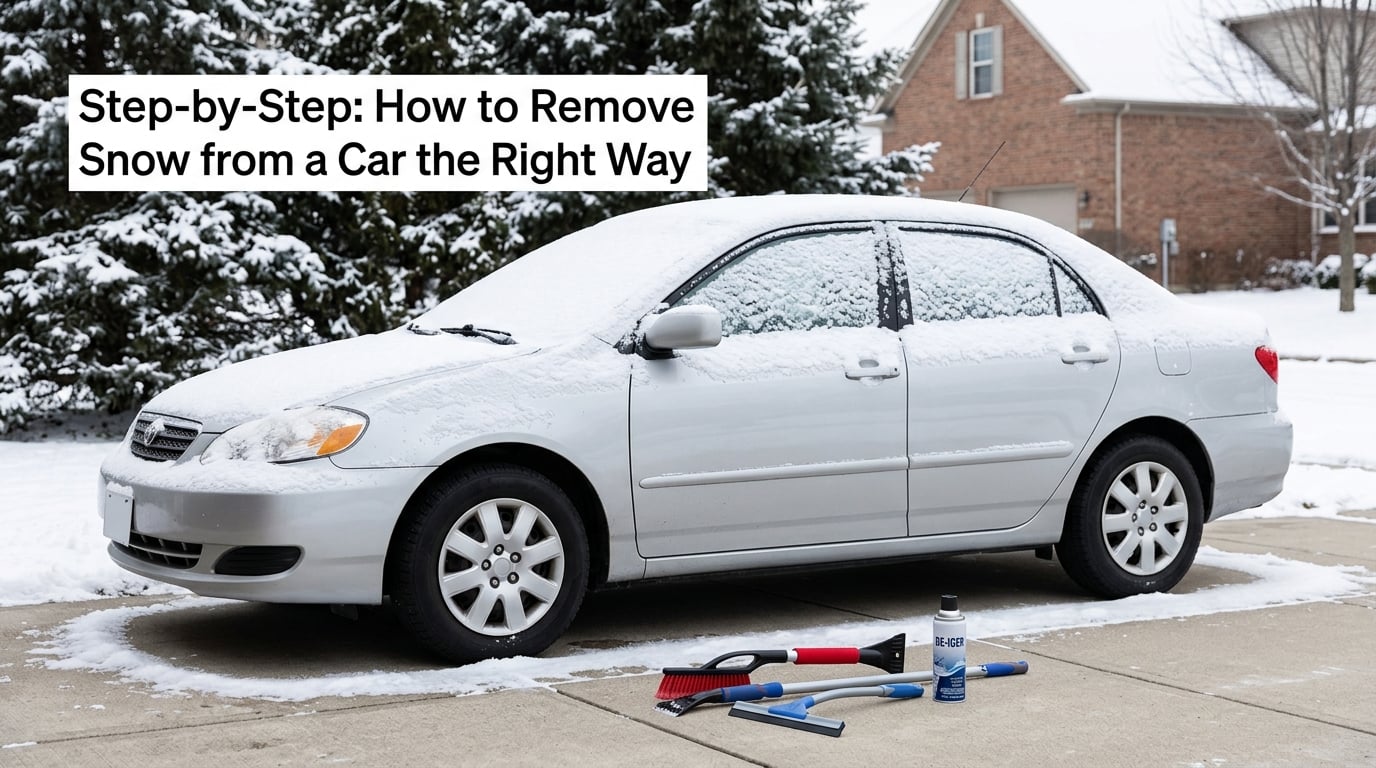
Run the defroster while you work if the glass is iced over, and start at the highest point of the car. The order below is not a suggestion. Everything you clear at the top ends up on the panels below.
Clear the Roof Before the Windshield
Push loose snow off the roof and rear window from the center outward toward the edges. Lift the brush a few inches at the far side of the roof and let the snow drop rather than flinging it forward onto the windshield you have not cleared yet.
Take your time at the edges. Snow often packs into a lip along the roof rail and the rear window channel, and that packed lip is what breaks loose and slides down the glass at highway speed. It is also the chunk most likely to chip a windshield. Break the lip free with the edge of the plastic scraper, working along the rail, not prying downward at the glass.
Clear the snow off the sunroof while you are up there too. It sits in a recessed track that tends to hold ice against the seal, and drivers find out about it when the glass stops moving.
Clear the Windshield, Side Windows, and Mirrors
Start at the edges of the windshield and work inward for loose snow, then switch to the scraper for bonded ice. Scraping from the outside edge toward the center leaves a clear stripe you can push slush into instead of pushing the slush back across glass you just made clear.
The stroke is push, then pull. Push the blade to move the pile of broken ice and slush aside, then pull the blade back to the clean section for the next cut. Scrubbing the blade back and forth in place grinds grit into the glass and is how plastic blades end up looking hazy.
Keep the blade flat and take short overlapping passes. The moment a plastic blade starts skating is usually because the ice is gone and you are still pushing, so stop once it stops cutting. Side windows and the quarter glass get the same treatment, and the mirrors get cleared last of the glass because they are small and easy to miss.
For the small areas, the lukewarm water trick works. A spray bottle of lukewarm water, or a jug held above the glass and allowed to run down, will shift a thin film in seconds. People on r/drivingUK swear by the jug for a whole car in about a minute, and the reason it works is the same as for the spray bottle: the temperature gap is small, so nothing cracks.
Brush the Hood, Trunk, and Body Panels
Snow on horizontal panels comes off with long, light strokes. On the hood, work from the windshield end toward the front edge so the snow falls off the car instead of back onto the cowl. The trunk and rear deck work the same way.
On the sides, follow the shape of the panel. Vertical doors collect less snow than the roof and hood, but they collect the most grit, so treat them gently. Brush from the beltline down to the sill rather than up, because there is nothing to push the snow toward and upward strokes only work grit into the clear coat.
Do not forget the small stuff. Snow around badges, in the gap under the door handles, on the fuel door, and around the wing mirrors is the stuff people find at the first car wash of the season, when the meltwater has carried road salt across the paint for two months.
Clear Wheel Wells, Lights, and Lower Body Areas
Packed snow in a wheel well comes out with the brush and a gloved hand. No sharp objects, no ice chisels, and nothing metal. One bent heat shield or a sliced tire sidewall costs far more than the ten minutes you saved.
Clear snow and ice from the headlights, tail lights, and license plate. A tail light or plate you cannot read is the kind of thing that gets you pulled over, and snow across the backup camera or parking sensors can make a car behave oddly when you reverse out of a driveway.
Clear the grille openings and anything clogging a sensor. Snow and ice packed into a radar sensor behind the front bumper can trigger warnings or disable features you did not know were there. Make sure the exhaust pipe and the area around it are clear before you start the engine.
Break Up Ice and Check the Car Before Driving
Once the bulk is gone, treat what is left as ice rather than snow. Spray de-icer on the remaining patches of glass and bumper plastic, give it a minute, then push the loose ice off with the scraper. Repeat once. A second pass after the de-icer has been sitting will usually take care of what resisted the blade.
Before you get in, walk the car once. Check the roof edges and the rear window for a lip of snow that will shed. Check that every glass surface is clear, not just the windshield. Check the lights and the plate. Look at the tires for a packed wedge of snow that would ride up over the tread and destroy your traction on the first block.
This is also the point to decide whether the car is safe to start. Clear tailpipe means you can start the engine to run the defroster and the heated mirrors. Snow on the exhaust, snow in the grille, or a tailpipe still blocked means you wait.
Common Mistakes
These are the moves that turn a ten-minute job into a repair bill. Each one comes with the reason it fails, because the reason is what lets you remember it in a hurry.
Scraping over grit. Once a windshield has picked up sand, salt, and road film, the scraper becomes a sanding tool. The scuffing shows up as faint circular marks once the sun hits the glass, and on painted panels the same thing is called swirl marks.
Using a metal shovel. A shovel is for the driveway. On a car it is a chip generator, and one pass across a frozen window can turn an annoyance into a replacement.
Pouring hot or boiling water. Thermal shock. Frozen glass plus near-boiling liquid equals a crack that often starts at an edge and radiates across the driver’s view. Lukewarm only.
Clearing the windshield last. Then the roof snow lands on it on the first block, and the clear job is a repeat job. Roof first, always.
Starting the car with snow still packed around the exhaust. The exhaust needs somewhere to go, and a running engine in an enclosed space is a carbon monoxide risk regardless of snow.
Using the wipers to clear snow. Wipers are not snow tools. If a blade is frozen to the glass, forcing it can tear the rubber and strain the motor, and a burned wiper motor is one of the most common winter repair claims.
Forgetting the roof and the sensors. A car that looks clear from the driver’s seat routinely has snow packed on the roof rails, behind the rear window, and over the backup camera. The clearance you need is full, not partial.
How to Remove Snow Without Scratching the Paint
The scratch risk is grit, not snow. Dry powder snow sits loosely and acts as its own cushion between the brush and the paint. Wet snow, by contrast, picks up road salt and grit, turns into something closer to wet sand, and holds that mixture against the clear coat while you brush it off.
Detailers on r/AutoDetailing deal with this by leaving a thin sacrificial layer of snow in place rather than stripping the car bare. Brush the loose top layer off, and stop while the layer underneath still covers the panel. The remaining snow keeps the bristles off the grit, and it sloughs off later with the meltwater instead of being scrubbed across the finish. It feels wrong the first time you try it, then it becomes the default on a car that lives outside.
A few more habits do the rest.
Rinse before you brush when you can. A quick blast of water from a hose or a pressure washer flushes grit off the panels and out of the wheel arches, and then the brush is moving over clean surfaces. This matters most on the lower body, where the salt and sand collect. It is also the single most useful thing you can do before a car has sat through a storm.
Watch the brush direction. Long strokes in one direction, lifting away at the end. Back-and-forth scrubbing keeps the grit trapped under the bristles for the whole stroke and doubles the number of passes it takes.
Keep scrapers and shovels off painted panels entirely. If you need to move packed snow off a body panel, use the brush. If the brush will not shift it, the de-icer and time are your options, not a blade.
Towels get a rule of their own. The towel that dried a door panel goes to the laundry, not onto the glass. A microfiber towel is not a license to rub grit into paint, and a dirty one is basically a polishing pad with bad intentions.
Then wash off what is left. Clearing snow does not clean a car. Road salt left on the finish stays there, and the same grit that was under the snow is now exposed to be dragged around by every wipe. Wash with a pH-balanced shampoo, use the two-bucket method so grit from the bottom of the bucket never returns to the paint, rinse the undercarriage where the salt collects, and dry with clean microfiber. Some people treat winter washing as optional, and it is the one that decides what the paint looks like in March.
A clay bar and a wax or sealant before the first snowfall makes next winter’s job noticeably easier. Snow and ice slide off a hydrophobic surface instead of bonding to it, and detailers point this out often. It is an autumn job, and it is the cheapest snow-removal upgrade available.
One cloudy-windshield note while we are here. If your glass has a haze that no washer fluid touches, that is usually the mineral film left behind by road salt rather than a scratched surface. A glass-specific cleaner used as directed, on a cool panel in the shade, clears it. Abrasive glass cleaners made for removing water spots are the wrong tool, because the same grit that gets the spot off is what etches the glass.
When to Use Warm Water or a De-Icer
Match the tool to the snow. Dry powder, wet heavy snow, thin ice, and thick ice are four different jobs and they do not respond to the same approach.
Dry powder snow. Brush only. No heat, no chemical, no water. It comes off in long strokes and the surface underneath stays clean.
Wet heavy snow. Brush, and use the sacrificial-layer approach. Wet snow clings, and getting underneath it too fast is how grit ends up on the finish. If a storm is still falling, clearing a car halfway can be worse than waiting, because what you cleared will just get loaded again.
Thin ice or frost on glass. Lukewarm water works and works fast. Warm water, not hot. A spray bottle is more controllable than a jug, and a jug is faster. Either way, keep the water moving and keep it off the plastic trim and the door seals, where it runs down and refreezes in the gaps.
Thick ice on glass. Scraper first, de-icer second. Mechanically breaking thick ice is faster and more predictable than waiting for a chemical, and the de-icer handles what the blade leaves behind. A plastic blade, short overlapping passes, and the push-then-pull stroke.
Warm water carries two real limits. First, the temperature gap: the glass has to be only slightly warmer than the water, or you are back to thermal shock. Second, and more mundane, warm water melts the snow and the meltwater freezes again in the door gaps, the mirrors, and the seals, which is how you create the frozen-doors problem you were trying to avoid. If you use it, dry the gaps afterward.
De-icers have limits too. Most are a salt solution, so they leave residue that needs to be washed off, and spraying them over a sensor lens or a headlight can leave a haze that distorts output. Apply to cloth and wipe the surface rather than spraying straight onto glass, lenses, or plastics, and follow whatever the label says about lens coatings. Some cars with coated or aftermarket headlights are sensitive to specific products.
On the WD-40 question that comes up a lot: it is a lubricant, not a de-icer. It will shift a thin film, and it has its own place in a garage, but it leaves an oily film on glass that catches dust and is a poor substitute for a real de-icer on a frozen windshield. The zip-lock bag of hot water trick people share on r/LifeProTips works for the same reason the jug does, with the same thermal shock warning attached: water hot enough to feel good on your hands is closer to the problem than most people think.
A tarp or cover is the best de-icer there is, because nothing sticks in the first place. It only works if it is secured, and it has to come off before you drive, because a loose cover on a moving car is a windshield hazard. A fitted cover that survives the night without flapping is the version worth owning.
Frequently Asked Questions
What is the safest way to remove snow from a car without scratching the paint?
Brush from the roof down, use a soft-bristled snow brush, and keep any scraper off painted panels entirely. Rinse grit off the body first with a hose when you can, leave a thin layer of snow in place as a cushion rather than scrubbing the panel bare, and wash road salt off afterward with a pH-balanced shampoo and the two-bucket method.
Can I use warm water to remove ice from a car windshield?
Lukewarm water is fine and fast on thin ice. Mix it roughly half and half with hot tap water, so it sits near body temperature, and use a spray bottle or a jug to run it across the glass. Never use hot or boiling water, which causes thermal shock and can crack a frozen windshield.
Should I start my car while it is still covered in snow?
Not until the tailpipe and the grille are clear of snow, since the exhaust needs a clear path and a running engine in a closed space is a carbon monoxide risk. If you start it to run the defroster and heated mirrors, do it before you begin brushing, and never leave the car idling unattended or in a closed garage.
How much snow is safe to leave on the roof before driving?
Clear it. Snow on the roof and rear window can slide onto your windshield as you brake, and it sheds onto the car behind you at speed. Break up any packed lip along the roof rail before driving, since that hard chunk is what breaks loose and chips glass.
What is the best way to clear ice without damaging a car window?
Use a plastic or copper-blade scraper, not metal, in short overlapping passes. Push slush aside, then pull the blade back to the clear section, and work from the windshield edges inward. Stop when the blade stops cutting, and use lukewarm water or de-icer for the film that remains.
Do I need to remove snow from around sensors and cameras?
Yes. Packed ice on a parking sensor or radar sensor behind the front bumper can trigger warnings or disable features, and snow across a backup camera makes reversing unreliable. Clear snow from headlights, tail lights, the license plate, grille openings, and anything you cannot see into before you pull away.
The job in its shortest form: clear the roof and the lip along the roof rail first, brush the body panels from the top down, then take the glass with a plastic scraper using short overlapping strokes, and finish with lukewarm water or de-icer for whatever the blade did not clear. Check the tailpipe before you start the engine, walk the car once before you pull out, and wash the salt off when the weather breaks.
A clay and wax before the first snowfall makes next winter’s job noticeably shorter, and that is a better return than any gadget in the trunk.