
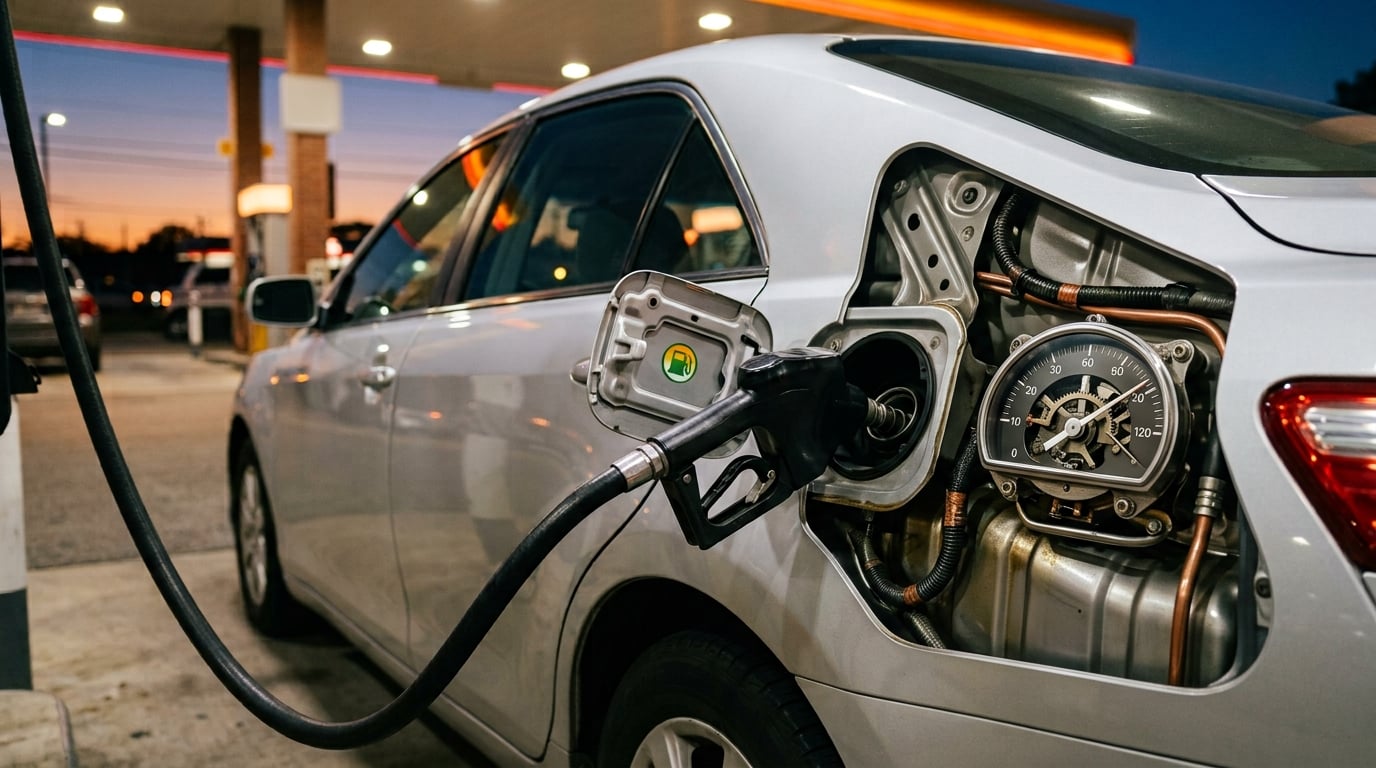
Putting regular gas in a premium car is usually harmless for a single tank. The engine control unit pulls spark timing to prevent knocking, so you notice a little less power, a small drop in fuel economy, and sometimes a rattle under hard acceleration. Damage comes from repeating that for months, not from one mistake.
Updated for 2026. The short version below applies to most modern cars with a fuel door sticker calling for 91 or 93 octane.
Table of Contents
- Can Regular Gas Damage a Premium Car?
- What Is the Difference Between Regular and Premium Gas?
- How Much Regular Gas Is Usually a Problem?
- What Should You Do After Using Regular Gas?
- When Is an Engine Repair Needed?
- Does Premium Fuel Make the Car Faster or Cleaner?
- Frequently Asked Questions
- What to Do First
Can Regular Gas Damage a Premium Car?
One accidental fill-up will not wreck a modern engine. Every car built in the last few decades has knock sensors and a controller that watches combustion, so the failure mode is slower performance rather than a broken engine.
Here is how the protection works. Lower octane fuel ignites under pressure more easily, which can start burning before the spark plug fires. A knock sensor, basically a microphone bolted to the block, picks up the high-frequency vibration that abnormal combustion creates. The controller responds by retarding spark timing, moving the ignition earlier relative to the piston so the burn is gentler.
That is the whole safety net. It works, and for a tank or two of regular fuel it works well. What you pay is measured in spark advance, and that is where horsepower lives.
What regular gas will not do to most modern engines: destroy them instantly, ruin the catalytic converter from a single tank, or damage the fuel pump. What it can do over time, especially in a turbocharged or high-compression engine driven hard, is keep the engine in a state of constant timing retard.
Enthusiast forums split on whether knock sensors are a genuine safety net or a damage meter. Both camps describe real behavior, just at different points in the sequence. A knock sensor reacting is the ECU seeing combustion noise in time to react, and a professional tuner on a Mustang forum described stock knock retard as costing power rather than engine life. A worn or damaged knock sensor is a different story, and that is a mechanical fault to diagnose, not an octane problem.
What Is the Difference Between Regular and Premium Gas?
Octane rating measures one thing: how resistant the fuel is to detonating under compression. It is a knock resistance number, not an energy number, not a cleanliness number, and not a horsepower number.
Regular unleaded is typically 87 octane. Premium is usually 91 or 93, and 93 is a step up from 91 rather than a different fuel entirely. Higher octane fuel does not contain more energy per gallon, so on a car that does not need it, you are simply paying more for the same combustion.
What premium is for is engines that run higher compression ratios or higher cylinder pressure. A turbocharged engine, a modern naturally aspirated V8 with a 12:1 or higher compression ratio, and most performance sedans are designed around fuel that will not light off too early. Give those engines 87 and the ECU has to work harder to keep the burn controlled.
Now the part that trips people up. Read the fuel door sticker and the fuel section of the owner’s manual, because the wording matters more than the grade number.
| What the manual says | What it means | Regular fuel risk |
|---|---|---|
| Premium fuel required | The engine was calibrated around higher octane and the manufacturer expects that grade | Timing retard, knock under load, reduced power; extended use raises the odds of real damage |
| Premium fuel recommended | Regular will run, but the engine is tuned to make more power or smoother on premium | Minor hesitation and a small economy drop; no damage expected |
| Unleaded regular only | The vehicle was never designed for higher octane | No issue from using regular; higher octane adds nothing |
Some cars list an acceptable range, such as 87 minimum with 91 preferred. That is a different situation from a hard requirement, and it is worth knowing which one you own before you panic.
What Happens to Performance and Fuel Economy?
Timing is the throttle. Advance the spark and the burn happens closer to the top of the stroke, where pressure helps you make more work from the same fuel. Pull timing back and the engine makes less.
Enthusiast datalogs on a high-output naturally aspirated V8 put the loss at roughly 5 to 10 horsepower per degree of timing pulled, with an overall drop in the 40 to 50 horsepower range when the car is running 87 instead of 93. A tuner on a Mustang forum also noted that a knock event near redline can take a few seconds of recovery before spark comes back, which is why the car feels like it hesitates and then picks up.
Fuel economy moves too. Retarded timing, a richer air-fuel mixture under knock retard, and a longer burn all cost you miles per gallon. Expect a small percentage drop, not a collapse.
How much you feel depends on the engine and the driving. A low-compression naturally aspirated four-cylinder on 87 might barely register it. A turbocharged six under load will knock early and often, because boost raises cylinder pressure and cuts the margin for error.
How Much Regular Gas Is Usually a Problem?
Think in terms of how much of the tank is actually wrong and how hard you drive it.
| Situation | What you will notice | What to do |
|---|---|---|
| A small amount, a gallon or two in a full tank | Probably nothing at all | Fill up with the specified grade on the next stop |
| A partial tank, half regular or mixed | Mild knock on hard acceleration, slightly softer response, a point or two of economy | Top off with the specified grade now, drive gently until the tank is replaced |
| A full tank of regular, driven normally | Persistent knock, hesitation, rough idle, a check-engine light if the misfire is severe enough to register | Fill the tank completely with the specified grade, avoid towing and hard acceleration, then watch for warning lights |
The driving style matters as much as the volume. Gentle cruising on a full tank of 87 in a naturally aspirated engine is far less demanding than repeated wide-open-throttle pulls up a highway on grade.
What Should You Do After Using Regular Gas?
Work through these in order, and the risk drops to almost nothing.
- Check the fuel door sticker and the fuel section of the owner’s manual. That tells you whether premium is required or merely recommended, which changes how worried you should be.
- Note the tank level and any symptoms. If the car feels slower, rattles under acceleration, or idles rough, write down what you heard and when. That detail matters to a technician later.
- Refill promptly with the specified grade. If half a tank is regular, adding the same amount of premium gives you roughly a mid-grade blend for the rest of that tank, which is usually fine for the drive home.
- Drive gently until the tank is fully replaced. Skip hard acceleration, high rpm, towing, and steep grades. You are giving the engine the least demanding conditions possible while the wrong fuel burns off.
- Watch for a check-engine light and any new noise. A light that stays on after a full tank of the correct fuel needs a scan. Owners who ran regular for months report check-engine lights and emissions codes tied to the catalytic converter, along with carbon build-up on intake valves in direct-injection engines.
- Do not add additives on your own. An octane booster can raise the effective octane of what is already in the tank, but additives in modern direct-injection engines can add deposit risk. Fixing the fuel level is cleaner than treating the fuel.
What Happens if You Put Regular Gas in a Premium Car and Keep Driving?
Short term, you are living with less spark advance than the engine wants. The pinging or rattling noise most drivers describe is the abnormal combustion the ECU is fighting, and it usually shows up on acceleration or when the engine is under load rather than at idle.
Hesitation on hard acceleration and a rougher idle come next. If a cylinder is misfiring badly enough, the check-engine light can come on with a misfire code, and running a misfire long enough can damage the catalytic converter. That is the scenario worth paying attention to, and it is also the one that usually resolves after a tank of the correct fuel and a key-on reset.
The real danger is repetition. An engine that spends months in knock retard is working harder for less output, burning a richer mixture, and running hotter in the exhaust. Owners who ran regular as a habit report emissions faults and deposit issues, and they report warranties getting harder to argue about when the manual says required.
None of that is a reason to panic about a single tank. It is a reason to go back to the grade on the sticker.
When Is an Engine Repair Needed?
Most octane-related symptoms clear up on their own once the correct fuel is in the tank and the old fuel is burned through. That is the normal case, and it does not call for teardown.
Get a technician involved when the warning does not go away. A check-engine light that stays on after a full refill, especially with a stored misfire or knock code, means something needs a scan rather than a guess.
Other reasons to book a look: heavy knocking that continues at steady throttle and low load, a real loss of power that does not come back, overheating, a fuel smell at the filler, or a hissing sound near the tank. Signs like a hard metallic clatter at idle, a run-on that keeps firing after you shut the engine off, or damage found around the spark plug threads point to pre-ignition from a hot spot or heavy carbon, and that is a repair.
Diagnostic work for suspected knock damage usually starts with a compression test, a borescope look at the cylinder walls and piston, and a datalog of air-fuel load, lambda values, and timing. Bring the symptom notes you made in step two. They cut the guesswork more than anything else you can hand the shop.
Does Premium Fuel Make the Car Faster or Cleaner?
No, not on its own. Higher octane does not add energy, so on an engine that does not need it, the car will not go faster and the tank will not stretch.
It also does not clean anything. Premium is not a detergent, and it will not clear carbon off intake valves. Carbon on direct-injection valves comes from how the fuel is delivered, and additives have their own tradeoffs.
What higher octane actually does is let the engine run the spark timing the engineers designed for, which is where the power and the smoothness come from. On a car whose manual specifies premium, that is the point. On a car that only recommends it, the difference is a small gain you may never notice.
So the answer to whether premium makes a car faster or cleaner is no. It makes an engine that was designed for premium run the way it was meant to run, and on a car that was not, it mostly just costs more.
Frequently Asked Questions
Will one tank of regular gas ruin a premium-fuel engine?
Almost certainly not. Modern engines have knock sensors and a controller that retards spark timing before abnormal combustion can do damage. You may notice less power, slightly worse fuel economy, and some pinging under hard acceleration. Fill the tank with the grade on the fuel door sticker and the symptoms usually go away once the old fuel is burned through.
Can I mix regular and premium gasoline in the same tank?
Yes, gasoline of different octane grades mixes without issue. Blending 87 and 93 gives you something in between, and if a half tank of regular is topped off with the specified grade you get a workable mix for the drive home. Blending does not clean the fuel system or protect you long term, so refill fully with the correct grade as soon as practical.
How do I know if my car is experiencing fuel knock?
Knock sounds like a brief metallic rattle or ping, most noticeable when you accelerate hard or climb a steep grade at low engine speed. It is different from a steady ticking valve train noise because it comes and goes with load. If the sound continues at a steady cruise, or comes with a check-engine light, have a technician look at it rather than driving on it.
Should I replace the fuel pump after using the wrong gasoline?
Almost always no. A knock sensor reacting is a controller doing exactly its job, and a worn or damaged knock sensor is a separate mechanical fault that gets diagnosed on its own merits. Replacing a fuel pump because of one tank of 87 is a costly answer to a problem that usually resolves with a correct refill. Have the pump tested if you have symptoms that persist.
Can premium gas improve gas mileage?
Premium holds no more energy per gallon than regular, so it cannot stretch a tank on a car that does not need it. On a car that requires higher octane, the engine gives back some of the power and economy it loses to timing retard, so the two grades end up closer than the price gap suggests. On a car that only recommends premium, the difference is small enough that most drivers never notice it.
What to Do First
Open the fuel door, read the sticker, and put in the grade it names. If the tank is part regular, fill it completely so the blend is washed out, and keep the next drive easy until it is done.
Then listen. A little knock on hard acceleration that fades after a correct refill is expected. A check-engine light that stays on, a knock that will not quit, or a loss of power means a technician and a scan, not more guessing at the pump.