
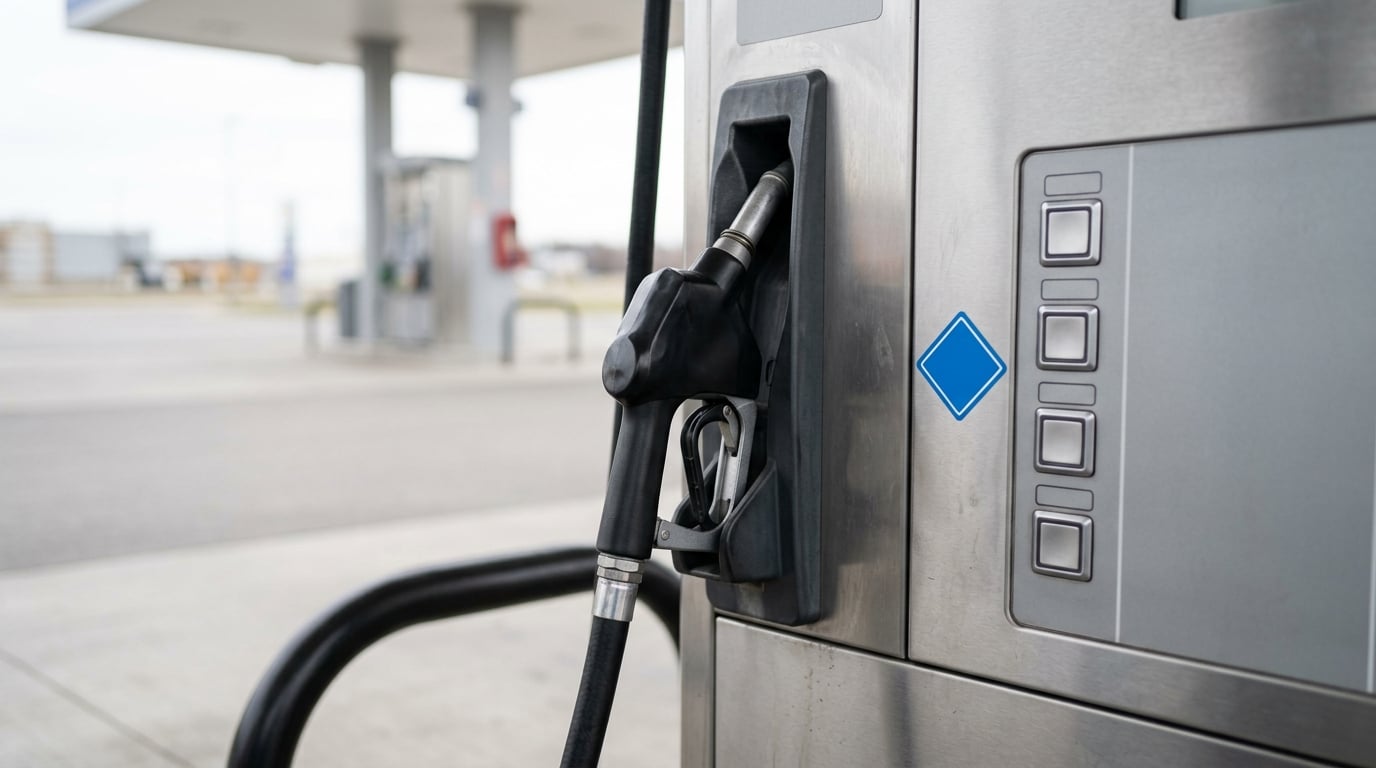
What is top tier gasoline? It is a fuel performance standard set by a group of automakers, not an octane grade. TOP TIER gasoline carries more detergent additive than the federal minimum requires, and because every octane at a participating station carries it, the standard costs you nothing extra at the pump.
That last point trips up almost everyone who sees the logo for the first time. The decal on the pump is not telling you to buy premium. It is telling you the fuel in that dispenser was formulated to a stricter cleanliness spec set by the people who built your engine.
Two separate ideas get tangled together in this topic: the detergent standard and the octane number. Once you can tell them apart, choosing fuel at the pump takes about ten seconds.
Table of Contents
- What Is Top Tier Gasoline?
- What Does the Octane Number on the Pump Mean?
- Does Higher Octane Gasoline Give More Power and Better Fuel Economy?
- How Do You Find the Right Gasoline Grade for Your Car?
- Will Premium Gasoline Protect a BMW Engine?
- Why Deposits Build Up Faster in Modern Engines
- Which Brands Sell TOP TIER Gas and How to Find One
- Is Top Tier Gasoline Worth the Extra Cost?
- What Can Cause Engine Knock With the Wrong Fuel?
- What Should You Do If Your Car Prefers a Higher Octane Fuel?
- Frequently Asked Questions
- The Right Fuel Starts With the Manual
What Is Top Tier Gasoline?
TOP TIER gasoline is a fuel performance standard that requires a higher level of detergent additives than the U.S. government minimum, established by leading automakers to keep modern engines free of carbon deposits.
Here are the facts worth holding on to:
- Cleaner engines: the extra detergent additive is formulated to hold carbon away from fuel injectors, intake valves, spark plugs and the combustion chamber walls.
- Not an octane rating: TOP TIER says nothing about knock resistance. An approved 87 octane fuel still burns exactly like any other 87.
- Set by automakers, not regulators: Audi, BMW, Ford, General Motors, Honda, Toyota, Volkswagen, Mercedes-Benz, Subaru, Stellantis and Daimler Truck back the program. The EPA does not set it and does not audit it.
- No added cost across every octane: if a station sells TOP TIER, it carries it in regular, mid-grade and premium at the same per-gallon price as its non-approved equivalents.
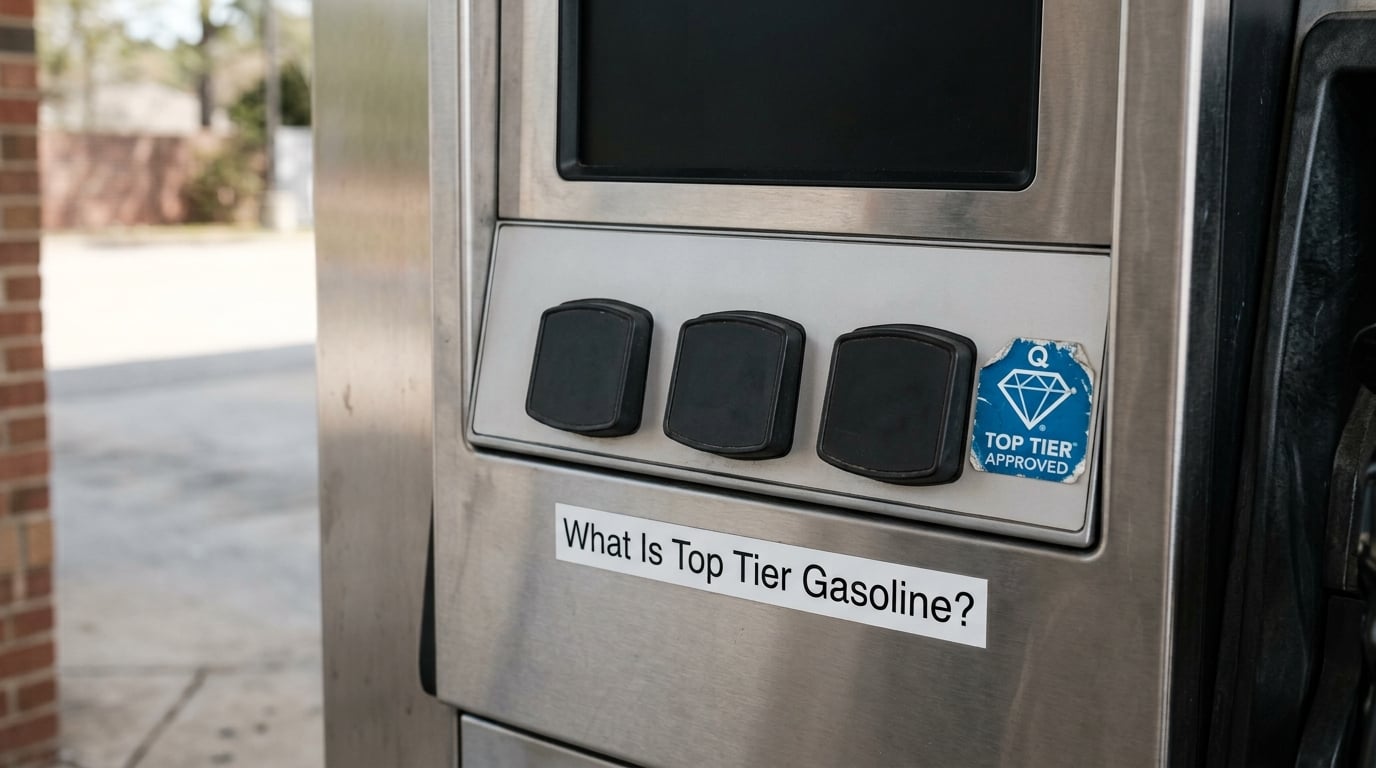
- Easy to verify: the logo appears on the pump, the door and often the window, plus there is an official station finder and a mobile app.
The federal minimum comes first. Since 1996 the EPA has required all U.S. gasoline to contain enough detergent to control deposits. That rule was written for port-injected engines of the era, and it never anticipated direct fuel injection feeding injectors in the cylinder, or turbochargers cranking up cylinder pressure well past what the old baseline assumed.
One more myth to kill early: TOP TIER is not the same thing as ethanol-free. A TOP TIER gasoline can absolutely contain ethanol. The two labels describe different properties, and plenty of stations sell approved fuel with ethanol in it.
Diesel is a separate program with its own approvals and its own station list. Not every location that dispenses TOP TIER gasoline dispenses approved diesel, so check the diesel finder separately if that is what you drive.
What Does the Octane Number on the Pump Mean?
Octane measures how resistant a fuel is to knock, the uncontrolled ignition that happens before the spark plug fires. It is a knock-resistance rating, nothing else. Higher octane does not mean more energy per gallon, and it has no relationship to how clean the fuel burns.
Two numbering systems cause the confusion. Outside the US, fuels are labeled with the Research Octane Number. In the US, pumps show the Anti-Knock Index, which is the average of the research octane number and the motor octane number. That is why a fuel called 95 RON at a European pump shows up as roughly 91 on an American pump, and why 93 AKI in the US is about 97 or 98 RON abroad.
| Fuel grade | Typical US pump label (AKI) | What it controls | TOP TIER available |
|---|---|---|---|
| Regular | 87 | Knock resistance only | Yes, at the same per-gallon price |
| Mid-grade | 89 | Knock resistance only | Yes, at the same per-gallon price |
| Premium | 91 or 93 | Knock resistance only | Yes, at the same per-gallon price |
| TOP TIER program | Not an octane grade | Detergent additive level and deposit control | Applies across all three grades above |
Grades and formulations vary by market and by station, so treat the table as the shape of the system rather than a promise about what a specific pump in a specific town sells.
The practical takeaway: octane tells you whether the fuel resists knock in your engine, and the detergent standard tells you whether the fuel is formulated to keep parts clean. A driver can buy approved 87 and get every deposit benefit, with no need to move up a grade.
Does Higher Octane Gasoline Give More Power and Better Fuel Economy?
Sometimes, but not because the fuel contains more energy. An engine makes more power when it can advance ignition timing or hold more boost without knocking, and higher octane unlocks that on engines tuned to use it. On an engine designed for 87, the same fuel gains you nothing and the timing computer will never ask for it.
Fuel economy works the same way in reverse. If an engine knocks lightly on 87, the ECU retards timing to protect it, and you lose efficiency. Correcting that with the specified octane is where a real mileage difference shows up, most often on turbocharged or high-compression engines.
What neither grade nor premium packaging does is clean your engine, remove existing carbon, or add power on its own. That is the detergent’s job, and it is a separate axis entirely.
How Do You Find the Right Gasoline Grade for Your Car?
Read the fuel door, then confirm in the owner’s manual. Not the badge, not what your neighbor runs, not what the car feels like. The fuel door sticker lists the minimum octane the engine was calibrated for, and the manual gives the full picture including any premium recommendation for load or weather conditions.
A workable decision sequence:
- Everyday commuting: fill with whatever the fuel door specifies, and pick the approved station when the detour is short. Deposit protection is cumulative, not urgent.
- Towing or sustained load: use the grade the manual recommends for heavy load, usually one step up. Knock risk climbs with cylinder pressure and heat, and a loaded trailer on a grade adds both.
- Mountain driving and sustained high speed: thin air and long climbs raise knock tendency. Many manuals call for premium in exactly these conditions even if regular is fine at sea level.
- Track or competition use: follow the manufacturer or tuner specification, which may exceed the premium grade on the pump.
What Is Top Tier Gasoline in AKI Terms?
In AKI terms, TOP TIER gasoline is available in 87, 89, 91 and 93, depending on what the station stocks. The program does not specify a grade because it is not a grade. Typical US premium grades run 91 or 92 AKI, and exact availability and labeling shift by market and station, so check the pump rather than assuming.
Will Premium Gasoline Protect a BMW Engine?
Not by itself. What protects a BMW engine, or any engine, is fuel that meets the octane the tune was calibrated for plus a detergent package strong enough to keep the hardware clean. Turbocharging, high compression and direct injection all raise the stakes, and BMW manuals commonly list a minimum octane and recommend a higher one under load.
The mistake to avoid is running premium in a car specified for regular and assuming the engine is protected. You get the octane the car never needed and none of the detergent benefit. Premium does not substitute for maintenance either: oil changes, spark plugs, coils and injectors still matter more than the pump choice.
Why Deposits Build Up Faster in Modern Engines
Direct injection moved the fuel injector from the intake port into the cylinder. From there, the injector is repeatedly bathed in combustion gases, and a single sticking or partially clogged injector cylinder misfires badly enough to foul a spark plug. On turbocharged engines the same hardware runs hotter, which speeds the whole process.
AAA testing published in 2016 examined gasoline meeting the TOP TIER standard against fuel meeting only the EPA minimum, and found the approved fuels left about one nineteenth the deposit on injectors, intake valves and in the combustion chamber. Consumer Reports has reported a related 2% to 4% fuel economy penalty in the non-approved case, and higher emissions. Both figures come from that era of testing, and no independent re-test has displaced them as the commonly cited numbers.
This is also the case that the skeptics rarely make, and they are not wrong to raise it. Deposits accumulate slowly, a healthy engine makes minor efficiency losses hard to feel, and plenty of cars run for 150,000 miles without a cleaning. The program is preventive, not corrective. What it is doing is removing a variable you can control for no extra money.
Which Brands Sell TOP TIER Gas and How to Find One
Costco fuel is approved, which is why so many owners ended up using it without choosing to. Approved fuel also turns up at a range of other chains, including stations carrying Shell, Chevron, Exxon, Mobil, 7-Eleven, Circle K, Arco, Wawa, Sheetz and QuikTrip in some markets. Approval attaches to the specific station, not automatically to every location of a brand, so confirm before you rely on it.
Three ways to check:
- Look for the decal on the pump face, the door or the window.
- Use the official TOP TIER station finder or the mobile app, which is the authoritative list and updates as retailers change.
- Ask at the counter whether all three grades at that location are approved, since some stations carry it in only certain dispensers.
Worth noting: because approval is not tied to grade, switching stations changes the detergent package without changing your octane. You can stay on 87 forever and still get the full benefit.
Is Top Tier Gasoline Worth the Extra Cost?
At an approved station there is no extra cost to weigh. The per-gallon price of approved 87 matches the station’s regular, so the decision is a matter of convenience. If the nearest approved station is a ten-minute detour versus a convenience store, that is the only trade in play, and for most commuters paying it once or twice a month is a reasonable bill for deposit protection.
For anyone buying up a grade, the honest comparison is different. Figure your monthly fuel use first: your typical monthly miles divided by your real-world miles per gallon gives gallons. Multiply that by the per-gallon gap between grades shown on the pump. A driver doing 500 miles a month at 25 mpg uses about 20 gallons, so a small per-gallon difference becomes a small monthly one. Now compare it to what a single intake valve or injector cleaning costs, which is a different order of magnitude.
Who does not need to bother switching: an older carbureted car, a short-commute driver on a tight budget, and anyone whose nearest approved station is a genuine hassle. The standard is preventive. If you cannot get to the fuel consistently, using it when you can is still better than never.
What Can Cause Engine Knock With the Wrong Fuel?
Knock has more causes than octane, and blaming the fuel is usually the last thing to try rather than the first.
- Octane below specification: the simplest cause, and the one the ECU can partly compensate for by retarding timing until it cannot.
- Carbon deposits: a buildup on piston crowns or combustion chamber walls raises pressure and temperature enough to ignite fuel early.
- Ignition timing or a failing knock sensor: a sensor giving bad readings can make a healthy engine knock on fuel it should never knock on.
- Wrong or worn spark plugs: wrong heat range, fouled tips or worn electrodes change the ignition event itself.
- Overheating or low coolant: a cooling problem turns an engine designed for 87 into one that knocks on 87.
- Mechanical wear: worn piston rings, a failing injector or low compression from a blown head gasket all read as a fuel problem at first.
Stop driving and get it looked at if you hear a hard metallic ping under load, see the check engine light with a knock-related code, feel a loss of power, or see the temperature needle climb. Untreated knock can damage pistons and pins, and continuing to drive to save a tank of fuel is a bad trade.
What Should You Do If Your Car Prefers a Higher Octane Fuel?
Work in this order:
- Identify the required grade from the fuel door and the owner’s manual, including the premium recommendation for load or altitude.
- Use that grade consistently for a full tank, then another. The ECU adapts, and the fuel in your tank is what the test is measuring.
- Track economy and driveability over three or four fills. Most cars on the wrong octane will not show an obvious change, which is exactly the point of the earlier sections.
- Investigate persistent knock rather than climbing the octane ladder indefinitely. If a stated 91 knocks cleanly, the problem is not 93.
For long-time users of non-approved fuel, do not go hunting for a carbon cleaning right away. Switch to an approved station, give it a few thousand miles, and see whether throttle response and economy come back on their own. Most drivers notice nothing, which is a good outcome. If the engine runs rough at idle, smokes, misfires or rattles, that is a mechanical conversation, not a fuel one.
Frequently Asked Questions
What is top tier gasoline?
TOP TIER gasoline is a fuel performance standard, not an octane grade. Participating retailers supply gasoline containing more detergent additive than the U.S. EPA minimum, a baseline set in 1996. The standard was developed by automakers including BMW, Ford, Honda, Toyota and General Motors to reduce carbon deposits on fuel injectors, intake valves, spark plugs and combustion chamber walls. It is offered in every octane at no added cost per gallon.
Is 93-octane gasoline the same as 93 AKI?
They are different measurement scales, so 93 AKI is not the same as 93 on a European pump. U.S. pumps show the Anti-Knock Index, the average of the research octane number and the motor octane number. Fuels labeled by research octane number elsewhere run roughly two points higher, so a 95 RON fuel appears as about 91 AKI in the United States. Know which label your pump uses before comparing numbers.
Does using premium gas make an engine more powerful?
Only on an engine tuned to take advantage of it. Higher octane resists knock, which lets the engine advance ignition timing or hold more boost, and that can produce more output. On an engine specified for 87 octane, the engine computer never requests the extra capability and you get no measurable change. Premium also adds no energy per gallon, so it cannot add power on its own.
Can premium gasoline improve fuel economy?
Sometimes, and indirectly. When an engine knocks lightly on a lower grade, the ECU retards timing to protect it, and that costs efficiency. Filling with the specified grade lets timing return to normal, and Consumer Reports has reported differences of roughly 2% to 4% in that situation. Premium fuel does not clean an engine or remove existing deposits, and it will not improve economy in a car that never needed it.
What octane does my BMW require?
Check the fuel door label on the filler neck and the specifications section of the owner’s manual for the exact model and year, since tune requirements changed across generations and engines. Many BMW models list a minimum regular octane with a premium recommendation for sustained high-speed, mountain or fully loaded driving. Turbocharged and high-compression engines are the ones most likely to knock on regular, and that is a tune issue rather than a fuel quality issue.
The Right Fuel Starts With the Manual
Open the fuel door and read the octane label. That sticker, confirmed against the owner’s manual for your exact model, is the answer to what your engine needs, and no forum thread, badge or pump logo outranks it.
Fuel that meets that octane at a station carrying the TOP TIER detergent standard gives you the whole package, at the regular per-gallon price, in every grade. Step up a grade only when the manufacturer recommends it or when a knock problem under load tells you to. Start there on the next fill-up and you will have answered the question for good.