
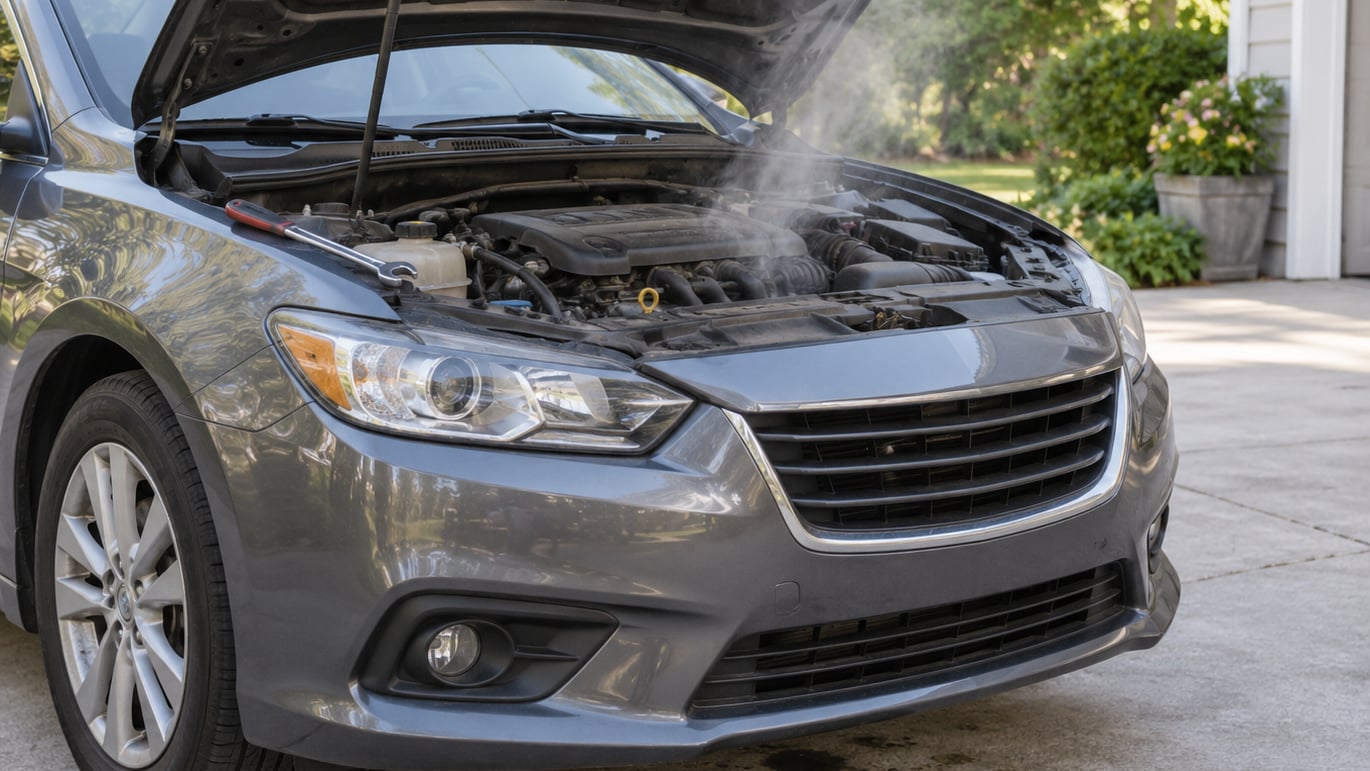
Short answer: a burning oil smell almost always means engine oil is escaping somewhere and touching a surface hot enough to vaporize it, usually an exhaust manifold or the pipes under the car. On most cars the first suspect is a leaking valve cover gasket or oil filter housing gasket. A tiny drip is enough to make the whole cabin smell, and on some engines you will never find oil on the ground because it burns off the hot metal before it drops.
There is a short list of things worth checking before you assume the worst, and most of them take five minutes with the car cold and parked on level ground. This guide covers how to tell the causes apart, which ones you can safely inspect yourself, and which ones mean you shut the engine off now.
Table of Contents
- Is a Burning Oil Smell Normal?
- What Does Burning Oil Smell Like?
- What Causes a Car to Smell Like Burning Oil?
- Is It an Oil Leak, Burning Oil, or Exhaust Problem?
- What Should You Check First?
- Can You Drive With a Burning Oil Smell?
- How to Fix the Most Common Causes
- BMW and European-Car Considerations
- Frequently Asked Questions
- Can my engine be damaged if it smells like burning oil?
- Is it safe to check the oil dipstick when the engine is hot?
- Why can I not find the oil leak under my car?
- Is it safe to degrease an engine bay with a burning-oil smell?
- Should I drive to a mechanic if the oil smell returns after adding oil?
- When does a burning-oil smell mean the car needs a tow?
- Bottom Line: What to Do First
Is a Burning Oil Smell Normal?
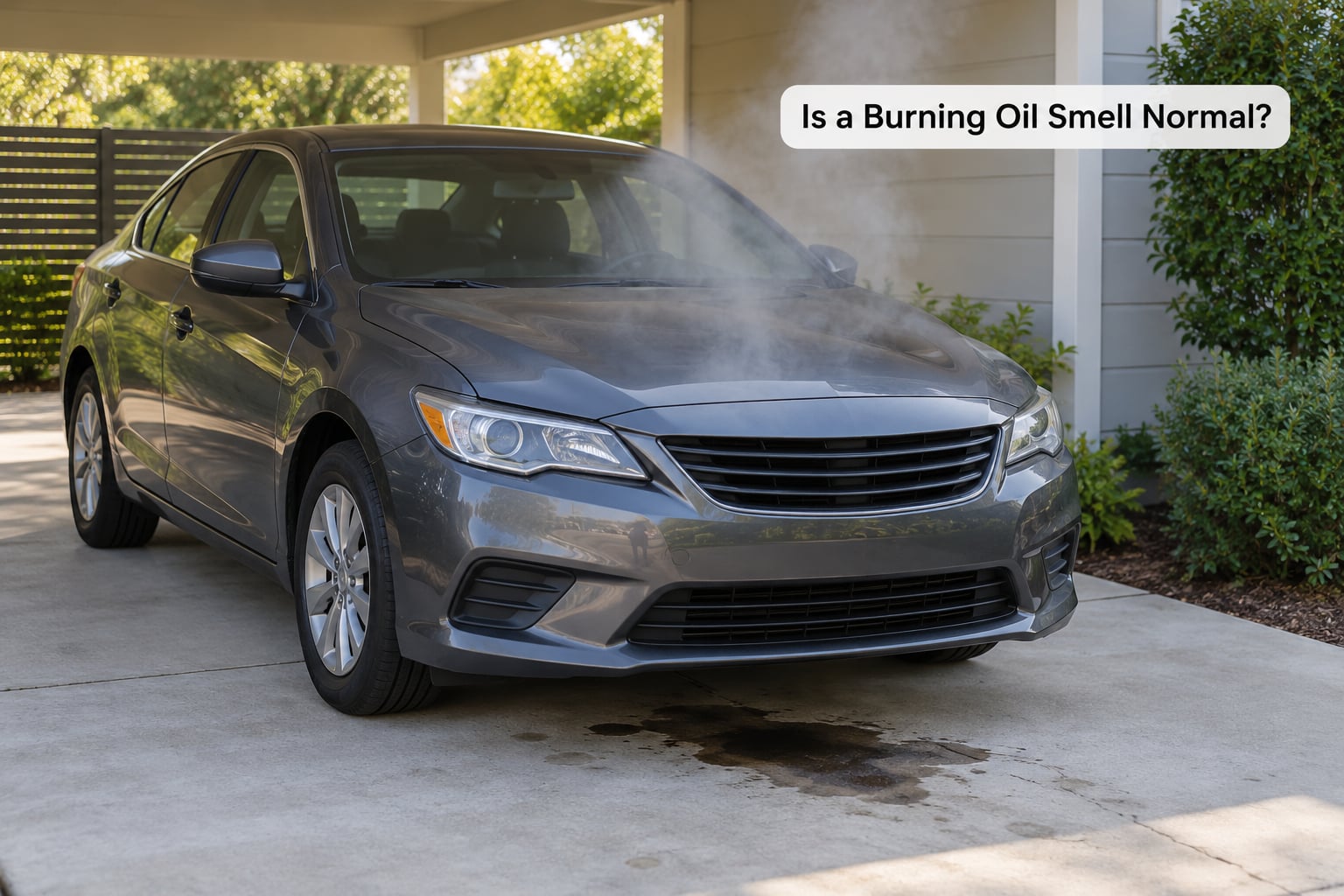
No, not as an ongoing condition. A persistent burning oil smell is not something a healthy engine produces, and it is not something to get used to.
One exception is genuinely harmless. If the smell shows up right after an oil change, an oil filter swap, or a repair visit, extra oil may have been spilled onto the engine block, exhaust, or heat shields and is now cooking off. That scent fades on its own, usually within a few drives, and it does not come back.
Treat anything else as a fault to find. Oil that reaches a 400-degree surface burns and produces a thin acrid vapor, and that vapor travels. Some of it gets pulled into the cabin through the fresh air intake at the base of the windshield, which is why the smell can be strongest inside rather than under the hood.
What Does Burning Oil Smell Like?
Burning oil smells hot, sharp and slightly chemical, like a hot chain or hot metal coated in oil. It is heavier and greasier than exhaust fumes and far more unpleasant than a dusty cabin filter. When it is coming through the vents, people often describe it as a plastic or burnt-cheese note, especially at low speed.
Other smells get mistaken for it constantly. Brake dust smells sharp and metallic, and it appears after braking or on a cool morning rather than at idle. A burnt rubber smell comes from a slipping belt, a tire rubbing a fender liner, or a seized brake. Fuel smell is raw and volatile, and it is loud and immediate rather than a slow build. Coolant or antifreeze smells sweet and syrupy. Exhaust fumes are odorless and mostly carbon monoxide, which is the reason a smell-free cabin is not proof that nothing is wrong.
| What you notice | Likely source | Where you sense it | First thing to check |
|---|---|---|---|
| Acrid hot smell, no visible smoke | Oil hitting a hot exhaust or heat shield | Cabin and front of hood | Valve cover and oil filter housing gasket |
| Sweet smell, stained residue near a hose | Coolant leak | Strong at front of car, in cabin | Radiator hoses, water pump weep |
| Metallic smell after braking or cold start | Brake dust | Near the wheels | Brake pads and rotors |
| Sweet or fishy after a fill-up | Spilled fuel or a leaking fuel line or injector | Near the tank and along a rail | Fuel line fittings |
| Blue or thick gray exhaust smoke | Oil burning inside the engine | Behind the car | Valve stem seals, piston rings |
| Raw exhaust rattle | Exhaust leak ahead of the cabin | Loudest at idle, louder when cold | Manifold gasket, flex pipe |
What Causes a Car to Smell Like Burning Oil?
These are the causes, roughly in the order I would look at them.
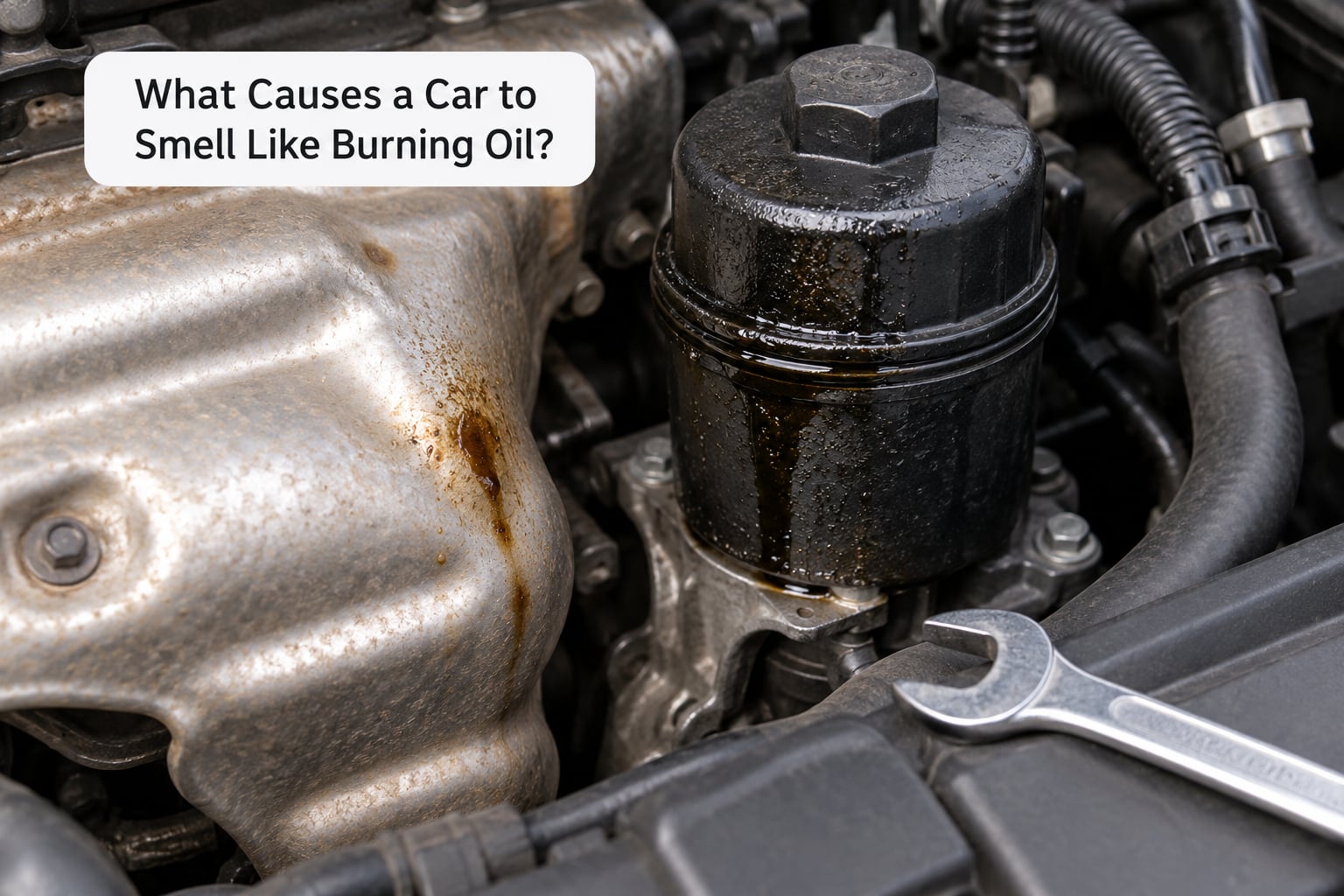
Valve cover gasket leak. The valve cover sits on top of the engine and its rubber or plastic gasket seals the oil underneath. When that gasket hardens, oil seeps out and runs down onto the exhaust manifold, which sits close and gets extremely hot. Members of r/e46 and r/MechanicAdvice both point to this as the number one suspect for a smell that appears with no oil on the ground.
Oil filter housing gasket or cap. On many cars the filter sits in a housing with its own seal, and that seal is just as likely to go as the valve cover gasket. On a lot of German cars it is the more common failure of the two.
Loose filter or drain plug, or an oil filter installed dry. A filter that went on without a coat of oil on its gasket can weep immediately. A drain plug left slightly loose shows up as a smell within days of a service visit.
Oil spilled during a recent service. A fresh drip trail that fades after a few drives is a spill, not a leak. Wisco Automotive makes the same point in their write-up: oil dropped during the last oil change burns off and creates a temporary smell that looks alarming and resolves itself.
Oil pan, front or rear main seal damage. A warped pan or a failed main seal lets oil fall onto the exhaust or the driveshaft tunnel. You will often find a puddle under the car rather than a smell alone.
Crankcase pressure pushing oil past a seal. The engine breathes through the positive crankcase ventilation system. When the PCV system is restricted or a hose has collapsed, pressure builds inside the crankcase and it forces oil out at the weakest seal it can find. A stuck or clogged PCV valve is a common trigger, and it also drives oil burning on its own.
Oil filter housing and aftermarket catch cans. An oil catch can that is mounted or plumbed incorrectly can vent oil onto the exhaust, and a poorly sealed aftermarket part is a common self-inflicted version of this problem.
Oil burning inside the engine. Oil past worn valve stem seals or down worn piston rings burns in the combustion chamber with the fuel. The tell is exhaust smoke, plus faster than normal oil consumption between changes.
Not oil at all. Transmission fluid or power steering fluid on an exhaust pipe smells very close to burning oil, and several auto service write-ups include it for that reason. Check the fluid color and whether that system is low before you chase a gasket.
Why Does My Car Smell Like Burning Oil After Driving?
Cold metal does nothing with oil. Hot metal vaporizes it, and the vapor is what you smell. That is why the smell usually shows up ten minutes into a drive rather than at the key-on stage, and why it is worst at idle or low speed where the exhaust manifold is the hottest part of the car and the airflow over it is slowest.
It fades after shutdown because the parts cool. That fading is not a fix. The same leak that produces a strong smell on a 40-minute highway drive is still there on the next cold start, and the fade is exactly why shop inspections often fail to reproduce the complaint.
The route into the cabin matters too. The HVAC fresh air intake sits at the base of the windshield, close to the engine bay and often right above the exhaust manifold area. Oil vapor rising there gets pulled straight in through the vents. Owners on r/MechanicAdvice and in the BMW forums describe precisely this pattern: a car that smells fine in the driveway and reeks in traffic.
If the smell is strongest when the engine is idling at a stoplight and gone at highway speed, that pattern points toward a leak near the manifold or an idle-related PCV fault. If it is strongest on the highway, look further back, at the oil pan and rear seals.
A stuck PCV valve is worth understanding on its own. It is a small one-way valve in a hose that connects the crankcase to the intake. Its job is to let blow-by gases out while pulling fresh air in. When it sticks shut, those gases have no route except back past the intake valve seals into the cylinders, where they burn along with the fuel. That both increases oil consumption and makes the engine run rough at idle, which is a different complaint from an external leak and a different fix.
Is It an Oil Leak, Burning Oil, or Exhaust Problem?
Separate the question into three before you spend money. External leaks show oil. Internal burning shows smoke and consumption. Exhaust problems show noise and rattle rather than oil, and they are a completely different repair.
For an external leak, look for fresh oil on the underside, oil film on a heat shield, or a wet ring around the filter housing. The oil is still on the car rather than in it. For internal burning, check the dipstick between changes and watch the tailpipe for blue or thick gray smoke, especially on startup and on a hard throttle. For an exhaust problem, listen: a leak ahead of the cabin is loudest at idle and often louder on a cold start, since the metal contracts as it cools.
Crankcase pressure is a good co-conspirator in both cases. The same restricted PCV system that pushes oil out past an external gasket also pushes combustion gases past the valve seals. A rough idle, a misfire, and a smell can all trace back to one stuck valve.
If you see a warning light, a low oil level, or a temperature gauge climbing into the red, the diagnosis stops being interesting. Shut it down.
What Should You Check First?
Work through this on level ground, with the engine off and cool to the touch. Use a light, wear gloves, and keep your face out of the engine bay while it is running.
- Check the oil level before anything else. Pull the dipstick, wipe it, reinsert it fully, then read it. Do this on flat ground with the engine off for a few minutes. A level near or below the minimum mark means stop driving, not keep investigating.
- Look for visible oil without starting the engine. Shine a light at the oil filter, the filter cap, the valve cover edges, and the front of the pan. Fresh oil looks wet and glossy; old oil looks dark, dusty and dry.
- Check the ground where you parked. A drip trail or wet spot under the front of the car points at the filter, the pan, or a main seal. A trail of clean drips is a better clue than a smell.
- Look under the car. Park on a driveway you can see afterwards. Note the shape of the trail: a line from under the engine, a puddle, or scattered spots.
- Read the warnings. Note whether the oil pressure light came on, whether the check engine light is stored, and whether the coolant temperature behaved normally.
- Compare against your last service. If the smell started within a day or two of an oil change, treat it as spilled oil first and give it a few drives to burn off. If it is still there after that, it is a leak.
- Do not open the cooling system hot. Never loosen a radiator or coolant hose when the engine is warm. Pressurized hot coolant sprays out and scalds.
If the level is fine, there is no visible drip, and the smell only appears when the engine is hot and under load, that is where a shop earns its fee: degrease the engine, run it until the smell returns, and trace the wet trail back to its source while it is fresh.
Can You Drive With a Burning Oil Smell?
Sometimes, for a short distance to a safe place. Not for a normal week of driving.
Stop the engine and arrange a tow if any of these apply.
- Oil is visibly spraying, streaming, or pooling fast under the car.
- The oil pressure light came on, or it came back after you topped the level up.
- The level is at or below the minimum mark on the dipstick.
- Thick smoke is coming from under the hood rather than a thin haze.
- The coolant temperature climbs into the red.
- The smell is overpowering in the cabin and the car has stopped moving.
A car parked in a garage is a different risk. Engine oil on an exhaust pipe in a closed space is the fastest route from a smell to a fire, and it is the one situation where you do not drive it out, you do not start it again, and you do not leave it there overnight. Move it outside only if it is safe to do so without touching hot metal; otherwise call a shop and tell them where it is.
A slow external weep from a valve cover gasket with a normal oil level and no warning lights is usually a short drive to a shop, not a trip to abandon the car on the shoulder. Keep it short, keep it slow, and park facing out.
Owners ask about idle time often, and the honest answer is that engines are not designed for it. Running at a stoplight still burns fuel, warms up faster than you want, and adds wear. If the smell is only there at idle, that is a clue about the leak location as much as a hint about how to drive. Our guide to whether idling is hard on your engine covers that side of it.
How to Fix the Most Common Causes
Each of these is a normal shop job with a different amount of work behind it.
Loose filter, cap, or drain plug. Clean the sealing face, torque the plug or cap to the figure in your service manual, and install the filter with oil on its gasket. Cheap fix, and the fastest one to confirm: if the smell is gone within a few drives, that was it.
Oil filter housing gasket. Replace the seal, and on some cars replace the plastic housing itself if it is brittle or distorted. Labor is usually a few hours on top of the part.
Valve cover gasket. Remove the cover, clean both sealing surfaces down to bare metal or the specified finish, fit the new gasket or seal, and torque in the specified sequence. Skipping the cleaning step is how the job gets done twice.
Oil pan or main seal. Bigger work. The pan may have to come down, the oil has to be drained, and on a transverse engine the pan often sits above the exhaust, which means the exhaust may have to move first.
Stuck PCV valve or a failed hose. Replace the valve and inspect the hoses for softening or collapse while you are there. Often the least expensive fix that stops the smell, and worth doing early rather than after a gasket repair.
Valve stem seals or worn piston rings. This is internal burning, and the repair jumps in scope fast. On some engines the fix is accessible; on others it is a teardown or an engine replacement, and that changes whether the repair is worth doing at all. If you are weighing a major engine job against what the car is worth to you, make that call with the estimate in hand.
Wrong oil viscosity or oil that is not what the manual specifies. Thinner oil on an engine that wants thicker oil can increase consumption, especially when worn. Our explainer on whether high-mileage oil actually helps covers the trade-offs there.
Skip the additives and thickeners. They change symptoms temporarily and can hide the oil consumption that tells you how bad the internal wear is.
BMW and European-Car Considerations
On many BMWs and other European cars, the oil filter sits inside a plastic housing in the engine rather than on a screw-on canister, and both the housing seal and the plastic itself go brittle with age. BMW owners in the forums repeatedly name the valve cover gasket and the oil filter housing gasket as their two repeat offenders, and those cars often smell worst through the cabin vents rather than under the hood.
Plastic oil pans are common in the same segment. They are lighter than steel and they do not corrode, but the sealing lip is thin and easy to strip during a service, and a stripped lip leaks quietly from day one. Underbody shields fitted over them can hide the drip trail until someone removes them.
A few practical points. Check for service bulletins or technical service documents for your model year before you accept a repair quote, since several of these gaskets were addressed in later production or by a revised seal. If the car is under a used-car purchase protection, state-specific buyer rights, or a dealer warranty, get the diagnosis in writing early and keep it, because the smell is often intermittent and hard to reproduce during an inspection. And if the car is a recent used purchase, ask the previous owner directly whether oil was added between changes, and when it was last serviced.
One more thing on this type of engine: hard knocks that come and go with the smell are a separate and more serious symptom than the smell itself. Our article on what a knocking engine sounds like covers how to tell the difference before you keep driving it.
Frequently Asked Questions
Can my engine be damaged if it smells like burning oil?
Yes, if it keeps running low. Burning oil that reaches a hot exhaust is a fire risk, and an engine that loses enough oil to drop below the minimum mark loses lubrication where the bearings live, which is the fast way to a failed engine. Most damage comes from ignoring the level rather than from the smell itself, so check the dipstick first and treat a low level as a stop condition.
Is it safe to check the oil dipstick when the engine is hot?
Pulling the dipstick on a warm engine is fine. What to avoid is opening the cap while the engine is running, because the crankcase is pressurized and oil can blow back at you, and opening anything in the cooling system when it is warm. For an accurate reading, park level, shut the engine off, wait a few minutes, then pull, wipe, reinsert fully, and read.
Why can I not find the oil leak under my car?
Three common reasons. A small drip can hit the exhaust manifold or a heat shield and vaporize before it ever reaches the ground, so there is no puddle to find. The leak may be on top of the engine, where oil runs down to the filter housing instead of falling. And a fresh leak only appears once the engine is hot and under load, so a cold driveway will show you nothing at all.
Is it safe to degrease an engine bay with a burning-oil smell?
Only once the engine is fully cold and you have found the leak. Degreasing is genuinely useful, because it wipes away the old trail and lets fresh oil mark where the leak actually starts. Hot engine surfaces plus aerosol solvent is a fast route to a fire, and you should also keep liquid out of the alternator, coil packs, and any wiring. Degrease first, then run the engine hot until the smell returns, then read the new trail.
Should I drive to a mechanic if the oil smell returns after adding oil?
Topping up and having the smell return is a meaningful signal, because it means oil is being consumed or leaked faster than the engine should. A short drive to a shop is reasonable if the level is normal, no warning light is on, and there is no smoke. It is not reasonable if you need to add oil again within days, if the pressure light came on, or if oil is visibly dripping. Keep records of what you added and when; that log is useful to the mechanic.
When does a burning-oil smell mean the car needs a tow?
Any time you have visible spraying or pooling oil, an oil pressure warning light, a level below the minimum mark, thick smoke under the hood, or a temperature gauge in the red. Also tow it if it is sitting in a garage, since oil on a hot exhaust in a closed space is the fastest path to a fire. If the oil level is normal and nothing is dripping, a slow drive to a shop is usually fine instead.
Bottom Line: What to Do First
If oil is visibly leaking, there is thick smoke, the oil pressure light is on, the level is below minimum, or the car is sitting in a garage, shut the engine off and stop driving it. That is the answer to why does my car smell like burning oil in those cases: something is failing, and heat plus fuel plus oil is the combination you do not want to leave running.
If none of that applies, park on level ground, let the engine cool, check the dipstick, and look at the filter, the filter housing, and the ground underneath in that order. Then check whether the smell started right after a service, because a spill burns off on its own and a gasket does not. If the odor comes back after a few drives, book the repair rather than topping up and waiting.