
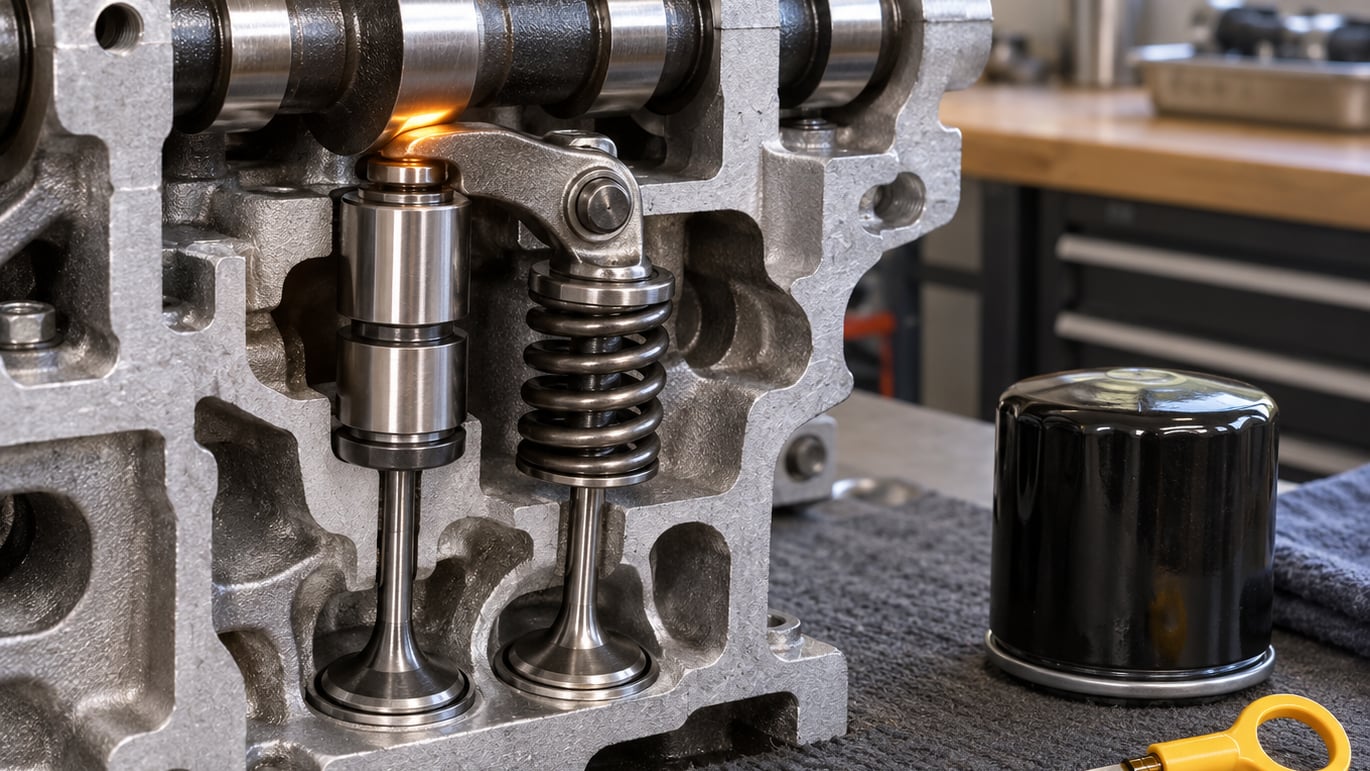
A lifter tick is a light, rhythmic tapping sound from the top of the engine that happens when a hydraulic valve lifter loses its internal oil pressure and lets the camshaft lobe tap on it instead of pressing smoothly against it. Most of the time it is a lubrication problem, not a broken one, and it can be sorted with an oil change, the correct viscosity, or a lifter additive. Put simply, this is lifter tick explained and how to fix it, from the first dipstick check to deciding whether a teardown is worth it.
Before you buy any parts, spend fifteen minutes on diagnosis. Most owners who panic about a lifter tick end up finding a loose oil cap, a failed oil pressure sender, or a gasket weeping onto the exhaust manifold. Those are cheap fixes. The genuinely expensive outcome, a collapsed lifter scoring a cam lobe, is rarer and almost always announces itself with other symptoms first.
Sound familiar? If your car is due for scheduled work anyway, our BMW E46 maintenance schedule explained guide covers the intervals that keep the valvetrain lubricated in the first place.
Table of Contents
- Lifter Tick Explained: What the Noise Means
- Common Causes of a Lifter Tick
- How to Tell a Lifter Tick From Other Engine Noises
- Lifter Tick Diagnosis: A Step-by-Step Checklist
- How to Fix a Lifter Tick
- Lifter Tick Repair Cost and When to Visit a Shop
- How to Prevent a Lifter Tick in the Future
- Frequently Asked Questions
- Conclusion: Start With the Oil and the Sound
Lifter Tick Explained: What the Noise Means
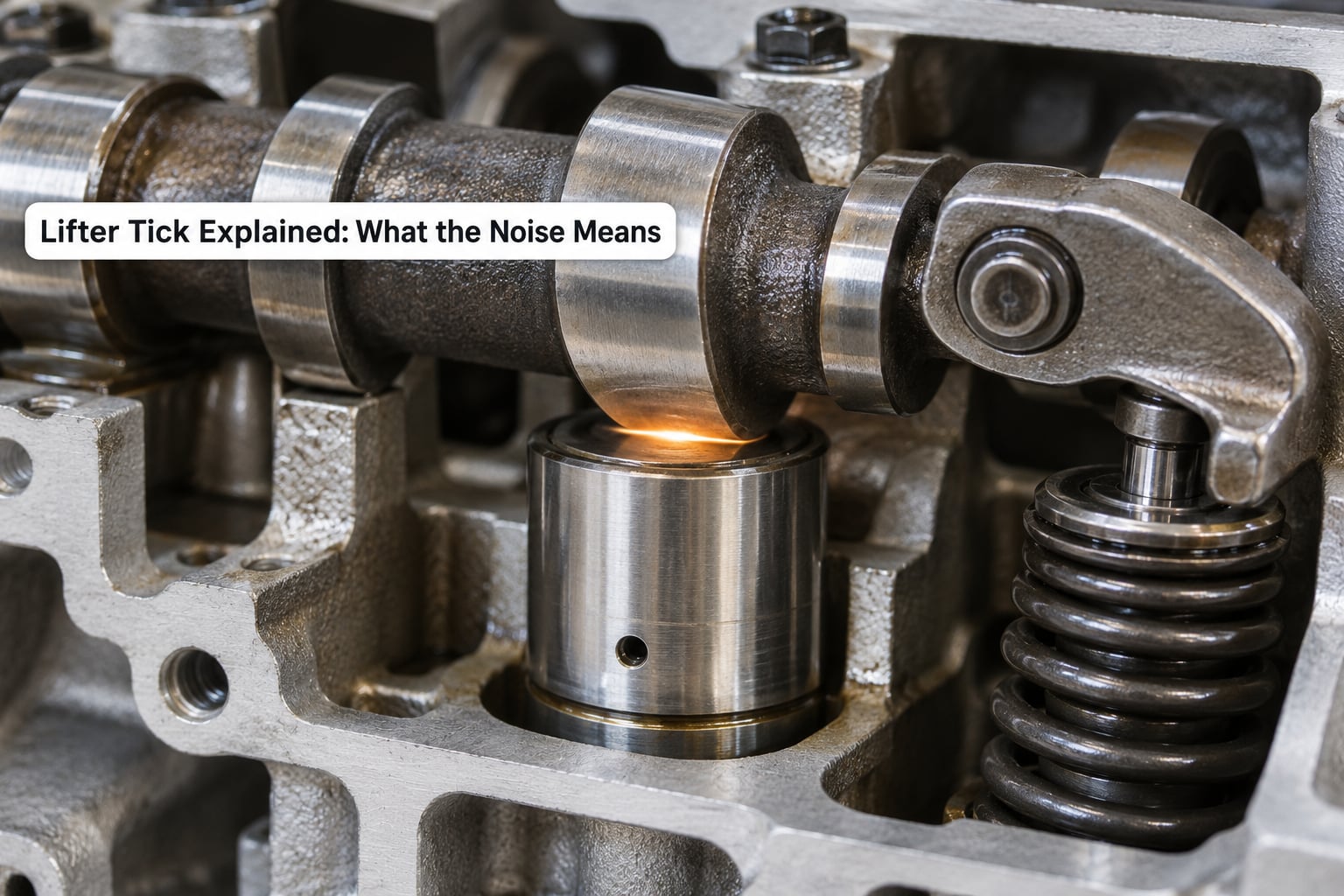
A lifter tick is a sharp, light metallic tapping that comes from the top of the engine, usually under the valve covers. It is most obvious at idle and at low throttle, and it often fades as the engine warms up. On many engines it is barely audible from inside the cabin with the windows up.
Where the sound actually comes from
A hydraulic lifter is a small cylinder that sits between the camshaft and either a rocker arm or the valve spring. Oil pressure from the engine’s oil pump holds a piston inside it up, keeping zero clearance between the cam lobe and the valve train. When that pressure fails, the lifter sinks a few thousandths of an inch and the cam lobe strikes it once per revolution of that lobe. That strike is the tick.
Because the noise follows engine speed, the frequency of the tick changes as you rev. That is the single most useful clue for separating it from a rattle that stays at a fixed pitch.
Why the tick comes and goes
Oil thins as it heats, and a lifter that is marginal when cold will often pump up properly once the engine is warm and circulating properly. That is why a tick that disappears after a ten minute drive is usually, though not always, benign. If the sound arrives as the engine reaches full temperature and stays, the oil and the lifter bore are both suspect.
Tick timing is a useful fingerprint. Cold start only, gone when warm, points at oil or a lifter on the way to being worn. Ticking that starts partway through warm-up and vanishes at full temperature is more likely piston slap. Ticking that never changes with temperature is a sticking or collapsed lifter, or something that is not a lifter at all.
One quick caveat. A parked car that has sat for weeks or months can tick on start-up for a few minutes because oil that has settled in the pan takes a moment to reach the galleries. That is not a fault, and it stops once circulation catches up.
Common Causes of a Lifter Tick

Almost every lifter tick traces back to oil: not enough of it, the wrong kind of it, air in it, or oil that no longer holds up. Here are the causes in the order they actually happen.
Low oil or oil that has broken down
The cheapest and most common cause is a level a quart or two under the full mark, or oil that is well past its service life. The pump still makes pressure, but not enough to fill every lifter at idle, which is exactly where the tick is loudest. Check the dipstick on level ground with the engine off and give it a couple of minutes after shutting down.
Oil that has been run long past its interval also carries water, fuel and metal in suspension, and it turns into the consistency of thin syrup. Some of the difference between synthetic and conventional oil and how each holds up at high mileage is covered in our synthetic vs conventional oil explained piece.
Oil pressure loss and aeration
A worn pump, a pressure-relief valve stuck open, or a failing lifter gallery can all leave the top of the engine under-pressurised. Aeration is the sneakier version. Air in the oil looks foamy and bubbly in the filler cap or on the dipstick, and aerated oil makes far less hydraulic pressure than liquid oil at the same pump output.
A failing pickup tube or oil pump O-ring is a known culprit. On the old LS1 V8, owners on ls1tech.com traced persistent ticking to aeration at the pickup tube O-ring, and replacing that seal helped even when new lifters had not.
Collapsed or worn lifters
A collapsed lifter is one whose piston has worn through its seal or the bore has been scored, so it loses pressure in fractions of a second. It ticks continuously, it does not respond to an oil change, and there is usually no oil consumption to go with it. GM’s active fuel management and displacement on demand systems add a second failure mode: a lifter that is designed to collapse on purpose can fail to re-expand and stay collapsed even with full oil pressure.
Lifter rotation, cam wear and install errors
Flat tappets and solid lifters are not meant to rotate, and a lifter installed the wrong way round, or with the wrong pushrod length, sits slightly off the lobe. The result is a tick with no oil symptom at all. A bent pushrod after a gear shift or a hydraulic jump does the same thing. On cam-in-cup engines, a cam lobe with a worn egg-shaped profile makes contact at the edge and produces a rhythmic tap.
Brand new lifters that tick immediately usually mean preload was not set, a pushrod is the wrong length, or the valve springs are above the lifter’s supported height. That symptom alone is worth a teardown.
How to Tell a Lifter Tick From Other Engine Noises
A lifter tick is a light, fast, top-of-engine tapping that tracks engine speed. If the noise is deep, hollow, and coming from the bottom of the block, you are looking at something else entirely. Here is how the common candidates separate.
| Noise | Where it comes from | How it behaves | How serious |
|---|---|---|---|
| Lifter tick | Top of engine, under the valve covers | Fast light tapping that rises and falls with RPM; often worse at idle and quiet when warm | Usually low to moderate; becomes serious if the lifter collapses and damages the cam |
| Rod knock | Bottom of the block, big ends | Deep hollow thud, loudest at low RPM and under load, gets worse as RPM climbs | Serious; can throw a rod through the block |
| Piston slap | Through the cylinder wall, cold | Hollow clatter that appears mid-warm-up and disappears completely at full temperature | Rarely urgent on its own; can keep a cylinder from holding compression |
| Exhaust leak | Muffler, manifold gasket or studs | Hissing or popping, loudest near the front of the car, changes with load rather than RPM alone | Not a lifter issue; affects emissions and fuel economy |
| Injector tick | Direct-injection injectors | Steady mechanical ticking that never changes with temperature and is normal on many GDI engines | Nothing to fix on most engines |
| Timing chain noise | Front of the engine or inside the cover | Rattling or whirring that rises quickly with RPM and often worsens with oil age | Can jump; fix before it strands the engine |
Two field tests help more than anything else. First, open the hood and listen: a lifter tick gets louder and clearly located at the top of the engine, while an exhaust leak seems to move and the air moves too. Second, note how the sound responds to revs. Exhaust and injector noise stay roughly the same character; a lifter tick scales neatly with engine speed.
Owners regularly post about mistaking one for the other. A cracked exhaust manifold on a Ford 5.4 Triton sounded exactly like a lifter tick to the owner, and on a GM LS1 a cold piston slap was misdiagnosed as lifter clicking for weeks until someone measured exhaust gas temperature and swapped the parts back.
Lifter Tick Diagnosis: A Step-by-Step Checklist
Work through this in order and stop as soon as you have an answer. It takes about twenty minutes for the first three steps and most owners solve it there.
Step 1: Confirm where the sound lives. With the engine at idle and the transmission in neutral, park, or in gear with the brake on, put the tip of a long flathead screwdriver or a mechanic’s stethoscope on the valve cover and on the exhaust manifold. Move it a few inches at a time. The spot where the sound is loudest is the spot making it.
Step 2: Check the oil level and condition. Pull the dipstick, wipe it, reinsert it fully, and read it. Look at the colour on the stick and at the inside of the filler cap. Milky residue means coolant is getting into the oil; a foamy, cappuccino-coloured film means air. A black gritty film with a fuel smell means the oil is well past due.
Step 3: Watch the temperature behaviour. Note whether the tick is present at start-up, when it disappears, whether it returns, and at what coolant temperature. This single observation separates most cases before you touch a tool.
Step 4: Look for evidence. Check the oil filler cap, the dipstick tube, the oil pan seams, and the exhaust manifold area for fresh seepage. Look under the car for oil on the driveway or in the parking bay. Check the valve cover gasket and the plug tube seals for oil that has run down into the exhaust side, which makes noise that fools people.
Step 5: Check oil pressure if anything else came up short. A mechanical or electronic gauge reading at hot idle tells you more than any additive will. On most engines the hot idle reading should be at or above the factory minimum, commonly around 20 to 30 psi. If it is near zero, stop; you have an oil pump problem, not a lifter problem.
Step 6: Decide whether the engine needs shop tests. Compression and leak-down tests separate a collapsed lifter and worn cam lobes from a bore or ring problem. Ask for a borescope inspection through the spark plug hole if a cam looks suspect, since you can see lobe wear directly.
A valve cover listening session is the fastest confirmation there is. Remove the cover while the engine is cold, restart it, and listen to each lifter in turn. Lifters that hold pressure go quiet with the cover off because the extra volume is there; ones that are genuinely collapsed keep ticking loudly, which makes them easy to point at.
How to Fix a Lifter Tick
Fixes are worth trying in order of cost, because most cases never get past the first two. Diagnose before you buy parts, though, since the same symptom can come from an exhaust leak and a lifter part will not fix that.
1. Correct the oil level. If the dipstick reads low, top up with the exact viscosity and specification on your oil filler cap or in the manual. This fixes a surprising share of ticks, particularly on engines that consume oil between services.
2. Do a full oil and filter change to spec. Drain, replace the filter, and refill with the grade and specification the manufacturer calls for. Some engines specify a low-viscosity oil for efficiency and still have noisy lifters at idle, and moving one weight up within the allowed range often quiets them. Our breakdown of synthetic and conventional oil side by side is worth a skim before you change grade.
3. Use a lifter additive as a trial, not a cure. Pour-in oil treatments that restore seal conditioning and lift detergent are worth one measured attempt. The procedure that actually helps is the one that takes time: add the treatment to warm oil, idle for 30 to 60 minutes, then drive 50 to 100 miles to circulate it through the galleries, then change the oil and filter again. Mechanic consensus is that this buys months, not years. Owners on r/Cartalk reported one quart of transmission fluid idled in the oil for an hour cleared a sticky lifter, which is a known trick, though it is not something I would put in a freshly rebuilt engine.
4. Purge trapped air. After an oil change, fill slowly in small amounts and let each addition settle before adding more. Start the engine and let it idle for a minute, then slowly raise the revs to about 3000 RPM in neutral a few times. The gulp that reduces oil volume in the sump is what you are pumping out.
5. Replace or adjust the lifters. On a pushrod engine this can mean shimming or swapping the rocker arm, which is a half-day job with the valve covers off. On a cam-in-cup engine the lifter comes out after removing the cam, so replacing individual lifters means pulling the camshaft. If the cam lobes are worn too, a full cam and lifter set is the only correct fix.
6. Correct assembly errors on fresh work. New lifters that tick need preload set properly, pushrods checked for length and straightness on a surface plate, and springs verified as within the lifter’s supported height. Fix the error rather than buying a second set of lifters.
Lifter Tick Repair Cost and When to Visit a Shop
Diagnostic and repair costs vary by region and change over time, but the ranges below are typical US figures for a four-cylinder or small V8 at an independent shop.
| Repair | Typical range (USD) | DIY friendly |
|---|---|---|
| Oil top-up | 10 to 30 | Yes |
| Oil and filter change | 40 to 100 | Yes |
| Lifter additive treatment | 15 to 40 plus an oil change | Yes |
| Shop diagnostic fee | 100 to 250 | No |
| Rocker arm shim or lifter adjust, four-cylinder | 500 to 900 labor | Advanced |
| Lifter replacement, pushrod V8 | 1200 to 2500 including parts and labor | No |
| Camshaft plus lifter set | 1800 to 3200 including parts and labor | No |
Access is the biggest cost driver. A pushrod V8 with rocker arms gives a mechanic reasonable room to work; a transverse compact engine with a plastic cover wedged against the fender can add hours of labour for the same part. Dealers routinely quote well above independents for the identical job.
Get a diagnosis before you get a number. A shop that quotes the repair without measuring hot idle oil pressure or running a compression test is guessing, and guesses on this noise are expensive.
When to stop driving
Stop and get it looked at the same day if the tick is joined by any of these: an oil pressure warning light or gauge reading below spec, a flashing check engine light, a power loss or misfire, visible oil on the ground, oil consumption of a quart or more between changes, or a tick that suddenly gets much louder.
A quiet tick with a normal oil pressure reading and steady oil consumption is usually a lubrication or lifter-wear issue, and owners on r/AskMechanics have driven tens of thousands of further miles on engines in that state. On a high-mileage vehicle where the repair approaches the value of the car, the sensible answer is often an oil change to spec, an additive trial, and continued driving with an ear on it.
For reference, coolant leaks around the water pump on some models can produce air bubbles and an oil-pressure warning that reads like a lifter fault. If you are tearing into the valvetrain anyway, how a water pump replacement works on common models is worth a skim.
How to Prevent a Lifter Tick in the Future
Most of this is unexciting and it works. Change the oil and filter on the interval your manual specifies, and treat short trips as hard miles because the oil never gets hot enough to clear condensation.
Use the exact oil specification and viscosity listed on the filler cap. Where an engine requires a low-viscosity oil for efficiency, and modern oils are designed for that, quietly running something much thicker to hide a noise creates as many problems as it solves.
Check the level every few thousand miles on an engine that burns oil, rather than waiting for the light. And let a newly rebuilt or freshly serviced engine idle and circulate oil gently before you drive it hard.
If new ticking starts, deal with it early. Oil level, oil condition, and leaks take ten minutes to check, and the alternative is letting a marginal lifter run long enough to groove the cam lobe it sits on.
Frequently Asked Questions
How serious is a lifter tick?
On its own, a lifter tick is usually a moderate problem rather than an emergency. A hydraulic lifter that is slow to pump up still works, and many engines run for tens of thousands of miles in that state. It becomes serious when the lifter collapses fully, starts scoring the cam lobe, or when the ticking comes with low oil pressure, a misfire, or heavy oil consumption.
Will thicker oil stop a lifter tick?
Sometimes, partially. A thicker oil raises pressure at hot idle, which helps a lifter that is marginal rather than damaged. Owners regularly report that one weight up quieted the noise for thousands of miles. That is a band-aid, though. If the tick returns as soon as the engine is fully warm, the lifter or its bore is worn and the oil change only buys you time. Use the viscosity your engine is approved for.
Do lifter ticks go away?
A tick that is caused by low or degraded oil usually disappears within minutes of a warm-up and stays gone after a proper oil change. A tick caused by air in the system clears after a purge cycle. A tick from a collapsed or scored lifter does not go away on its own at all, which is the clearest signal that a part is worn.
Can you fix a lifter tick yourself?
The first three fixes are genuinely DIY. Check the level, change the oil and filter to specification, and run a lifter additive through a 50 to 100 mile drive cycle before changing the oil again. Beyond that, replacing a rocker arm shim or a lifter means removing valve covers and, on a cam-in-cup engine, pulling the camshaft. Most owners cross the line from diagnosis to disassembly there.
How long can I drive with a lifter tick?
If the tick is quiet, the oil pressure reading is normal, the oil level stays stable, and the engine runs smoothly, you can keep driving while you book the repair. That is the situation most owners are in. The moment you add an oil pressure warning light, a flashing check engine light, a misfire, or visible oil on the ground, stop driving it and get it diagnosed.
Is a lifter tick worth fixing?
It depends on the vehicle and the root cause. On a younger engine with good oil pressure and an obvious oil problem, yes, cheaply. On a high-mileage vehicle where cam and lifter replacement approaches the value of the car, most shops and owners decide the same thing: run the correct oil, try one additive cycle, and drive it with an ear on the noise. That is a reasonable judgement call, not advice to ignore.
Conclusion: Start With the Oil and the Sound
Almost every lifter tick is a lubrication story rather than a broken part. Check the dipstick on level ground, look at the colour and smell of the oil, and confirm the noise really is coming from the valve covers with a stethoscope or a screwdriver.
If the tick tracks engine speed and lives at the top of the engine, start with an oil change to the exact specification your engine calls for, then add a lifter treatment with a proper idle and drive cycle behind it. If the tick comes back after that, or never quieted at all, have hot idle oil pressure and a compression test run before anyone talks about lifters.
And if the ticking arrives with an oil pressure light, a misfire, or a sudden drop in power, stop driving it. That combination is the one case where the answer is not in the garage.