
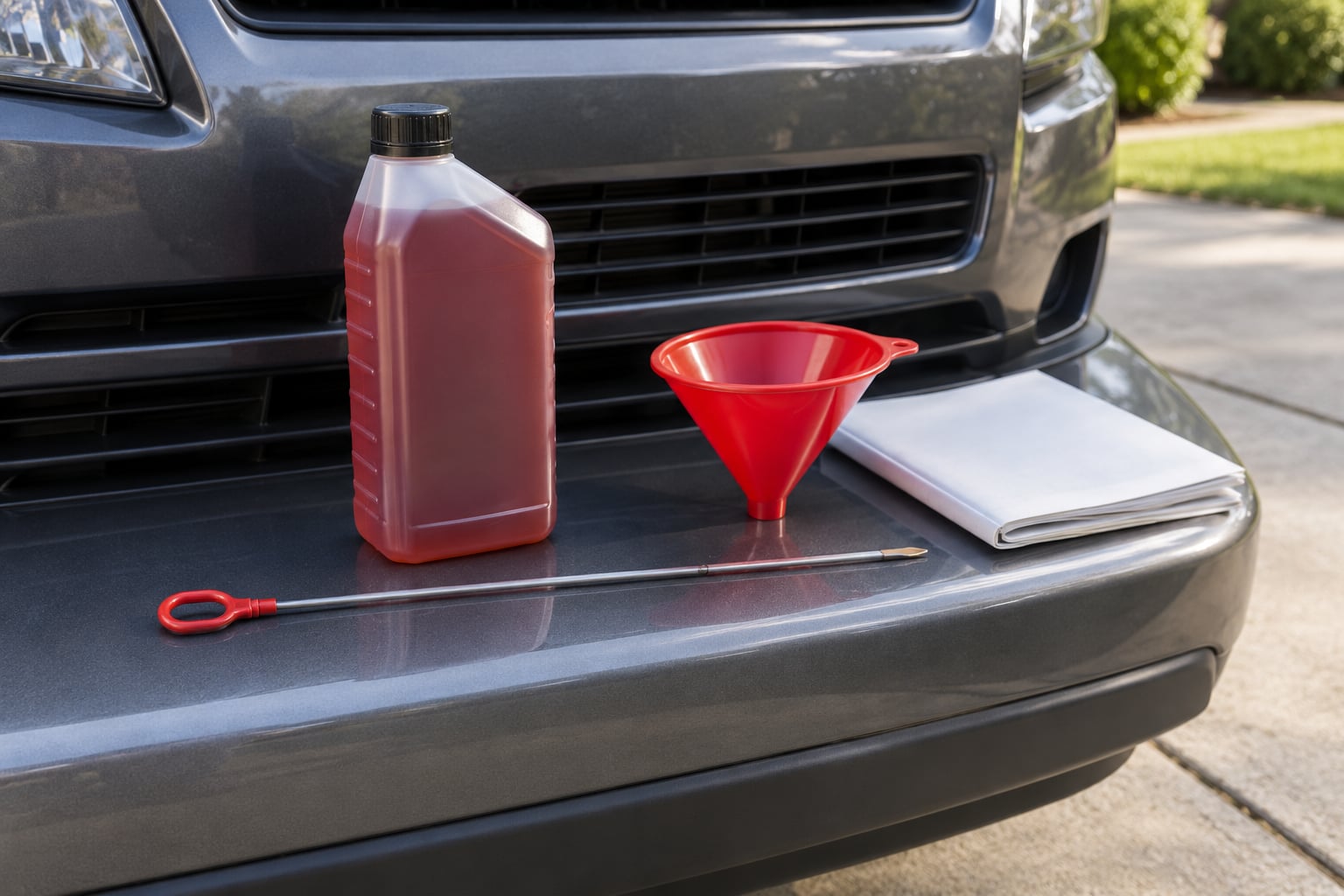
To check transmission fluid level, first find out how your car is designed to be checked. Many BMWs use a dipstick and want the fluid warm with the engine idling, while newer models hide the check inside the instrument cluster with no dipstick at all. The method, the temperature, and the gear selection all come from your owner’s manual, and following them takes about ten minutes on level ground.
The mistake I see most often is pulling a dipstick on a cold transmission, reading LOW, and topping up a car that was already full. Overfilling is harder on a transmission than a low reading ever is, so the conditions matter more than the technique.
Table of Contents
- What You Need
- Step-by-Step: How to Check Transmission Fluid Level Safely
- Step 1: Confirm Your BMW’s Transmission Fluid Level Check Method
- Step 2: Park on Level Ground and Set the Correct Conditions
- Step 3: How to Check Transmission Fluid Level With the Dipstick
- Step 4: Use the Electronic Transmission Oil-Level Check
- Step 5: Inspect the Fluid Condition and Check for Leaks
- Step 6: Correct a Low Level Safely and Recheck
- Common Mistakes
- Frequently Asked Questions
- Conclusion
What You Need
Gather these before you start, so you are not standing in a driveway with a wet dipstick and nowhere to put it.
- Your owner’s manual for the exact model and year. It names the check method, the fluid specification, and the required fluid temperature.
- The approved transmission fluid for your transmission, if the manual allows you to add it. A sealable plastic bottle keeps the rest clean for next time.
- A clean rag or paper towel to wipe the dipstick, plus a small clear bottle to catch drips.
- A clean funnel and gloves, for topping up through the fill point.
- Level ground with the parking brake accessible. A driveway with a slight slope will give you a wrong reading.
That covers the tools. What varies more is the car. Some BMW transmissions have a service dipstick with MIN and MAX marks. Others have no dipstick at all and use an electronic oil-level measurement instead, which is where a lot of owner’s-manual hunting happens. Read that section first.
Step-by-Step: How to Check Transmission Fluid Level Safely
Step 1: Confirm Your BMW’s Transmission Fluid Level Check Method
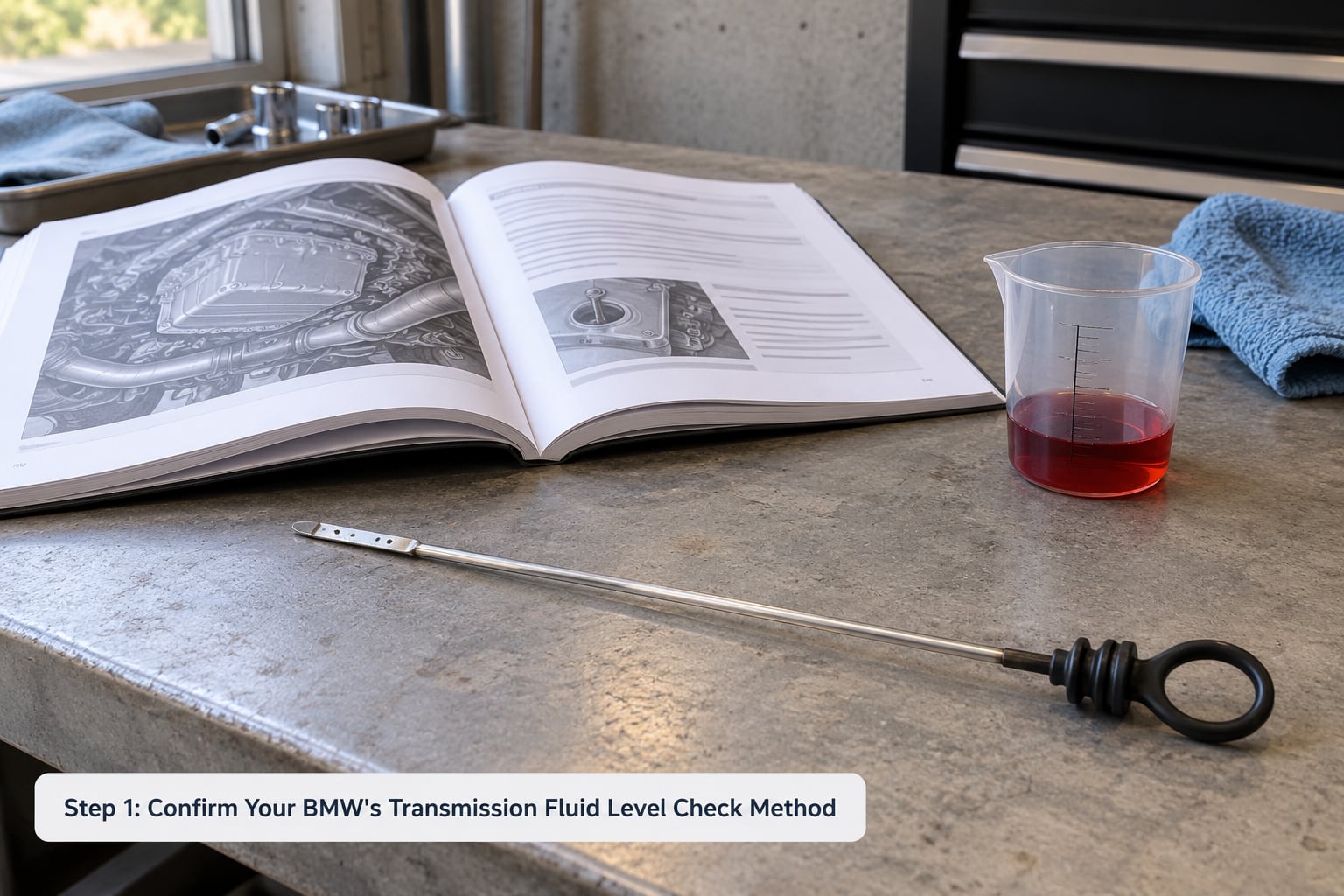
Look in the maintenance section of the manual for transmission fluid inspection. You will land on one of three setups: a transmission dipstick, an electronic level check through the instrument cluster, or a fill and check plug underneath the car.
Do not assume a BMW is checked the same way as the BMW you drove last year. The procedure changed across model years and transmission types, and the fill point may sit at the rear of the car rather than under the hood. If your manual lists a specific fluid temperature, write it down now. You will need it in a few minutes.
Step 2: Park on Level Ground and Set the Correct Conditions
Park on flat ground, select Park for an automatic, and set the parking brake hard. For a manual, leave it in neutral with the brake on. If the manual specifies that the engine should be running, start it and let it idle. If it specifies engine off, shut it down first.
Temperature is the part people get wrong. If the manual calls for warm fluid, drive the car until the transmission is at operating temperature, or idle it for the time it specifies. Don’t take a reading on a cold transmission and compare it against a hot-scale mark. A cold fluid contracts and sits lower in the pan, which is exactly how people end up overfilled.
Step 3: How to Check Transmission Fluid Level With the Dipstick
Pull the dipstick, wipe it clean with the rag, and put it back in all the way until it seats. Then pull it again and read it. That second pull matters: the first one wipes the film off the tip and gives a falsely low number.
Read at the temperature your manual names. If the dipstick has two scales, a cold range and a hot range, use the one that matches the state of the fluid right now. Between the marks is fine. Below the low mark means add fluid. Above the maximum is overfilled, and that is not a safe reading to shrug off.
Put the dipstick back in, seat it, and close the filler neck or tube so nothing leaks onto the exhaust.
Step 4: Use the Electronic Transmission Oil-Level Check
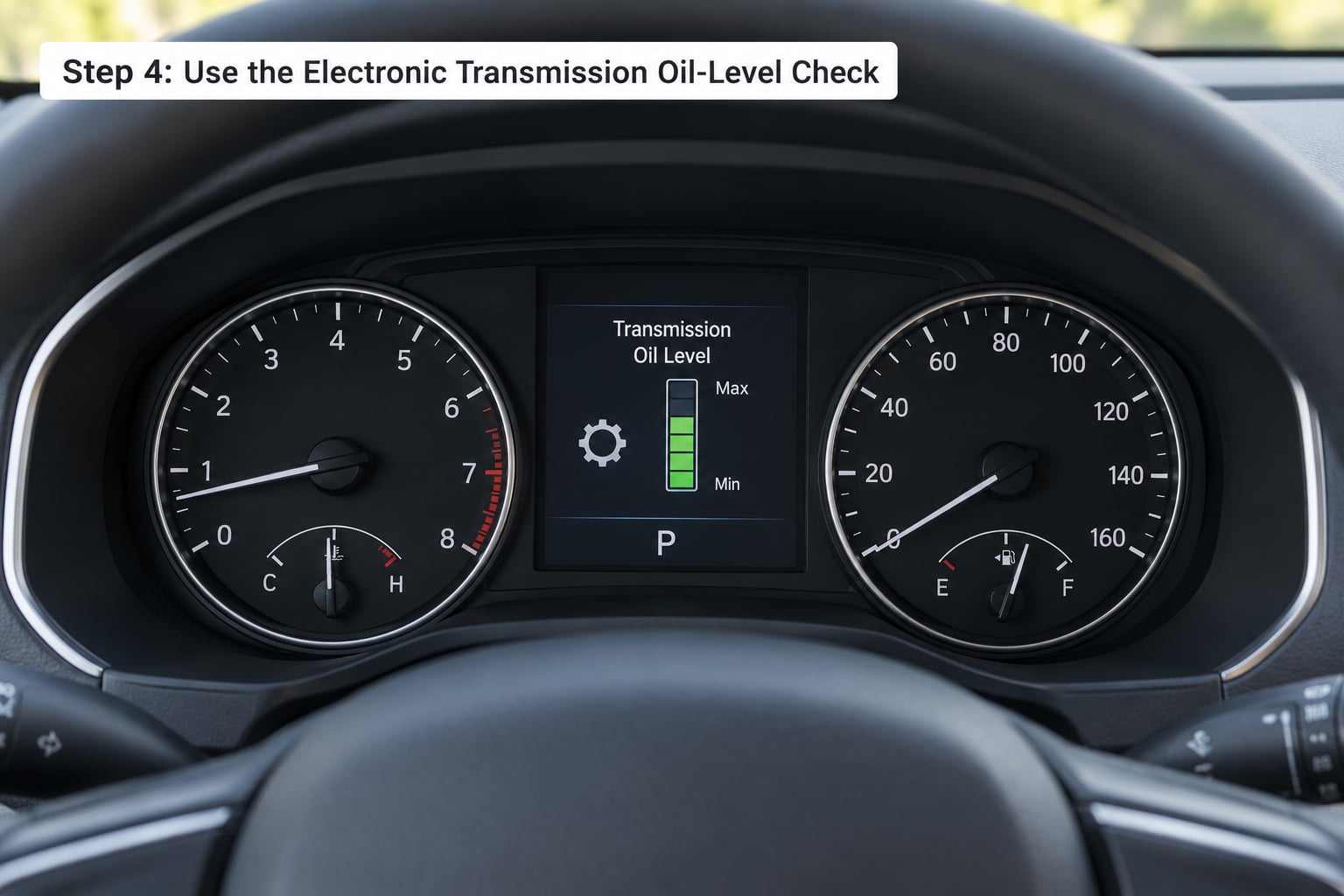
On transmissions without a dipstick, the reading comes from a temperature and level sensor reported through the car itself. Put the car in Park on level ground, run the engine as the manual directs, then cycle the drive selector through each position and back to Park, which primes the oil circuit. Several models want you to repeat the cycle two or three times.
Bring up the oil level display in the instrument cluster or the menu on the centre screen, and let the value settle before you trust it. If the display reports low, the correct fluid, and a warm condition, the fix is a small top-up through the fill plug rather than a dipstick pull.
Step 5: Inspect the Fluid Condition and Check for Leaks
Rub a small amount between your fingers and look at it before you put the dipstick back. Fresh fluid is clear and translucent, often with a pinkish or amber tint. Dark brown with a sharp burnt smell means it has been cooked. Gritty particles, or bright silver flecks, point to wear inside the transmission.
While the car is still in the position you checked it in, look underneath. A fresh spot of fluid on the pan or a stain on the driveway is a leak, not condensation. Our guide to what causes a puddle under the car walks through the usual suspects, including the cooler lines that run to the radiator.
A low reading plus a leak means topping up is a temporary fix, not a repair. A low reading with a dry underside usually points to slow seepage at a seal or a seepage that only shows once the car is fully warm.
Step 6: Correct a Low Level Safely and Recheck
Use only the fluid specification your manual names. Add in small amounts through the designated fill point, never more than about half a bottle at a time, and recheck between additions. Keep the funnel clean and keep the container capped.
Cycle through the gears or drive positions as the manual directs so the fluid moves through the valve body, then let the transmission settle at the specified temperature and take the reading again. An overfilled transmission foams internally, aerates, loses hydraulic pressure, and shifts harshly. Underfilled is bad too, but a top-up is a much cheaper mistake than an overfill.
Write the final reading down with the date. Next time you check, you have a baseline to compare against rather than guessing.
Common Mistakes
Each of these shows up over and over, and each has a simple fix.
- Checking a cold transmission against a hot mark. Fix: match the reading to the fluid temperature your manual specifies, and treat cold and hot scales as separate scales.
- Reading the dipstick without wiping it first. Fix: wipe, reinsert fully, pull again, read. Skip the second pull and the reading is always low.
- Leaving the dipstick partially seated. Fix: seat it by hand until it stops, then remove it in one straight motion. A crooked or shallow dipstick misreads the level.
- Grabbing the engine oil dipstick by mistake. Fix: trace the dipstick tube down toward the transmission. The engine dipstick has a loop or a wide flat handle and usually sits at the front of the bay. If you are unsure, pull each one and look at the colour of the fluid.
- Adding fluid without looking for the leak. Fix: inspect the pan, cooler lines, and the parking surface before you open the container.
- Overfilling to be safe. Fix: add in small increments and recheck. Above the maximum mark is a fault, not a safety margin.
- Pouring in a fluid that is close enough. Fix: match the specification exactly. Different fluid specs are not interchangeable, and the wrong one can cause slipping or damage seals. The myths around lifetime fill claims explain why the fluid marked in the cap is the one to use.
- Ignoring an electronic warning message. Fix: a transmission oil level message is a measurement, not a guess. Bring up the reading, follow the manual’s top-up procedure, and recheck.
One more habit worth building: check at the same point in the same conditions each time. A monthly look at the level and colour, on the same flat drive at the same temperature, catches a slow leak weeks before the car starts shifting oddly. Our guide to checking engine oil correctly on a BMW covers the parallel routine most owners skip.
Frequently Asked Questions
Should I check transmission fluid when it is hot or cold?
Use whichever temperature your owner’s manual specifies, and match the dipstick scale to it. Most BMW automatics are checked with the transmission fully warmed up and the engine idling in Park, because the sensor and the level both depend on operating temperature. Some manuals allow a cold check against a separate cold range. A cold reading compared against the hot mark is the usual cause of overfilling, so if in doubt, warm it up and read it hot.
What do MIN and MAX mean on a transmission dipstick?
MIN is the lowest acceptable level and MAX is the highest, and the fluid should sit between them. Below MIN, the transmission can run low enough to slip, heat up, and wear. Above MAX, the fluid foams and aerates, which causes harsh or delayed shifts and can damage internal parts. If a reading lands at or past MAX, correct it before driving normally. Also look at the colour and smell while the dipstick is out.
Where is the transmission dipstick on most BMWs?
On models with a service dipstick, it is usually at the rear of the engine bay, near the firewall, often on the passenger side and marked with a bright handle. It can be hidden behind intake ducting, so expect to move plastic before you find it. It looks similar to the engine oil dipstick, so trace the tube down toward the transmission. If your model has no dipstick, the manual will point to the electronic check or a fill plug instead.
How often should I check my transmission fluid level?
A quick look at the level and colour every month, or every few thousand miles, catches slow leaks early and costs a couple of minutes. If the car tows, hauls, or spends its life in stop-and-go traffic, check more often. High-mileage cars and anything without a dipstick benefit from a scheduled inspection. A level check is separate from a fluid change, so one does not replace the other.
What if my BMW has no transmission dipstick or electronic level check?
Some transmissions are checked with a fill and inspection plug at the rear of the car, which usually means lifting the vehicle safely and working underneath. The owner’s manual gives the plug location, the fluid volume, and the required temperature. If neither a dipstick, a display, nor a plug is available to you, have a shop measure the level with the right equipment rather than guessing or adding fluid on spec. Overfilling is the expensive mistake here.
Conclusion
Start with the maintenance section of your owner’s manual and find out which check your BMW uses. Then put the car on level ground, in the specified gear, at the specified fluid temperature, and take the measurement before you touch a bottle.
If the level reads between the marks and the fluid is clear and clean, note the reading and move on. If it reads low and there is fresh fluid under the car, the level is the smaller problem and the leak is the real one. If the fluid smells burnt, carries metal, or the car shifts harshly, slip hesitates, or clunks between gears, stop topping up and get the transmission looked at properly.