
Death wobble is a sudden, violent, self-feeding shaking of the steering wheel and front end that usually starts after you hit a bump at highway speed and gets worse until you slow down. It is a symptom, not a part: something in the front steering and suspension has free play, and that play lets the wheel oscillation feed itself.
Last updated for October 2026. This guide covers the nine causes that account for the large majority of cases, the order to check them in, and the point where you should stop driving and get help.
Table of Contents
- What Causes Death Wobble in a Car?
- How to Tell Death Wobble From Ordinary Steering Shimmy
- The 9 Most Common Culprits
- 1. Loose or Worn Steering-System Components
- 2. Warped, Out-of-Balance, or Separated Tires
- 3. Bent or Damaged Wheels
- 4. Loose Wheel, Hub, or Wheel-Bearing Play
- 5. Worn Ball Joints or Tie Rods
- 6. Failing Shock Absorbers or Struts
- 7. Alignment or Front-Suspension Geometry Problems
- 8. Brake or Wheel-End Problems
- 9. Loose or Damaged Steering-Rack Mounts
- How to Diagnose Death Wobble Safely
- When Should You Stop Driving?
- Frequently Asked Questions
- Conclusion: Start With the Fastest Safety Checks
What Causes Death Wobble in a Car?
What causes death wobble is a question about free play, usually in the steering linkage and front suspension. A small input — a bump, a bridge expansion joint, a pothole, a washboard patch — kicks the front wheels into an oscillation. On a solid front axle, that oscillation normally settles because the geometry pushes the wheels back into line.
When a component has slack, the wheels no longer return to center on their own. Each swing of the wheel is fed by the play, so the amplitude grows with every cycle. That is the difference between a shimmy that fades and a wobble that grows until the wheel is moving so hard you cannot hold the lane.
It shows up most often on solid-axle trucks, SUVs, and Jeeps, and on anything that has been lifted, fitted with larger tires, or driven a lot of miles without front-end service. The same loose components show up on independent front suspension, but a rack-and-pinion car needs a different set of parts checked than a leaf-spring solid axle.
The important thing to know before you start buying parts: forum consensus across the enthusiast communities is that this is rarely one failed part. It is usually several worn components at once, which is why fixing a single item often brings the wobble back within a month.
How to Tell Death Wobble From Ordinary Steering Shimmy
Ordinary shimmy is a buzz in the seat or a fine tremor in the wheel that stays roughly the same no matter how much steering input you add. Death wobble grows when you put input into the wheel, and the growth is what makes it dangerous.
- Wheel only, straight line, any speed: probably a balance or tire issue, not death wobble.
- Steering wheel grows with input, usually above 45 mph: this is the classic death wobble signature.
- Shake that fades after a second or two: more often a balance weight, a bent rim, or a driveline vibration on a 4×4.
- Shake that builds and builds until you slow down: a real oscillation, and it needs inspection.
- Rhythm that matches engine rpm, changes with throttle: driveline angle or driveshaft issue, not steering.
- Pulse through the brake pedal, only while braking: a brake problem, covered below.
Another useful signal is the road surface. A tire balance problem shows up on smooth pavement at nearly any speed. Death wobble often needs a trigger: a single bump starts it, and then it keeps going on flat road.
The 9 Most Common Culprits
The table below is the shortcut most guides skip: what each cause feels like, the fastest way to test for it, and whether it is a weekend job or a shop visit.
| Cause | What you feel | Fastest check | DIY or shop |
|---|---|---|---|
| Loose steering linkage or hardware | Free play in the wheel, clunking over bumps | Watch the tie rod and pitman arm while someone rocks the wheel | DIY with correct torque specs |
| Worn, damaged, or out-of-balance tires | Buzz at 50 mph, cupping, tread cracking | Inspect tread, sidewalls, and pressure; spin for balance | Shop for balance, DIY for inspection |
| Bent wheel or rim | Steering wheel shake that grows with input | Run a finger along the inner rim lip | Shop |
| Loose wheel, hub, or wheel bearing | Growling, humming, clunk when turning | Check wheel torque, then rock the tire at 12 and 6 | Shop once a hub is involved |
| Worn ball joints or tie rod ends | Steering play, clunk, tire wear on one edge | Rock the tire at 3 and 9 o’clock on a supported corner | Shop, alignment needed after |
| Failing shocks or struts | Bounce, floaty control, oil misting on shocks | Bounce the corner; check for fluid | DIY in pairs |
| Caster or toe out of spec | Wobble after a lift, or wander on the highway | Alignment check of caster and toe | Shop |
| Warped rotor or uneven pad wear | Pedal pulse, shudder only under braking | Inspect rotor surface, measure thickness | Shop |
| Worn steering-rack or track bar mounts | Vibration that returns right after repair | Inspect bushings and bolt holes for oval wear | Shop if the housing is damaged |
One clarification worth putting up front, because it is the most repeated mistake in the forums: a steering stabilizer or damper does not fix any of these. It adds damping so the symptom gets quieter while the underlying play keeps degrading. A worn damper is usually a casualty of the oscillation, not the root cause.
1. Loose or Worn Steering-System Components
Play anywhere in the steering path lets the wheel move without the tires moving, which is the raw material of a wobble. On a solid axle, watch the tie rod ends, the drag link, the pitman arm, and every bolt that holds them to the axle tube and the steering box.
Visually, look for a shiny witness mark where a nut has been moving, a cotter pin stretched, or a rubber boot split. A drag link or pitman arm that has been rear-ended is a real and commonly missed cause, and owners rarely suspect it until someone rocks the wheel with the truck on the ground.
Never treat a wrench on a steering fastener as a diagnostic result. Follow the manufacturer torque figure and check whether the bolt hole itself is worn oval; a bolt torqued into a wallowed hole holds nothing.
2. Warped, Out-of-Balance, or Separated Tires
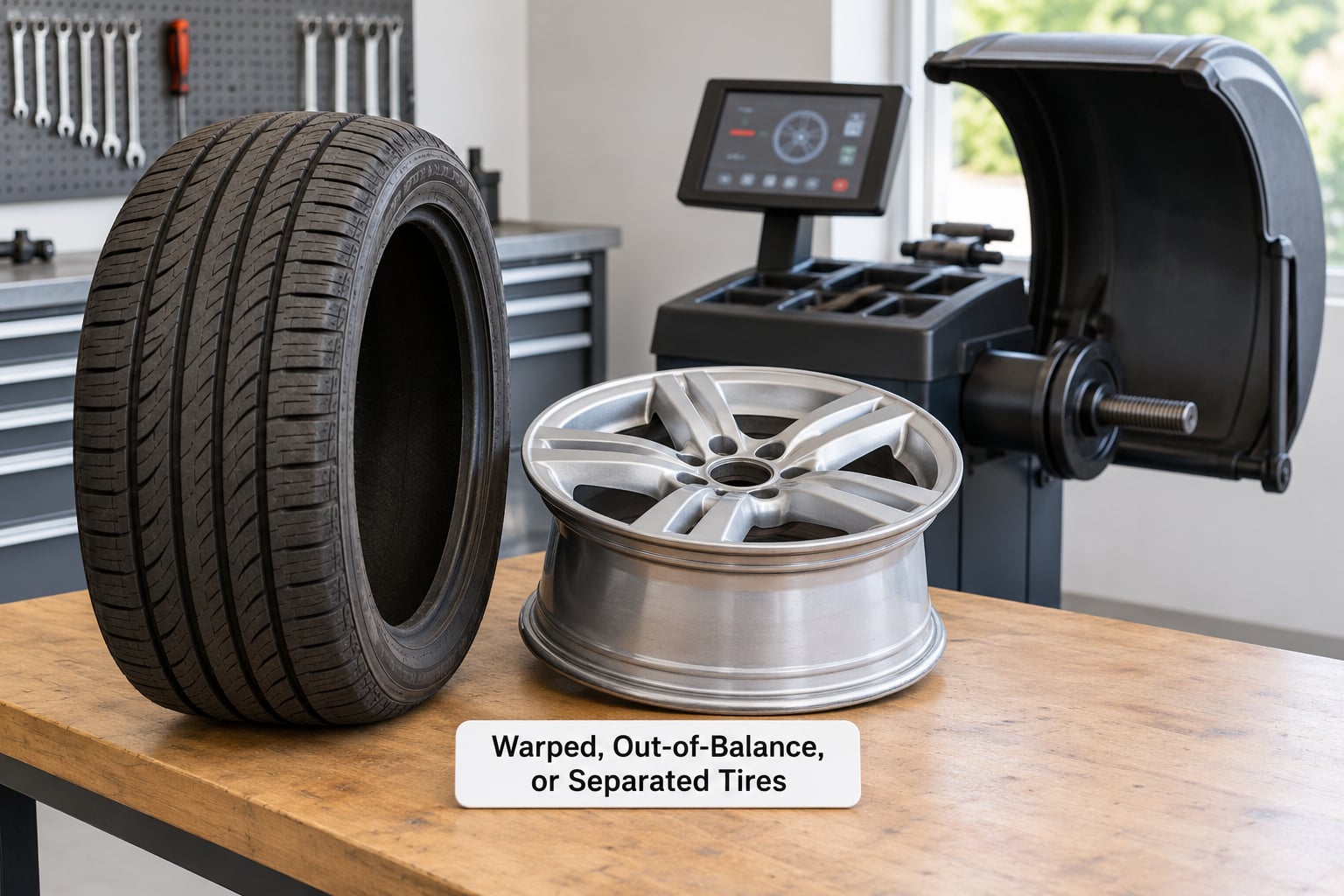
Damaged tires produce a vibration the wheel reacts to, and the steering amplifies it. A sidewall bulge, a belt that has started to separate, or a patch of uneven wear will do it. So will a simple imbalance, and so will two tires on the same axle at different pressures or with noticeably different tread depth.
Unbalanced tires more often give you a straight-line buzz, but a bad front tire can absolutely feed a wobble that grows with steering input. If the shoulders are wearing unevenly, read what tire feathering is and what causes it — uneven wear points at a front-end problem feeding the tire, not the other way around.
Order matters here. A ruined or badly worn tire gets replaced, not balanced around. Balance a new tire pair, verify the two front pressures match and match the manufacturer spec, and only then re-check whether the wobble is still there.
3. Bent or Damaged Wheels
A rim knocked against a curb or dropped into a pothole can bow just enough to change how the tire sits. The tire then runs slightly conically, and the wheel itself is out of round, so the same steering input produces a different reaction at different points in the rotation.
You can feel it: vibration that comes and goes with wheel rotation speed and increases as you steer. The check is quick. Remove the tire and run a finger around the inner rim lip and the outer lip; a flat spot, ripple, or a lip that catches a fingernail means the wheel is done.
4. Loose Wheel, Hub, or Wheel-Bearing Play
This is the one that ends the driving immediately if you suspect it. A wheel nut or axle nut that has backed off lets the wheel move relative to the hub under load, and nothing about that is stable. Wheel bearings with measurable play change the geometry of the front end constantly as the wheel turns.
Symptoms run from a hum that changes pitch with speed to a clunk when you turn at low speed, and a fine rumble that only shows up under braking torque. Related noise questions are worth a look too, especially what causes a clicking noise when you turn — that pattern points at the wheel-end hardware, not the steering.
ABS adds a wrinkle on some vehicles: a wheel speed sensor reading can contribute to a stability or traction intervention that pulls at the brakes, and a loose hub can damage the sensor tone ring. Check wheel torque first. If the torque is correct and you can feel play at the hub, stop driving and have it inspected.
5. Worn Ball Joints or Tie Rods
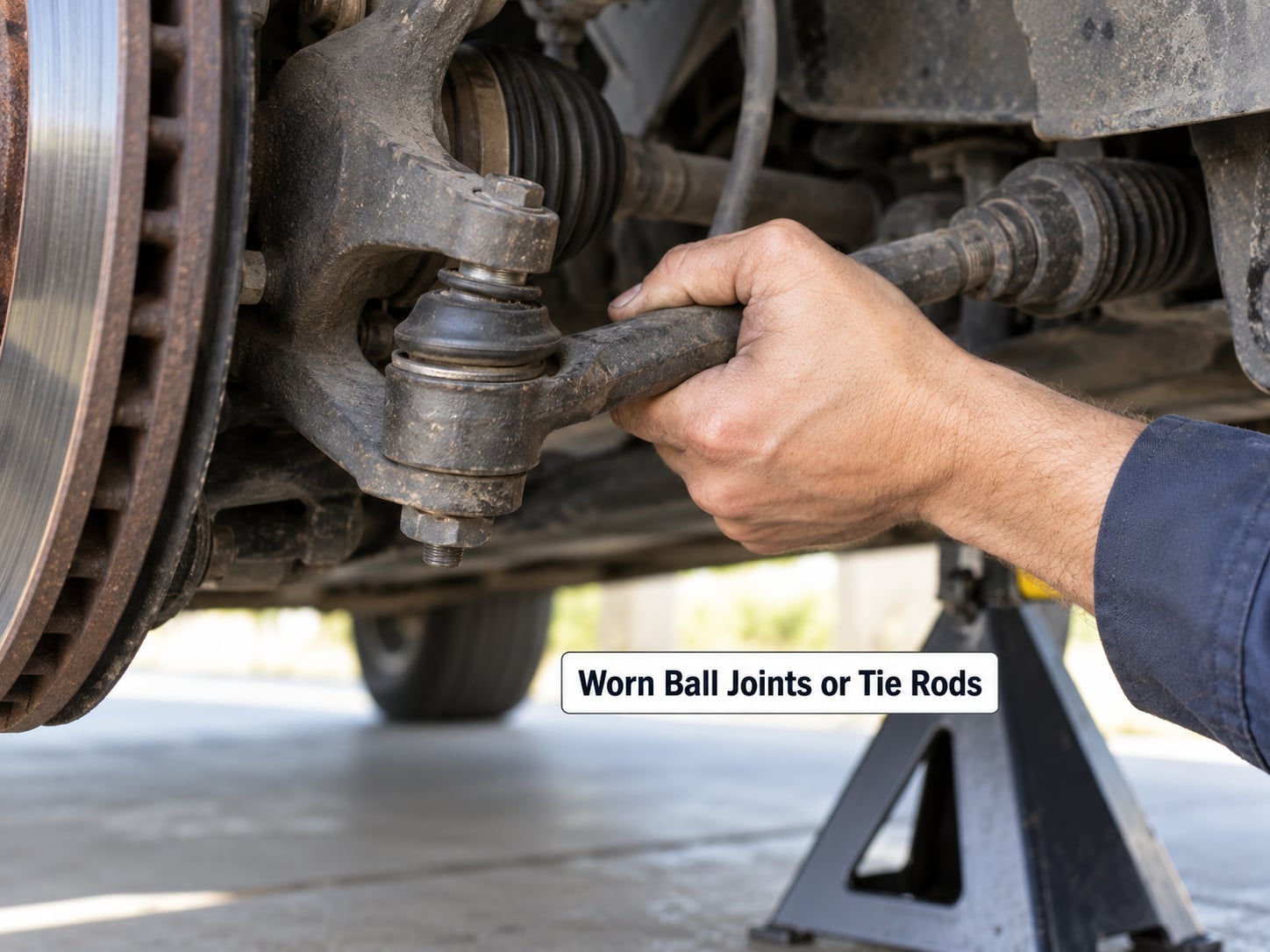
A worn ball joint develops a taper: the socket fits loose when the joint is at one angle and tight at another, so the wheel moves under load. The boots crack first, the grease goes, and the joint starts to wear internally. Scuffing or feathering on one side of a front tire is a classic sign that the geometry is shifting under load.
The test needs the vehicle supported properly. With the front corner on a jack and the wheel supported so the joint is loaded, rock the tire at the 3 and 9 o’clock positions; that checks for ball joint and tie rod play. Then rock at 12 and 6; that shows wheel and hub play. Never do this with the vehicle on a jack stand alone at the driven corner, and never under a car held only by a jack.
Ball joints and tie rod ends come as matched pairs on most front ends. Replace them together, torque to spec, and treat the alignment as part of the job rather than an optional extra.
6. Failing Shock Absorbers or Struts
Shocks do not hold the geometry, they control how fast the wheel moves. When damping fades, the front wheel keeps moving after every bump, which is exactly the movement that feeds an oscillation that would otherwise settle in a second or two.
A visual check catches an obvious leak, and bouncing one corner against the other reveals a dead shock. It does not catch a unit that has quietly lost most of its damping while still looking clean, which is why a failed shock is often only confirmed by measurement or by what the vehicle does on the road.
Heat makes this worse. A worn damper that held back a masked wobble on a cool morning fades on a hot day, and owners frequently describe the wobble coming back harder in summer. A rubber-banded-on stabilizer can do the same thing.
7. Alignment or Front-Suspension Geometry Problems
Geometry decides whether the front end self-centers. Wrong caster removes the self-centering force that pushes the wheels back into line; wrong toe makes the front tires scrub during a wobble and wears them faster. Worn control arm bushings let the axle move laterally under load, which changes the tracking all the way up to the wheel.
This one often arrives disguised. After a lift kit, an adjustable control arm install, or a set of taller springs, caster can move well outside the factory window without anyone noticing a change in how the truck drives. A wheel alignment is the correct place to find out, and it is a straightforward measurement.
Get the diagnosis before the alignment. Aligning a front end that still has play in the track bar, bushings, or a worn ball joint just locks in a bad starting point, and the wobble returns.
8. Brake or Wheel-End Problems
A warped rotor or unevenly worn pad sends a pulse through the hub and the suspension, and the steering wheel is the easiest place to feel it. The giveaway is that it happens only while you are braking, and it stops the moment you lift off. What is a floating brake rotor covers that mechanism in more detail, since a hub that is free to float in a fore-aft direction is a related kind of play.
Other wheel-end issues produce different signatures. A caliper that sticks drags constantly, which can imitate a vibration until it heats up. A seized or improperly adjusted bearing hums with speed. If the shaking is tied to braking or to engine rpm rather than to steering input, you are not looking at death wobble.
9. Loose or Damaged Steering-Rack Mounts
The steering box or rack is bolted to the frame through rubber bushings. Once those bushings harden, split, or lose their preload, the entire steering gear can shift a few thousandths of an inch under load, and the play runs straight up the linkage to the wheel.
Wallowing bolt holes are the tell. Look at the mounting brackets and bolts for an oval hole, a shiny ring of rust around the washer, or a bracket that rocks under a pry bar. This shows up most often on high-mileage BMWs and other performance-oriented cars, where the rack and the mountings take a lot of heat and vibration, and where a rebuild or a mount kit is the realistic fix.
How to Diagnose Death Wobble Safely
Work in an order, not a guess. Every hour spent on the wrong component is an hour of parts money, and the most common thread pattern is someone replacing tie rods, then ball joints, then a track bar, then tires, before reaching the real cause.
- Reduce the risk first. Drive below the speed at which the wobble appears and skip highway testing until the front end is checked.
- Inspect the tires. Tread depth and condition, sidewalls for bulges, and both front pressures compared to the door-jamb spec. This is the fastest check and it rules out or confirms a whole category.
- Check wheel security. Torque the wheel nuts to spec, then look at the wheel face and rim lip for damage.
- Load the front end on stands and rock the tires. 3 and 9 o’clock for ball joints, tie rod ends, and the drag link; 12 and 6 for wheel and hub play. A helper makes this far more reliable.
- Look for movement with the wheel on the ground. Have someone turn the steering wheel a few degrees while you watch the linkage, the track bar bracket, and the control arm bushings.
- Check every fastener and bushing. Torque to the manufacturer figure, and reject any hole that is worn oval.
- Verify geometry last. A caster and toe check should be the confirmation that the repair worked, not the first step.
- Reassess with a road test at a lower speed first, then work up. If play remains anywhere, stay off the highway.
Repairs worth grouping together: if the ball joints are worn, the tie rod ends are usually close behind, and the control arm bushings are usually not far off. Replacing them in one visit with one alignment is less expensive and far more likely to hold than chasing each one.
When Should You Stop Driving?
Stop driving and have the vehicle inspected or towed if you notice any of these. Each one is a separate reason, and none of them wait for a better day.
- You can feel free play in the steering wheel with the vehicle parked and the engine off.
- Any wheel nut or axle nut will not stay tight, or a wheel shows visible movement relative to the hub.
- A tire has a sidewall bulge, a visible belt separation, or exposed cord.
- The oscillation is severe enough that you cannot hold a lane, or it starts at lower speeds as time goes on.
- There is a clunk, grind, or continuous growl from the front end.
- Any part of the steering or suspension is visibly bent, or a bolt hole is worn oval around a steering fastener.
If the wobble strikes while you are moving, ease off the accelerator and let the speed drop smoothly, grip the wheel with both hands at the 9 and 3 positions, avoid abrupt steering inputs and hard braking, and pull off at the next safe place. Fighting the wheel is what turns a shake into a loss of control. Nobody reading this is going to die from a single episode, but the failure is progressive and the severity does not stay where you left it.
Frequently Asked Questions
Can a bad tire cause death wobble?
Yes. A damaged, out-of-balance, or unevenly worn front tire can start a wheel oscillation that the steering amplifies into something that feels like death wobble. Look for sidewall bulges, tread separation, cupping, and mismatched pressures between the two front tires. Replace anything damaged rather than balancing around it, balance the pair, and set both pressures to the door-jamb spec. If the wobble survives all of that, the tire exposed the problem rather than caused it.
Does wheel alignment fix death wobble?
Only after the mechanical cause is fixed. An alignment corrects caster, camber, and toe, so it can cure a wobble caused purely by geometry after a lift or a spring change. It cannot correct play in a track bar bushing, a worn ball joint, a damaged tire, or a bent wheel, and doing the alignment first just locks in a bad starting point. Get the front end inspected, replace the worn parts, then align.
Why does my steering wheel shake more at higher speeds?
Speed gives the oscillation more energy to build on, and the self-centering forces that settle the front end weaken as speed climbs. Most wobbles first appear somewhere around 45 to 65 mph, often triggered by one bump or bridge joint, then grow with every cycle because of free play in the suspension. Slowing down usually stops it, which is why highway testing makes the symptom obvious and makes it more dangerous.
Can worn ball joints cause death wobble?
They are one of the most common culprits, especially on high-mileage solid-axle trucks and Jeeps. A worn ball joint wears into a taper, so the wheel moves under load in one direction but not the other, and that shifting geometry is a direct feed for a steering oscillation. Look for cracked boots, scuffing on one edge of the front tire, and play when the tire is rocked at 3 and 9 o’clock with the corner properly supported.
Is death wobble dangerous to drive?
Treat it as unsafe to drive at highway speed until the front end has been inspected. The severity of the oscillation rises with every bump you drive over, and the steering input required to control it grows with it, which is a bad combination on a road where you have very little room to correct. If the wheel has free play while parked, a wheel will not stay torqued, or a tire is damaged, do not drive it to a shop. Have it towed.
Should I replace both front tires at the same time?
In most cases, yes. A pair with mismatched tread depth, construction, or wear behaves differently under load, and that difference alone can feed a front-end oscillation on top of any existing looseness. Replacing both fronts together and balancing the pair is the simplest way to remove tires as a variable. If your tires are nearly new, with even wear and no damage, keep both and move on to checking the suspension components instead.
Conclusion: Start With the Fastest Safety Checks
Start where the answers come quickest. Ease off the gas and keep the speed down if the wobble is active, do not drive it further if the wheel has free play while parked or a tire looks damaged, and treat a steering damper as a cover-up rather than a repair.
Then work the front end in order: tires and pressures, wheel security, rock the tire at 3 and 9 and again at 12 and 6, check every steering fastener and bushing for movement and for wallowed bolt holes, and finish with a caster and toe check. Replace the worn pieces together and align once. That sequence is what separates a repair that holds from one that comes back next month.