
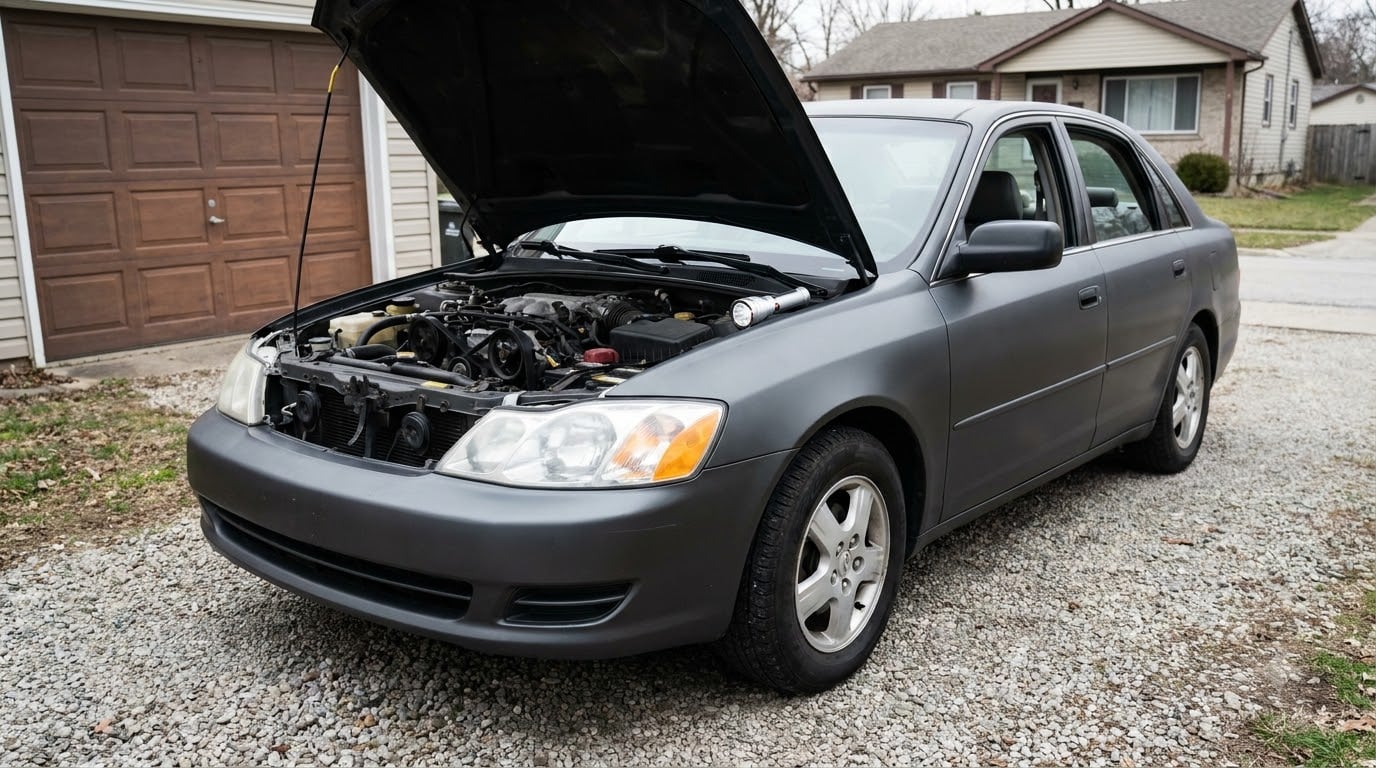
When your car makes whining noise when accelerating, the sound almost always comes from a spinning part that speeds up under load — a belt-driven accessory, the power steering pump, a gear inside the transmission or differential, a wheel bearing, or a driveshaft joint. In most cases you can split the candidates into two groups in about a minute by listening to whether the pitch follows engine RPM or road speed.
That distinction matters because it removes half the parts on the shelf before you spend anything. A whine that climbs and falls with the tachometer is front-of-engine; one that climbs with road speed regardless of what the engine is doing is transmission, driveline, or wheel.
Common causes, front of car to back:
- Worn serpentine belt or failing tensioner: the pitch tracks engine RPM exactly, gets worse under throttle, and often chirps or squeals for the first second after a cold start.
- Low or contaminated power steering fluid: the whine rises with RPM and changes pitch or volume when you turn the wheel at a standstill.
- Dry or failing idler and tensioner pulley bearings: a constant rasp that gets louder with RPM and does not change when you steer.
- Front-wheel drive hub or wheel bearing: a hiss that increases with road speed, shows up on corners, and worsens on the loaded side of the car.
- CV axle or U-joint: clicking, snapping, or grinding that appears when the car is loaded or turning, not a smooth whine.
- Differential or transfer case: a steady hum at highway speed that changes with gear and gets louder during acceleration.
- Turbocharger or supercharger spool: a rising whistle with boost on turbos and supercharged cars, plus exhaust leaks and cold-start chirps on older turbos.
- Fluid and exhaust problems: low oil, low coolant, worn transmission fluid, or a leaking exhaust manifold can all raise a whine that sounds mechanical but isn’t.
Table of Contents
- What Makes a Car Whine When You Accelerate?
- How to Identify the Noise Before Buying Parts
- 8 Common Causes and Their Sound Patterns
- When the Whine Means Fluid Service or a Safety Stop
- What to Check First: A Quick Diagnostic Order
- When to Replace the Part or Get a Professional Diagnosis
- Frequently Asked Questions
- Conclusion
What Makes a Car Whine When You Accelerate?
Acceleration whine is a mechanical sound, not an electrical one, and it follows a simple rule: pitch rises with the speed of whatever is spinning. Every rotating component has a natural frequency, and when that frequency lands in the range your ears are most sensitive to — roughly 1,000 to 4,000 Hz — you hear a tone rather than a rumble.
That’s why the same car can be silent at 30 mph and shriek at 55. Nothing has broken in between; the component simply crossed into the range where it is loudest.
It also explains why acceleration specifically triggers it. Steady cruising holds a component at one speed. Accelerating sweeps it through several speeds quickly, so you pass through the noisy band faster but hear it more clearly, and you add load, which pushes more force through the belt, pump, gears, and bearings at the moment of peak stress.
Why a Car Makes Whining Noise When Accelerating
Four mechanisms cover almost every case you will run into: belt-driven accessories spinning at engine speed, internal rotating shafts and gears, tire or bearing speed, and fluid flow through a pump or restriction.
- Belt-driven accessories turn at a fixed ratio to engine RPM, so their whine rises and falls with the tachometer no matter how fast the car is going.
- Shafts and gears — transmission, differential, transfer case, CV axle, U-joint — spin in proportion to road speed, so their sound tracks the speedometer instead.
- Tires and wheel bearings also scale with road speed, which is why they can be mistaken for a transmission.
- Fluid flow through a power steering pump, a worn transmission, or a sucking leak gets noisy when demand rises, which is exactly what acceleration does.
| Cause | What it sounds like | Tracks | Where | Urgency |
|---|---|---|---|---|
| Turbo or supercharger | Rising whistle, chirp on lift | Engine RPM and boost | Front, near exhaust | Low if clean, high if wailing |
| Serpentine belt | Chirp or squeal, worst cold | Engine RPM | Front of engine | Medium — can throw the belt |
| Idler or tensioner pulley | Rasp or growl at idle and up | Engine RPM | Front of engine | Medium |
| Power steering pump | Groan that changes when steering | Engine RPM | Front, low down | Low, unless fluid is dark |
| CV axle or U-joint | Click, snap, or grind under load | Road speed and load | Front wheels or driveshaft | High — boot tears spread |
| Wheel bearing | Hiss or hum that grows with speed | Road speed | Corner, often the loaded side | Medium to high |
| Differential or transfer case | Steady hum, louder on acceleration | Road speed and gear | Rear, AWD center | Check fluid first |
| Low fluid or exhaust leak | Rising whine or hiss with leak | Engine RPM | Anywhere you see wetness | High if fluid is disappearing |
One caveat worth knowing: some cars are simply designed to whine. Straight-cut gear teeth, used for strength in first gear and reverse on many manuals and on some automatics, produce a tone rather than the hum a helical gear gives. If your car whines only in first gear and reverse, holds a steady pitch at a fixed road speed, and shifts away cleanly, that is normal gear design rather than a fault.
Our guide on humming noise that changes with speed goes deeper on how pitch and volume behave across different components.
How to Identify the Noise Before Buying Parts
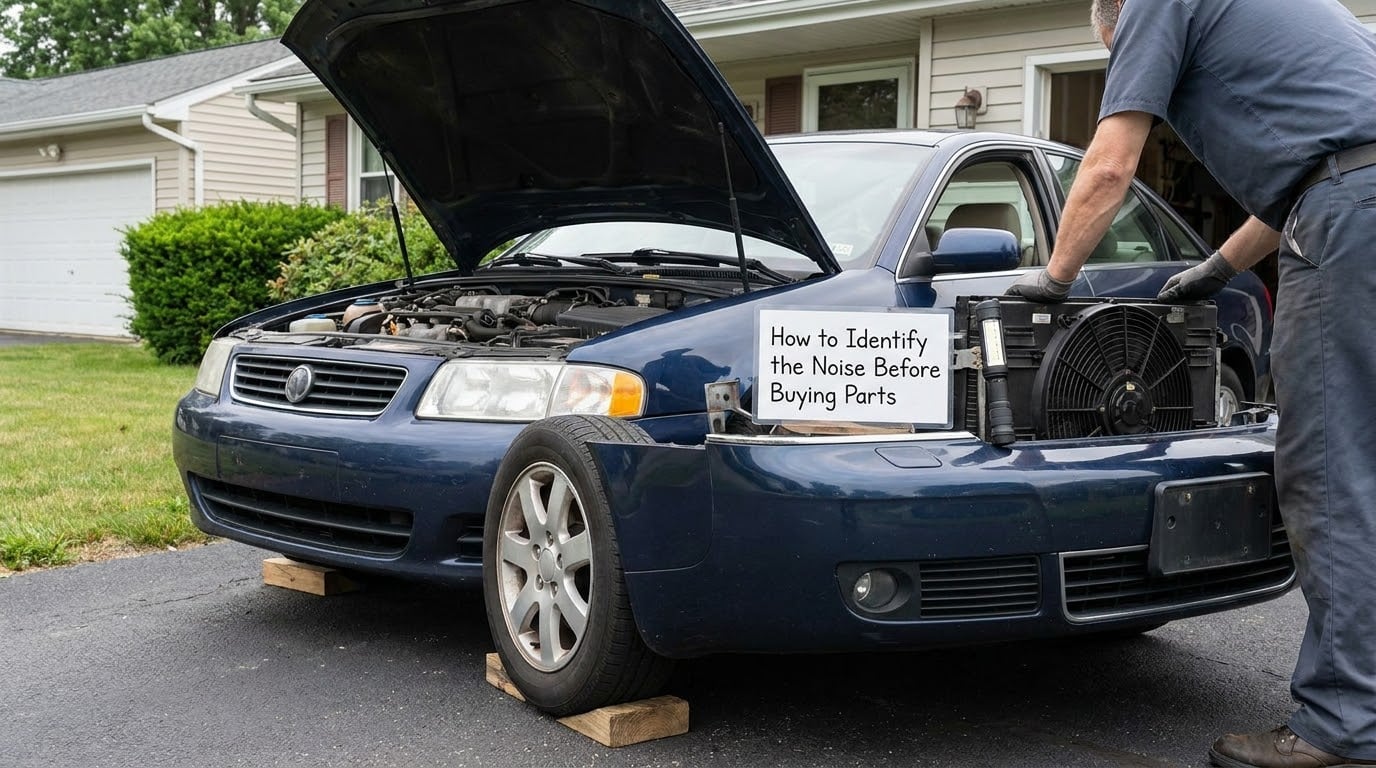
Most people end up buying the wrong part because they start with a part name instead of a test. Run these checks in order, and stop as soon as the sound is accounted for.
- Rev in park. Park on level ground, parking brake on, transmission in park or neutral, and let the engine idle. Blip the throttle in short bursts. If the pitch jumps up and drops with every blip, the source is belt-driven and lives at the front of the engine.
- Turn the wheel test. Still at a standstill, hold the engine around 1500 rpm and turn the wheel lock to lock. A power steering whine changes pitch, gets louder, or turns into a groan as the rack loads up. A belt whine stays exactly the same.
- Reverse and first gear. Shift into reverse and creep a few feet, then do the same in first. A sound confined to those two gears and tied to road speed is gear-related. Most normal straight-cut whine shows up here.
- Rolling test at two speeds. Get to a steady 30 mph and note the pitch, then a steady 50 mph. Now make one hard acceleration from 30 to 50 and listen. A whine that is identical at both steady speeds but loud during the pull is a load-driven sound. One that rises only with road speed is a bearing, gear, or tire.
- Stationary hand checks. With the engine off and cool, look at the belt for cracks, fraying, glazing, or a shiny surface. Check for a wet or dark puddle under the car. Spin the wheel on a jack and listen for a hiss at the hub.
Never put a hand, rag, or wrench near a running belt or pulley. If you are going to check belt tension or spin something by hand, the engine is off, the key is out of the ignition, and the car is on level ground or properly supported.
Before buying anything, check the fluids your owner’s manual lists for your engine. If it is not a manufacturer recommendation to check a fluid yourself, have a shop check it — some systems are only meant to be inspected by a technician with the car on a lift.
8 Common Causes and Their Sound Patterns
How to Check a Turbo or Supercharger Whine
A healthy turbocharger makes a soft, rising whistle that matches boost and settles when you lift off. On an older turbocharged car you may also get a brief chirp at revs as the wastegate or bypass valve lets pressure out — that is expected on many models.
The version that means trouble is a metallic wail, a grinding rasp, or a whistle that keeps going after the throttle shuts. That points to bearing wear in the turbo shaft, and it often arrives with a burning oil smell, exhaust smoke from the tailpipe, or coolant in the oil. Check oil and coolant levels first, then look for oil around the turbo and along the exhaust manifold gasket.
A rattling noise or shaft play when the engine is idling and off-throttle points the same way. Once you suspect internal turbo damage, stop driving it and get a proper diagnosis — a seized turbo can take the engine with it.
How to Tell If It Is the Serpentine Belt or Pulleys
Belt and pulley noise tracks engine RPM perfectly. At idle it is a chirp; at 3000 rpm it is a solid squeal. A loose belt under load slips and chirps for a second or two, which is why the noise is worst on a cold morning before everything warms up.
Look for a cracked, ribbed or glazed belt surface, frayed cords, a belt that sits in the wrong groove, or bright rust dust on a pulley face. Check the tensioner: on a manual-tensioner engine the belt should deflect roughly half an inch when pressed firmly between two pulleys. An automatic tensioner should hold steady tension, and a belt that flickers against the pulley face is a tensioner sticking.
Pulley bearings make a constant growl at idle that climbs smoothly with revs. A bad idler or tensioner bearing will often fail in the middle of a drive, and the belt tensioner is the part to look at first when the whine only appears under hard acceleration.
How CV Joints and Axles Sound During Acceleration
A CV joint rarely whines smoothly. It clicks, snaps, or grinds, and the sound shows up under load or while turning, because that is when the joint’s internal splines and bearing take torque they do not get while coasting.
A clicking that speeds up in rhythm while you accelerate is a classic failing CV. On rear-drive cars the same behaviour from the driveshaft points at a U-joint or a worn center support bearing, and under-jointed U-joints often add a vibration felt through the seat at the same time. Our guides on wheel bearing noise diagnosis cover how to tell those apart by location.
Check the rubber boots. Grease thrown around the inside of the rim or on the CV boot means the boot has split and grease is leaving. Once a boot is torn, dirt gets in and the joint fails quickly, so treat it as a repair rather than a noise to live with.
How Wheel-Bearing, Differential, and Tire Noise Compare
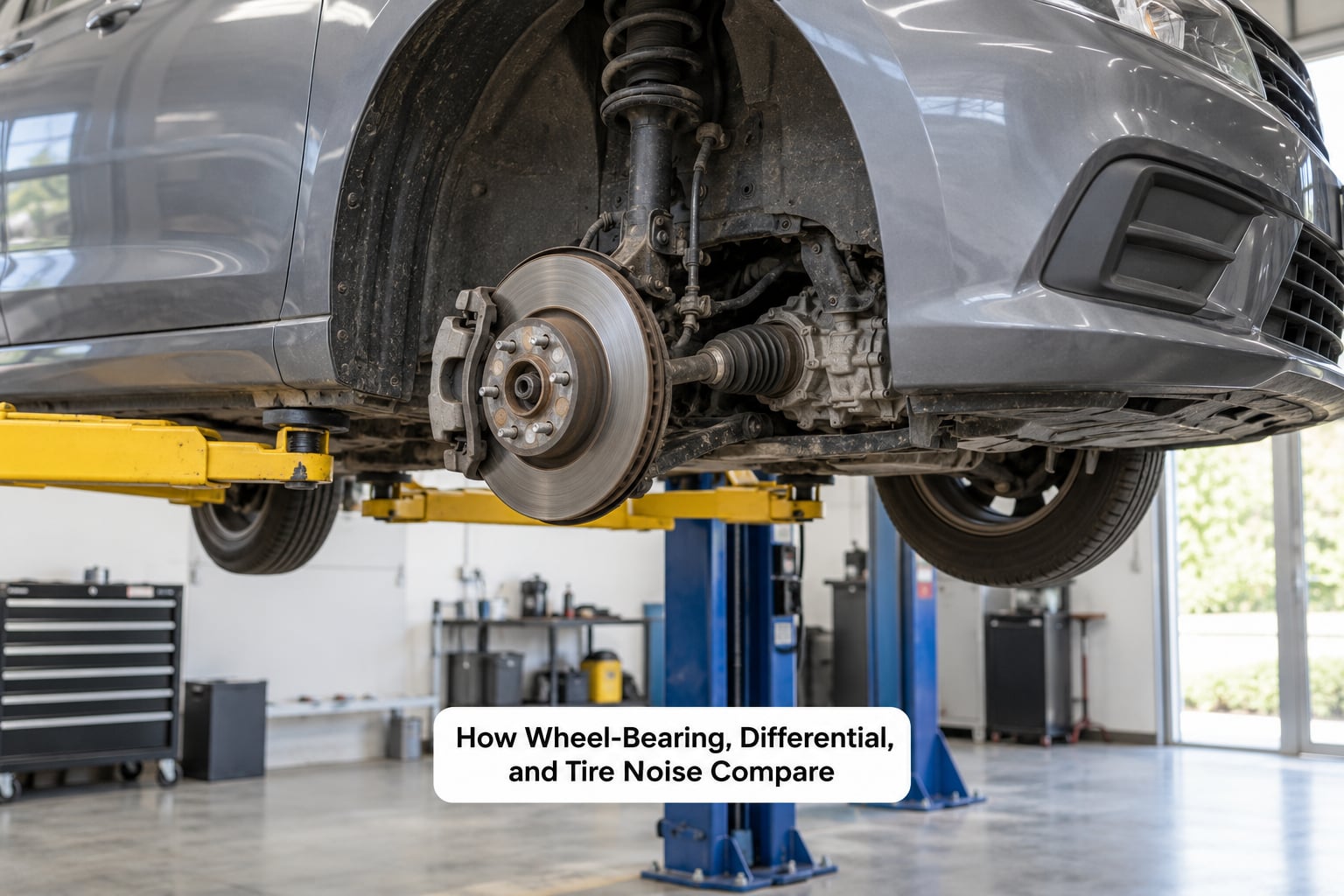
These three are the ones owners mix up most, because all three get louder with speed.
A wheel bearing is a hiss or low hum that changes as you corner. If the noise gets louder turning left, the right wheel is the suspect, since the outer bearing takes more load in that turn. It also often gets louder under acceleration than at a steady speed.
A differential hums at a road speed and gets louder when you accelerate or climb. On all-wheel-drive vehicles the transfer case can do the same, and the tone may not change with steering at all.
A tire roars rather than whines. It is usually broadest and lowest in pitch, comes with visible tread wear, and does not follow RPM. A quick rotation of the wheels by hand on a jack, plus a pressure and tread check, clears this one up fast.
Compare all three on the same road, at the same speed, in the same gear, and the distinction becomes obvious in minutes rather than guesswork.
When the Whine Means Fluid Service or a Safety Stop
Some whines are fluid problems wearing a mechanical disguise, and those are the ones worth acting on immediately.
Low engine oil reduces the lubrication film between rotating parts. On some engines that shows up as a metallic whine under load, and continuing to drive can score bearings and wipe the engine. Low power steering fluid makes the pump cavitate, which sounds like a whine that climbs with RPM and rises when you turn. Worn or burnt transmission fluid changes under load for the same reason.
Check fluids exactly as your owner’s manual specifies — engine off and level for most, hot for some, and never above the MAX line. If a fluid is low, find the leak before topping it up, because a low reading that keeps coming back is a leak you cannot ignore.
Stop driving now if the whine comes with any of these: grinding or metal-on-metal noise, a burning smell, visible fluid loss, smoke, a temperature gauge climbing, a vibration through the pedal or seat, or a brake pedal that feels different. Those point to actual damage, not a worn part.
If the engine is overheating, treat it the same way. Our piece on what a stuck thermostat feels like while driving describes the temperature symptoms that show up alongside a rising whine.
What to Check First: A Quick Diagnostic Order
Work down this list in order, because each step costs a few minutes and rules out whole groups of parts.
- Look under the car and in the engine bay first. Puddles, oil mist, coolant residue, a shiny exhaust manifold, or a wet belt all identify the problem before you touch a tool.
- Do the rev-in-park and blip test. RPM-tracking sound means stop looking at the driveline.
- Check the engine oil, coolant, power steering fluid, and brake fluid. Use the manual’s method and temperature requirement for each one.
- Inspect the belt by eye. Cracks, glazing, fraying, a loose tensioner, or a rusty pulley face.
- Check tire pressure and tread depth. Cheap, fast, and rules out one of the top three guesses.
- Road test at two steady speeds and one hard pull. Note whether the pitch follows the tachometer or the speedometer.
- Jack up one wheel and spin it. A hiss at the hub is a bearing; a rough notch or clunk is a CV joint or boot.
- If the sound is still unexplained, book a diagnostic test. Bring the recorded audio, the speed at which it appears, and which gear it happens in.
Record the sound on your phone from inside and outside the car before you go in. Mechanics diagnose this symptom by listening, and a clip tells them in ten seconds what a written description takes ten minutes to convey.
When to Replace the Part or Get a Professional Diagnosis
Replace the part when you have confirmed the source rather than guessed it. A belt with visible cracking, a torn CV boot, a hub with play in it, or a fluid that is dark and burnt each have an obvious end point.
Go straight to a shop when the sound comes with a warning light, a fluid leak, overheating, smoke, or a burning smell, when it is getting louder week over week, or when the pitch follows road speed and you cannot confirm whether it is the transmission, a wheel bearing, or a tire from the driver’s seat.
Be careful about the order of repairs. A worn belt can damage an alternator, a neglected power steering pump can ruin its own rack, and low oil pressure driving a turbo is expensive in a way that is easy to walk around. Replacing the cheap part first and then the expensive one it damaged costs far more than doing both at once.
A vehicle scan is worth doing when the noise is intermittent or only on a cold start, because it can catch a sensor signal or a data code that is not visible from the driver’s seat. Owners of certain German makes, BMWs in particular, get a fuel pump or turbo warning in the instrument cluster alongside turbo whine and boost loss — that combination is a stop-driving sign rather than a “monitor it” situation. That does not make the noise unique to those cars; it just makes that specific combination more urgent there.
Frequently Asked Questions
Is it safe to drive if my car whines when accelerating?
Usually yes, but it depends on what comes with the noise. A steady whine from a belt, pump, or bearing with no warning light is generally fine for a short drive to a shop. Stop and do not drive if the whine comes with grinding, a burning smell, smoke, leaking fluid, overheating, or a vibration. If a fluid level is low, driving with it low can turn a small fix into a much larger one.
Why does the whining noise get louder when I press the gas?
Because acceleration puts load through whatever is spinning. A belt or power steering pump responds to engine RPM, so the sound climbs with the tachometer as the pulley speeds up. Gears, bearings, and axles respond to load, so pulling hard makes them work harder and louder. If the pitch only rises with road speed and not with engine revs, the source is in the driveline or a wheel rather than a front-of-engine accessory.
Can a bad tire make a whining noise when accelerating?
Rarely. A damaged or badly worn tire roars or hums rather than whines, and it follows road speed instead of engine RPM. A split CV boot can add a chirp that comes and goes with throttle, but that is more of a rubbing sound. Check tire pressure, tread depth, and sidewalls first because it is quick, then move on to the belts and fluids.
What does turbocharger whine sound like on a BMW?
On a healthy turbo it is a soft whistle that rises with boost and fades when you lift off. A failing turbo makes a harsh metallic wail or grinding rasp that does not fade, often with a burning oil smell, smoke from the exhaust, or a boost warning in the instrument cluster. That combination is a stop-driving signal. The noise itself is not unique to BMWs; other turbocharged cars sound the same when the turbine bearings wear.
Will driving with an acceleration whine make the problem worse?
It depends on the cause. A worn belt can slip and throw, taking the alternator with it, and a low-fluid power steering pump can damage its own rack within a short drive. A torn CV boot lets dirt into the joint, so the damage accelerates quickly. A healthy bearing or normal first-gear whine will not worsen. Identify which one you have before deciding how much driving to do.
Conclusion
Start by stopping the car if the whine comes with grinding, a burning smell, leaking fluid, smoke, a vibration, or an overheating gauge. Those are damage, not wear.
If the noise is a plain whine, record it at two different road speeds and at two different engine speeds, then run the rev-in-park and turn-the-wheel tests. Whatever follows RPM lives at the front of the engine; whatever follows road speed lives in the gears, axles, or wheels. Check fluids and belt condition in that order, and bring the recording to a shop if the sound is still unexplained.