
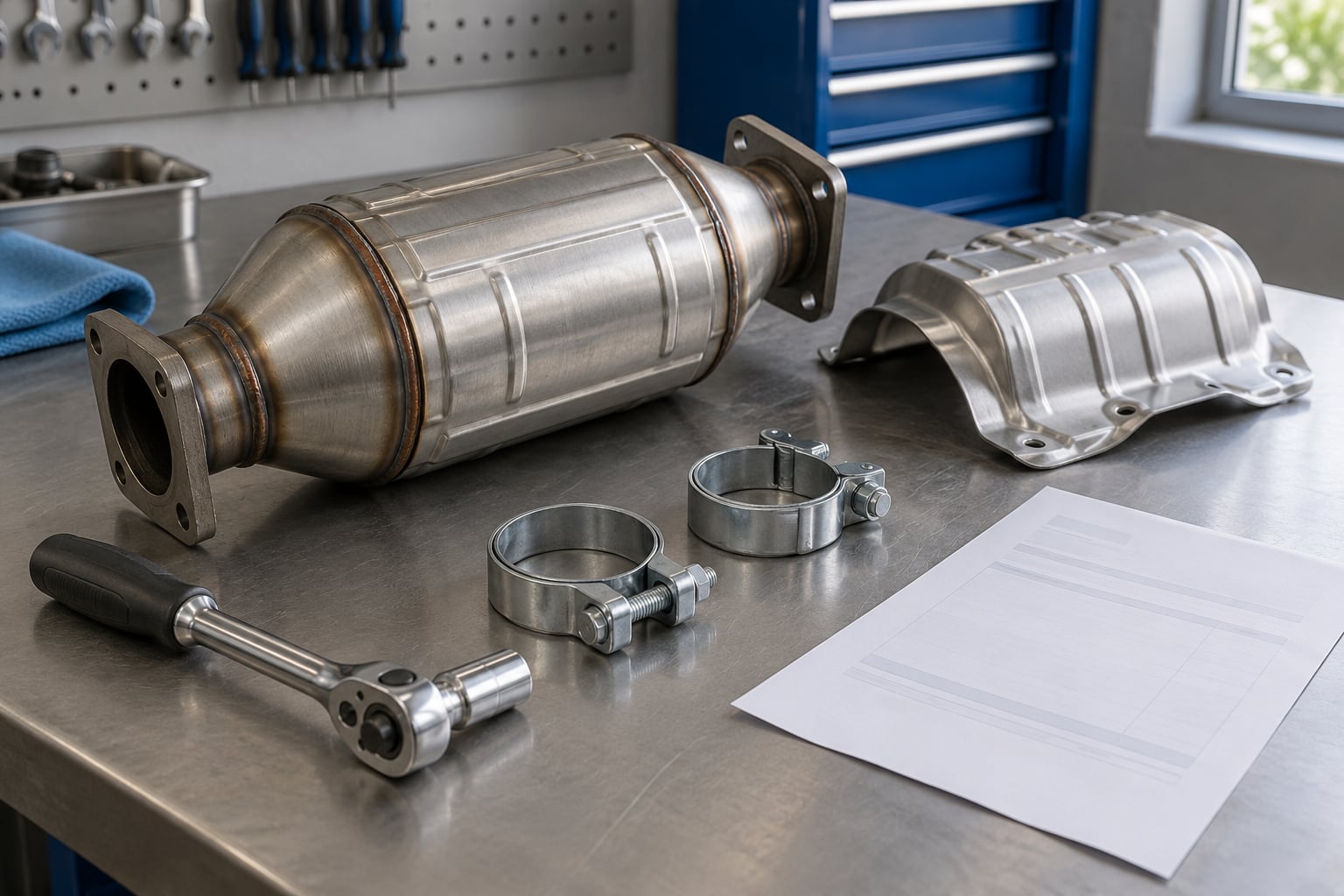
Most catalytic converter replacements run 1,150 to 3,250 dollars at an independent shop and 1,500 to 4,500 dollars at a dealer using the factory part. That wide spread is the whole story: how much does it cost to replace a catalytic converter comes down to which part tier you buy, who does the work, and whether the old unit is credited back to you. The part is normally the bigger half of the invoice.
Here are typical US ranges for 2026. They vary by region and change over time, so treat them as planning numbers rather than quotes.
Owner-reported numbers in the forums sit all over that map, and that is the honest part nobody likes. On r/askcarguys a regular described a cat as going anywhere from a few hundred dollars to well over a grand, with their own job landing near 700. On CarTalk another owner asked whether 873 dollars was a fair price for the same work, which tells you how much the market varies for a single repair. Meanwhile an RV owner on rvforum.net was looking at 7,600 dollars to clear a converter on a Ford coach, and a Lexus owner walked away from a dealership quote in that same neighborhood.
None of those are crazy numbers. They are the same part in different vehicles, sold at different markups, with different amounts of labor bolted on. If a converter is part of a bigger repair year, it is worth budgeting for the rest of the car too, and our guide on how much to budget for used car repairs covers that side of the math.
Table of Contents
- Replacement Cost Breakdown
- What Affects the Price
- Ways to Save
- Frequently Asked Questions
- Can I replace a catalytic converter myself?
- How much does a catalytic converter cost without labor?
- Is it cheaper to replace or repair a catalytic converter?
- Does replacing the catalytic converter reset the check engine light?
- Are aftermarket catalytic converters legal and effective?
- Does a catalytic converter replacement include the oxygen sensors?
Replacement Cost Breakdown
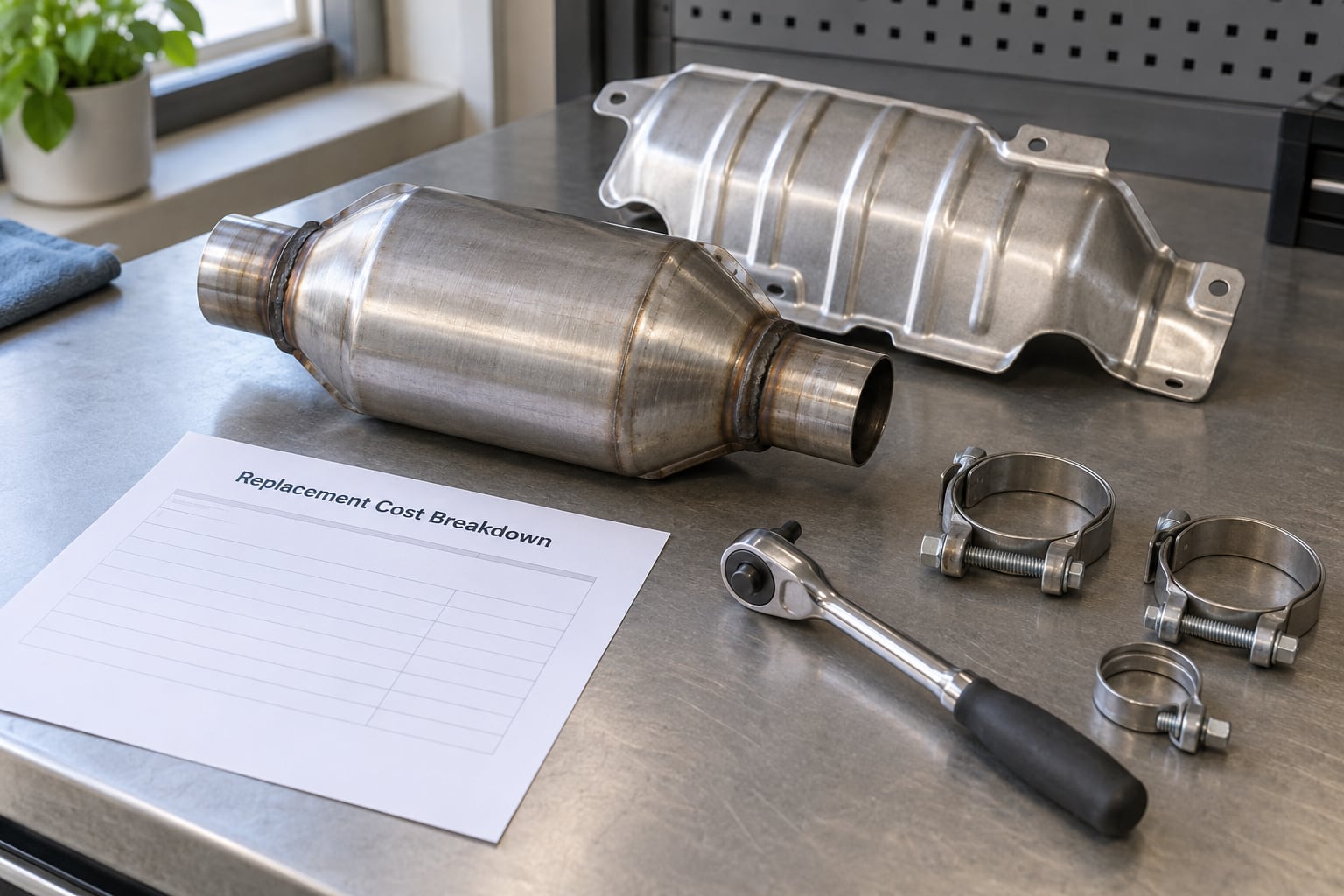
The table below breaks the job into the part, the hours of labor, and the total you should expect to be quoted. Labor assumes a bolt-on flange unit in a normal passenger car. A welded-in or manifold-integrated converter is a different job entirely, and the row at the bottom shows what that looks like.
| Converter option | Part price (USD) | Typical labor hours | Expected installed total (USD) |
|---|---|---|---|
| Direct-fit aftermarket | 250-700 | 1-3 | 900-1,800 |
| Universal / weld-on | 150-450 | 2-3 | 1,000-2,000 |
| Remanufactured / rebuilt core | 300-800 | 1-3 | 1,000-1,900 |
| High-flow performance unit | 350-900 | 1-3 | 1,100-2,200 |
| OEM new from the dealer | 600-1,800 | 1-3 | 1,500-3,000 |
| Fabricated or welded-in OEM replacement | 700-2,000 | 4-8 | 1,800-3,500 |
Trucks, SUVs with two converters, hybrids and diesels all sit above these bands, sometimes well above. A half-ton pickup with a factory exhaust can land past 3,000 dollars at a dealer, and a hybrid converter carries far more precious metal in the substrate, which is why those cores are worth more back.
How Much Does It Cost to Replace a Catalytic Converter by Option?
The economy route is a direct-fit aftermarket or remanufactured unit, and it is the most common fix on an older car. You are usually looking at 900 to 1,800 dollars installed, with the caveat that your state may require a CARB-certified part with a valid Executive Order number on the box.
The mid-range answer is the same repair with a better-documented part and a warranty that puts a name behind it. Remanufactured and OE-supplier units sit here, and 1,200 to 2,000 dollars installed is a realistic target.
Going OEM through a dealer is the top of the ordinary range at 1,500 to 3,000 dollars for a car, and it is the only path that guarantees the part matches the vehicle in emissions terms. Some buyers still take it, especially on a car they plan to keep or one still under an emissions warranty.
Then there are the premium cases: a high-flow unit for a performance car, or a fabricated replacement where the original is welded into the exhaust manifold. Fabrication adds hours of shop time, not just parts, and it is the single biggest reason a quote can run 3,500 dollars or higher.
One thing to separate clearly: replacing a bolt-on converter takes roughly 1 to 3 hours. Removing other exhaust components to reach a welded-in or manifold-integrated unit, or cutting and fabricating a flange, pushes it to 4 to 8 hours. Ask the shop to quote the converter replacement on its own so you can see which one you are buying.
Add-on line items are where quotes quietly inflate. Expect a diagnostic fee in the 100 to 200 dollar range, gaskets and hardware from 20 to 80 dollars, an oxygen sensor at 30 to 150 dollars each if one is needed, sales tax on the part in most states, and a small hazardous waste or recycling fee at some shops.
What Affects the Price
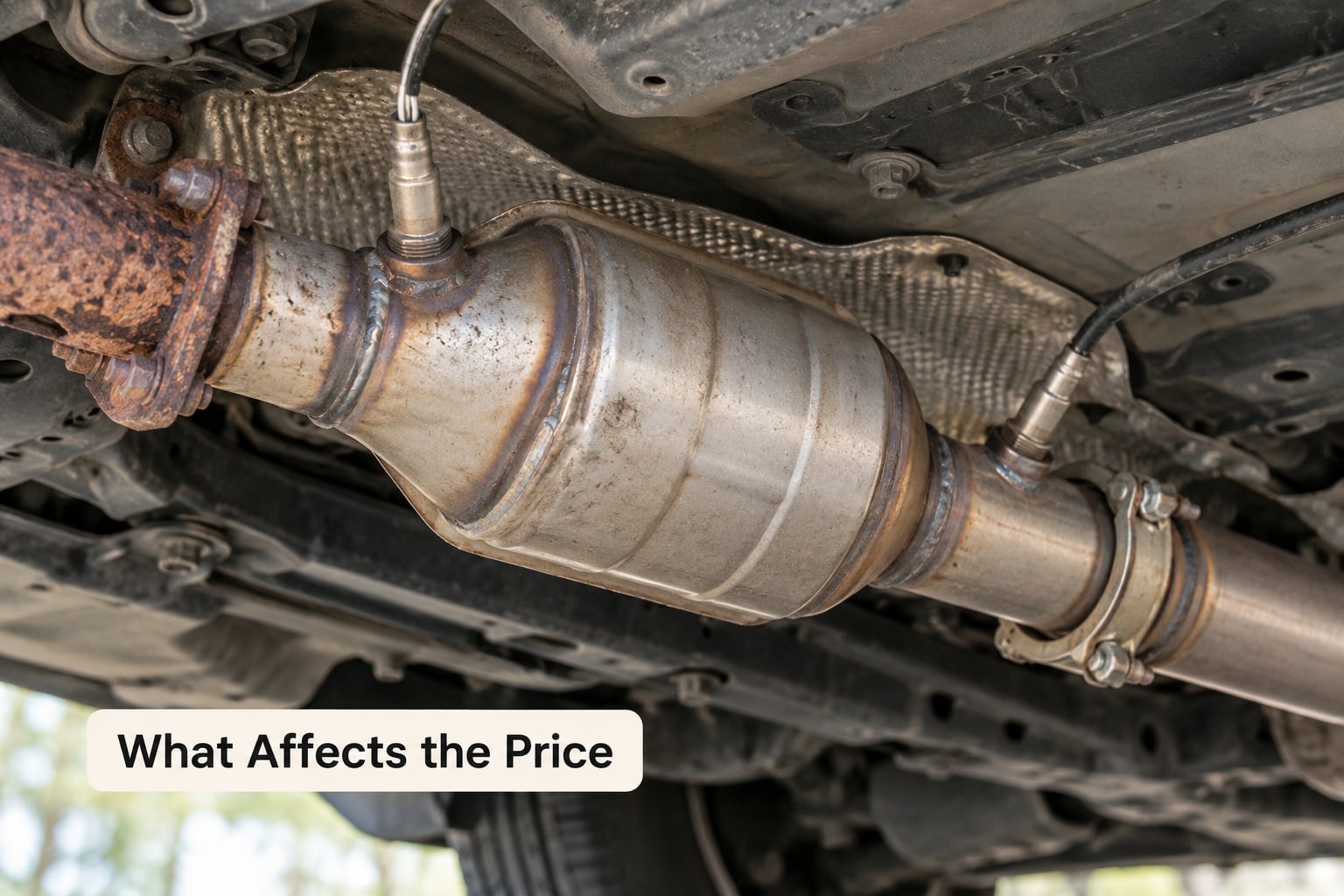
Ten things move the final number more than the part sticker does.
- Make, model and year. A 4-cylinder sedan and a V8 truck with two converters do not share a price, even with the same engine code. The number of converters alone can double the parts bill.
- BMW generation. This is where assumptions cause arguments. Earlier 3-series and Z3 chassis generally use a bolt-on flange converter, while later turbocharged models moved toward welded-in or manifold-integrated designs with the catalyst baked into the manifold assembly. Same badge, completely different labor hours.
- OEM certification. A CARB Executive Order number and EPA compliance are not optional in California and in states that follow those rules. A part without them may be cheaper on the invoice and useless at the emissions counter.
- Where the catalyst sits. Under the floor pan is the friendliest job. Inside the manifold is the worst. Location, more than the converter itself, decides the labor hours.
- Engine layout and access. A transverse engine with the converter tucked against the transmission tunnel can take far longer to reach than a longitudinal layout with a straight shot from underneath.
- Part availability. If the vehicle is out of production or a generation is decades old, the part may be made to order or built from a fabricated section of exhaust, and that shows up as a wait and a higher number.
- Condition of the surrounding exhaust. Rusted flange studs, cracked seams and seized fasteners add time. On a BMW with a corroded flange, the shop will often recommend replacing the flange hardware in the same visit.
- Fabrication and welding. A welding surcharge and extra shop hours apply any time the converter has to be cut out and a new flange built.
- Local labor rates and shop minimums. Independent shops often run 30 to 50 percent below dealers on the same part and the same hours. Some shops also apply a minimum charge that swallows a small job.
- Tax and disposal fees. Sales tax on parts varies by state, and some shops add a core or hazardous handling fee.
The retail-to-wholesale gap is the other thing that makes the price feel indefensible. On a 1,400 dollar quote, commenters regularly noted that the wholesale cost of either converter was under 400 dollars, so retail is running close to three times the underlying metal and manufacturing. That markup is real, and it is why nobody is offended when a good independent shop quotes a good deal less than a dealer.
Before accepting any number, make sure the diagnosis is settled. A P0420 or P0430 code tells you the catalyst system efficiency dropped, not that the converter is the guilty party. A leaking exhaust joint upstream, a lazy downstream oxygen sensor or an engine running rich can all set the same code. One owner on r/askcarguys replaced the converter only to learn the real fault was a short in the engine control module that ran the engine rich, which is what had ruined the original. Our guide to replacing an oxygen sensor on a BMW step by step is worth reading if a sensor code is also in the list.
Ways to Save
Every item below keeps the repair legal, safe and likely to last. None of them cut corners on fitment or welds.
- Collect three written, itemized quotes. Compare line by line, not by total. A cheap quote with no core credit and a 1,500 dollar quote with one are not the same deal.
- Ask a dealer and two independents for the same part tier. A dealer quote against an independent quote on the same part isolates the shop markup cleanly.
- Price a remanufactured or direct-fit aftermarket unit. It is the same job with a cheaper box, and a reputable maker usually warrants the unit for a couple of years and a set mileage.
- Check the emissions warranty before you pay anything. Federal rules cover the catalytic converter on most vehicles for 8 years or 80,000 miles, and some categories run to 15 years or 150,000 miles. If your car qualifies, the repair can be free. The VIN decides this, not the shop.
- Do not replace oxygen sensors that are working. Test them first. Unnecessary sensors are a very common add-on line.
- Fix exhaust leaks and misfires before installation. Whatever broke the first converter will break the replacement the same way. Our piece on what a bad oxygen sensor does to gas mileage covers the fuel economy side of this.
- Get the old converter’s core value back. Old units hold platinum, palladium and rhodium and are worth real money, often 50 to 450 dollars and more on hybrids. Ask whether the credit is on the estimate, whether you can take the unit with you and sell it by its stamped code, or whether they will simply buy it outright.
- Check whether the part or the labor is warranted. A recent paid repair is worth a receipt or a dealer claim. A cheap part plus shop labor is often cheaper than the labor rate the manufacturer wants.
- Ask if the shop will install a part you buy yourself. Dealers usually refuse. Independents often accept it for a flat install fee, which cuts the number substantially. Confirm the part is compliant for your state first.
- Do the job yourself only when it is a bolt-on flange. If the old unit is welded in, this is fabrication work, not a weekend project. Whenever you do take it on, use the correct part, torque the fasteners to the manufacturer specification, mount it securely, and weld leak-free.
And before spending anything at all, run the number against the car. On an old vehicle, a converter quote above roughly 25 to 30 percent of the trade-in value usually means the repair does not pay for itself. One owner with an A4 at 215,000 miles described a car worth about 3,000 dollars facing a 1,650 dollar bill, and worked through that arithmetic honestly instead of pretending the car was worth repairing at any price.
Frequently Asked Questions
Can I replace a catalytic converter myself?
Only when it is a bolt-on flange unit with intact studs and a flange you can reach from underneath. You need a jack or lift, a socket set, a pry bar and new gaskets, plus a way to support the exhaust. Welded-in or manifold-integrated converters need cutting and fabrication, and most shops will not stand behind that work. The labor saving is real, the risk of a bad leak and a ruined new part is also real.
How much does a catalytic converter cost without labor?
A direct-fit aftermarket unit runs roughly 250 to 700 dollars, a universal weld-on about 150 to 450, and a remanufactured unit around 300 to 800. The factory part from a dealer commonly lands between 600 and 1,800 dollars for a car, and well past that for trucks, hybrids and luxury models. Online retail prices reflect the part only. Nothing in those numbers includes the diagnostic, gaskets, sensors, tax or labor.
Is it cheaper to replace or repair a catalytic converter?
A converter cannot be repaired once the ceramic honeycomb is broken or the melt has frozen, so replacement is the only real option for a failed unit. The cheaper path is often fixing what broke it: an exhaust leak ahead of the catalyst, a lazy downstream oxygen sensor, or an engine misfire burning the substrate. Repair those first even when you are replacing the converter, or the new unit fails the same way.
Does replacing the catalytic converter reset the check engine light?
Not by itself. Most shops clear the codes with a scan tool after the work, and the light stays off only if the fault is genuinely gone. If the underlying cause was a leak, a bad sensor or a rich-running engine, the code returns within a few drive cycles. Once the codes are cleared, drive the car long enough to complete a full warm drive cycle so the monitors can run before you consider the repair complete.
Are aftermarket catalytic converters legal and effective?
Yes, when the part carries current EPA compliance and, in California and states that follow those rules, a valid CARB Executive Order number printed on the box. A quality direct-fit aftermarket unit performs like the original and usually costs much less. Universal and used units are a different story: used converters are restricted or banned from installation in some states, and penalties reach thousands of dollars for a shop or individual and far more for a dealer.
Does a catalytic converter replacement include the oxygen sensors?
Usually not. The quote covers the converter itself, new gaskets, and the labor to swap the unit. Sensors are separate line items unless the diagnosis showed one is faulty, and a downstream sensor commonly adds 30 to 150 dollars for the part plus a little labor. Replacing sensors that still work is one of the most common upsells on this repair, so ask for test results before agreeing to any of them.
Before you commit to any number, do four things. Pull the VIN and confirm exactly which converter the car takes, because the same BMW badge covers bolt-on and welded-in hardware. Check the emissions warranty status, since an 8 year or 80,000 mile federal warranty can make the repair free. Have the exhaust inspected for leaks, studs and seams, because a converter installed over a leak fails fast. Then get an itemized written quote showing the part, the labor hours, every add-on, and the core credit.
Get two more quotes before you sign anything, and read them line by line. The difference between a fair quote and a padded one is usually one part tier and one core credit, and both are visible once the estimate is written down.