
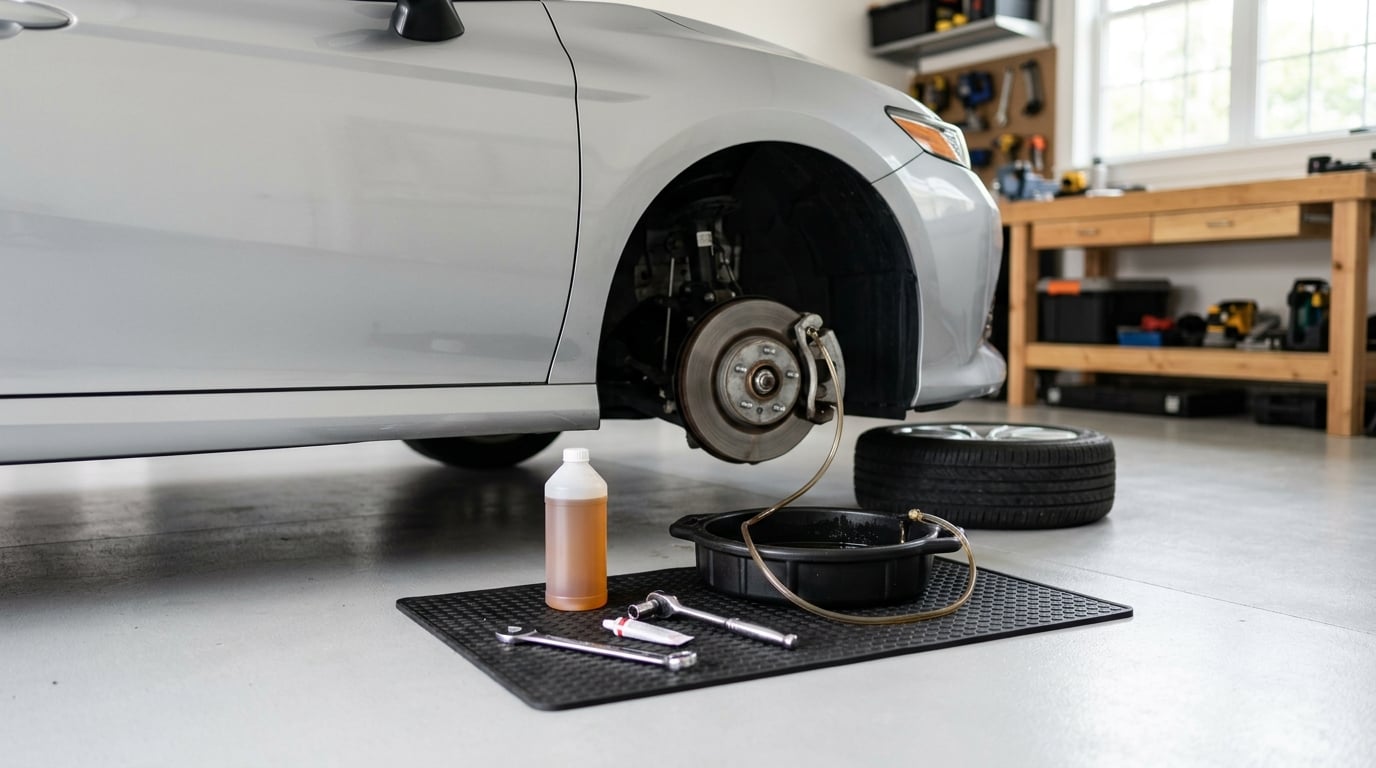
Brake fluid change cost usually lands between 80 and 250 dollars in the US, and how often you change it is set by your owner’s manual: usually every 2 to 3 years, or 24,000 to 36,000 miles, whichever comes first. Labor is the expensive part. The fluid itself is a 15 to 30 dollar purchase.
That is the whole answer, and it is also the answer most shops will not give you plainly. Chain pages and dealer sites say “contact your store” and then quote you when you arrive. Here is the cost spread, the interval logic, and how to tell a legitimate recommendation from an upsell.
One note before we start. Every price in this guide is a typical US range. Your region, your shop’s labor rate and your vehicle all move these numbers, and they change over time. Treat the table as a benchmark you can compare a real quote against, not as a price list.
Table of Contents
Brake Fluid Change Cost by Service Type
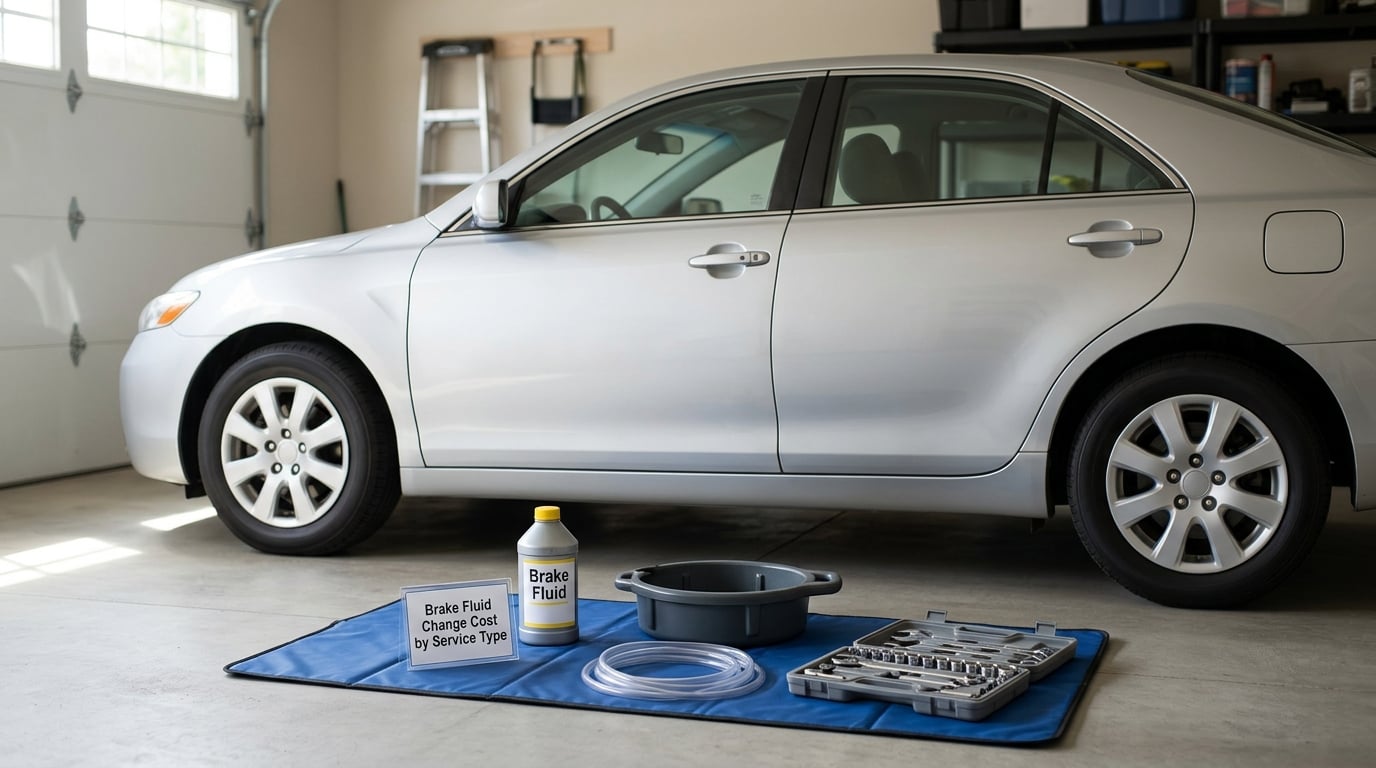
A flush on a typical passenger car runs 90 to 160 dollars at an independent shop, 130 to 220 dollars at a quick-lube chain, and 180 to 330 dollars at a dealer. A DIY drain-and-refill of the reservoir and calipers costs roughly 20 to 60 dollars in fluid and tools.
Those numbers are for a straightforward four-wheel car with a hydraulic or mildly electronic parking brake. Once you add a BMW with silicone fluid, a truck with a rear drum or an ABS unit that needs a scan afterward, the top of every range moves.
What “flush” actually means
Three different services share one name, and the price gap between them is huge.
- Top-off. Someone pours new fluid into the reservoir until it reads full. Costs a few dollars and exchanges almost none of the fluid in the lines. On many cars it is worse than useless, because fluid level is how the car reports pad wear. You mask a warning light and leave the old fluid in place.
- Drain-and-refill. The reservoir is emptied, the calipers are opened and drained, new fluid goes in, and the system is bled. Removes a meaningful share of the old fluid. This is what most people are actually buying when they ask for a change.
- Full exchange or flush. New fluid is pushed through the system while the old fluid is bled at each caliper and the ABS unit, so nearly all of the old fluid leaves. More labor, more fluid, higher price. Worth it if the fluid is old, dark or contaminated.
If a shop will not tell you which of the three you are getting, that is your first red flag.
Cost by service channel
| Service type | Typical total (USD) | What is included |
|---|---|---|
| DIY drain-and-refill | 20 to 60 | 2 to 3 quarts of correct-spec fluid, drain pan, bleed sequence done at home |
| Independent brake or general repair shop | 90 to 160 | Labor for a drain-and-refill or flush, fluid, new bleed, disposal |
| Quick-lube chain | 130 to 220 | Same labor, often bundled into a scheduled service appointment |
| Dealership | 180 to 330 | Factory-spec fluid, documentation on the maintenance record, higher labor rate |
| Mobile mechanic | 150 to 275 | Shop labor rates and fluid, with a call-out fee added on |
BMW owners should expect the dealer end of that table or higher. Silicone DOT 5 fluid runs roughly three times the price of glycol fluid per quart, and BMW specifies it on most models. Our guide to what DOT 5 brake fluid is used for explains why those two fluid families cannot be mixed.
How Often Should Brake Fluid Be Changed?
Change brake fluid every 2 to 3 years or 24,000 to 36,000 miles, whichever comes first, following your owner’s manual. Shorter intervals apply to towing, mountain driving, coastal humidity and heavy stop-and-go use, and a fluid change is due immediately after any caliper, hose or master cylinder is replaced.
Manufacturers disagree on the exact numbers, and that disagreement is real, not marketing. Common schedules in owner manuals include 2 years or 24,000 miles, 3 years or 30,000 miles, and 3 years or 36,000 miles. Your manual is the only one that counts for your car.
Why fluid goes bad even when the brakes feel fine
Brake fluid is hygroscopic. It pulls moisture out of the air through the reservoir vent, through the rubber flex hoses and every time a caliper is opened for service. Nobody is doing anything wrong. The fluid is designed to do this.
Moisture does two things. It drops the boiling point, so fluid that has absorbed water can boil inside a hot caliper after a long descent or repeated hard stops, and the pedal goes soft or all the way to the floor. It also corrodes the steel hard lines, the caliper bodies and the small passages inside the ABS hydraulic control unit, which is the expensive part to replace.
There is a third, quieter change. The additive package that inhibits corrosion and keeps rubber seals supple depletes as the fluid ages, and there is no indicator light for that. Old fluid also becomes more viscous when cold, which is part of why a cold pedal feels vague on a neglected car.
So the honest answer to “do I actually need this” is: the interval exists because the fluid changes whether or not the pedal feels bad, and you cannot feel moisture content through the pedal.
Interval by duty cycle
| How you drive | Suggested interval | Why |
|---|---|---|
| Daily commuter, mostly highway | 3 years or 36,000 miles | Baseline, low heat load on the fluid |
| Heavy stop-and-go city driving | 2 years or 24,000 miles | Frequent heat cycling and frequent pedal work |
| Mountain roads, long descents | 2 years or 24,000 miles | Repeated sustained braking cooks the fluid, and this is the fluid’s boiling point showing up as pedal travel |
| Towing and hauling | 2 years or 24,000 miles | Trailer weight multiplies brake heat on every stop |
| Coastal or high-humidity climate | 2 years or 24,000 miles | More ambient moisture available to absorb |
| Low mileage, mostly regen braking | 2 to 3 years, whichever first | Time matters more than miles; see below |
The last row gets asked about more than anything else, mostly by EV owners. A regular reader on a Rivian asked on r/Rivian how fluid goes bad when they barely touch the pedal, and the thread pulled hundreds of reactions. The short answer: fluid ages on the calendar through moisture ingress and additive depletion, both of which happen with the car parked. The regen argument is real for fuel use and irrelevant for fluid chemistry.
Do not wait on the calendar if you notice these
- The pedal feels spongy or mushy, or travels further than it used to
- The pedal goes soft after a long descent or repeated hard braking, then firms up once the car cools
- The ABS or stability-control warning light comes on
- The fluid in the reservoir looks dark, opaque or murky instead of clear amber
- You see rust-colored particles or flecks in the fluid
- Any brake component was replaced recently, or the car sat parked for a year or more
Two of those deserve an explanation. Pedal travel that grows when the brakes are hot is vapor lock from contaminated fluid, and it is the single most convincing sign that fluid is past due. We break the rest down in our walkthrough of how to tell if brake fluid is contaminated. Fluid level dropping between services is not listed because many cars use that level as a pad-wear indicator, which is the argument against a cheap top-off.
What Affects the Price
Seven things move a brake fluid change cost quote, and they are mostly independent of each other.
Vehicle size and brake layout. A compact sedan with four small calipers bleeds fast. A truck or SUV with larger calipers, a proportioning valve setup or larger fluid volume takes longer, and the caliper banjo bolts have to be resealed. Labor scales with the number of bleed points and access, not the badge.
BMW and the DOT 5 surcharge. Most BMWs specify DOT 5 silicone fluid. A quart of it can cost two to three times a quart of DOT 3, and the fluid is often sold in smaller containers. The hydraulic system also needs the correct bleed procedure, which is slower. Both push a BMW toward the top of every range here, and it is a specification issue rather than a luxury-brand tax.
Which fluid your car requires. The spec is embossed on the reservoir cap or printed on a decal on the master cylinder. DOT 3 and DOT 4 are glycol-based, DOT 5.1 is a glycol blend, and DOT 5 is silicone and should never be mixed with glycol. Using the wrong one means draining it again.
The service method. A top-off is trivial. A drain-and-refill takes real bench time. A full exchange means bleeding at every caliper in sequence and purging the ABS unit, and that is the single biggest line item difference between a 100 dollar quote and a 250 dollar quote on the same car.
Shop type and labor rate. The fluid costs the same wherever you buy it. What changes is the hourly rate, and a dealer or mobile service can easily run two to three times an independent shop’s rate for identical work. This is the part forum owners keep coming back to: on rennlist.com a Porsche owner put it plainly, brake fluid is less than 20 dollars a bottle, so it is all about labor rates.
Fluid quantity. Most cars take 1 to 2 quarts, larger vehicles closer to 3. A full exchange deliberately uses more fluid than the system holds, because the extra is what pushes the old fluid out. This is another reason the fluid line on the invoice looks bigger than expected.
Hardware that needs extra procedure. Electronic parking brakes usually have a service mode or a pedal-peddling sequence in the owner’s manual, and some sedans with rear drums need the adjustment taken apart to bleed. Hard lines versus flex hoses changes access, and a flex hose that is old and stiff can make the job longer. None of this is exotic, and a good shop prices it up front.
Ways to Save
Each of these cuts a different part of the bill, and none of them compromise the job.
Ask for a standalone written quote. Chains routinely list a flush at a low figure when it is bundled and quote much more when it stands alone. Ask what the price is by itself, in writing, before you arrive. A quote you can compare is the cheapest tool you have.
Buy the fluid yourself. The exact spec is on your reservoir cap. Buying 2 to 3 quarts of DOT 3, DOT 4, DOT 5 or DOT 5.1 as the label requires and handing it to the shop removes the mark-up entirely, and most shops accept customer-supplied fluid if you hand it over sealed. It is a small line item, but it is free money.
Do the reservoir and caliper drain-and-refill at home if your car suits it. Cars with a manual or hydraulic parking brake and no complex ABS suite are reasonable candidates. You need a bleed bottle, a clear hose, a drain pan and a bleed sequence, and the fluid cost is under 40 dollars. The catch is honest: on an ABS-equipped car with an electronic parking brake, an air bubble left in the system can mean a trip to the dealer anyway, and bleeding a modern system properly is fussy work.
Skip the additives. Brake fluid additives, DOT 5 conversion claims and conditioners sold alongside a flush are not on the factory schedule and do not extend the service interval. DOT 5.1 is not an upgrade you can pour over DOT 3. Ask what is in the owner’s manual specification and buy exactly that.
Do not bundle a fluid change into a big service unless it is due anyway. A clublexus.com owner quoted 580 dollars for a 30,000-mile service in which the brake fluid change was a 130 dollar line item, and said the fluid was worn out by 30,000 miles. Bundling is fine when both items are genuinely due. It is not fine when a 130 dollar service becomes 250 dollars because it rode along with pads and rotors that had years left.
Get the fluid tested before you agree to anything. Cheap test strips or a bench test tell you the moisture content and whether the additive package has broken down. Our step-by-step on how to test brake fluid with a moisture tester covers the two methods worth knowing. If a shop says the fluid is fine, that test is a reasonable thing to ask for before agreeing to an exchange.
Time the service to your own schedule, not the shop’s. Fluid ages with time as much as miles. If your car sits between long drives, the calendar matters more than the odometer, and scheduling on the two-to-three-year mark is fine even at low mileage.
Frequently Asked Questions
How much does a brake fluid change usually cost in the US?
A DIY drain-and-refill runs 20 to 60 dollars in fluid and tools. An independent shop charges 90 to 160 dollars, a quick-lube chain 130 to 220 dollars, and a dealer 180 to 330 dollars. Labor is the cost driver, not fluid, and BMW models with silicone DOT 5 sit at the top of every range.
Do I need a full brake flush or just a fluid refill?
A refill drains the reservoir and calipers and exchanges part of the fluid, which suits a car on schedule with clear amber fluid. A full exchange pushes new fluid through while bleeding every caliper and the ABS unit, which is worth the extra cost when fluid is several years old, dark, or after a brake component was replaced. Ask the shop which one you are getting.
Can I change brake fluid myself on a BMW?
It is harder than on most cars. BMWs commonly specify silicone DOT 5 fluid, which costs two to three times a quart of glycol fluid and must not be mixed with DOT 3 or DOT 4. Many also have an electronic parking brake that needs a service mode before the rear calipers will bleed. Confirm the spec and the procedure in the manual before starting.
What type of brake fluid does my car need?
Check the reservoir cap, which normally has the DOT number molded into it, or a decal on the master cylinder or engine bay. Most passenger cars use DOT 3 or DOT 4, many use DOT 5.1, and most BMWs use silicone DOT 5. Never mix silicone DOT 5 with glycol fluid, and do not pour DOT 5.1 over DOT 3 assuming it is an upgrade.
How do I know when brake fluid should be changed sooner?
A pedal that feels spongy, travels further than it used to, or goes soft after a long descent and firms up once the car cools is the clearest sign. Also watch for the ABS or stability-control light, fluid that looks dark or murky instead of clear amber, rust-colored flecks, and any brake component replaced in the last year. Any of these means test the fluid now rather than waiting for the interval.
Conclusion
Start with the owner’s manual in the glove box. It gives you two things no shop can argue with: the interval and the fluid specification, usually printed on the reservoir cap. Then look at the fluid in the reservoir and compare it with the symptoms list above, because dark fluid and a pedal that changes with heat are worth acting on early.
After that, compare two quotes side by side: one for a DIY drain-and-refill if your brake design is simple, and one from an independent shop, with a dealer quote as the ceiling. Ask each of them to say in writing whether it is a drain-and-refill or a full exchange. Whichever you pick, brake fluid change cost is a known job with a known range, and you should never have to guess what you are paying for it.