
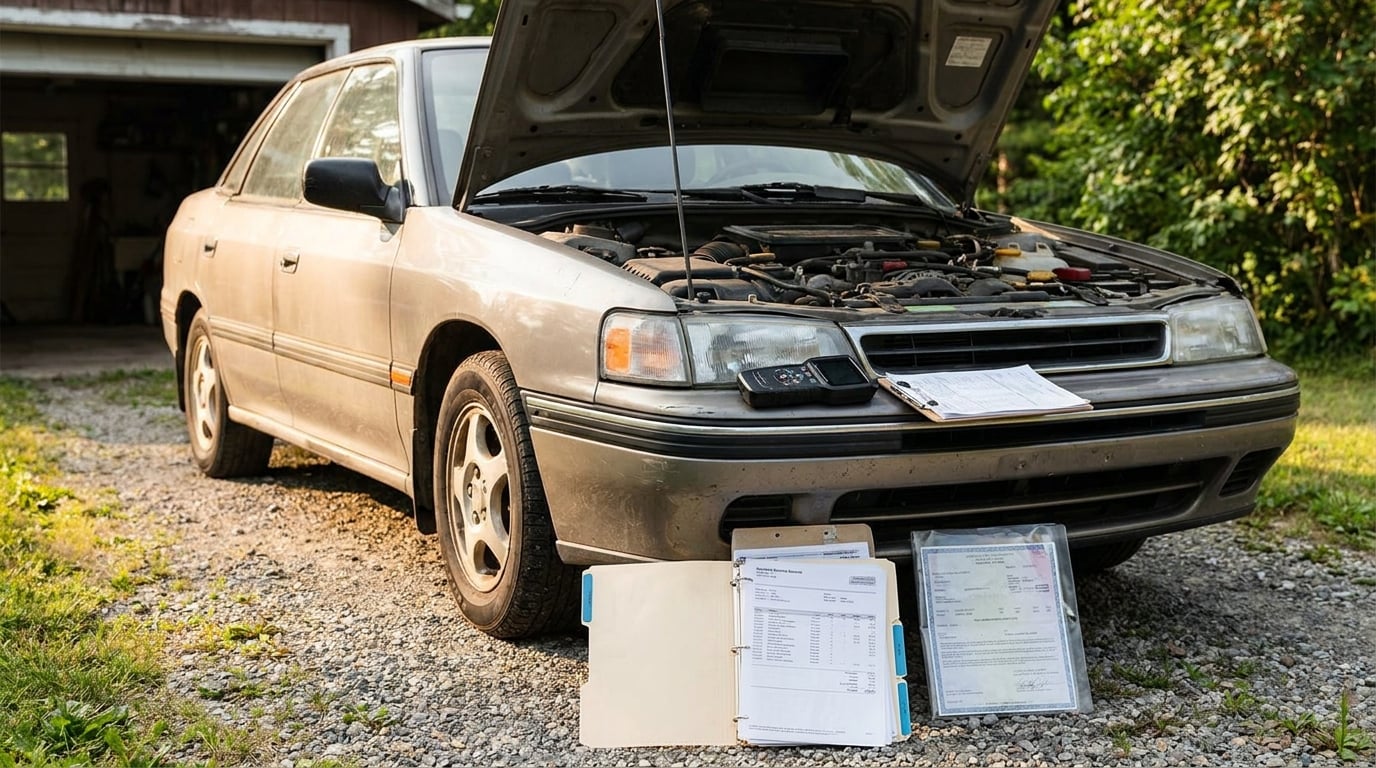
What to look for when buying a high mileage car comes down to three things: documentation that proves the miles are real, a body and underside free of structural rust, and a mechanical condition that matches the number on the odometer. Mileage itself is only a proxy for wear, and a well-documented 150,000-mile car is a far better purchase than a detailed 90,000-mile one.
Most high-mileage buyers get burned the same way. They trust a clean engine bay, believe the odometer, and discover a head gasket job or a rusted-through floor six months later. A slow walk-around in daylight, a scan tool, and an independent inspection catch nearly all of that before you commit.
Here is how I would approach a high mileage car, in the order I would approach it, whether it is a 12-year-old sedan or a pickup doing 25,000 miles a year.
Table of Contents
- What to Look for When Buying a High Mileage Car at a Glance
- Verify the Mileage and Service History
- Check the Title, VIN, and Ownership Record
- Inspect the Exterior for Accident and Rust Damage
- Look Under the Car for Leaks and Structural Damage
- Check the Engine Bay for Maintenance and Warning Signs
- Test the Engine, Transmission, and Brakes
- Review Tires, Wheels, Alignment, and Suspension
- Check the Interior for Warning Signs
- Compare the Asking Price With Maintenance Costs
- Use a Pre-Purchase Inspection and Ask Smart Questions
- Frequently Asked Questions
- What mileage is too high for a used car?
- How can I tell if a used car’s mileage was rolled back?
- Should I get a pre-purchase inspection for a high mileage car?
- Can a reliable service history make a high mileage car worth buying?
- How much should I negotiate on a high mileage used car?
- Is a seller’s warranty or buyer’s guarantee enough protection?
- Conclusion
What to Look for When Buying a High Mileage Car at a Glance
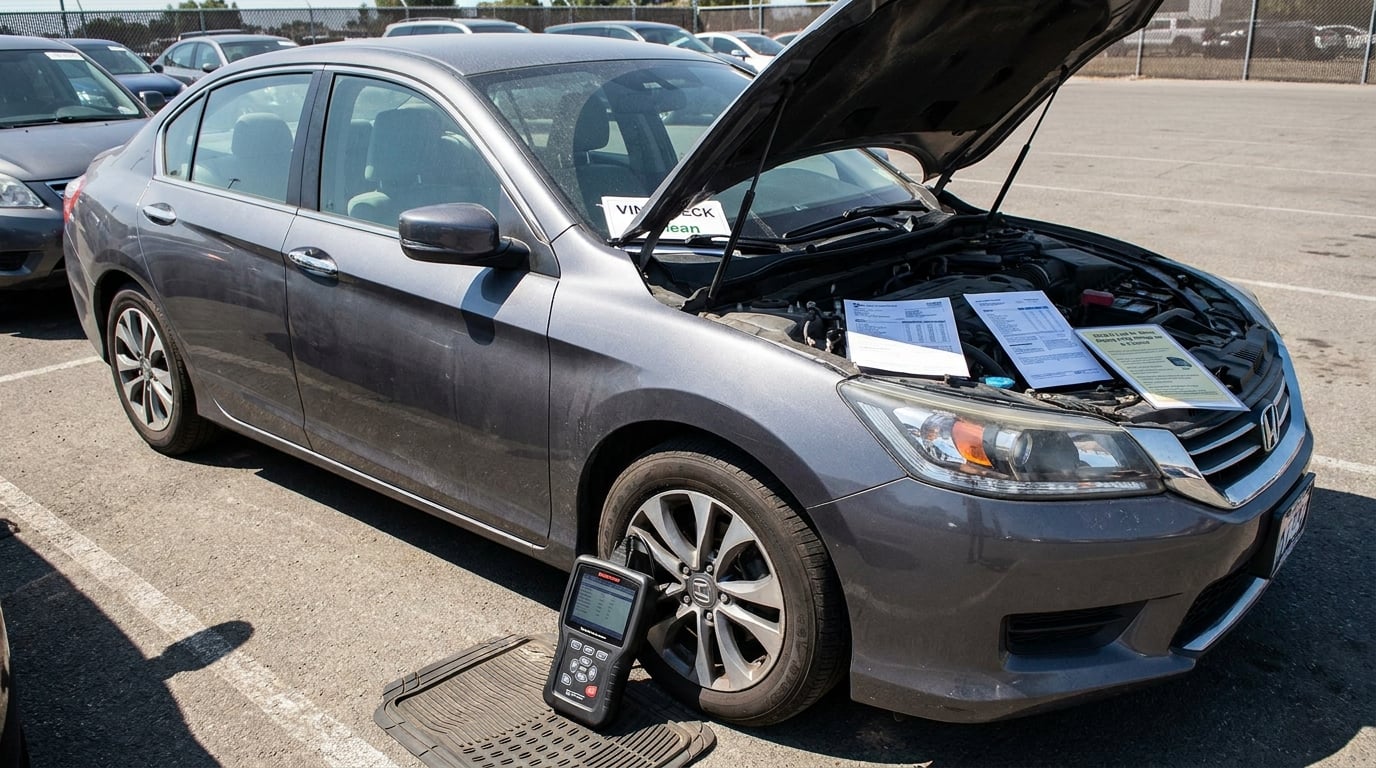
There are seven checks that decide most high mileage purchases, and only two of them need a mechanic. Everything else takes about 30 minutes with the engine cold and the car in daylight.
| Check | Main warning signs | Mechanic needed? |
|---|---|---|
| Mileage and records | Odometer reading lower than history-report entries, missing service intervals, a digital cluster that cannot report its reading | No |
| Title and VIN | VIN mismatch between door jamb, dash and title, salvage, rebuilt or flood brand, open lien, too many owners in a short span | No |
| Body and paint | Paint mismatch across panels, uneven gaps, overspray, weld lines, bubbling clear coat, filler under paint | No |
| Rust and underside | Rust holes, crust at strut towers and floor pans, fresh undercoating hiding a previously bare frame | Yes, ideally on a lift |
| Engine bay | Low or foamy oil, low coolant with dried crust, cracked belts and hoses, rodent nests, disturbed emissions labels | Mostly no |
| Test drive | Blue or white smoke, hard shifts, hesitation, brake pulsation, pulling to one side, vibrations over a certain speed | Yes if anything shows up |
| Price | A number that ignores the repairs the inspection just found | No |
Run through that table in order. It stops you from standing in a parking lot trying to remember the order of things you meant to check.
Verify the Mileage and Service History
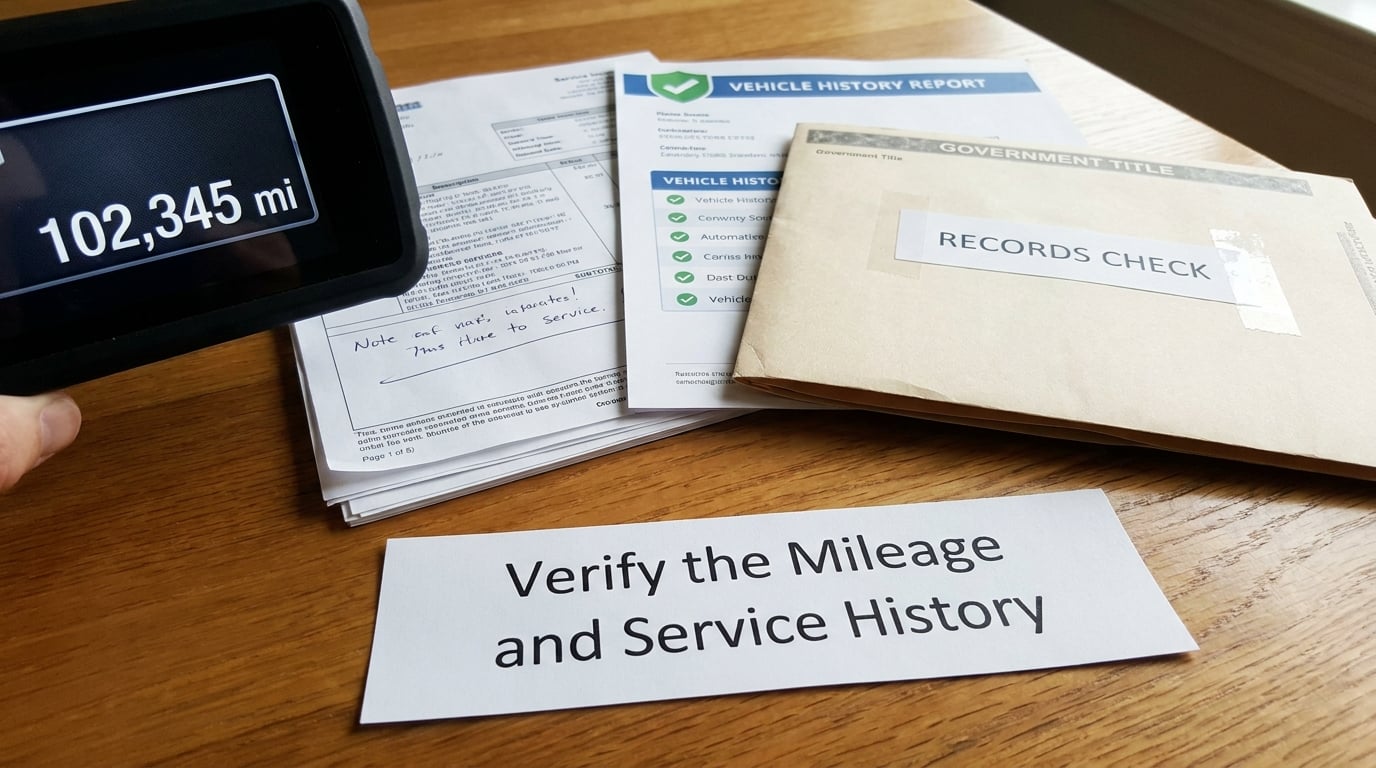
Honest mileage is verified by cross-checking, not by looking. The odometer number means nothing on its own.
Line up these sources and compare them against each other:
- The odometer reading as it stands now, photographed before anything else happens.
- Vehicle history report entries, which carry a mileage reading at every service visit, inspection and title transfer recorded.
- Service invoices and receipts, dated and stamped with a mileage.
- Title and registration history, which usually record distance at transfer in some states.
- Physical wear inside the car, described in detail further down.
Rollback leaves a paper trail. A 2016 car with 78,000 miles showing on the cluster but with history-report entries at 91,000 and 104,000 miles has a problem no amount of good paint fixes. In older cars, a non-digital or physically damaged cluster and a suspiciously clean replacement-style bezel are worth a closer look. A report showing an odometer exception is a walk-away.
What makes mileage credible is boring and specific: oil changes at believable intervals, a cooling system service, transmission fluid work, brake work when the mileage called for it. Forum owners consistently point to dated, verifiable records as the number one trust signal, and advice in r/Porsche threads is simple, buy one with complete records and one or two owners, ideally ending with a long-term owner.
One r/MechanicAdvice thread is worth reading as a calibration point. An owner with a 2011 Mazda 3 at 217,000 miles replaced a serpentine belt, an alternator, spark plugs and a valve cover gasket in a single year. Every one of those is a consumable part, not a verdict on the car. That is what a documented life looks like.
Check the Title, VIN, and Ownership Record
A VIN that matches everywhere and a clean title are the minimum. Anything less is a reason to stop, not a negotiating position.
Compare the VIN in at least four physical places: the plate visible through the windshield, the driver-side door jamb sticker, the title, and the printed history report. Those four must be character-for-character identical.
Then read the title brand, which carries more weight than most buyers realize:
- Clean is the normal status and the only one that should feel comfortable.
- Salvage means an insurer declared the car a total loss. Repairs are often done cheaply.
- Rebuilt or Salvage-rebuilt means it was repaired and re-certified by a shop, not by the manufacturer.
- Flood means submerged water entered the cabin or engine area. Hidden corrosion and electrical failures often appear years later.
- Certificate of Destruction means it should not be back on the road at all.
Check for open liens at the DMV using the VIN before you pay anyone. An unpaid lien means the previous owner still has a claim on the car and a seller with a story about paying it off later is a common failure.
Walk away when the VIN does not match, when the title is missing or in transit, when the seller cannot produce a title, when a lien is unresolved, or when the ownership record shows a pattern of very short private-party ownership that never lines up with a registration. A title that does not add up is not a bargaining chip. Do the reasoning and then leave.
Inspect the Exterior for Accident and Rust Damage
Cosmetic defects are rarely cosmetic. A repainted panel on a high mileage car usually means a structural or electrical repair happened behind it.
Walk the car in a parking lot, not a driveway, and look at it from a crouch at panel height. Check these in order:
- Panel gaps that vary along one door, or a hood and fender that do not line up on the same side.
- Paint mismatch, where a panel is a slightly different shade, especially on a car that was supposedly one color from the factory.
- Overspray and texture on trim, weatherstripping or the edge of an adjacent panel, plus overspray on the ground beneath the car.
- Sanding marks and mismatched primer visible in a chip or a door edge.
- Weld lines and heat-discolored metal near structural areas such as the strut towers, inner fenders and rear wheel housings.
- Bubbling or peeling clear coat, which usually means corrosion or adhesion failure underneath.
Paint meter readings from different areas of a panel are a cheap, fast way to catch filler, though the number means little on a car that is due for a respray anyway.
Fresh undercoating deserves suspicion of its own. A thick, even, black coat on a car that has never been in a salt belt, applied this year over a frame that was clean before, is a question you should ask out loud. In road-salt states, surface rust on a subframe is far more common than holes, and thick coating is often covering exactly what you want to see. If you are buying in the Northeast or upper Midwest, treat undercoating as a reason to ask for an undercarriage look on a lift.
Look Under the Car for Leaks and Structural Damage
The underside is where rust kills cars quietly, and it is the one area most buyers never see.
With the car on level ground, park it somewhere you can lie flat safely, ideally after a short drive so the fluids are warm and easier to see. Look first, touch nothing hot.
- Fluid spots under the front end, especially dark oil, pink or green coolant, and clear or dark transmission fluid.
- Wetness or fresh streaks running down from suspension components, and brake dust that looks unusually heavy on one side only.
- Crusty, flaking rust at strut towers, subframe mounts, floor pans, rocker panels, wheel arches and the exhaust hangers.
- Rust holes you can see daylight through, or metal that flexes when you press on it.
- Exhaust hangers broken or missing, visible bends in the pipe, and a heat shield hanging loose.
- Fluid on the brake booster or master cylinder, or on the transmission pan.
Some marks are perfectly normal. A clean car can drip a few drops of condensation from the air conditioning line after sitting, brake dust on the front wheels is what you would expect from normal stopping, and a light film of oil under a valve cover gasket is common past 100,000 miles. What is not normal is a steady puddle, crust, or streaks that follow gravity from a specific joint.
Owners in enthusiast forums are near-unanimous that rust on the frame, floors and strut towers is the number one deal-breaker, and the reason is simple. Corrosion in those areas is a structural problem, it is expensive, and no amount of cosmetic work fixes it. Ask the seller to have the car put on a lift at a shop you choose, and expect to pay a small shop fee for the look.
Check the Engine Bay for Maintenance and Warning Signs
The engine bay tells you whether this car was maintained or just cleaned. Ask to see it start cold, because a freshly detailed bay means nothing once the engine warms up.
Before starting, look at:
- Oil level and color on the dipstick, and the underside of the oil filler cap. Milky residue on the cap or a coolant-like level on the dipstick is a head gasket problem, not a service item.
- Coolant level in the radiator or expansion tank, and any dried crust or residue around the cap, which points to a past overflow.
- Belts and hoses for cracking, fraying, glazing or a shine on the side of the belt. Note the date on the battery label, since a battery over five years old is near the end.
- Engine mounts for separated rubber, and visible oil weeping from a seal.
- Intake and wiring for torn boots on the crankcase vent hose, a chewed wire loom, or a connector with a repaired pin.
Look for nests, shredded insulation and gnawed wiring under the hood. Rodents build in a warm engine bay and a chewed harness is a real failure waiting for weather.
Check the underhood emissions and warning stickers for signs they were peeled or disturbed. A missing sticker is more of a hint that the car was not kept on the original powertrain than a defect in itself.
Two safety rules that are not optional. Never open a radiator or coolant cap on a hot engine, because the system is pressurized and the release scalds. And keep your hands out of belts, fans and pulleys while the engine runs, even on an automatic car in park.
Test the Engine, Transmission, and Brakes
A test drive tells you more about a high mileage car than a walk-around does, and a short hop around the block tells you almost nothing. Insist on 20 to 30 minutes, mixing city streets, a highway on-ramp and a stop-and-go section.
Cold start, idle and smoke
A healthy cold start catches within a second or two and settles to a steady idle. White vapor for a moment in cold weather is condensation and nothing more. Blue smoke at startup that clears is a valve stem seal weep, common and often manageable with a high-mileage oil. Thick blue smoke under load, or white smoke with a sweet or burnt smell, is a different conversation entirely. Thick white exhaust means coolant is getting into the combustion chamber, which is expensive.
Transmission behavior
Watch and feel every shift. A dip into a lower gear is often just a torque converter working as designed. Hesitation, a shudder, a flare that never returns to a clean shift, or a clunk between drive and reverse means the transmission is not healthy. If the car has a CVT, the shudder at low speed under load is the well-known failure and it is not a small repair.
Steering, braking and tracking
The car should track straight and the steering wheel should not sit noticeably off-center. Floating or vibrating over one speed band and then settling is usually a wheel or tire imbalance. Pulsation in the brake pedal at highway speed usually means warped rotors. A firm pedal that drops toward the floor means air or moisture in the hydraulic system. Any pull to one side, thumping over bumps, or clunk when turning is a suspension or steering problem that needs a rack on a lift.
Warning lights and throttle response
Note every illuminated light and ask what it means. A tire pressure light, a bulb-out warning or a glow plug indicator are minor. A check engine light, an SRS or airbag light, or a stability-control light is a conversation before the sale. Throttle should respond immediately and smoothly, and the engine should not stumble when you pull away from a stop.
Anything that shows up as a noise, smoke, shake or bad light on the test drive makes an independent pre-purchase inspection non-negotiable. The car does not get cheaper because you liked the way it felt in the first five minutes.
Review Tires, Wheels, Alignment, and Suspension
Uneven tire wear is the cheapest diagnostic tool you have, because it tells you what is happening underneath the body.
Start at the tread. Look for tread depth across the full width of each tire, including the inner edge, not just the center. Irregular or cupped wear, one side of a tire worn smooth while the other is fine, points to an alignment or suspension issue. Feathering, where the tread blocks feel like they are combed to one side, is an alignment symptom and worth understanding before you pay for anything. Our guide to tire feathering and what causes it breaks down the pattern and the fix.
Check the sidewalls for cuts, bulges and exposed cords, and confirm the tire date codes are not all clustered at the end of their shelf life. Age matters as much as tread. If all four tires are the same brand and roughly the same age, the car probably had them replaced together, which is a good sign.
On the wheels, look for cracks, especially around the spokes or the rim lip, heavy curb rash, and evidence of a recent repair. Check lug nuts for rounded or mismatched heads, which means a wheel came off and the shop used whatever was in the bin.
For wear matching, an aggressive driver leaves a worn seat bolster, a polished steering wheel rim and shiny pedal faces. A commuter who never sees a race track can leave the same mileage with almost no interior wear. That mismatch is not proof of anything, but it is worth asking about. On age and mileage, the tire mileage and age guide covers how to read date codes and estimate remaining life.
Check the Interior for Warning Signs
The inside tells you about water, air bags, electronics and how the car was used. All four change the price.
Look for dampness first. Pull up the driver-side and passenger-side floor mats, lift carpet edges, and check the trunk floor and the area behind the rear seat. Musty odor, water rings on the headliner, a musty smell under the sun visors, or a hatchback weatherstrip that holds moisture all point to water entry, and a flood or storm history should already be visible on the title.
Check the airbags. Every SRS light means the passenger or driver air bag, side curtain or seat-mounted bag deployed. Verify the passenger air bag indicator and that the seat belt pretensioners look original, since replacement parts and repainted trim give the game away.
Test the electronics. Every window up and down, both lock sets, all power accessories, every light including headlamps, brake lamps, signals, hazards and reverse, plus the horn. A window regulator that grinds or a blend door actuator that rattles on an older car is a nuisance repair, not a deal-breaker, but it is a real line item. Fresh detailing in a car of this age is a reason to ask what was being hidden.
Finally, look under the driver-side dash and behind the glove box for a posted code list, and check the odometer reading against the wear on the pedals, seat and steering wheel. Mismatched wear and mileage is a prompt to re-check the history report, not a verdict.
Compare the Asking Price With Maintenance Costs
A low price on a high mileage car is not automatically a bargain, because the buyer usually pays the deferred maintenance soon after the sale anyway. Think in total cost, not sticker price.
Budget in layers. The first layer is normal consumables that a car at this mileage needs soon: a set of tires, brake pads and possibly rotors, a battery, fresh fluids, and one or two ignition components. The second layer is deferred work visible in the records, such as a cooling system service or a transmission fluid change. The third layer is the unknown, which is why you fund a reserve instead of pretending it does not exist.
As a rule of thumb, set aside a repair reserve equal to a meaningful percentage of what you planned to spend on the car, and treat it as money that is already spent. Owners in high-mileage threads tend to keep cars alive on exactly this kind of cash buffer, and several describe the benefit in plain terms: a car that starts every morning, with no loan attached, and no surprise capital expense.
Also count the costs that follow the car, not the ones that come with it. Liability insurance and registration can move sharply by state and by the vehicle, fuel depends on how many miles you actually drive, and resale value matters if you plan to sell in three years rather than keep it for a decade.
When you price the car, use the writing on the wall: look up the model and trim on Kelley Blue Book or Edmunds, then adjust for mileage, options, condition, and the region you are in. A mid-range sedan with 150,000 clean miles is priced very differently from the same car with 150,000 miles of neglect, and the difference is the number you negotiate against.
Do your own math on oil, because it is the most common high-mileage complaint. A faint ring around the oil filler cap from a valve cover gasket is normal wear at this mileage and high-mileage oil with seal-swelling additives often manages it. Find out what your oil means in your situation before you treat seepage as a deal-breaker; we explain the range of causes in what metal in engine oil means.
Use a Pre-Purchase Inspection and Ask Smart Questions
One pre-purchase inspection, paid for by you, at a shop you choose, is the single highest-return thing you can do on a high mileage car. It is the one place you get a lift, a scan tool, a compression test and a transmission check at the same time.
What an independent shop finds that a seller’s presentation does not:
- Frame and subframe rust that undercoating was hiding.
- Stored and pending diagnostic trouble codes, plus incomplete readiness monitors, which show that the battery was recently disconnected or a code was cleared.
- Uneven compression or a leak-down result, pointing at head gasket or valve problems.
- Worn CV axle boots, ball joints, tie rod ends and wheel bearings.
- Fluid condition on a lift, where a small seepage that looked like a stain at ground level turns out to be a steady drip.
- Brake rotor thickness and pad depth measured rather than eyeballed.
Ask the shop for a written report and ask them to sort findings into safety-critical, needed soon, monitor, and cosmetic. That sorted report is what you negotiate with. Every line in the needed-soon tier is a dollar argument, and the written number from an independent shop is much harder to dismiss than your own opinion.
Ask the seller direct questions, and watch the answers:
- Has the car ever overheated, and who did the work.
- Has the transmission ever been repaired, slipped or serviced, and when the fluid was last changed.
- Does the car have a timing belt or a chain, and has the belt, tensioner and water pump been replaced or is any of it due.
- Has any suspension work been done, and why.
- Which fluids leak, if any, and when were they last serviced.
- Why is the car being sold, and is the title clean with no lien.
Before you go, pull the VIN report yourself and check the NHTSA recall database for open recalls plus technical service bulletins. At high miles, bulletins matter more than recalls, since campaigns that were never formally recalled still leave the same worn part on the car.
For a hybrid or an EV, ask for a battery state-of-health report before you look at anything else. Owners weighing high-mileage Teslas tend to treat pack health as the deciding number, and a car with a report beats a car with a promise. If the seller declines an inspection, that refusal is the answer.
One last piece of forum wisdom worth keeping: a maintained car with high miles is frequently the cheapest reliable transportation you can own, and a 1982 Mercedes 300TD-T bought at 350,000 miles, driven to roughly 425,000, and sold for three times the purchase price is the example that comes up most often in r/whatcarshouldIbuy. The pattern in that story is condition and documentation, not the number.
Frequently Asked Questions
What mileage is too high for a used car?
For most used cars, 75,000 to 100,000 miles is where high mileage starts, and the answer depends more on the model than the number. Well-built trucks and Toyotas or Hondas routinely run 200,000 miles with records, while some European sedans show wear at 90,000. Treat age and mileage together: a ten-year-old car averaging 12,000 to 15,000 miles a year is on the normal curve.
How can I tell if a used car’s mileage was rolled back?
Cross-check instead of guessing. Compare the cluster reading with mileage entries on the vehicle history report, compare those against dated service invoices, and look for an odometer exception on the report. A report showing higher mileage than the cluster is the clearest signal. A physically damaged or non-digital cluster, a suspiciously clean bezel, or interior wear that is far lighter than the stated miles are the softer ones.
Should I get a pre-purchase inspection for a high mileage car?
Yes. On a car past 75,000 miles, an independent inspection you pay for yourself is the cheapest risk control available. It puts the car on a lift, reads stored codes, and measures things you cannot, such as compression, brake rotor thickness and subframe condition. Budget it as part of the purchase. If the seller resists or picks the shop for you, treat that as a serious warning.
Can a reliable service history make a high mileage car worth buying?
Often, yes. Dated, verifiable records at believable intervals are the strongest signal you can get, and they are the thing owners cite most often in high-mileage threads. Records showing oil, cooling system and transmission service on time tell you the car was maintained rather than simply driven. A documented 150,000-mile car is a different proposition from a detailed 90,000-mile one with no history at all.
How much should I negotiate on a high mileage used car?
Anchor the number on written findings rather than a percentage. Every item on the needed-soon list from the inspection report is a concrete reduction, so quote the estimate and ask for that amount. Also price against the current market for the year, trim, options and mileage, and adjust for deferred items the seller can prove were done. Then stop at your number and walk if the seller will not meet it.
Is a seller’s warranty or buyer’s guarantee enough protection?
Treat it as a short buffer, not insurance. A buyer’s guarantee usually covers only a short window and a defined list of parts, and many items on a high mileage car, such as a transmission or cooling system, are excluded outright. Ask for the exclusions in writing before you rely on it. A written pre-purchase inspection report plus a reserve fund is far more useful than a warranty you have to argue about later.
Conclusion
Buy the condition, not the odometer number, and work through this in order. Verify the VIN in four places and read the title brand. Confirm the mileage against service records and a vehicle history report. Walk the body in daylight for paint mismatch and rust, then look underneath, ideally on a lift. Cold start the car, run a 20 to 30 minute test drive, and read it with a scan tool. Pay for an independent pre-purchase inspection, sort the report into safety-critical, needed soon, monitor and cosmetic, then negotiate from the written findings with a repair reserve already planned.
Walk away on structural rust, a flood or salvage brand, an unresolved lien, an odometer exception, a VIN mismatch, overheating history, hard shifts, or a seller who refuses the inspection. Those are the deals that turn a cheap car into an expensive one, and a high mileage car only becomes a good buy when someone did the work to prove it.