
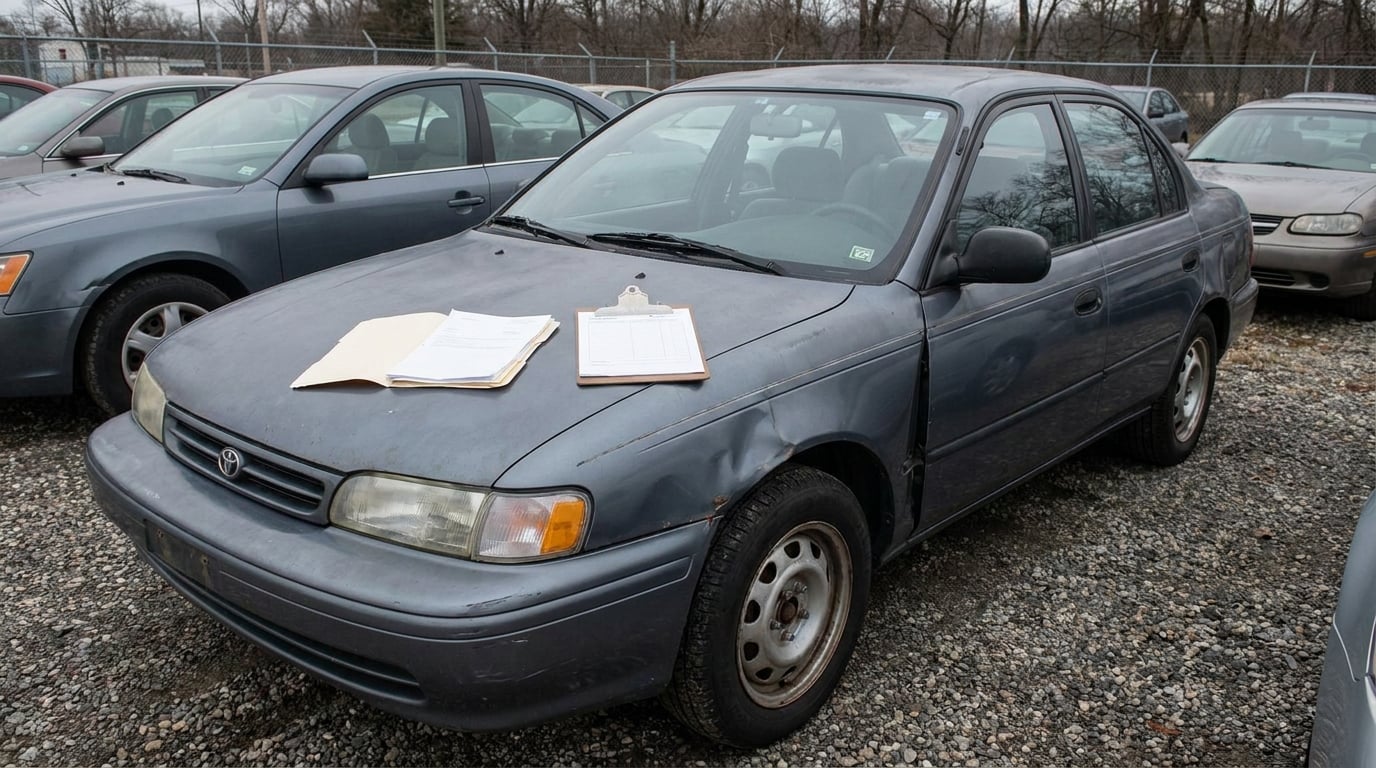
A salvage title car is usually a bad deal for the average driver, and it is a genuinely good deal for a narrow set of buyers who know what they are doing. The discount is real, often steep, and it is the reason these cars exist on the market at all. What most people underestimate is that the discount is buying a car with an unresolved repair bill and a permanent mark on its paperwork.
Here is the honest version of the salvage title car pros and cons. A salvage title means an insurer declared the vehicle a total loss because the estimated repair cost exceeded its actual cash value. The title stays branded for the life of the car. It never returns to clean, and that single fact touches financing, insurance, registration, and resale all at once.
I have watched good deals come out of salvage auctions and money pits come out of them too, and the difference almost never had anything to do with the badge. It came down to what kind of damage happened, whether the buyer could fix it, and whether the price left room for the fix. This guide is updated for 2026 and covers how these cars are titled, what you gain, what you risk, and how to inspect one before you commit.
Table of Contents
- Salvage Title Car Pros and Cons at a Glance
- What Is a Salvage Title Car?
- The Main Advantages of Buying a Salvage Title Car
- The Main Disadvantages and Financial Risks
- Salvage Title Car Pros and Cons by Buying Situation
- How to Inspect a Salvage Title Car Before You Buy
- Title, Registration, Insurance, and Resale Considerations
- Which Should You Choose?
- Frequently Asked Questions
- Is it ever a good idea to buy a salvage title car?
- Why should you not buy a salvage title car?
- Is insurance higher if you have a salvage title?
- Which is worse, a salvage title or a rebuilt title?
- How much of a discount makes a salvage car worth buying?
- What happens if a dealership sells you a car with a salvage title?
- Conclusion
Salvage Title Car Pros and Cons at a Glance
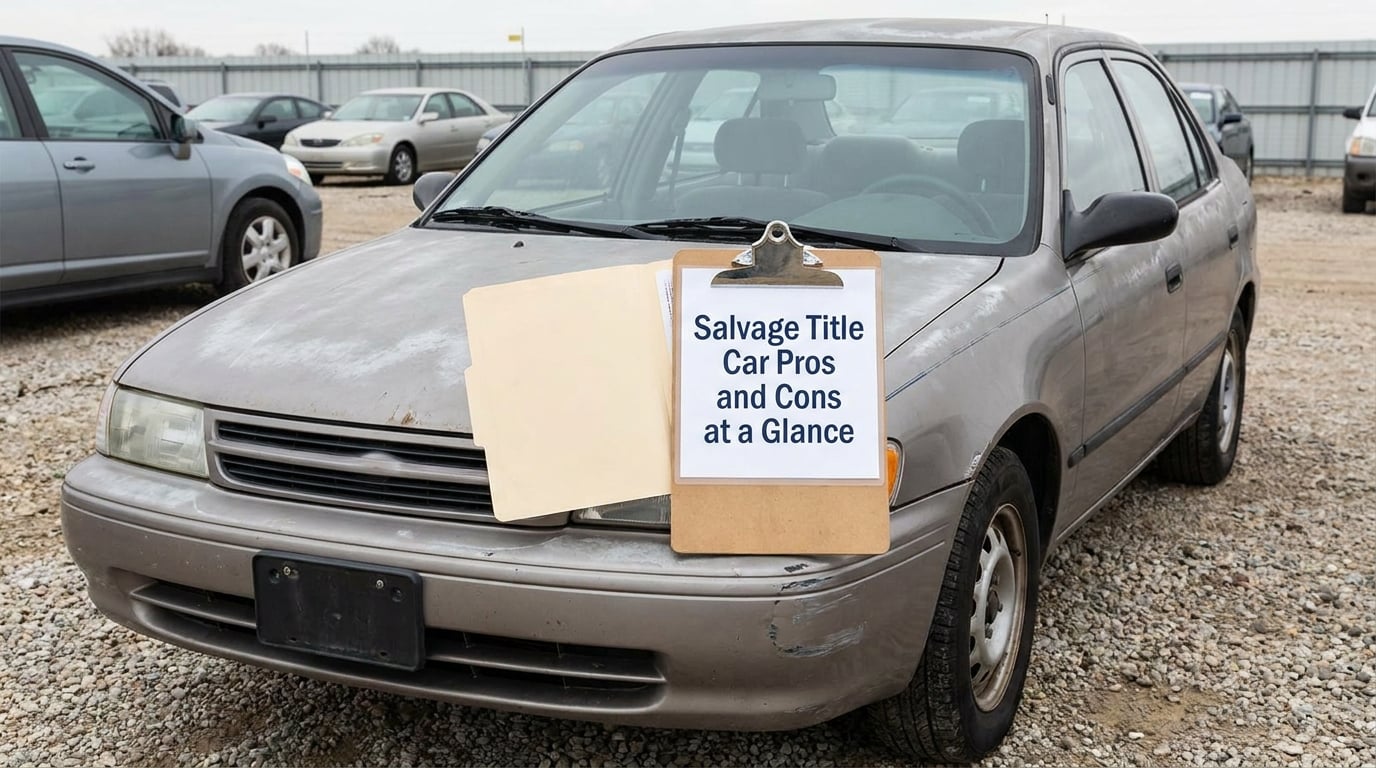
This table is the short version. Read the right-hand column as the honest assessment, not the marketing pitch.
| Factor | The advantage | The disadvantage | Verdict |
|---|---|---|---|
| Purchase price | Typically 20% to 60% under a comparable clean-title car | The discount is sized against an unknown repair bill, not a known one | Strong pro, easily erased by repairs |
| Financing | Cash purchase, no loan overhead at all | Most lenders decline outright; secondary-market loans are expensive | Strong con for most buyers |
| Insurance | Liability-only policies are usually available | Collision and comprehensive are often unavailable or surcharged, sometimes by up to 20% | Mixed |
| Registration | Some states register a salvaged car as-is for limited use | Most states require a rebuild, an inspection, and re-titling before it is road legal | State by state, verify before you buy |
| Resale | Plenty of buyers want cheap project cars | Expect roughly 20% to 40% below a clean-title equivalent, and a slower sale | Clear con if you plan to sell on |
| Structural risk | Cosmetic and hail damage is often recoverable | Frame, unibody, flood, and fire damage can be unrecoverable or slowly fatal | Depends entirely on the damage type |
| Best fit | Mechanics, rebuilders, parts buyers, track and farm use | Poor fit for commuters, families, and anyone needing a loan | Niche, not mainstream |
What Is a Salvage Title Car?
A salvage title car is one whose insurer declared it a total loss, which happens when the repair estimate reaches roughly 70% to 80% of the vehicle’s pre-loss actual cash value. The exact percentage varies by insurer and state. When the owner keeps the car or sells it, the DMV issues a salvage certificate instead of a clean title, and that brand follows the VIN for the rest of its life.
It helps to separate the three title statuses people mix up constantly. A salvage title means the vehicle has not been put back in service yet. A rebuilt or reconstructed title means someone repaired it, it passed a state inspection, and the DMV re-titled it, so it is generally street legal and insurable. A certificate of destruction means the car was crushed or scrapped and cannot be registered at all.
Salvage status by itself does not mean the car is unsafe. A car that got a total-loss brand for hail, a key fob, or a low-speed impact can be mechanically fine. A car totaled by deep floodwater or a frame rail strike is a different story entirely.
The Main Advantages of Buying a Salvage Title Car
The case for a salvage title car is not complicated, and the benefits are honest when the damage type cooperates.
- A large discount at the start. Vehicles commonly sell well below comparable clean-title examples, which is the entire reason insurers and auctions move them.
- Access to models that are otherwise out of reach. Luxury and performance trims that once cost far more than a normal used buyer would pay can show up in this inventory.
- Cosmetic damage is often the whole story. Hail, a stolen-navigation theft, or body-panel damage frequently produces a total-loss brand without touching the engine, transmission, or structure.
- No loan means no interest and no lender drama. Paying cash removes financing as a variable entirely, which is why many experienced buyers shop this way.
- A real parts car. A totaled vehicle with a healthy drivetrain can donate panels, bumpers, headlights, and electronics that are expensive to source otherwise.
- Some auctions let you see the vehicle in person. Physical inspection yards let you walk the car, check panel gaps, and read the underside before bidding, which is far better than buying blind.
Owners in enthusiast forums tend to frame the discount rule the same way. On Pelican Parts, the consensus was that a salvage car is only worth it when it is so cheap that a mistake does not hurt, or when you can part it out for more than you paid. That is a surprisingly good filter for any auction.
The Main Disadvantages and Financial Risks
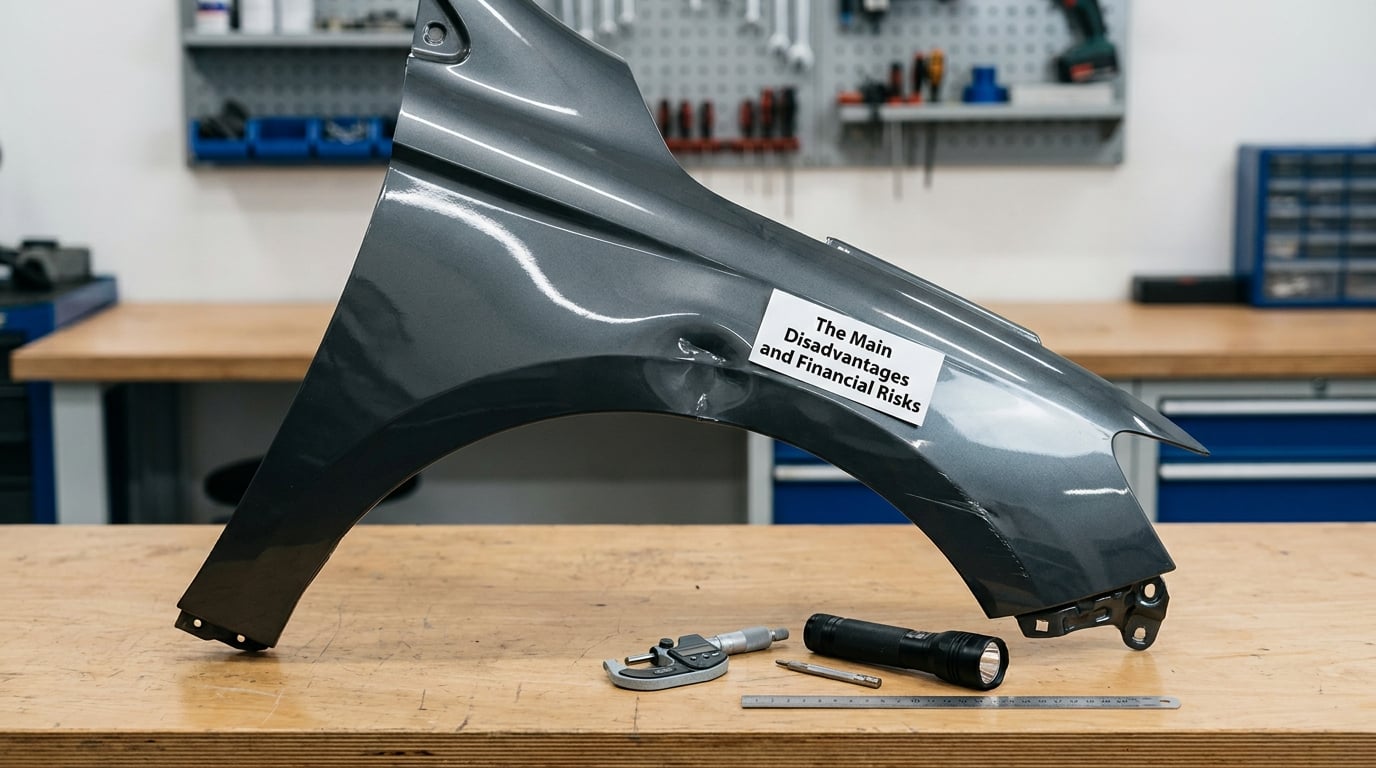
Every advantage above has a matching cost, and the costs hit at the worst possible times: when you need money, when you file a claim, and when you try to sell.
- The repair scope is unknown until you open it up. Insurers total on an estimate. Hidden structural work behind cosmetic panels is the classic way a cheap car becomes expensive.
- Almost no financing exists. Banks and credit unions routinely decline branded titles. Buyers discover this mid-transaction, which kills more deals than bad repairs do.
- Insurance is narrower. Many carriers write liability only and refuse collision or comprehensive coverage, and some add a premium surcharge that can run up to 20%.
- Registration can block you from driving. In most states a salvage vehicle cannot be legally driven until it is rebuilt, inspected, and re-titled, so you may be paying for a car that sits.
- Resale is harder and slower. Expect a penalty of roughly 20% to 40% against a clean-title equivalent, and expect private-sale buyers to treat the brand as disqualifying on its own.
- As-is means no recourse. Auction sales carry no warranty and no return rights. Cosmetic filler and overspray instead of real panel work are common and hard to prove later.
- Flood and fire damage fail slowly. Saltwater and burned wiring corrode for months, and the electronics problems often show up long after you thought you were done.
- Frame and unibody damage is a deal breaker. Bends in a frame rail, a pulled suspension mount, or a strut tower that no longer lines up cannot be priced in advance and rarely go away.
The resale penalty is worth dwelling on, because it is the most underrated of these. Mechanics in the forums make a point of it often: the stigma around a branded title is social far more than mechanical. Buyers skip a car over the word on the paperwork even when the work behind it was done properly, and that buyer behavior is what you are really paying for.
Salvage Title Car Pros and Cons by Buying Situation
Who is buying changes the answer more than how much the car costs.
For a first-time buyer on a tight budget
This is the worst-case scenario even though it feels like the best one. A first car usually needs financing, needs comprehensive insurance, and needs to keep running without surprise garage visits. A branded title removes all three advantages at once, and r/RZ34 and r/askcarguys regulars keep returning to the same conclusion: it is not worth it as a daily driver.
For an experienced DIY mechanic
This is where the pros list grows and the cons list shrinks. Working mechanics on r/AskMechanics argue that mechanical condition and rebuild quality matter far more than the title label, and that mechanical damage is usually easier to repair than structural damage. If you have a garage, the tools, and a realistic estimate for the work, the discount can be genuine money in the bank.
For a daily commuter
Unattended downtime is the issue. A breakdown in a salvage car is a tow, and a tow is a day lost plus a bill. Insurance gaps and registration limbo add friction to a car you are meant to depend on every day.
For road trips and long drives
It is a poor match. Structural repairs affect handling, braking consistency, and alignment, and none of those are things you want to discover at highway speed. Members of r/RZ34 put it plainly: a salvage car makes sense as a track-only extra project car, not as something you load the family into.
For a collector restoring a project
Good fit. You are not buying transportation, you are buying a starting point, and the brand matters far less when the car will be dismantled anyway. A project that never gets finished is the usual way this goes wrong, so be honest about the time you have.
For someone who needs a reliable family vehicle
Skip it. Financing, full coverage, and predictable reliability are the entire point, and every one of them works against a salvage title car.
Which damage types are worth considering
Ranked loosely from most to least recoverable: cosmetic and hail damage, low-speed front or rear impact with no frame involvement, side impact with a clean door aperture, then a hard no on flood, fire, and any frame or unibody damage. Mechanics repeatedly single out flood damage as the one to walk away from, and r/askcarguys and Facebook groups give the same advice for the same reason.
How to Inspect a Salvage Title Car Before You Buy
Run these nine checks in order. If a seller resists any of them, that resistance is your answer.
- Pull a vehicle history report and confirm the brand. Use a paid report rather than a free one, and match the VIN on the report, the door jamb, and the title paperwork exactly.
- Run a NMVTIS check through your DMV. This is the federal title-record system, and it is the most reliable way to confirm the vehicle has not been titled in another state or reported stolen.
- Ask for the original repair estimate and every invoice. Enthusiasts ask for this first, more than anything else. A seller with documentation is telling you the work was real.
- Pay for an independent inspection by a shop with frame-rigging equipment. Measuring capability is the point. A visual look by a friend is not a substitute.
- Check paint thickness on every panel. Factory paint is usually 4 to 5 mils. Body filler reads far higher, and a reading well above that on a non-accident panel means someone has a story to tell.
- Look at panel gaps and door apertures. Uneven gaps, a door that sits proud, and mismatched shut lines all point to a cut-and-weld panel or a bad alignment repair.
- Verify the VIN plate and check for the door-jamb stickers. A VIN that was etched instead of riveted, or a missing manufacturer sticker, suggests the car has been in a jurisdiction where VINs get restamped.
- Inspect the underside and the structure. Look for weld marks, ground-down spot welds, patched floor pans, frame rail bends, and any part of the car that was clearly cut off and reattached.
- Confirm airbag deployment and repair. Deployed airbags and a replaced steering wheel or front seat are clues about how deep the original impact went. If the SRS was deployed and nobody documented the repair, assume the worst.
Then take a long test drive, ideally on roads with a mix of surface conditions, and watch for pull to one side, a loose or wandering wheel, and brake pedal travel that feels long.
Title, Registration, Insurance, and Resale Considerations
Title branding is permanent. A salvage title never converts back to clean, and a rebuilt title stays rebuilt for the life of the vehicle, no matter how good the workmanship or how many owners follow. Forum regulars consider that a myth worth repeating precisely because people keep hoping it is not true.
Registration rules are where the biggest surprises live, and they change from state to state. Some states will title a salvaged vehicle in your name but restrict how it can be used until it passes inspection. Others will not register it at all until the rebuild is complete and verified. A few require special rebuilt or reconstructed plates. Before you sign anything, call your own DMV with the VIN in hand and ask exactly what your state requires.
Insurance is the next call. Ask for the coverage in writing, before the purchase, not after. Get a quote with a salvage or rebuilt brand entered the way your state records it, and compare it against the same quote on a clean-title car of the same model year. The difference tells you the real annual cost of the brand before you own it.
Resale is where the brand lingers longest. Private buyers, used-car marketplaces, and many dealers treat a branded title as an automatic pass. Expect the discount to persist on the way out as well as on the way in, and if you are a flipper, build that into the return from the start.
Buying from a dealer rather than an auction does not erase the brand, but it does change your legal footing. Dealers are required to disclose a branded title in the paperwork, and undisclosed salvage titles are a well-documented source of litigation. If a dealer offers a car as clean and the title says otherwise, that is a dispute worth taking seriously rather than arguing about on the lot.
Which Should You Choose?
Choose a salvage title car when the purchase price already accounts for a realistic repair bill, you have inspected it independently, and either you can do the work or you have a shop you trust lined up. Choose a clean-title vehicle when you need financing, need comprehensive and collision coverage, carry passengers, or expect to sell the car within a few years. For anyone in that second group, the discount is not a bargain, it is a deferred repair bill with extra steps.
There is a version of this purchase that works well. Cosmetic or hail damage, a car with full documentation, a clean independent inspection, and a seller who hands over every invoice without being asked. Buyers in r/UsedCars make that case often, arguing that a clean titled used car is only marginally safer, if at all, than a properly rebuilt one. That is a fair argument for a mechanic and a bad argument for a commuter.
Frequently Asked Questions
Is it ever a good idea to buy a salvage title car?
Yes, in three narrow situations. The damage was cosmetic only, the buyer is a mechanic who can rebuild the car to factory specification, or the car is a track, farm, or weekend project that does not need daily transport. In all three cases the price has to leave room for the repairs and any registration delay. For a commuter or a first car, the same purchase usually ends badly.
Why should you not buy a salvage title car?
Because you are buying an unfinished repair with paperwork that follows you forever. Most lenders will not finance it, many insurers will not write collision or comprehensive coverage, several states will not register it until it is rebuilt and inspected, and resale typically runs 20 to 40 percent below a clean-title equivalent. Flood and fire damage add slow electrical failures on top of all of that.
Is insurance higher if you have a salvage title?
Usually. A branded title often limits you to liability-only coverage, and some carriers add a premium surcharge that can reach 20 percent. Others decline the vehicle entirely. Get a written quote with the salvage or rebuilt brand entered exactly as your state records it, and compare it against the same coverage on a clean-title car of the same year. Do this before you buy, not after.
Which is worse, a salvage title or a rebuilt title?
A salvage title is worse in practice, because the car has not been repaired, inspected, and re-titled yet, and most states will not register or let you drive it in that condition. A rebuilt title means the work was done and a state inspection passed, so the car is generally road legal and insurable. It is still a permanent brand that reduces resale value, but it is the more realistic of the two.
How much of a discount makes a salvage car worth buying?
Enough that you can lose the entire repair budget and still come out ahead, which in practice means the car needs to sell well below a clean-title equivalent for the same year and model. Add your realistic repair estimate, inspection fees, registration costs, and a higher insurance quote, then compare that total against a clean-title alternative. If the discounted car does not win on total cost, it is not a deal.
What happens if a dealership sells you a car with a salvage title?
Dealers are required to disclose a branded title on the paperwork, and buying a vehicle based on a disclosure you never received is a different problem entirely. Keep the sales documents, the original title, and any written representations about condition. Depending on your state, undisclosed salvage status can support a claim to rescind the sale or recover part of what you paid. A state consumer protection office is the right first call.
Conclusion
The salvage title car pros and cons come down to one question: are you buying a car, or are you buying a repair project? If it is a car you need to drive to work, take passengers in, and resell in a few years, a clean-title vehicle is the better purchase every time, and the discount will not make up the difference in insurance, financing, and resale.
If it is a project, the discount can be substantial and the risk is manageable. Do three things before you commit, in this order:
- Verify the title brand and run a NMVTIS and history report on the VIN yourself.
- Pay for an independent inspection by a shop with frame-measuring equipment, and walk away from flood, fire, or frame damage.
- Add up the full cost to own, repairs plus inspection plus registration plus insurance, and compare it against the clean-title car you are choosing not to buy.
Every rule of thumb in the forums comes down to the same test. If losing the whole repair budget would not bother you, and the damage was cosmetic rather than structural, the salvage title car might be exactly the right buy. Anything else, and you are better off with clean paperwork.