
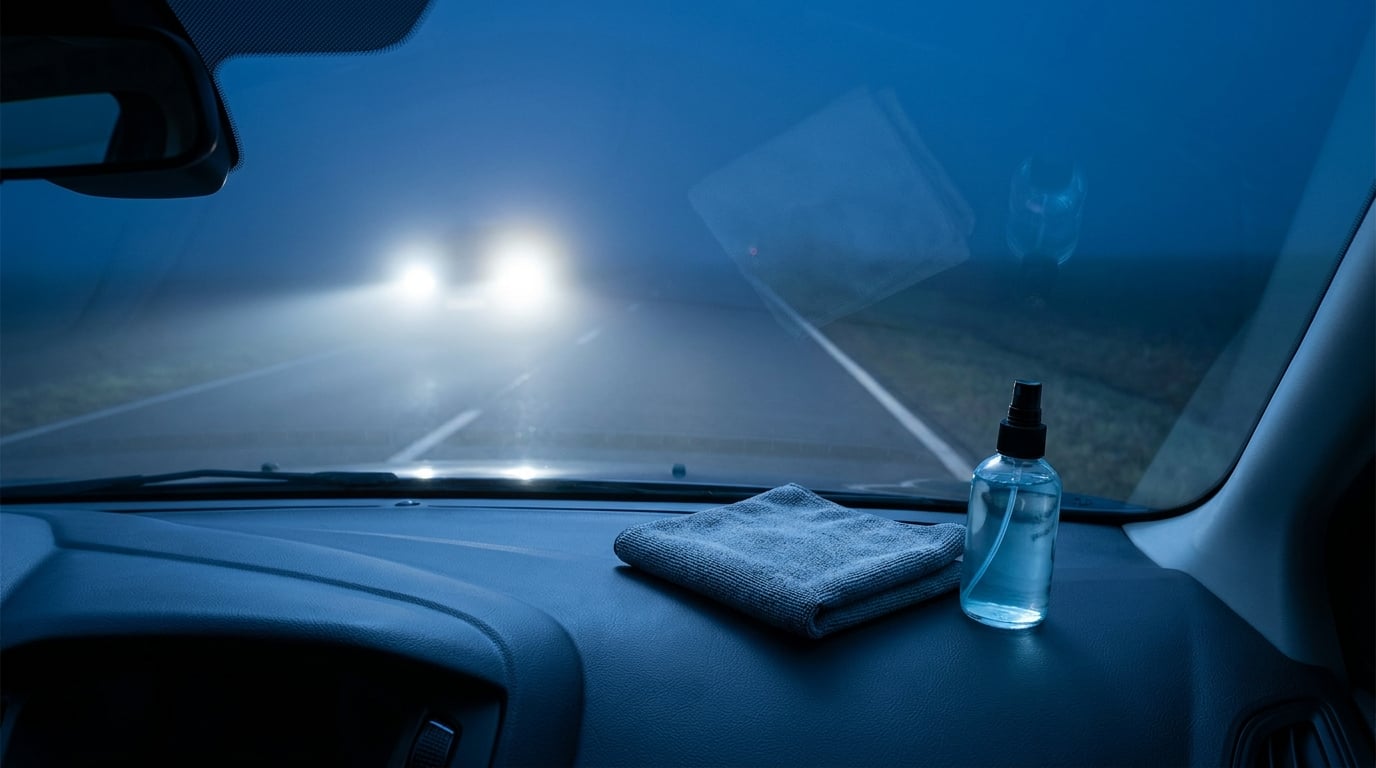
Night driving tips to reduce glare come down to three things: keep the glass clean on both sides, dim the cabin so your eyes stay adjusted to the dark, and look at the road rather than at the light source. Everything else, from mirror position to high-beam discipline, builds on those three. Most glare problems are fixable in an afternoon with a microfiber cloth and a glass cleaner.
I have driven enough night miles to know where the trouble shows up. Two-lane roads at dusk are the worst of it, where an oncoming car’s beam hits you every few seconds. The light itself is bright, but the reason it hurts so much is almost always the film on your windshield turning one hard point of light into a wide bloom across the whole pane.
Below is a list of 12 tips, ordered the way I would work through them on a car that has been driven hard for a couple of years. The first four take an hour in the driveway. The rest happen while you are moving, and they matter just as much.
Most drivers get the order wrong, shopping for glasses before they clean the glass. A clean windshield and a fresh eye exam solve the problem for most people, and neither costs what a specialty lens does.
Table of Contents
- Night Driving Tips to Reduce Glare at a Glance
- 1. Clean the Outside of Your Windshield
- 2. Clean the Inside of Your Windshield
- 3. Replace Worn Windshield Wipers
- 4. Check and Correct Your Nighttime Vision
- 5. Adjust Your Mirrors Before You Drive
- 6. Dim the Dashboard and Instrument Panel
- 7. Wear the Right Night-Driving Eyewear
- 8. Slow Down and Leave More Space
- 9. Look Away From Bright Lights When Safe
- 10. Use the High Beam Only When It Helps
- 11. Watch for Glare-Affected Road Users
- 12. Do Not Drive When Fatigue or Storms Impair Vision
- Frequently Asked Questions
- Do polarized sunglasses help reduce glare while driving at night?
- How can I stop my windshield from reflecting headlights?
- Should I use high beams when another car is driving toward me?
- Why do my headlights seem to create more glare at night?
- Can a dirty windshield cause dangerous nighttime glare?
- When should I avoid driving at night because of glare?
- Start With the Cleanest and Clearest View
Night Driving Tips to Reduce Glare at a Glance
| Action | Primary benefit | Best time to use it |
|---|---|---|
| Clean the outside of the windshield | Stops scattered light from smearing every headlight | Before the first night drive of the week |
| Clean the inside of the windshield | Removes interior haze that blooms oncoming beams | Every few months, or when a defogger leaves film |
| Replace worn wiper blades | Eliminates streaks that scatter light upward into your eyes | At the first sign of chatter or smearing |
| Check and correct your night vision | Fixes halos and starbursts at the source | When glare keeps coming back after a clean |
| Adjust your mirrors | Cuts reflections of headlights behind you | Every time you change drivers |
| Dim the dashboard | Keeps your eyes adapted to the dark road | Every drive, at the first sign of dusk |
| Choose the right eyewear | Avoids lenses that darken the road or add flare | When you buy or renew prescription lenses |
| Slow down and leave more space | Buys reaction time when your view drops out | Any drive where you cannot read the road |
| Look away from bright lights when safe | Shortens the time your eyes need to recover | Each time a vehicle approaches in the opposite lane |
| Use high beams only when they help | Stops you from blinding drivers coming at you | Open roads with no oncoming traffic |
| Watch for glare-affected road users | Spots pedestrians and cyclists who are hard to see | Through towns and on unlit roads |
| Delay the drive when vision is impaired | Removes the risk of driving on inadequate rest or in a storm | Any time you are drowsy or visibility is poor |
After a bright oncoming beam, most drivers lose one to three seconds of useful vision. At highway speed that is roughly 50 metres of travelling without a clear view of the road, and it is why the tips below focus on shortening that window rather than pretending it does not exist.
1. Clean the Outside of Your Windshield
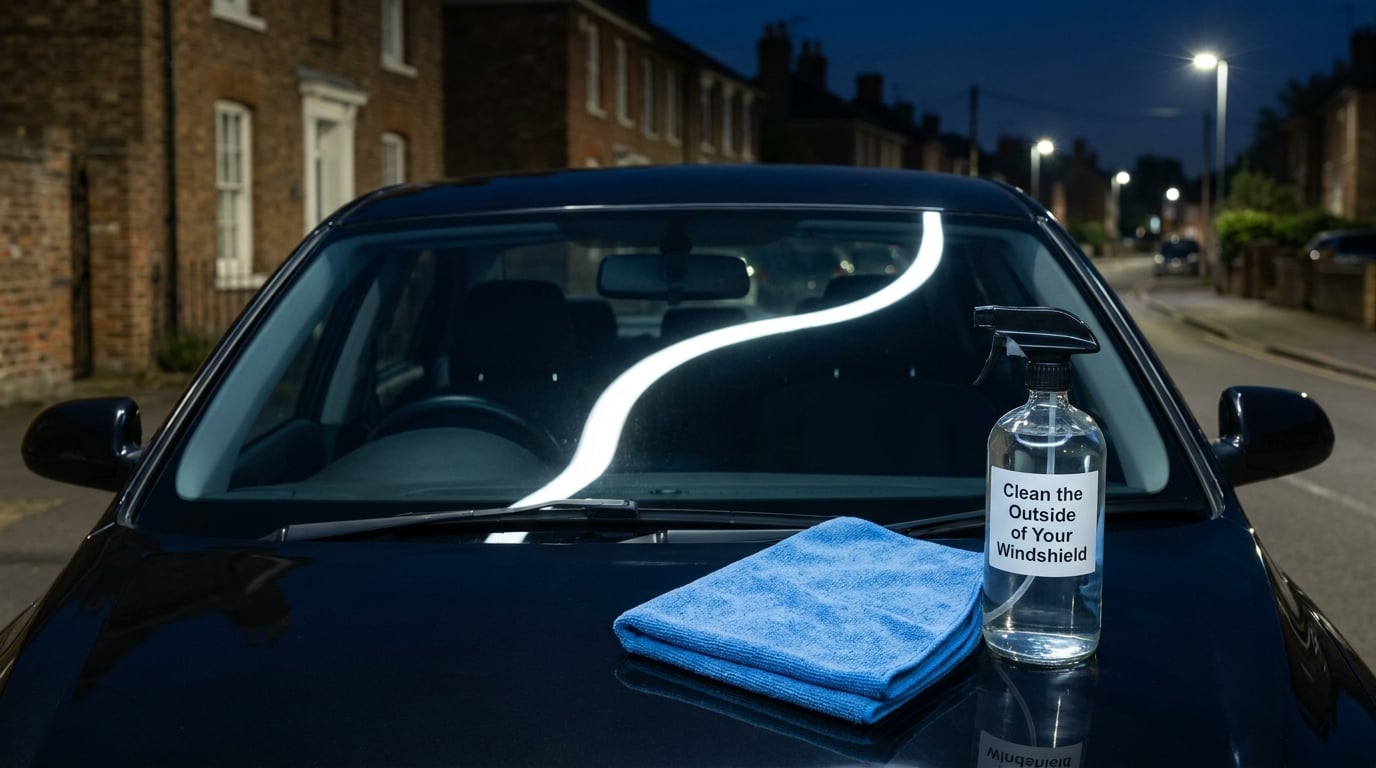
Road grime on the outside of the glass is the most common cause of complaint, and the easiest to fix. Bugs, sap, road film, wax buildup and winter salt all scatter incoming light instead of letting it pass through.
Use a glass cleaner made for automotive glass and a clean microfiber towel, working in small circles from the center out. Clean the windshield when the surface is cool, ideally in the shade, because hot glass flashes the product back at you and leaves a haze of its own.
Professional detailers make the same point about every car they take in: the outside is the easy half. If you only have ten minutes, spend them here rather than on the inside.
2. Clean the Inside of Your Windshield
Interior haze is the real culprit for most drivers, and the hardest to remove. It builds slowly from defogger use, hand oils, off-gassing from the dashboard and years of not being cleaned at all. Then oncoming headlights hit that film and scatter across the whole pane.
To reduce windshield glare, follow the method detailers actually recommend: a clean, lint-free microfiber cloth dampened with distilled water, no detergent. Household cleaners leave a residue that re-hazes the glass within days, which makes the problem worse the week after you clean.
Work from the center toward the edges, rotate the cloth frequently, and repeat the pass once the glass already looks clean. A second, dry microfiber kept just for the final buff removes the last streaking. In summer, park in the sun briefly with the windows up so the interior glass warms enough to shed trapped moisture, then clean it cool and dry.
If a defogger is the source of the film, check that it is blowing onto the windshield rather than the floor, and that the cabin filter is not clogged.
3. Replace Worn Windshield Wipers
Streaking wiper blades put light exactly where you do not want it, arcing up toward your eyes on every pass. Skip a few blades and you get smears; skip a lot and you get horizontal bands of scattered light through the view.
Signs it is time: the blades chatter or skip across the glass, leave a misty trail even after the glass is clean, curl at the edges, or smear instead of sweep. Rubber hardens with age and heat, so a blade can go bad well before it visibly tears.
Replace them in pairs, front and rear, and clean the rubber with isopropyl alcohol a couple of times a year to keep it flexible. Never run wipers on a dry windshield; on glass with grime baked on, that is how fine scratches and permanent haze start.
4. Check and Correct Your Nighttime Vision
If glare keeps coming back on clean glass with new blades, the cause is usually on your side of the windshield. Halos and starbursts around streetlights, extra difficulty reading signs at dusk, and a general sense that the road went dark too fast are all worth an exam.
Common culprits include an outdated prescription, uncorrected astigmatism, dry eye, early cataract changes, and the reduced pupil size that comes with age. Astigmatism in particular produces halos and makes point light sources smear, and drivers often put up with it for years believing it is normal.
Glare cannot be fixed with a car part, so this is the tip that needs a professional. Book an eye exam if the problem shows up on a clear night with a clean windshield, or if it has been getting worse over a few months. Bring your current glasses to the appointment and say specifically that night driving is the problem, because that phrasing changes what gets checked.
If you already wear prescription lenses, an anti-reflective coating on them does more for night glare than any tinted lens. It is also the one upgrade that does not cost you any road brightness. Follow your vehicle owner’s manual on anything touching the windshield, and skip any lens or film that reduces light.
5. Adjust Your Mirrors Before You Drive
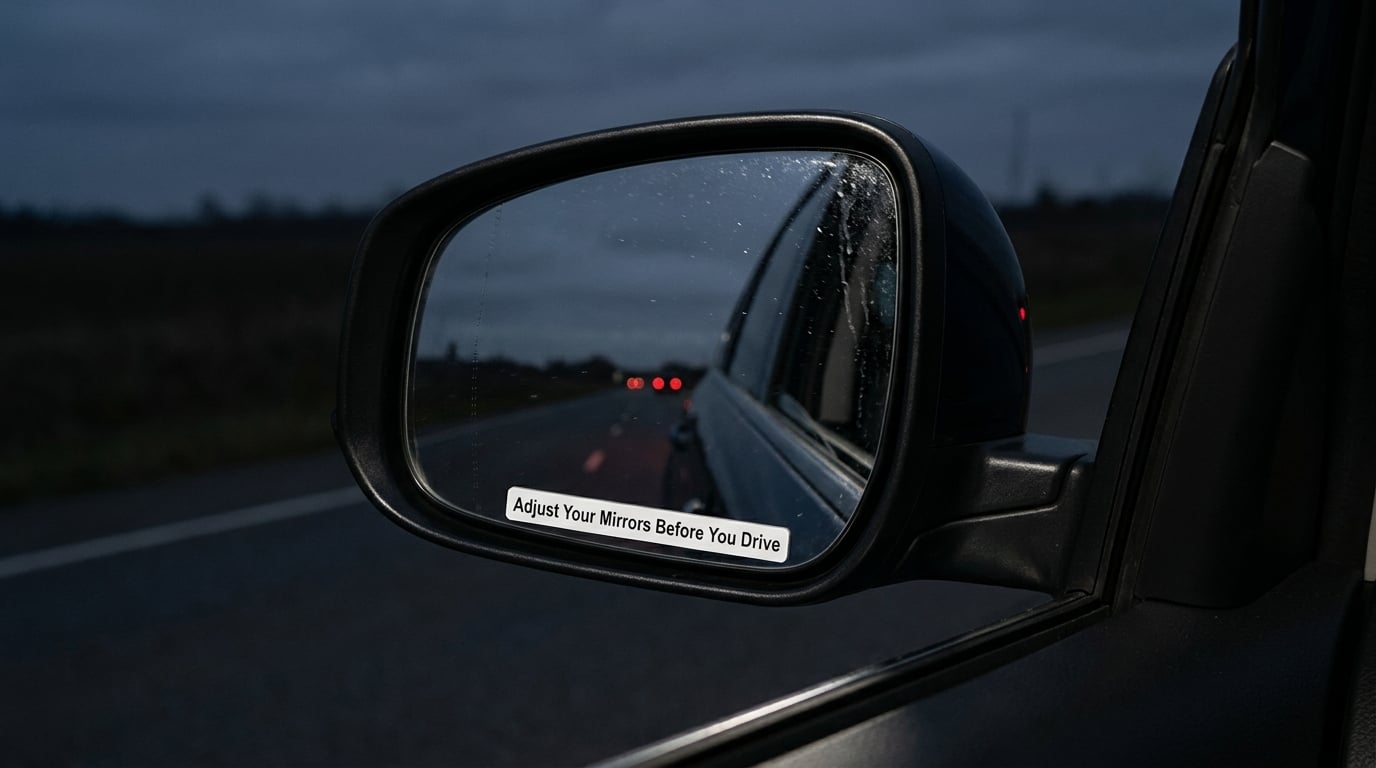
Mirrors positioned to show as much as possible will hand you every headlight behind you, right in your eyes. Set the side mirrors so they show mostly road and shoulder, with headlight beams hitting the car body or the road beside you rather than coming straight back.
Start with the side mirror in its normal position, then tilt it down and slightly inward by roughly a finger width. You should still be able to see a vehicle in the adjacent lane in your blind spot mirror, but the reflection of the car behind you should mostly vanish. Test at night with someone following you, and keep adjusting until their headlights are no longer reflected.
If your rearview mirror has a night mode or auto-dimming function, turn it on after dark. It darkens the mirror when light hits it from behind, which is exactly the light you do not need bouncing back at you. Adjust the rearview mirror itself slightly lower for the same reason, so it looks at the road rather than into the sky where headlights sit.
6. Dim the Dashboard and Instrument Panel
A bright instrument cluster is the second biggest cause of windshield glare behind dirty glass. When the dash is brighter than the road, light reflects off the inside of the windshield straight into your eyes as a pale wash across the middle of your view.
Most cars have a dimmer switch, usually on the dash or the headlight stalk. Set it so the speedometer is readable but clearly dimmer than the road ahead. A speedometer you can barely see at night is safer than one bright enough to light the glass.
Turn interior lights off entirely for driving. Cabin lights, map lights and any LED strip or phone charger glow reflects off the windshield and does the same damage as a bright dash. If your car has a selectable instrument display, the night-time layout is usually dimmer than the daytime one.
7. Wear the Right Night-Driving Eyewear
The honest answer on night driving glasses is that most of them make things worse. Yellow-tinted lenses cut total light, so dark road surfaces, lane markings and unlit shoulders disappear, and many drivers who try them end up taking them off in the glove box.
Polarized lenses are the same story in reverse. They work well against daylight reflections off wet road and car bodies, but they do little against a point source like an oncoming headlight, and they can suppress the light from some signs and instrument displays.
| Option | What drivers report | Why it falls short |
|---|---|---|
| Yellow-tinted night glasses | LED beams feel softer | Removes overall light, so the road goes dark |
| Polarized sunglasses | Good against daylight road glare | Does little against point-source headlights |
| Aftermarket lens coatings | Mixed results | Varies wildly; coatings on cheap lenses scratch fast |
| Anti-reflective coating on your prescription | Clearer night vision, no brightness loss | Needs a fresh coating; a worn one hazes over |
| Clean windshield and an eye exam | Fixes the actual cause | Takes an afternoon and a scheduled appointment |
For most people, clear lenses with a good anti-reflective coating beat any tinted option. If you want to try yellow lenses, drive a familiar route in daylight first, then in darkness, and judge them on whether you can still read the road rather than on whether the beams feel softer.
8. Slow Down and Leave More Space
Glare is only dangerous because of what you might not see during the seconds it lasts. Slower speed and more following distance are the two cheapest countermeasures you have, and they cost nothing but a few minutes.
Use a four-second following distance at night, which means watching the vehicle ahead pass a fixed point and counting until you pass the same point yourself. If it takes less, back off. Around oncoming vehicles, a wider gap means fewer beams hitting your eyes per minute and fewer recovery windows overlapping.
Slow down specifically when you cannot read the road. If you are straining to see the lane line or the far edge of an intersection, your speed is too high for the visibility you have.
9. Look Away From Bright Lights When Safe
How to reduce glare from oncoming headlights comes down to where you point your eyes. Use the right-hand edge of your own lane as a fixed guide, and keep your gaze there until the vehicle has passed.
It works because your eyes never fully adapt to the beam. Instead of adapting back and forth, you stay locked on a fixed point in your own lane and let the bright light pass across your peripheral vision.
Blinking hard or squeezing your eyes shut for a second can help too. Drivers also report a short, deliberate look toward the darker roadside to speed up recovery. Keep your hands steady and your attention forward while you do it, and never do this on a road where you need the oncoming position, such as a two-lane road with no shoulder or a bend you cannot see through.
Expect one to three seconds of reduced vision after each beam. Keep both hands on the wheel, hold your line, and let your view come back before you change lanes or brake hard.
10. Use the High Beam Only When It Helps
High beams throw light much further, which is exactly why they bother oncoming drivers. Use them on open roads with no traffic ahead, in curves with no vehicle in view, and when nobody is approaching within about 500 feet, or 150 metres.
Drop back to low beams as soon as you see an approaching vehicle, or when you enter a curve, a dip, or a stretch with street lighting. In fog, heavy rain and falling snow, low beams are better because the high-beam pattern reflects back at you off the moisture in the air.
For your own car, keep the headlight lenses clean. Oxidized or yellowed lenses cut output and scatter light, and an improperly aimed beam sends glare straight into the eyes of the person coming the other way. If your lights look dim or fuzzy on a wall at night, have the output and aim checked rather than swapping in brighter bulbs yourself.
11. Watch for Glare-Affected Road Users
Anyone whose eyes are struggling with glare is also the person most likely to be walking, cycling or standing in your path without seeing you. A pedestrian in dark clothes at an unlit junction is close to invisible at night, and other drivers who are also dazzled will not see them either.
Scan well ahead of your headlights, where the beam simply does not reach, and check the edges of the road at every junction, driveway and curve. Assume a cyclist without lights is a motorcycle without lights, and give unlit residential streets a lower speed than the road type suggests.
Wide tires and the noise they put through the cabin are unrelated to glare, but they do change how much you feel a surface change under a dark road. Our piece on all-terrain versus highway tires for daily driving is worth a read if your night driving is mostly on pavement, since tread pattern and compound affect the way the car settles over bumps in the dark.
12. Do Not Drive When Fatigue or Storms Impair Vision
Glare and tiredness compound each other, and drivers routinely mistake one for the other. If you are fighting to keep your eyes open, yawning, drifting in your lane or losing track of the last few miles, stop. Fatigue does not care that you are nearly home.
Heavy rain, fog and snow make glare dramatically worse. Water film on the road and moisture in the air turn every headlight into a wide, bright smear, and the contrast that would normally tell you a cyclist is ahead simply disappears. In those conditions, drop your speed, turn on the windshield defogger, run the wipers on intermittent if the rain is light so they clear the glass without strobing your eyes, and leave a bigger gap on spray.
If visibility is genuinely poor, fog is thick enough to hide a pedestrian, or there is ice or standing water on the road, postpone the trip. Fog and glare are a bad combination precisely because both of your speed cues are gone at once, and no technique compensates for that.
How These Tips Work Together
The 12 night driving tips to reduce glare work as one routine rather than 12 separate choices. A pre-drive check takes a few minutes: glass clean on both sides, blades free of chatter, mirrors set, dash dimmed, headlights clear and aimed.
Then the moving parts take over, and they are all about protecting your eyes’ adaptation to the dark. Dim cabin, fixed lane-edge gaze, low beams for oncoming traffic, a four-second gap and a speed you can actually see at. Get the cabin and glass right once, and the rest is habit.
Frequently Asked Questions
Do polarized sunglasses help reduce glare while driving at night?
Only partly. Polarized lenses are effective against broad daylight reflections, such as glare off wet pavement or a car hood, because they block reflected light. Against an oncoming headlight they do very little, since a point source of light is not a reflection. They can also dim signs and instrument displays at night, so many drivers find them less useful after dark despite handling bright sun better.
How can I stop my windshield from reflecting headlights?
Work from the inside out. Clean the interior glass with a lint-free microfiber cloth dampened with distilled water and no detergent, repeat the pass once dry, and finish with a second clean cloth for buffing. Then dim your dashboard and switch off all cabin lights, since interior light is what reflects off the glass in the first place.
Should I use high beams when another car is driving toward me?
No. Drop to low beams as soon as you see an approaching vehicle, and stay on low beams through curves, dips, and stretches with street lighting. High beams reach far enough to blind someone driving the other way at the moment their vision is most reduced. Use them only on open road with nobody approaching within about 500 feet.
Why do my headlights seem to create more glare at night?
It is usually your own car, not other drivers. Oxidized or yellowed lens surfaces cut output and scatter light, and lamps aimed too high throw glare toward oncoming traffic. Dirty glass and streaking wipers make it look worse. Clean the lenses, check the aim, and have the output tested rather than fitting brighter bulbs yourself.
Can a dirty windshield cause dangerous nighttime glare?
Yes, and it is one of the most common causes. Bugs, wax, road film, interior haze and streaking all scatter incoming light instead of transmitting it, so one headlight becomes a wide bloom across the pane. A dirty windshield also cuts the light you need for the road ahead. Clean the inside of the glass as carefully as the outside.
When should I avoid driving at night because of glare?
Avoid it when your eyes cannot recover quickly from oncoming headlights, when halos and starbursts persist on clean glass, or when rain, fog or snow are cutting your visibility. Also skip the drive if you are drowsy, since fatigue and glare worsen each other. If glare is a new problem, get an eye exam before adding more night miles.
Start With the Cleanest and Clearest View
If you do three things this week, make them these. Clean the inside of the windshield with distilled water and a clean microfiber, dim the dash and kill the cabin lights, then set your side mirrors down and out so headlights behind you stop bouncing into your eyes.
If glare still bothers you on clean glass, the problem is not the car. Book an eye exam, and say that night driving is what is failing, because halos and starbursts point to something correctable that no amount of glass cleaner will touch.
And when the weather closes in or the drive home has been going on too long, changing the plan beats adding another trick. There is no technique that makes a foggy road visible when it is not.
These 12 night driving tips to reduce glare are updated for 2026, and they cost an afternoon and a bag of supplies. Follow your vehicle owner’s manual for anything involving headlights, wipers or the windshield, and talk to an eye-care professional about anything involving your own eyes.