
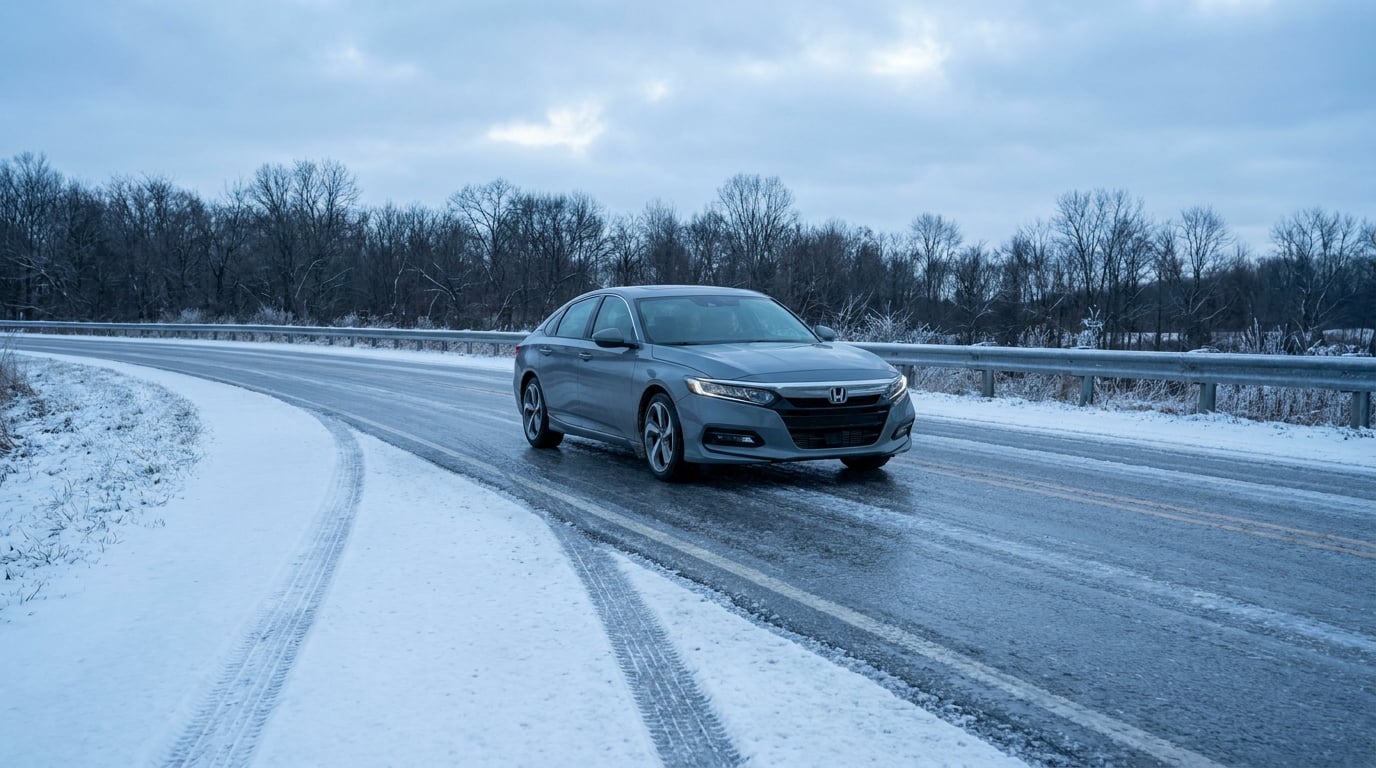
Knowing how to drive on ice without losing control comes down to one idea: grip is a budget, and speed spends it. Slow down before you need to brake, triple your following distance, make every steering, throttle and brake input slow and progressive, and if the car starts to slide, lift off the accelerator and steer smoothly toward where you want it to go.
That protocol is short enough to learn on a quiet afternoon, and it works in an old sedan or a new crossover. This guide covers what to check before you leave, how to handle throttle, braking and corners, what to do when a skid starts, and the conditions where staying home is the smarter call.
It is general driving guidance, not a substitute for professional instruction or the owner’s manual for your vehicle.
Table of Contents
What You Need
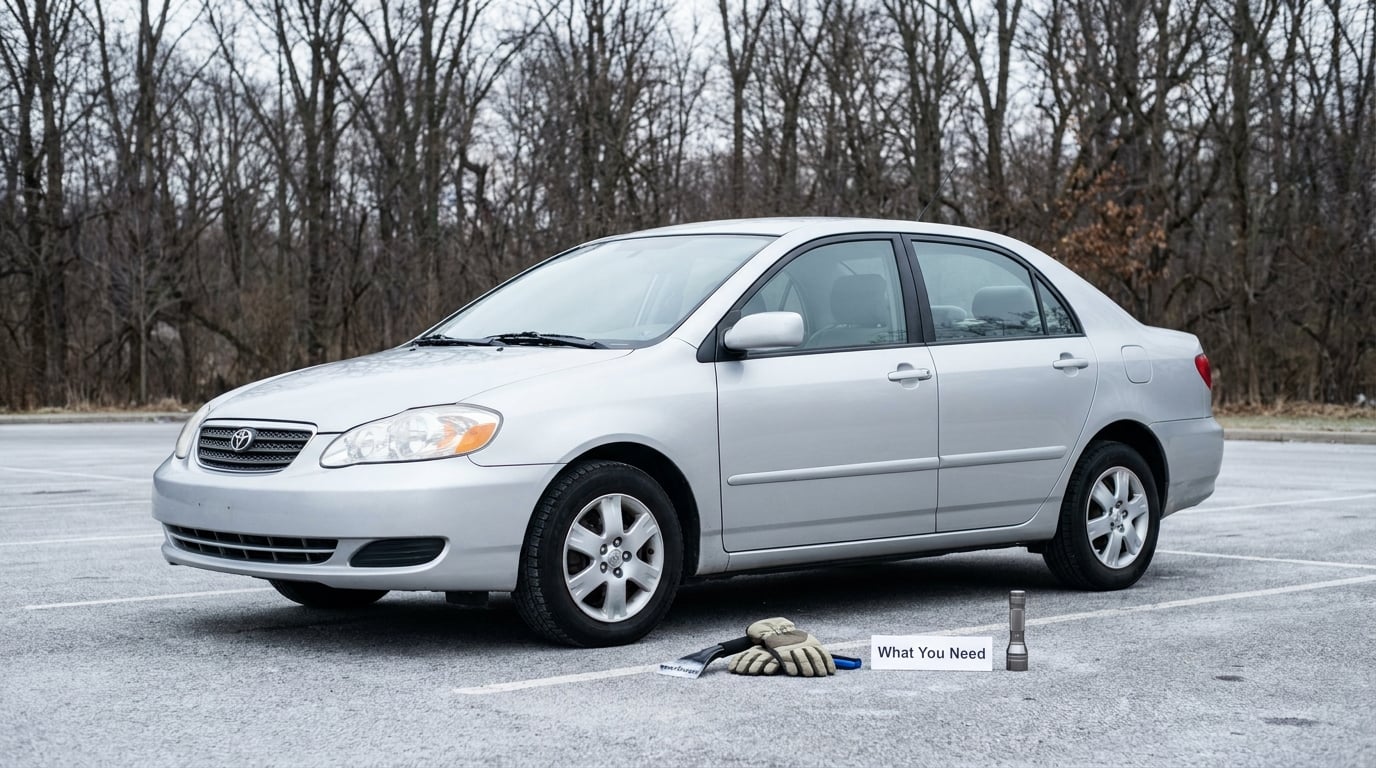
You do not need a specific car to drive well on ice. You do need tires that still have something left, glass you can actually see through, and a few things in the cabin in case the trip takes longer than planned.
Tires with usable tread. Summer and all-season compounds get hard and slippery below about 45F, which is exactly when you need grip. The AAA Foundation for Traffic Safety recommends winter tires with at least 4/32 inch of tread, and its coin trick still works: a quarter pushed into the tread should leave its top edge level with the surface. If the quarter drops into the groove and you can see over it, the tire is done. If a wheel is still on the car you rarely drive, read our guide to removing a stripped lug nut without damage before you fight a frozen wheel.
Tire pressure at the door-jamb number. Cold air drops pressure, and a soft sidewall flexes and loses contact. Check the pressure listed on the driver’s door or door frame, not the number on the tire sidewall, and inflate while the tires are still cold.
Clear glass and a defroster that works. A plastic scraper, a stiff brush, and a bottle of de-icer handle the outside. Use lukewarm water on glass, never hot. Hot water on a frozen windshield can crack it, and you need the defroster to clear the inside, not just the outside.
A small emergency kit. A flashlight with fresh batteries, a charging cable, a scraper, a blanket or bivy sack, a gallon of water, and a few days of food. Long stretches of rural road in winter can go a long time between fuel and help.
Knowledge of your own brakes. Nearly every car built since the early 2000s has ABS, but drivers often do not know whether theirs does. Check for an ABS warning light on the dash when you turn the key. If it is there, the pedal is meant to be held, not pumped. If the car has been sitting for months, our walkthrough on maintaining brakes on a car you rarely drive is worth reading before winter.
Step-by-Step
How to Prepare Your Car and Speed
Before the wheels turn, clear every window, the roof, the mirrors, and the headlights. Then set a speed that matches the worst surface you expect to cross, not the best one. Ice is not a uniform surface, and a shaded straight road and a sunlit bridge can be a full weather system apart.
Give yourself time rather than distance to react. A common rule of thumb is to cut your speed by a third on wet pavement, by half on packed snow, and further on ice. For following distance, eight to ten seconds on clear winter roads is the AAA’s standard, and on genuine ice, more is better than less.
Give yourself room to stop, not just room to follow. Braking distance grows sharply as the surface loses grip, so the gap you need is measured in time, and time is bought back with speed you have already given up.
How to Accelerate Gently on Ice
Throttle is traction. A tire makes two demands at once, and on ice there is never enough grip for both. Asking for acceleration while also steering or braking means one of the two loses, and on a front-wheel-drive car the front tires are the ones that give up, which pushes the nose wide.
Feather the accelerator with your foot rather than stamping it. Press slowly until the car picks up speed, then hold. On a grade, a gentle throttle is often safer than a full pedal, because a sudden surge can break traction and have the car sliding before you reach the top.
On a manual transmission, use the clutch to change speed rather than a sudden downshift. Drivers on r/stickshift describe the trap well: dropping to second gear at 40 mph can start a slide on its own. Clutch in, let the engine and the car slow gently, and pick the gear you want once the speed is already coming down.
How to Brake Without Sliding
The best braking on ice happens on pavement that is not yet ice. Look far ahead, and as soon as you can see a hazard or a stop ahead, take the speed off before you reach it. Standing on the brake while you approach a problem wastes the grip you need at the problem.
With ABS, press the brake firmly and hold it. The pedal will pulse and chatter, which is the system releasing and reapplying pressure faster than you can. Keep your foot planted, keep both hands on the wheel, and keep steering.
Without ABS, you have to modulate by feel. Press quickly, then reduce pressure to the point just before the wheel locks, which experienced drivers call threshold braking. If the pedal drops toward the floor or the steering stops responding, ease off immediately. Slamming the brake on a non-ABS car locks the wheels, and a locked wheel slides straight rather than steering.
Stopping distance on a low-grip surface is a rule of thumb, not a measurement. Tire compound, temperature, road salt and ice thickness all change it, so treat these as planning multipliers, never as a target.
| Surface | Braking distance compared with dry pavement | What changes |
|---|---|---|
| Dry pavement | Baseline | Tires at full grip, nothing to think about |
| Wet pavement | Roughly 2x | Water film reduces grip; braking pressure must rise |
| Packed snow | Roughly 3x | Tire cuts through and rolls the loose layer ahead of it |
| Black ice | Up to 8 to 10x | Tires roll on a near frictionless surface; steering has almost no effect |
How to Steer Through a Turn on Ice
Slow down before the corner, not in it. Braking while turning asks the front tires for grip at the exact moment they are least able to deliver it, and the front tires are the ones that push a car wide.
Once in the turn, hold a steady wheel angle and make small corrections. A quick flick of the steering wheel loads the outer front tire, scrubs speed, and produces either a slide or a snap back the moment grip returns. Looking well into the exit of the corner, rather than at the tire or the ditch, keeps your inputs smooth.
If the car is already sliding through the corner, do not add brake. Let the car finish the slide and straighten up first, then brake on the straightened car.
What to Do When the Car Starts to Skid
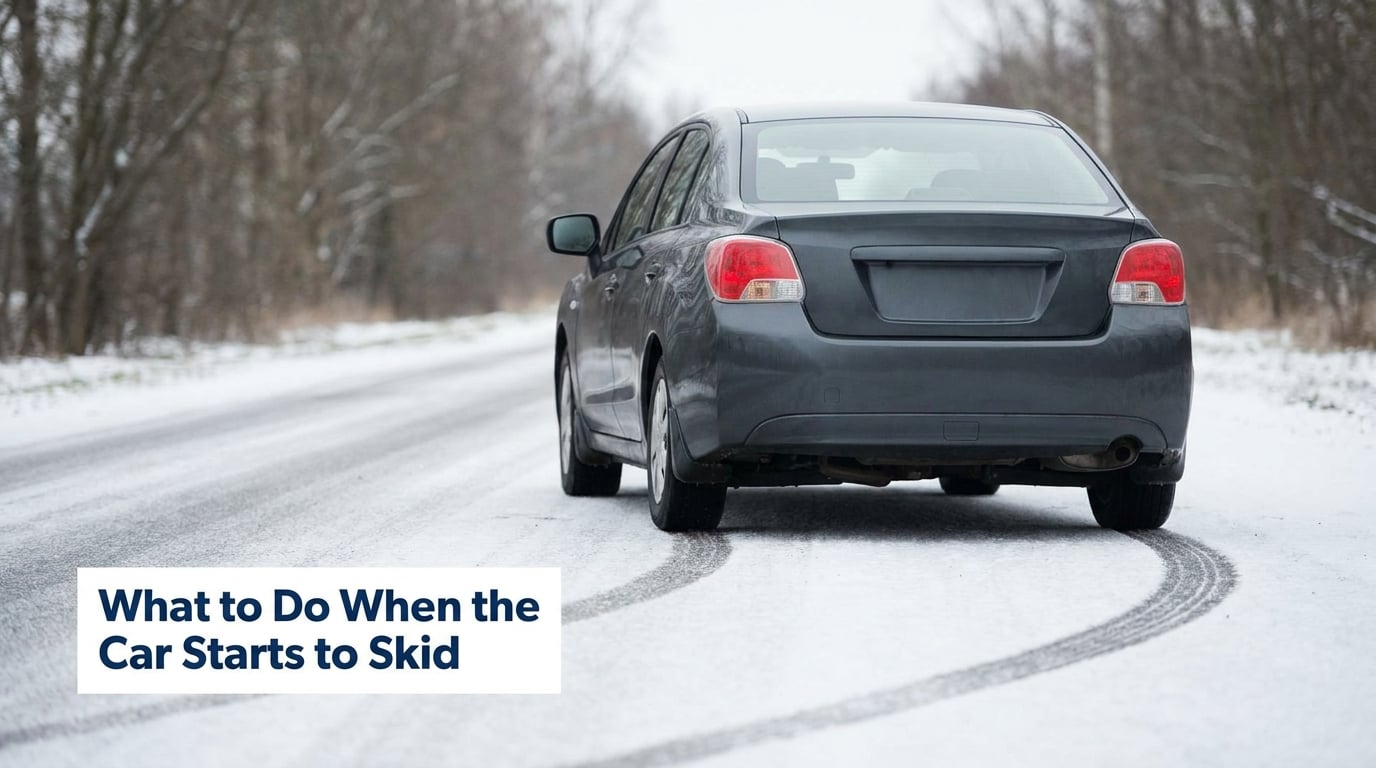
A skid is a slip angle problem, and the rule that matters most is the one most often argued about: steer smoothly toward where you want the car to go. For a rear end sliding out, that means counter-steering into the slide. For a front end pushing wide, it means easing off and taking your hands off the correction.
Use this order, and give each step a moment to work before adding more.
- Lift off the accelerator completely. Do not brake, and do not add throttle to “power through” it.
- Look at where you want the vehicle to end up, which is usually the direction the car is already travelling.
- Steer smoothly into the direction of travel, holding a steady wheel angle. Small inputs only.
- Wait for grip to return. The car will tighten up under the tires, and that tightening is your cue to add steering back toward your intended path.
- Straighten the wheel as the car comes back under control, then re-evaluate speed before doing anything else.
Do not stamp on the brake during a slide. A locked tire has no steering ability at all, and the car becomes a passenger sliding along the road.
Stability control and traction control deserve realistic expectations. ESC can cut throttle and brake one wheel at a time, and on a slide that intervention can lengthen the slide rather than end it. Traction control is not a rescue; experienced drivers on r/Edmonton and Edmunds agree it will not save you if you spin the wheel and lock it at speed on black ice.
Different skids need different responses. This is the part most guides blur together, and drivers who treat a spin like a fishtail usually end up in a ditch.
| What you feel | What is happening | What to do |
|---|---|---|
| Front end pushes wide, nose sliding outward in the turn | Understeer, the front tires have run out of grip | Ease off the accelerator and reduce speed. Do not add steering. |
| Rear end swings out, car rotates and fishtails | Oversteer, the rear tires have let go | Ease off and counter-steer smoothly into the slide. |
| Rear steps out while braking in a straight line | Braking oversteer, forward weight transfer unloads the rear | Release the brake pressure and let the rear tires regain grip. |
| Car spins fully around | The tires have no meaningful slip angle left to work with | Brake very lightly if needed. Do not apply full steering input. Keep both hands on the wheel and wait. |
Common Mistakes
Braking hard and then turning. Weight moves onto the front tires under braking, which is the last thing the front tires need in a corner. Take the speed off before the turn, not during it.
Over-correcting the wheel. The instinct is to snap the wheel back the other way, and that reaction is what turns a survivable slide into a spin. The wheel angle stays roughly where it is until the tires bite.
Stamping the brake in a car without ABS. It locks the wheels and the car stops steering. Modulate instead.
Shutting the throttle off in a rear-wheel-drive car on ice. The rear tires are what is sliding, and lifting can transfer load forward and make the back step out further. In a rear-drive car, a light, controlled throttle input can be the correct recovery tool, which is the one case where the everyday “ease off the accelerator” advice needs qualifying.
Relying on all-wheel drive. AWD helps a car get moving. It does not shorten braking distance, and it does not help a car stop faster on a downhill grade, which is where most winter crashes actually happen.
Using engine braking hard on a descent. Retarders and aggressive downshifts can lock or overload the rear tires on ice, particularly on a grade or in a loaded vehicle. Shift gently, let the car slow first, and follow the guidance in your own owner’s manual. If the engine retarder can be switched off, that is the safer setting for a descent on ice.
Leaving cruise control on. Cruise control holds your speed through corners, ramps and shaded curves, which is exactly where you need a foot on the brake to lift off. Turn it off as soon as the surface changes.
Following too closely, and driving during the storm. If you cannot see 200 feet ahead of your own hood, you do not have the reaction distance you need. A gap that looks generous in a normal snowfall is nothing on glare ice.
When Driving on Ice Is Not Worth the Risk
There are conditions where the honest answer is to stay parked, and knowing how to drive on ice without losing control starts with knowing when the ice has already won.
Ice hidden under packed snow. Fresh snow over a freezing rain layer is the most dangerous surface there is, because the road looks like snow while behaving like ice. Nothing about the surface gives you a warning.
Active freezing rain or an ice storm warning. Ice accumulates on the car before the road, which means the road underneath is already slick. Ploughs and salt are usually the last thing to arrive.
Poor visibility. Blowing snow, fog freezing to the windshield, or a road glare you cannot see past all remove the visual half of safe driving.
Bridges, overpasses and ramps. These freeze first because cold air moves under them, and shaded curves freeze first because they never get sun. If you have to pick your line, cross the open, sunlit pavement and avoid the exposed structures.
Unplowed rural roads and grades you have not driven in winter. You cannot see the ice under the snow, and a long grade with no recovery shoulder is a place where a small slide becomes a serious one.
On genuine black ice, no tire and no safety system gives you reliable grip. Drivers describe this bluntly on forums: a three-car pileup where even studded tires provided nothing usable. Nobody has a technique that defeats a surface with almost no friction. On those roads, the only control that still works is speed, and sometimes the right control is not driving at all.
Frequently Asked Questions
What speed should I drive when roads are icy?
There is no safe top speed for ice, only a speed you can stop from. As a starting point, cut your speed by about half from what the conditions would allow on dry pavement, and slow further on a bridge, a shaded curve or a grade. Remember that braking distance can be several times longer on ice, so the gap you need behind the car ahead grows too, not just the gap at a stop sign.
Do winter tires make driving on ice safer?
Yes, and the compound matters as much as the tread. Winter tire rubber stays flexible in cold temperatures while all-season rubber hardens, which is where most of the grip comes from. Look for at least 4/32 inch of tread using the quarter test, and keep pressure at the number on the door jamb. Winter tires help you accelerate, brake and steer, but they do not shorten stopping distance on clear black ice.
How much farther should I stop on an icy road?
Plan on roughly three to four times the dry braking distance on packed snow, and considerably more on black ice, where the gap can reach eight to ten times. Treat those as planning multipliers rather than measurements, because ice thickness, temperature and tire compound all change the result. Increase your following distance to eight to ten seconds in clear winter conditions, and add more when the road is icy.
Does ABS help me stop on ice?
It helps you keep the wheels rolling and steering, which is the part that matters in a corner or a sudden swerve. On straight ice, ABS does not shorten stopping distance, because there is no grip left to give. Press firmly and hold the pedal: the chatter and pulsing is the system working, and pumping the brake switches off the very function that makes it useful.
What should I do if my car starts sliding on ice?
Lift off the accelerator, look at where you want to go, and steer smoothly toward it. If the rear end has swung out, that means counter-steering into the slide with a steady wheel angle. If the front end is pushing wide, ease off instead and do not add steering. Wait for the tires to grip again, then add steering back toward your intended line. Do not stamp on the brake mid-slide.
Can I safely drive during an ice storm?
Usually not. Freezing rain builds a glaze on vehicles before it builds one on the road, so by the time the road looks bad it has been accumulating for a while. Ice under fresh packed snow is close to invisible and behaves like a polished surface. If an ice storm warning, freezing rain advisory or travel restriction covers your route, wait for the advisory to end and for crews to treat the roads first.
Conclusion
If you take four things away, make them these. Slow down early, before you reach the ice. Leave three times the gap you normally would. Make every input slow, smooth and progressive, and if a slide starts, lift off the accelerator and steer toward where you want the car to go. And when conditions are bad enough that the surface is unpredictable, postpone the trip. You cannot out-drive a road you cannot see.