
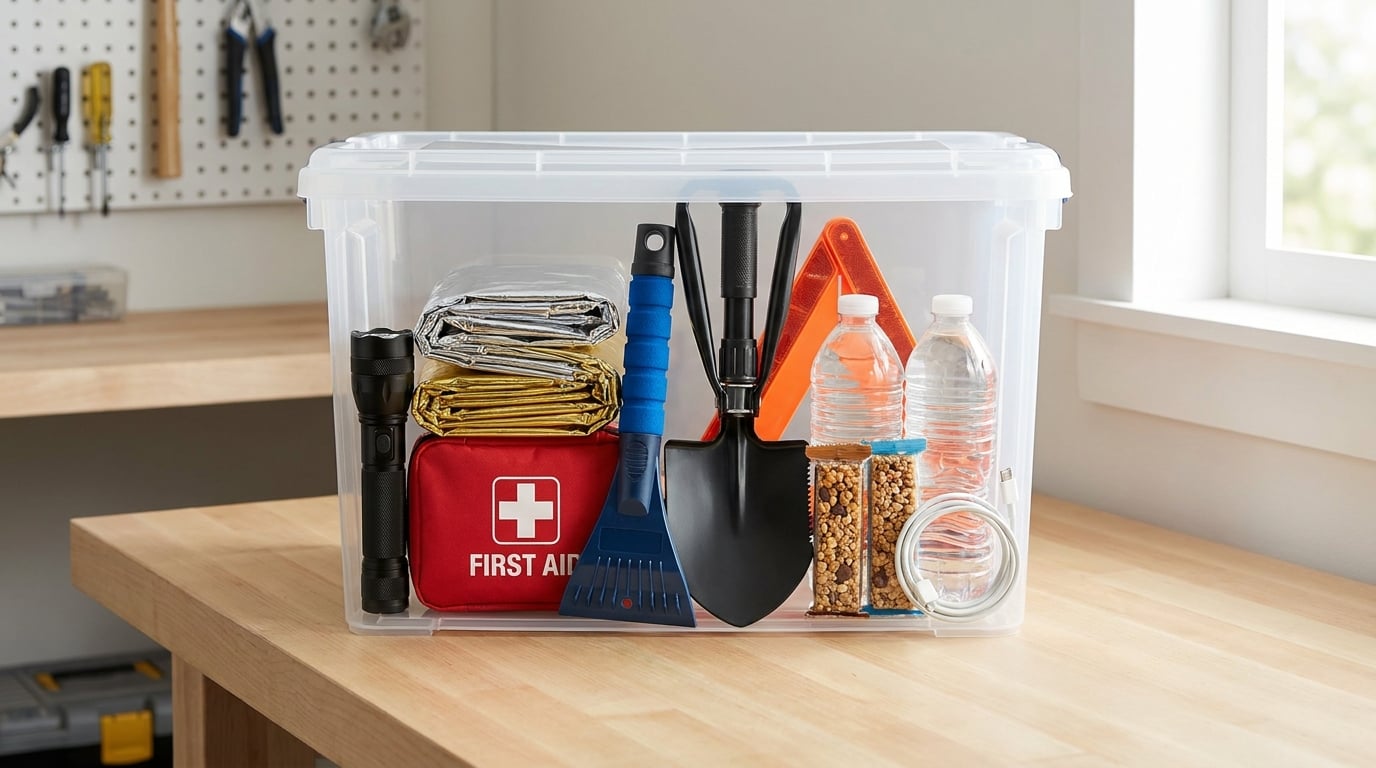
A winter emergency kit for your car is a go-bag of traction tools, warmth supplies, lighting, food, water, and battery power that lives in the vehicle with you. Most drivers need ten items to cover a breakdown, a slide-off, or being stranded in freezing weather, and this list covers all ten in the order I would pack them. The whole thing should fit in one tote in the trunk and take about twenty minutes to assemble.
If you only have room for five things, make it the flashlight, the warning triangles, the blanket, the shovel, and a charged phone. Everything else on this list is a real improvement, but those five are what actually gets you through the first hour. I have rearranged my own trunk more than once over the years, and the same five keep surviving every purge.
The reason winter deserves its own kit is that failure and cold arrive at the same time. Batteries give up faster when they are cold, a stalled engine means no heater, and help travels slower on an icy road. If you park outside overnight, you are also juggling a dead battery every morning, which is where the tire and battery tools in this list start to pay for themselves.
Table of Contents
- Winter Emergency Kit for Your Car at a Glance
- 1. Heavy-Duty Flashlight and Spare Batteries
- 2. Warm Emergency Blanket or Space Blanket
- 3. First-Aid Kit With Winter-Specific Supplies
- 4. Tire Pressure Gauge and Portable Inflator
- 5. Ice Scraper, Brush, and De-Icer
- 6. Roadside Warning Triangles or LED Flares
- 7. Small Shovel and traction Aid
- 8. Reflective Vest and Work Gloves
- 9. Water, Food, and Emergency Contact Information
- 10. Charging Cable, Power Bank, and Basic Car Documents
- How to Pack and Check Your Kit
- When the Kit Is Not Enough
- Frequently Asked Questions
- What should I include in my winter emergency kit for my car?
- What is the best survival kit to keep in my car?
- What are the essential items to have in my car for winter driving?
- How long can a car sit unused in winter?
- Can I run my car in the snow to stay warm?
- How often should I replace my car emergency kit?
- Conclusion
Winter Emergency Kit for Your Car at a Glance
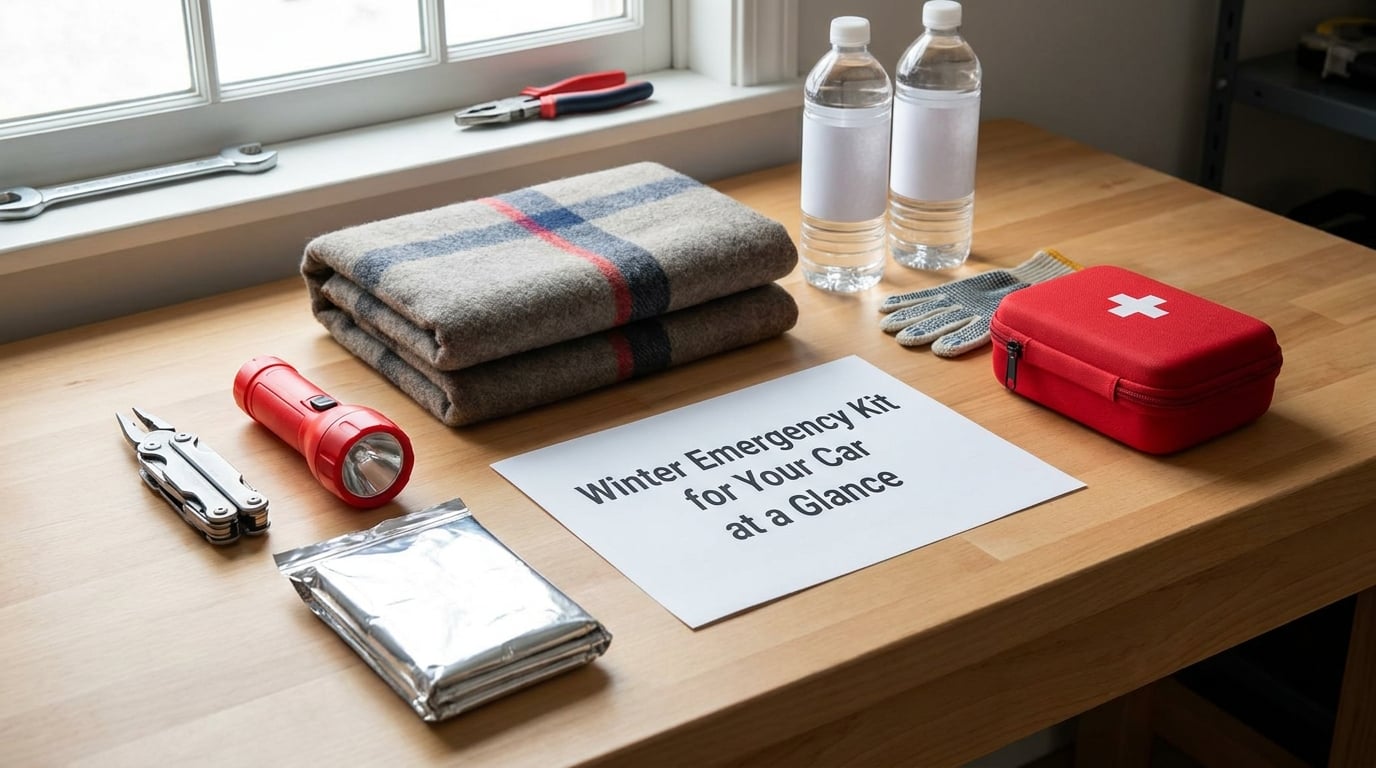
This table shows what each item handles and the one reason it earns a spot in a compact kit. Items marked essential are the ones I would not drive a snowstorm without, and the rest earn their place once you have the basics covered.
| Item | What it handles | Why it earns a place | Priority |
|---|---|---|---|
| Heavy-duty flashlight and spare batteries | Nighttime breakdowns, checking under the hood, signalling | Your phone dies or the screen is unreadable in the cold | Essential |
| Mylar or wool emergency blanket | Retaining body heat when the car is stopped | Cheap, tiny, and it does not depend on the engine running | Essential |
| First-aid kit with cold-weather extras | Cuts, sprains, minor burns from dry air and heaters | Help may be a long way off in poor conditions | Essential |
| Tire pressure gauge and portable inflator | A low or damaged tire before it strands you | Cold pressure drops on its own, and slow leaks show up in winter | Essential |
| Ice scraper, snow brush, and de-icer | Cleared glass so you can actually see and signal | Scraping ice off a frozen window with a bare scraper can crack it | Essential |
| Warning triangles or LED flares | Making a stopped car visible at night | Snow hides your brake lights and gives drivers less stopping room | Essential |
| Small folding shovel and traction material | Digging out and regaining grip on packed snow | The single most requested item from cold-weather drivers | Essential |
| Reflective vest and work gloves | Being seen outside, and handling frozen hardware | Both take under two seconds to put on when you are standing in the wind | Recommended |
| Water, food, and a written information card | Delays of an hour or longer | You cannot call for help you do not describe clearly | Recommended |
| Charging cable, power bank, and car documents | A live phone, navigation, and proof of who you are | A dead phone turns a small problem into a large one | Recommended |
1. Heavy-Duty Flashlight and Spare Batteries
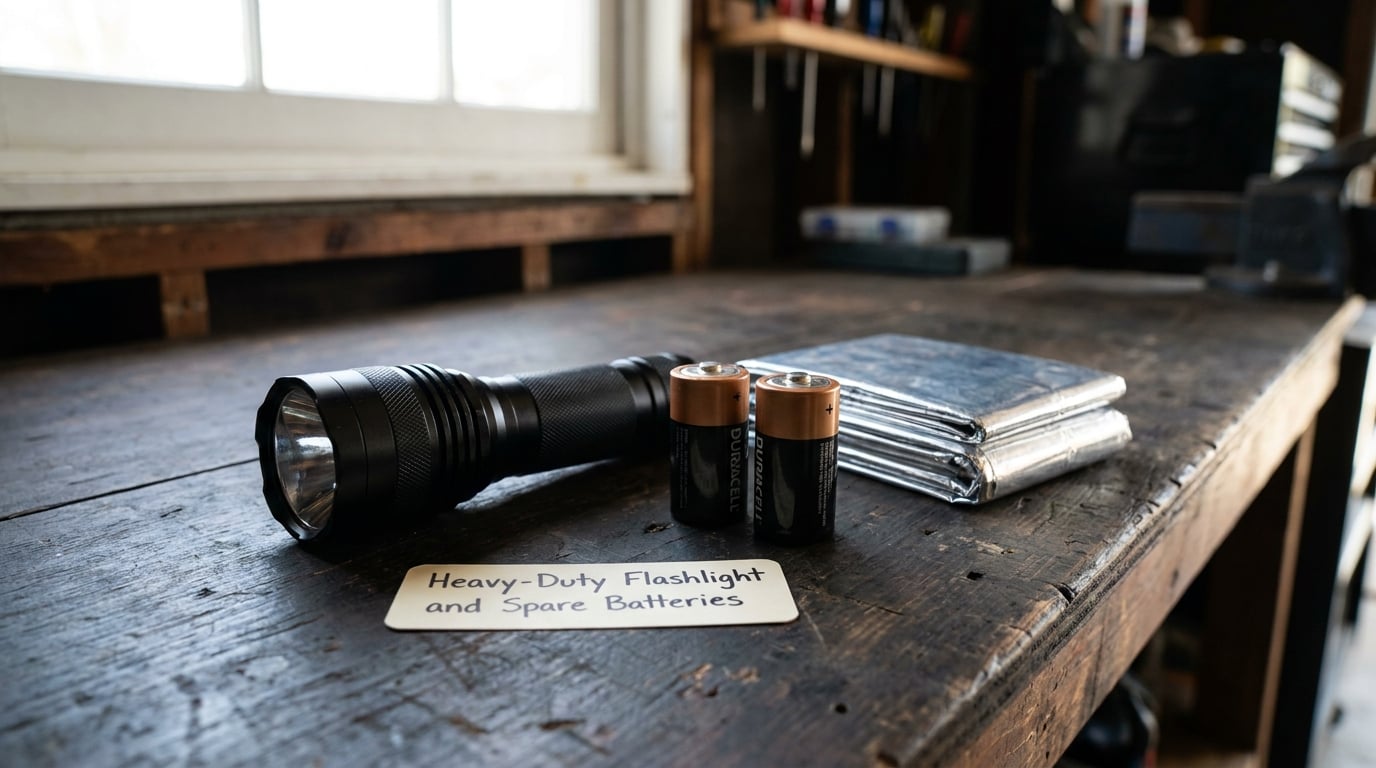
A bright flashlight is the item people skip and then regret. A phone screen is a poor substitute: it dies in the cold, it is hard to read through a scratched case, and holding it up drains the last of your battery. A hand-sized LED flashlight with a rubber grip gives you both hands free and runs for hours.
Look for one with a metal or thick plastic body, a strap, and a tail switch you can find with gloves on. Avoid anything so small it rolls under the seat. Test it before every storm season, and store spare batteries indoors with the kit but keep them sealed until you need them.
Alkaline batteries lose capacity when they sit in a freezing car, so a kit packed in October can be dead by January. Rechargeable lithium cells hold up far better in the cold, which makes them the better pick if you remember to top them off.
2. Warm Emergency Blanket or Space Blanket
A Mylar space blanket folds down to the size of a paperback and reflects your body heat back at you, which is why it survives being shared by two people. A wool blanket is warmer, heavier, and easier to wrap around, and it lasts for decades without going bad.
Pack at least one per person in the car, plus a spare. Use the blanket to cover exposed skin, neck, and head rather than trying to warm the whole body evenly, and remember that the biggest heat loss is from the ground, so sitting on an insulated layer beats adding another blanket on top.
Do not use a blanket to cover the front of a running engine while trying to keep it warm. That is the single worst thing you can do in a snowstorm, and the guide to keeping a garage from freezing covers the same physics indoors.
3. First-Aid Kit With Winter-Specific Supplies
Buy a kit that already has bandages, gauze, tape, antiseptic wipes, tweezers, small scissors, and latex-free gloves, then add winter-specific items most kits leave out. Instant cold packs handle sprains, a small tube of antibiotic ointment helps with road rash, and pain reliever covers the headache that comes after an hour of cold exposure.
Winter adds two specific risks. Dry cabin air and heater output pull moisture out of your skin, so a heavy lip balm and a small bottle of lotion are not luxury items. And anyone in the car may be on daily medication, so a short written list of what they take matters more to a paramedic than the kit itself.
This kit is for the first few minutes of a minor problem, not a replacement for medical care. Anything involving a deep cut, a chest pain, a suspected break, or a person who cannot stop shivering is a 911 call, and the first aid guidance published by the American Red Cross is a better reference than anything packed in a trunk.
4. Tire Pressure Gauge and Portable Inflator
Tire pressure falls as temperature drops, and a tire that was fine at 35 PSI in October can be down a few PSI by midwinter. Underinflated tires run colder, generate more heat, and are the ones that fail on a freezing morning. A pencil gauge costs almost nothing, takes no space, and tells you in thirty seconds whether you have a problem or not.
A small 12V inflator that plugs into the cigarette lighter is the bigger convenience, because it handles the slow leak that would otherwise leave you walking to a gas station. Check both spare and road tires on the same trip, and remember that a spare under the cargo floor has probably gone flat on its own.
Always inflate to the number on the driver door jamb placard rather than the number moulded into the tire sidewall, and set the gauge while the tires are cold. The winter tire pressure guide covers the exact numbers and how much they drop as the temperature falls.
5. Ice Scraper, Brush, and De-Icer
The brush comes first and always will: snow and slush get cleared with the brush, and the scraper only touches what is left. Trying to scrape a windshield loaded with wet snow is how windshields crack, because the grit underneath acts like sandpaper across the glass.
Work in long sweeps from the bottom edge upward, clear the roof and mirrors, and leave the last few inches of glass at the bottom for last so your wipers can finish the job. Keep the de-icer spray separate from the washer fluid, and never pour hot water on frozen glass, because the thermal shock will crack it.
Push the scraper so it sits flat rather than at an angle. An angled edge digs into the glass, which is how a cheap plastic scraper becomes an expensive replacement windshield.
6. Roadside Warning Triangles or LED Flares
When your car stops on a dark winter road, the first thing that saves you is being seen from far away. Reflective warning triangles are the standard choice because they need no battery and reflect headlights from a long distance back at the approaching driver. Set them well behind the vehicle, on level ground where they cannot be run over.
LED flares and strobes are a good upgrade for anyone who drives highways or unlit rural roads. They stay visible in daylight, which snow glare makes harder, and they run for hours on a charge. Mark them as a roadside device rather than a flare substitute, and check your state rules, because a few states restrict what you may ignite on a roadway and how far ahead you can place devices.
7. Small Shovel and traction Aid
A compact folding shovel is what gets you out of a plow bank, and a plastic or telescoping model will fit in the door pocket where a full-size steel one will not. Push with the blade flat, lift small amounts, and work from the rear wheels forward so you are not standing downhill of the weight you are moving.
For traction, cat litter and coarse sand work well and can be reused if you scoop them back up, while rock salt works faster and melts ice but leaves a slurry that gets tracked onto your paint and into the garage. Traction mats that sit under the driven wheels are the tidiest option, since nothing ends up in your wheel wells.
Keep the material in a sealed container or contractor bag so it does not absorb moisture and turn into a solid brick in your trunk.
8. Reflective Vest and Work Gloves
A reflective vest turns an unlit shoulder into something drivers see at a distance, and it is the difference between being a shape in the snow and a person. Most drivers already own one from a work shift or a road project, so the real job is getting it into the kit instead of a work locker.
Insulated work gloves matter too, especially for a jack handle or a wheel nut that has been sitting in a wet wheel well. Bare hands lose fine motor control in a few minutes, and that is when the lug wrench slips. Thin gloves that still let you feel a phone screen are the better all-round choice.
9. Water, Food, and Emergency Contact Information
Pack water that has not been frozen and does not need it, and food that tastes acceptable cold. A few bottles of water, some granola or trail mix bars, and a sealed bag of shelf-stable items will carry three people through a day without much fuss.
Then add a card. Write down names and phone numbers for two emergency contacts, your roadside assistance provider and policy number, your insurer, your vehicle make, model, year, and licence plate, and any medical conditions or medications for everyone on board. Handwriting is better than a phone you cannot unlock, and a laminated card in the glovebox outlives a note in the sun visor.
Keep the fuel light above half a tank when a storm is forecast. It takes one tank of gas to run a heater for a while, and finding an open station during a blizzard is far harder than topping off the night before.
10. Charging Cable, Power Bank, and Basic Car Documents
A charging cable is the item most often missing from a kit that was assembled in a hurry, and a power bank keeps your phone alive through a long wait. Charge the bank in the house every month or so, because a bank stored in a cold car for months is the one that will be flat when you need it.
One confusion is worth clearing up here. A power bank charges a phone. A jump starter, sometimes called a booster pack, is built to deliver enough current to turn a starter motor, and no amount of extra phone battery will do that. If your concern is a cold-morning dead battery, a booster pack with its own clamp cables is the tool, and it should live indoors between uses in a cold climate.
Keep your registration, proof of insurance, and licence in the vehicle as well, and consider an older phone with no SIM and a charger in the car, plus a paper map. A dead battery and a dead cell tower are two different failures, and the second one only takes a device that was never online to solve.
How to Pack and Check Your Kit
Choose a waterproof tote with a lid and a bright colour, or a dry bag if your kit lives in the cargo area of a truck. A clear-sided bin also works well, since you can see what is missing without unpacking everything on a dark shoulder.
Where should the kit live in the car?
Most people put it in the trunk, and that is the right call for most sedans, since a heavy bag in the cabin behind the seats changes how the car handles and eats into rear leg room. Keep the weight low and centred, and do not stack it above the rear axle where it can lighten the front end on a slippery road.
Two exceptions: a heavy battery-powered inflator or a case of water is more useful in the cabin, and drivers who travel alone in genuinely cold climates may prefer the kit within reach rather than behind a luggage barrier. The deciding question is simple: can you get it without leaving the road?
The fall inspection routine
Once a year, in autumn, take the whole kit out on a bench rather than checking it in the trunk in the dark. Test the flashlight and the charger, check battery dates, inflate the spare tire, confirm the flares or strobes fire, and read the expiration date on any tire sealant. Replace water, replace food, and refresh the information card with current contacts and plate details.
Between inspections, re-pack consumables every few months. Water that has sat through two freezes is not water any more, and food has shelf lives that are shorter than people expect.
Before a named storm, add what that storm demands: more shovel work, extra sand, a second blanket per person, and a full tank of gas. Seasonal gear that was fine last January is not automatically fine this January.
When the Kit Is Not Enough
A winter emergency kit handles the first hour. It does not handle a night in a blizzard, a car in a ditch, or a mechanical failure you cannot fix with the tools you packed. Knowing where the line sits is part of the kit.
Stay with the vehicle unless you can walk to a house or building with certainty. Leaving the car means leaving your warmth, your signalling devices, and your phone behind. If you are going to walk, tell someone the direction you are heading and take a whistle.
Watch the tailpipe before you start the engine. Snow around the exhaust can trap carbon monoxide, and the risk climbs when the car is parked in a garage, a driveway, or a shallow drift. Do not run the engine in a closed garage, ever, not even with the garage door wide open, because carbon monoxide is odorless and you will not notice it building up.
If you must run the engine for heat, clear a path around the tailpipe first, crack a window, and limit idling. Run the engine and the heater sparingly rather than continuously, and check on the exhaust area periodically to make sure the snow has not drifted back over it. People die every year in cars that are not parked in a garage, so the garage rule is only the most famous version of this risk.
Skip improvised repairs. A tow strap, a homemade chain, or a bungee around a tire is not a fix, and a jack on soft ground can drop the car on itself. Call roadside assistance, and if the conditions are dangerous to you, call emergency services instead and describe your location as precisely as the mile marker or cross street you can find.
Also know when a car is simply done for the season. A vehicle that has sat for months may have degraded fuel, a weakened battery, and oil that has separated, which is worth knowing before you rely on a car you have not started since last spring.
Frequently Asked Questions
What should I include in my winter emergency kit for my car?
Ten items cover nearly every winter roadside emergency: a heavy-duty flashlight with spare batteries, a warm blanket or space blanket, a first-aid kit, a tire pressure gauge and portable inflator, an ice scraper with brush and de-icer, warning triangles or LED flares, a small shovel with traction material, a reflective vest and gloves, water and shelf-stable food with a written contact card, and a charging cable with a power bank.
What is the best survival kit to keep in my car?
The best kit is the one that fits your driving, not the one with the most compartments. Build around three groups: vehicle recovery and tools, warmth and survival supplies, and safety and communication. Anything that only makes sense on a mountain pass belongs in a separate small bag, not in the everyday kit that weighs down your trunk.
What are the essential items to have in my car for winter driving?
The essentials are a flashlight, warning devices, a warm layer per person, a first-aid kit, tire tools, an ice scraper and brush, a shovel with traction material, and a charged phone with a cable. Those nine items handle the majority of breakdowns, slides, and stalls you will realistically see in a normal winter, and the rest of the list is refinement.
How long can a car sit unused in winter?
Without any preparation, expect the battery to be the first casualty within a few weeks, since cold weather accelerates its decline. Fuel left in a tank for months can degrade, coolant can lose protection, and tyres lose pressure as the temperature drops. If a car will sit for months, disconnect the battery or fit a maintainer, and run the engine long enough to circulate fluids before you rely on it.
Can I run my car in the snow to stay warm?
Only with real caution. A running engine produces carbon monoxide, and snow around the tailpipe can trap it and push it into the cabin where you will not smell or see it. Never run a car in a closed garage, clear a path around the tailpipe first, crack a window, and limit idling so the exhaust has time to clear. If you have another way to stay warm, use it.
How often should I replace my car emergency kit?
Give the whole kit a bench inspection every autumn: test the flashlight and charger, check battery dates, read the expiration on any tire sealant, and replace water and food. Swap the batteries twice a year and the consumables every few months, since water that has frozen and thawed is no longer fit to drink. Everything else can stay as long as it is dry and undamaged.
Conclusion
Start with six things: a heavy-duty flashlight with spare batteries, warning triangles, a warm blanket per person, tire tools, water, and a charged phone. Everything else on the list can follow as you have time, and most drivers get through several winters on those six alone.
Then tailor it. A highway commuter needs warning devices and a booster pack. Someone on a mountain pass needs chains, traction mats, and far more warmth per person than I listed. A family with a new teenage driver needs the information card, the shovel, and a rule about calling for help before walking off. Set aside one autumn afternoon to build it properly, and check it again next 2026.