
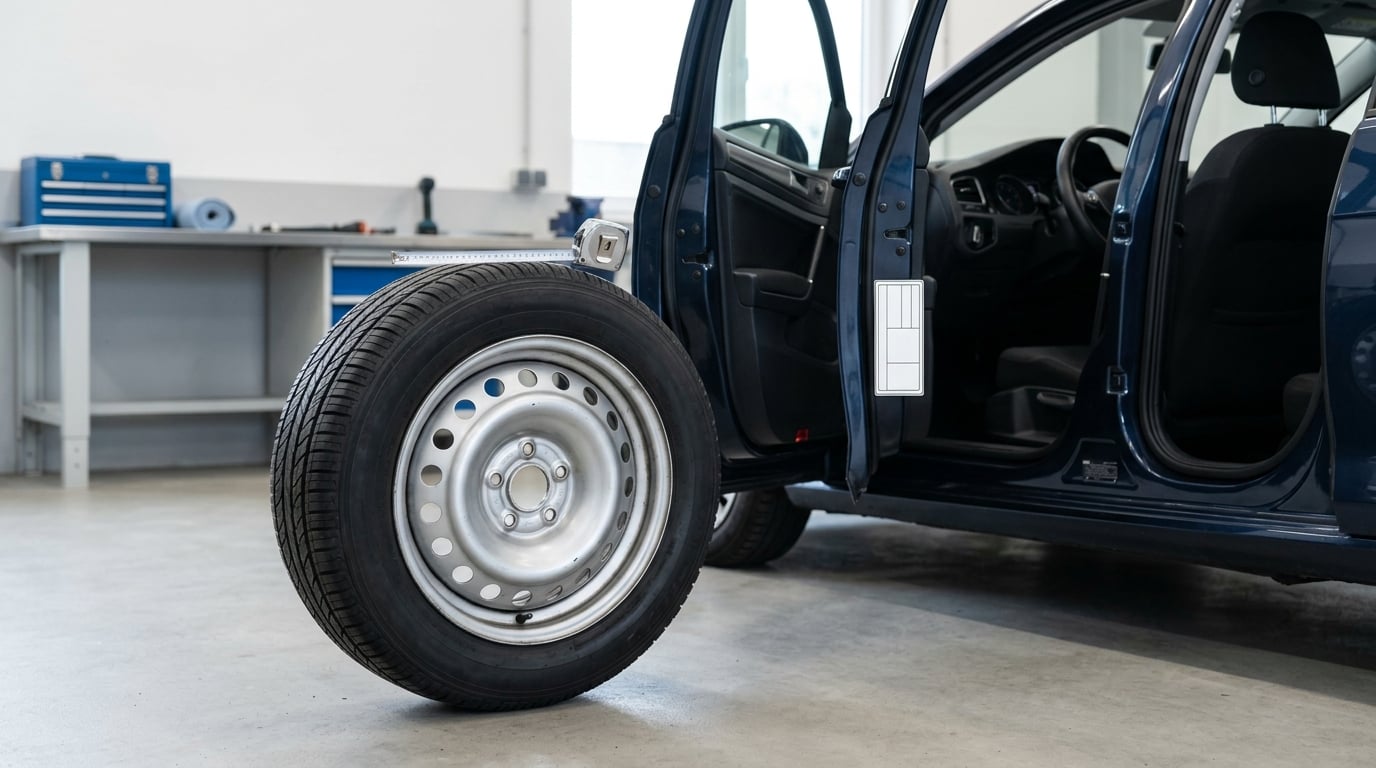
You can find the right tire size for your car in three places: the tire and wheel information placard inside the driver’s door jamb, the sidewall of the tire that’s on the car right now, and the owner’s manual. When those three disagree, the door placard wins. That’s the whole idea behind how to choose the right tire size for your car, and the seven steps below walk through it in order.
The job takes about ten minutes with the driver’s door open, and there is no special equipment. It does help to have a pen, though, because the last step is writing down a size code you can hand to a tire shop without misreading it.
Last updated in 2026. This guide follows the placard your vehicle manufacturer is required to fit, and it is written for people who have never read a tire code before.
Table of Contents
- What You Need
- Step-by-Step: How to Choose the Right Tire Size for Your Car
- 1. Find the Correct Tire Size on the Door-Placard
- 2. Check the Owner’s Manual for Load and Use Limits
- 3. Decode the Size on the Tire Sidewall
- 4. Match Width, Aspect Ratio, and Rim Diameter
- 5. Verify Load Rating, Speed Rating, and Construction
- 6. Compare the Stock and Installed Tires
- 7. Confirm Fitment Before Buying Four Tires
- Common Tire-Size Mistakes
- Frequently Asked Questions
- Can I use a different tire width than the one listed on my car?
- Does a tire’s width number mean its overall diameter?
- What is the correct tire size for my BMW?
- Can I change the aspect ratio while keeping the same rim size?
- How should I read tire load and speed ratings?
- Can four tires have different sizes?
- Conclusion
What You Need
You need five things, and four of them are already in the car or in the glove box.
- The driver-door tire placard. Open the driver’s door and look at the door frame and the edge of the door itself, not the side of the car. The sticker is usually on the jamb next to the latch, and it’s a rectangular label with tire sizes, pressures, and seating capacity printed on it.
- The owner’s manual. Not for the size code, mostly, but for what the car is allowed to be driven with. The tire chapter covers load ratings, spare tire limits, and winter use.
- The information molded into your current tires. Every tire has the full code on the sidewall. You’ll read it in step 3.
- A tire size guide or the manufacturer’s fitment search. Useful once you have a candidate size in mind and want the resulting overall diameter in inches.
- A clean sidewall. Mud and brake dust hide the small print. A damp cloth and thirty seconds of scrubbing make the last four characters readable.
That same placard also carries the recommended cold inflation pressures. If you’re shopping tires in cold weather, read What PSI Should Car Tires Be in Winter before you inflate anything.
Step-by-Step: How to Choose the Right Tire Size for Your Car
The process is: find the placard, read what the car requires, decode what you have, check the numbers that govern load and clearance, compare stock against installed, then confirm before you pay. Go in that order and the whole thing takes one sitting.
1. Find the Correct Tire Size on the Door-Placard
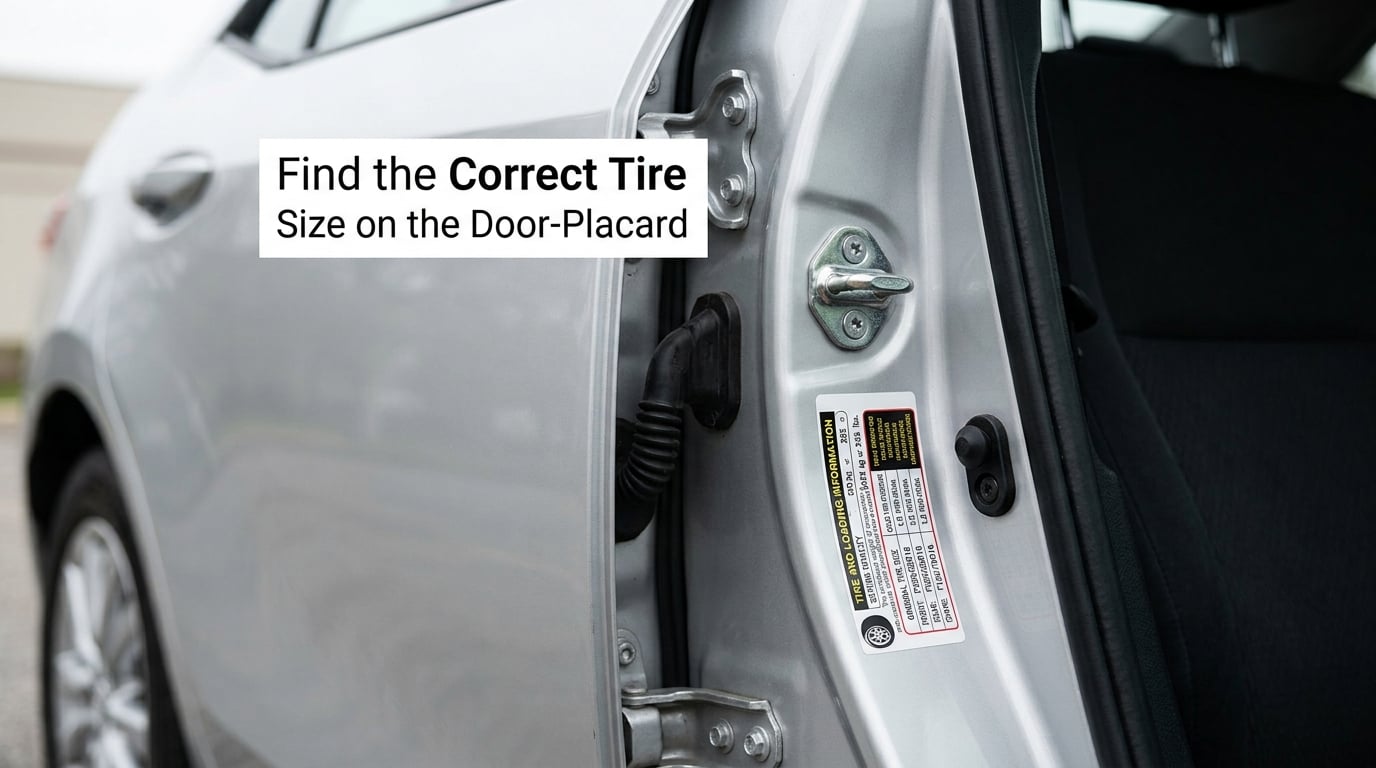
Open the driver’s door and find the tire and wheel information placard. The sticker sits on the door jamb near the hinges or on the edge of the door, and it stays on the car when the tire is changed, which is exactly why it beats the sidewall.
On that sticker you’ll find the manufacturer’s recommended tire size for your exact vehicle, usually written with a front and rear entry if the car came with a staggered setup. There is also a maximum seating capacity entry, which tells you the minimum size allowed when you carry five adults, and there may be a separate line for the spare.
The placard overrides the sidewall because it describes the car as built. If the tire on your rim is a different size from the placard, that means either a previous owner changed it, the car came with an optional wheel package, or the wheels are not the ones the car was built around. Only the first is a problem you caused by accident, and you’ll sort out which case you’re in at step 6.
Don’t confuse the spare tire line with the recommendation. A temporary spare has its own, smaller size and a much lower speed limit, and it’s printed in the same block as the real sizes.
2. Check the Owner’s Manual for Load and Use Limits
The manual tells you what the car may be operated with, which the placard does not. Look in the tire chapter for the approved size list per trim, the minimum load index, and any speed or stability restriction tied to a particular fitment.
Three things are worth finding before you buy. First, the permissible tire combinations, because some manufacturers allow a slightly different rear size only when the front stays at the listed size. Second, the original equipment requirements for specialty tires, which cover run-flats, winter compounds, and reinforced or extra-load constructions. Third, the spare tire section, which spells out the distance and speed a temporary spare is meant for.
Write down what the manual says before you look at tires. It gives you a reference to push back on a shop that tries to talk you into something bigger.
3. Decode the Size on the Tire Sidewall
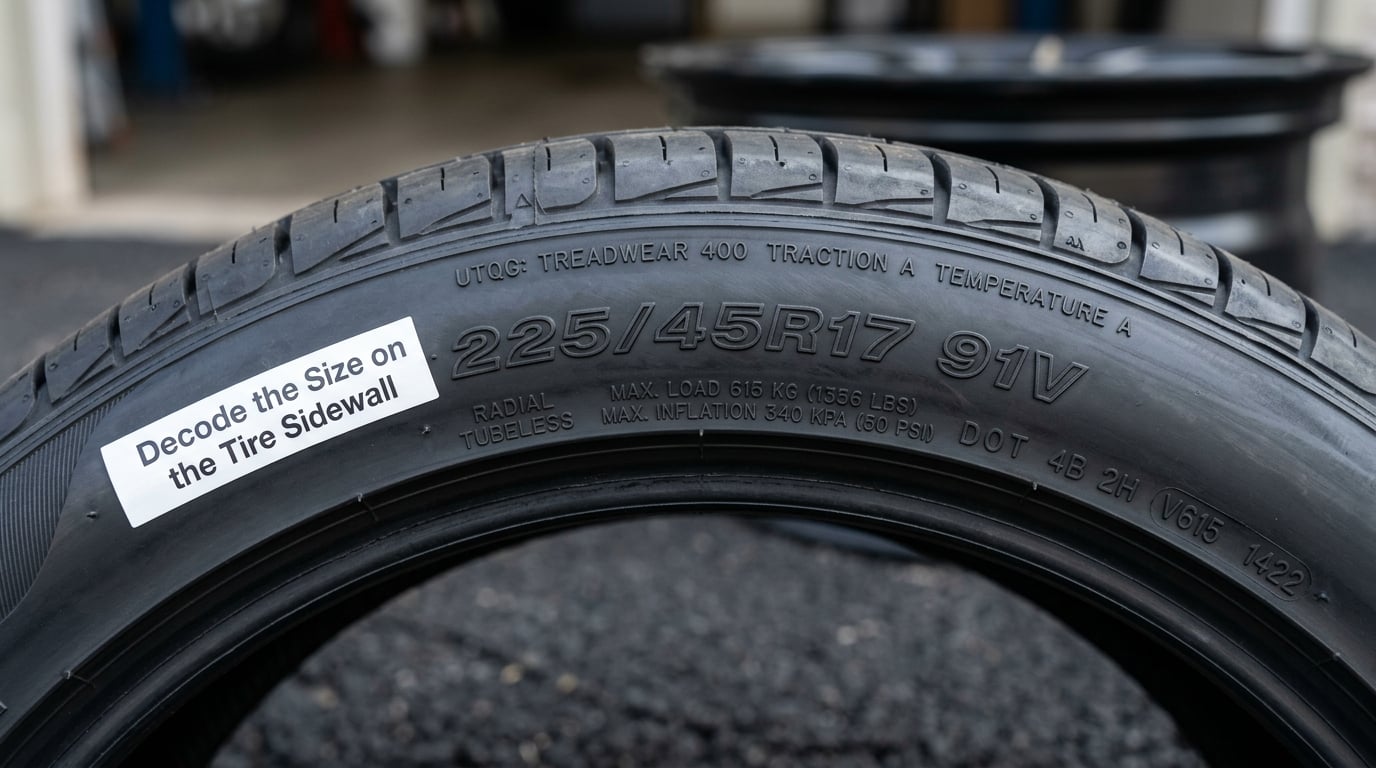
A tire size code is a handful of characters that describe the tire’s shape and its ratings. Take 225/45 R18 and read it left to right, one piece at a time.
- 225 is the section width in millimeters. It is the width of the tire from sidewall to sidewall, measured at a specific height, not the total width of the tire once it is mounted.
- /45 is the aspect ratio: the sidewall height is 45 percent of the section width. For this tire that’s 225 × 0.45 = 101.25 mm per side.
- R is the construction type. R means radial, which is standard on every passenger car today. A D means bias-ply, mostly seen on older bias-belted truck tires.
- 18 is the rim diameter in inches. It’s the bead seat diameter, and it’s the one number in the code that the wheel has to match exactly.
- Load index and speed rating come after the diameter, such as 102H. The number is a load index, the letter is a speed rating.
There may be a letter before the width as well. P means passenger car, LT means light truck, and no leading letter usually means Euro-metric, common on some European cars. The letter tells you which inflation and load standard the tire was tested to, and it changes what the numbers mean.
The overall diameter is the number that actually matters for fitment, and you can compute it: section width × aspect ratio × 2, plus the rim diameter in millimeters. For 225/45R18, that’s 225 × 0.45 × 2 = 202.5 mm, plus 18 inches which is 457.2 mm, for 659.7 mm. Call it about 26 inches. Write that number down, because every comparison from here uses it.
4. Match Width, Aspect Ratio, and Rim Diameter
Three dimensions decide whether a tire fits and how the car behaves: section width, aspect ratio, and rim diameter. The rim diameter has to match your wheel with no exceptions, because the tire bead has to seat on that exact surface.
Section width and aspect ratio are the flexible pair, and they’re flexible together. Widening the tire and lowering the aspect ratio by the same proportion can keep the overall diameter almost identical, which is how a carmaker fits a wider, lower-profile tire on a bigger wheel without changing gearing or fitment. One number goes up, the other comes down, and the rolling diameter barely moves.
Why does the overall diameter matter so much? Because it sets the rolling circumference, and the rest of the car is calibrated to it. Change the diameter and you change four things at once: the speedometer and odometer readings, the shift points in an automatic transmission, how ABS and traction control judge wheel lock, and how the suspension geometry works through a bump.
Nobody matches a rim diameter independently either. A 225/45R18 tire physically will not mount on a 17-inch wheel, and forcing it would damage both. Treat the rim diameter as fixed and change only the width and aspect ratio.
5. Verify Load Rating, Speed Rating, and Construction
The last two characters of the code are the load index and speed rating, and both are floors, not targets. A replacement tire must meet or exceed what the placard requires. An 88 load index means the tire is rated for 1,235 pounds, and the second digit in a two-digit index is not a decimal, it’s just the tens place.
Speed ratings are letters, and they run A through H in the low range with higher-speed letters above that: Q, R, S, T, H, V, W, Y. An H is 130 mph, a V is 149 mph. Matching or exceeding the placard rating is easy, and dropping below it is both a fitment problem and a warranty problem.
On trucks and larger SUVs you’ll also see a load range letter: C, D, or E. Those describe ply strength and how much load the carcass is built to take, and they tie directly to towing. A half-ton truck rated to tow needs the load range and load index the manufacturer specified, not a passenger-car tire with a similar size code.
One more thing belongs on the list: construction. Reinforced and extra-load versions of a size carry an XL or RE marker. They’re not a styling choice, they’re a different tire, and fitting one in place of the standard version changes sidewall height slightly.
6. Compare the Stock and Installed Tires
Now put two numbers side by side: the size the placard specifies, and the size actually on the car. If they match, you’re buying a like-for-like replacement and the rest of this step is done.
If they don’t match, the question is whether the difference is small enough to ignore, and the measure is the overall diameter you computed in step 3. A diameter change of more than about 3 percent in either direction puts you outside what most manufacturers consider a like-for-like fitment, and beyond that you’re changing the vehicle’s behavior, not just its tire.
Here’s a real example that comes up constantly. A sedan on 245/45R19 tires has an overall diameter of about 703 mm, computed as 245 × 0.45 × 2 = 220.5 mm of sidewall plus 482.6 mm of rim. Someone considers 245/50R19 tires on the same wheels, which give 245 × 0.50 × 2 = 245 mm plus 482.6 mm, or about 728 mm. That’s 25 mm larger, roughly 3.5 percent, so it sits just outside the 3 percent threshold.
The practical consequence is a speedometer error. Bigger tires mean the car travels further per rotation than the gauge expects, so at an indicated 60 mph the car is actually doing about 62. The gauge reads low, odometer miles undercount, and shift points come in earlier than the manufacturer calibrated them. It’s not dramatic, but it’s the kind of error that makes you doubt the car every time you check against a speed limit sign.
Also compare rim diameter and load index between the two. A different rim diameter means the wheels aren’t stock and the tire question can’t be answered from the size code alone.
7. Confirm Fitment Before Buying Four Tires
Write down the full specification from the placard, then check your candidate against it line by line. Rim diameter identical. Section width and aspect ratio either identical or within the tolerance your manual permits. Load index and speed rating equal or higher. Load range correct for the vehicle class.
Then check clearance, which is the part people skip. Wider tires need clearance at full steering lock, where the front wheel turns inward toward the fender liner. Suspension compression at full bump matters too, and a tire that clears at rest can rub on a driveway slope or a speed bump. Ride height, wheel offset, and any lowering or body kit all shrink the space available.
Contact a tire dealer or the vehicle manufacturer when any of these are uncertain: the placard is missing or unreadable, your rims are of unknown width or offset, the tire is a temporary spare, you’re changing construction type, you’re fitting winter tires to a car with a specific winter requirement, or the diameter difference is more than a couple of percent. A dealer can measure the existing setup and tell you in a minute what the car tolerates. A wrong guess shows up as rubbing, a damaged sidewall, or an ABS light, and neither is worth the savings.
Once confirmed, buy all four tires as a set from the same category. Mixing a highway touring tire with an all-terrain on the same axle is not a size problem, it’s a grip problem, and the two behave differently in the wet and at temperature.
Common Tire-Size Mistakes
The most common tire-size mistakes come down to reading the wrong source, ignoring the arithmetic, and treating one axle as independent from the other. Here’s each one and the fix.
Copying the size from the tire on the car. The sidewall tells you what’s fitted, not what’s approved. If a previous owner swapped sizes, the sidewall is documenting a change. Fix: start from the placard and treat the sidewall as a comparison.
Changing overall diameter without noticing. Going from a 65 to a 70 aspect ratio adds 22.5 mm of overall diameter on a 225/65R17 or 225/70R17 pair, which is around 3 percent. Fix: compute the diameter for every candidate before you commit.
Confusing section width with overall diameter. A tire marked 225 is not 225 mm wide on the car, and it certainly isn’t 225 mm tall. The number is a section, measured in a lab, and the overall diameter is what actually fills the wheel arch. Fix: use the formula from step 3 rather than reading the width as a size.
Ignoring the load index. A tire with a lower load index than the placard requires is not an acceptable substitute, regardless of size match or tread depth. Fix: treat the load index and speed rating as minimums.
Mixing specifications across the car. Different sizes or different constructions left and right on the same axle make the car pull to one side and wear the tread unevenly. Uneven wear across a tire is what tire feathering looks like when it goes ignored. Fix: pair tires axle to axle, left with left and right with right.
Treating the spare tire entry as the recommendation. A temporary spare is typically narrower, has a much lower speed limit, and can lose grip in the rain sooner. A full-size spare should match the set it’s stored with. Fix: read the spare line as its own specification, and check the date code on the spare with How to Tell How Old a Tire Is since spare tires age in the trunk like everything else.
Replacing only two tires on an all-wheel-drive car. A circumference difference between axles makes the drivetrain fight itself constantly, accelerating wear on the transfer case, differential, and center drive. Fix: on an AWD vehicle, replace all four when the size or category changes.
One more that’s easy to get wrong: assuming a bigger number means a bigger tire. It depends which number you’re comparing, which is why the arithmetic in step 3 matters more than any single figure on the sidewall.
Frequently Asked Questions
Can I use a different tire width than the one listed on my car?
Sometimes, yes, but the width change is the least important of the three numbers. A tire a little wider or narrower can fit if the rim diameter is unchanged, the overall diameter stays within roughly 3 percent of the placard figure, and the tire still clears the fender liner at full lock and full suspension compression. Check the load index and speed rating too, then confirm with a dealer if the tire will rub.
Does a tire’s width number mean its overall diameter?
No. The first number, such as 225, is the section width in millimeters, measured at a specific height on the tire, not across the whole tire and not its height. Overall diameter is a calculation: section width times aspect ratio times two, plus the rim diameter converted to millimeters. A 225/45R18 works out to about 660 mm, or 26 inches, overall.
What is the correct tire size for my BMW?
Read the tire and wheel information placard on the driver’s door jamb of your specific vehicle, which is the only source that reflects your sub-model, trim, and wheel package. Many BMWs were produced with staggered fitments, meaning the front and rear sizes differ, and the placard lists both. If the placard is missing or unreadable, give a dealer the VIN and let them confirm before you order.
Can I change the aspect ratio while keeping the same rim size?
You can, provided you compensate with width and keep overall diameter within about 3 percent. Dropping a 225/45R18 to a 225/55R18 adds roughly 45 mm of overall diameter, which is far too much, while 245/50R19 versus 245/45R19 on the same wheel comes out around 3.5 percent larger. That last figure changes your speedometer reading and shift points, so check the total, not just the sidewall.
How should I read tire load and speed ratings?
Both sit at the end of the size code, such as 102H, and both are minimums. The digits are a load index where 102 equals 2,045 pounds per tire, and the letter is a speed rating where H means 130 mph. Compare them with what the placard requires and match or exceed it. On light-truck tires you will also see a load range letter of C, D, or E, which relates to towing capacity.
Can four tires have different sizes?
Only in specific, documented cases. Some cars ship with a staggered setup where the front and rear sizes differ, and the placard lists both, so two of each is correct. Beyond that, keep the same size, construction, and category on each axle, and on all-wheel-drive vehicles keep all four within the manufacturer’s tolerance because a rolling circumference difference between axles wears the drivetrain.
Conclusion
Start at the driver’s door jamb, not the tire shop. Read the placard, decode the sidewall code into a real overall diameter, confirm the load index and speed rating meet or exceed what the car requires, and only then decide whether a different size is worth the clearance and speedometer consequences.
If the numbers tell you the tire on your car is not what the manufacturer specified, the size to go back to is the one on the placard, and the tire already on the rim is only a starting point for comparison.