
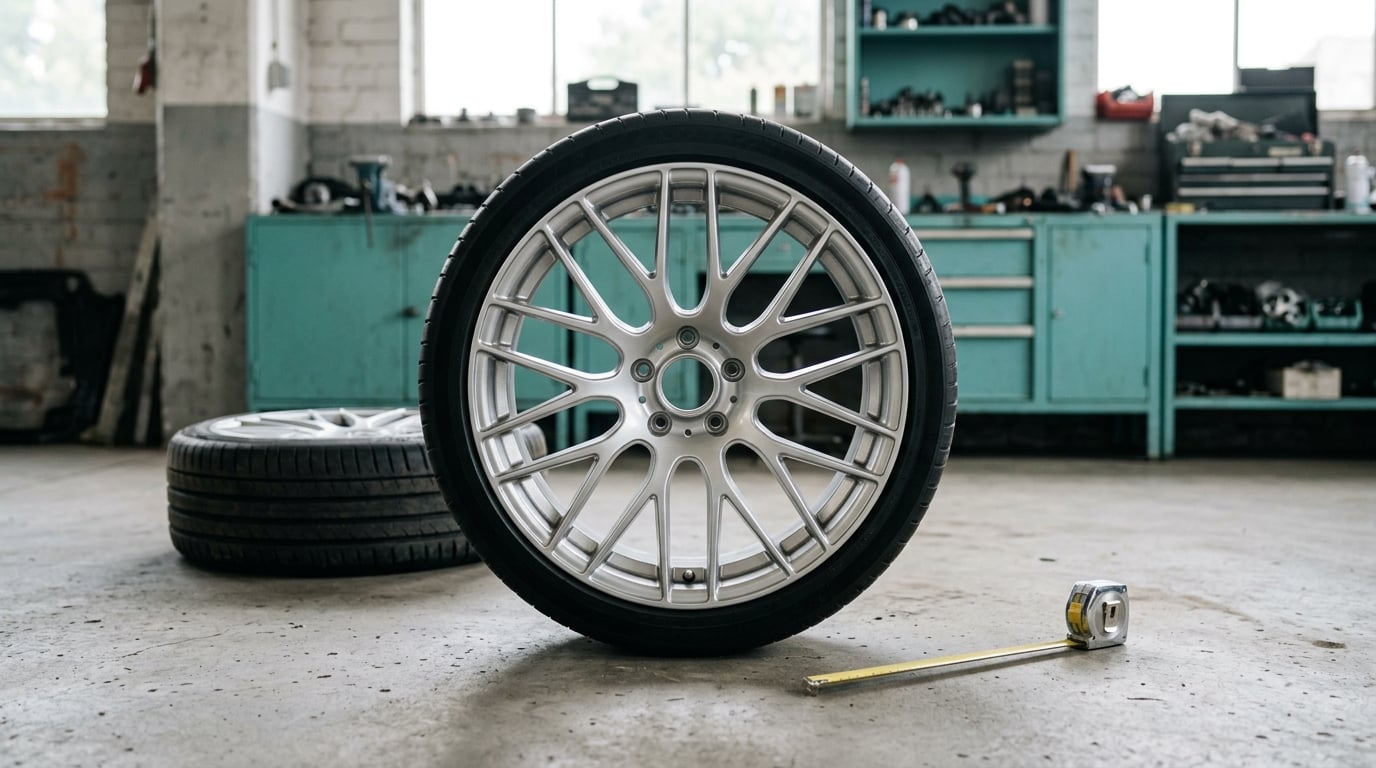
Plus sizing means fitting a larger-diameter wheel with a shorter-sidewall tire so the overall tire diameter stays within about 3% of the factory size. You get a bigger, better-looking wheel and sharper steering without upsetting the speedometer, the gearing or the ABS. Everything else is arithmetic on the numbers molded into your current tire.
That definition is the whole idea. Once you can read a tire size code, plus sizing stops being a mystery and becomes a small calculation you can do yourself in about two minutes. This guide on plus sizing wheels explained takes that calculation from a sidewall code to a finished BMW fitment, offset and clearance decision.
Table of Contents
- What Is Plus Sizing?
- How Plus Sizing Changes Wheel and Tire Dimensions
- What Does Plus Sizing Do to Performance?
- How to Choose Plus-Sized Wheels for a BMW
- Offset, Wheel Width, and Clearance
- Plus Sizing vs. Staying With the Factory Size
- BMW-Specific Plus-Sizing Considerations
- What Is the Difference Between Plus Sizing and a Wider Tire?
- How to Measure and Verify a Plus-Sized Fitment
- Does Plus Sizing Affect Insurance, Warranty or Legality?
- Frequently Asked Questions
- Conclusion: What to Do First
What Is Plus Sizing?
Plus sizing is the practice of increasing the wheel (rim) diameter by one or more inches and dropping the tire’s aspect ratio to compensate, so the tire’s overall rolling diameter barely changes. The wheel gets bigger. The sidewall gets shorter. The car reads the same.
The vocabulary comes straight from the number of inches you add. Plus one means a wheel one inch larger in diameter than factory. Plus two means two inches. Plus zero is a special case that does not change diameter at all.
| Term | Wheel diameter change | Typical tire change |
|---|---|---|
| Plus zero | None | Wider tire on the factory wheel |
| Plus one | Plus 1 inch | About 10 mm wider, about 5 to 10 fewer aspect ratio points |
| Plus two | Plus 2 inches | About 20 mm wider, about 10 to 20 fewer aspect ratio points |
| Plus three | Plus 3 inches | Very low profile, common on lowered sport builds |
You will also see “27.5 plus” or “29 plus” in mountain bike circles. That is not a different rim diameter. It means running a wider, larger-volume tire on the same 27.5 or 29 inch rim, and it has nothing to do with the automotive plus one you see in a fitment guide.
How Plus Sizing Changes Wheel and Tire Dimensions
Before any maths, you need to read the code on the sidewall. A size such as 225/50R17 97Y breaks into six parts, and each one matters when you plus size.
| Field | Meaning | Value in this example |
|---|---|---|
| 225 | Section width in millimetres | 225 mm wide, sidewall to sidewall |
| 50 | Aspect ratio as a percentage of section width | Sidewall is 50% of 225 mm, so 112.5 mm tall |
| R | Radial construction | Almost every modern tire |
| 17 | Rim diameter in inches | The wheel is 17 inches across |
| 97 | Load index | Rated for 730 kg per tire (97 x 7.5 kg) |
| Y | Speed rating | 195 mph rated |
The overall diameter of a tire is the rim diameter plus the sidewall height on each side. In millimetres, that is rim inches multiplied by 25.4, plus twice the sidewall height.
Plus sizing wheels explained: the worked BMW example
Here is a 17 inch BMW on factory 225/50R17 tires. Rim is 17 x 25.4 = 431.8 mm. Sidewall is 225 x 0.50 = 112.5 mm. Overall diameter is 431.8 + 225 = 656.8 mm, which is 25.86 inches. That number is the reference everything else gets compared against.
Now plus one it to 18 inch wheels with 235/45R18. Rim becomes 457.2 mm, sidewall becomes 235 x 0.45 = 105.75 mm, and the overall diameter comes to 668.7 mm. That is 1.8% larger than factory, comfortably inside tolerance. A plus two at 245/40R19 gives 678.6 mm, which is 3.3% larger and outside the 3% band. That last one is the mistake worth seeing, because nothing about it looks wrong until the speedometer is off and the gearing feels long.
| Setup | Tire size | Overall diameter | Difference |
|---|---|---|---|
| Factory | 225/50R17 | 656.8 mm (25.86 in) | Baseline |
| Plus one | 235/45R18 | 668.7 mm (26.33 in) | +1.8% |
| Plus two | 245/40R19 | 678.6 mm (26.72 in) | +3.3%, outside tolerance |
What is the 3% rule for tire size?
The 3% rule says the new overall diameter should stay within 3% of the factory diameter, comparing front to rear. That is the widely accepted limit because it is what ABS, traction control and stability systems are calibrated to absorb. Many fitment guides and wheel brands recommend 1% instead, and they are not arguing from ignorance. A 1% change keeps the speedometer error small enough that most drivers never notice it, and it keeps the electronic systems well inside what they were tested for. Treat 3% as the outer wall and 1% as the sensible target.
Work out what the error means at speed. A 1.8% larger diameter makes the speedometer over-read, because the tire covers more ground per revolution than the gauge assumes. At an indicated 70 mph the car is really doing about 68.7 mph. Your odometer accumulates distance faster than you drive it too, so a set of plus one wheels adds roughly 1.8% to every mile on the clock.
What Does Plus Sizing Do to Performance?
Plus sizing is a trade, not a straight upgrade. You sharpen some things and dull others, and how much you notice depends far more on the tire than on the wheel.
What tends to improve: steering response, because the shorter sidewall has less flex to work through before the tire reacts. Appearance, because a larger wheel face fills the arch. Grip potential, if the wider tire is a good compound rather than a cheap one in a bigger size.
What tends to get worse: ride comfort over expansion joints and broken asphalt, because there is less sidewall to absorb the hit. Road noise at higher speeds. Pothole survival, since a 45-series sidewall flexes far less than a 50-series one. And fuel economy, usually by a small amount, from stiffer casing and larger rotating mass.
Acceleration changes very little. Unsprung mass, the weight of the wheel, tire and brake hardware that the suspension has to push up and down with every bump, often rises as wheels get larger unless you drop into a forged wheel. On a daily-driven BMW I would not expect anyone to feel a straight-line difference from one plus step.
How to Choose Plus-Sized Wheels for a BMW
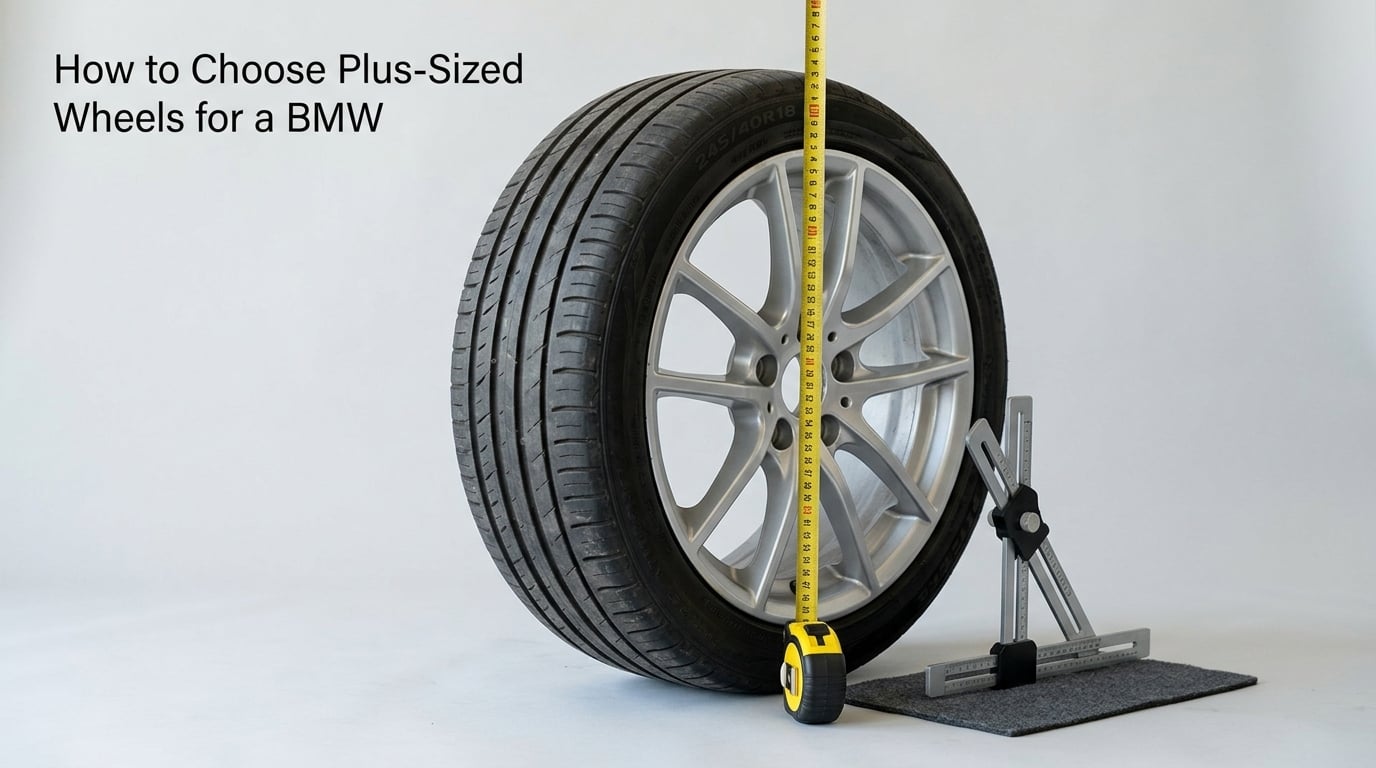
Work through these six checks in order and you will not buy something that does not fit.
- Confirm your factory size. Read it off the sidewall or find it on the tire placard in the driver door jamb. That code is the diameter you are trying to preserve.
- Pick the wheel diameter. Plus one is the sensible ceiling for a car that still has factory suspension and lives on real roads. Plus two and beyond start eating tire and pothole life.
- Work out the aspect ratio that puts the diameter back. Formula: aspect ratio = ((factory overall diameter in mm) minus (new rim in inches x 25.4)) divided by (section width x 2). Round to the nearest available size.
- Check the tire fits the rim width. Section width should roughly match the rim width in inches, and always sit inside the acceptable rim width range molded on the tire sidewall.
- Match offset and load rating. Offset usually drops by around 5 mm per plus step to sit the wider wheel under the arch rather than proud of it. Load index must meet or exceed what the car requires at its gross vehicle weight rating.
- Verify before you order. Run the numbers through a tire size calculator and cross-check against the wheel maker’s fitment data. If the result is within 1%, you are in good shape.
One more thing about load rating, because it gets missed constantly. XL on a tire sidewall means Extra Load, a reinforced version of that size with a higher load capacity. It does not mean 10 ply. A tire’s actual ply count is marked in the same size code, something like 6PR, and passenger car tires rarely exceed 4. Trucks and SUVs near their gross vehicle weight rating need the load index checked specifically, not assumed from the tire width.
Offset, Wheel Width, and Clearance
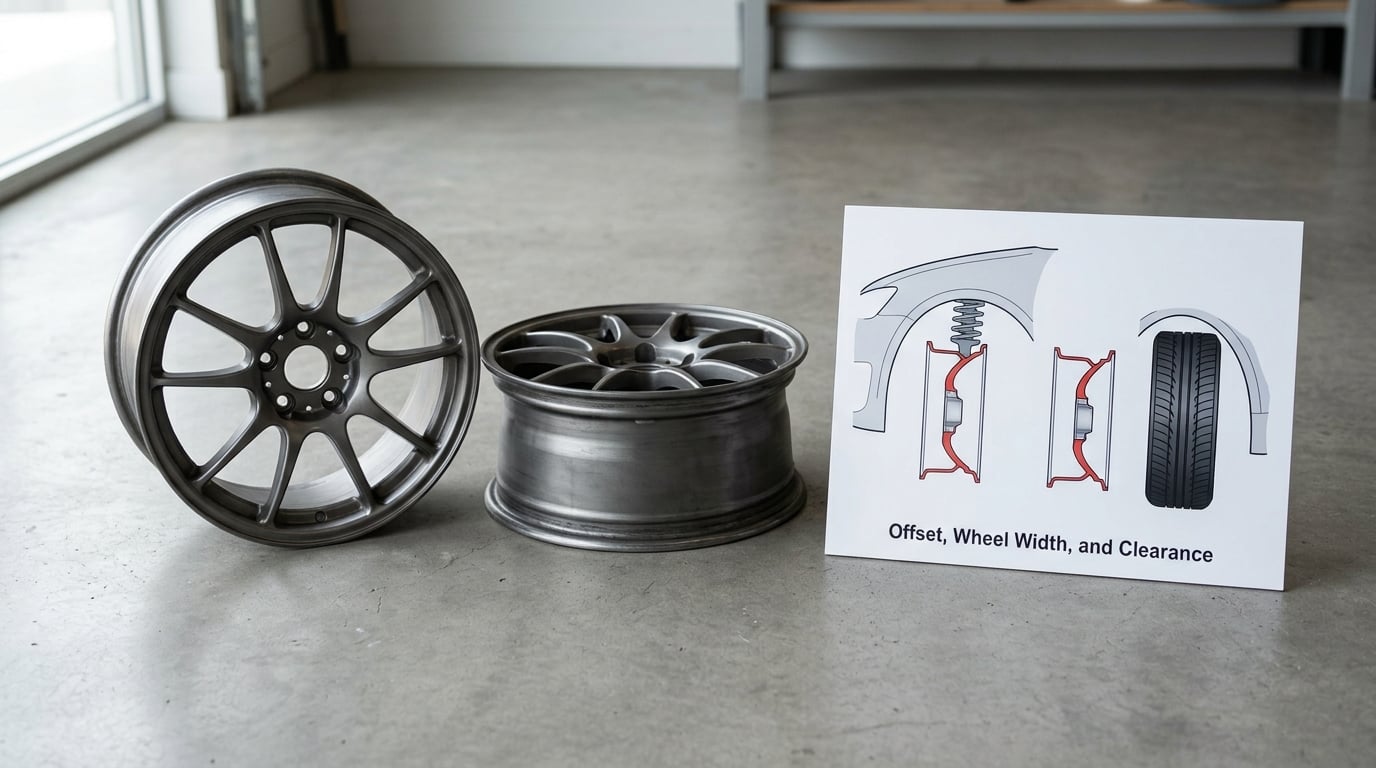
Offset, marked as ET, is the distance in millimetres between the wheel mounting face and the true centreline of the wheel. Positive offset pushes the mounting face outward, which is what most passenger cars run. Negative offset pulls it inward, which is what trucks and older designs used to keep the wheel face under the fender lip.
A wider wheel is not automatically a better fitting wheel. Width changes how much rubber you can carry and how hard the sidewall has to bulge, but offset decides where the wheel sits relative to the suspension and the fender. A wheel that is too wide for its offset will stick out past the arch, and one that is too narrow for its offset will tuck in and hit the strut or the inner fender liner.
Clearance is also a moving target, which is the reason people discover rubbing weeks after fitting new wheels. The car looks fine parked because the tire is straight. It only touches when you turn the wheel fully left or right at the same time as the suspension is at full droop, or when you load the car and it settles on the springs. Check at full steering lock, not in the driveway.
Brake clearance is the other static check. A larger diameter wheel with a lower profile tire can leave a big brake disc sitting with a thin band of sidewall around it, and the caliper has to clear that disc at every point in the caliper’s travel. If the wheel sits out past the mounting face, a spacer may be required, and spacers change the load on the studs and the wheel bearings.
Plus Sizing vs. Staying With the Factory Size
Staying with the factory size is the lower-risk option and it is right for a lot of people. This table is the honest comparison.
| Factor | Plus sized setup | Factory size |
|---|---|---|
| Appearance | Larger wheel face, fuller arch | Original look, smaller face |
| Steering response | Slightly sharper | Standard, softer on-center |
| Ride comfort | Firmer, more secondary ride | More compliant over rough surfaces |
| Pothole resistance | Lower, especially past plus one | Best of the two |
| Road noise | Usually louder at highway speed | Quieter |
| Speedometer accuracy | Reads high by the diameter change | Correct |
| Tire cost | Fewer options in low profiles | Widest selection and best value |
| Clearance risk | Needs real checking at full lock | Known to fit |
Keep the factory size if the car is a commuter on poor roads, if the ride already feels firm, if you tow, or if money matters more than looks. Plus size is worth doing when the car is well maintained, the suspension is factory and you genuinely want the shorter sidewall.
BMW-Specific Plus-Sizing Considerations
BMW fitment has its own wrinkles that a generic guide tends to skip.
Staggered setups are the big one. Many BMWs, particularly rear-drive models and the M cars, ship with wider front tires than rear. Running plus-sized fronts with factory rears changes the front and rear diameter, and the wheel speed sensors on each corner then report different rotation rates for the same road speed. Owners on BMW and Acura enthusiast forums report exactly that symptom, with traction control light and sensor readings that disagree. Keep front and rear diameters within about 5% of each other, and closer than that on all-wheel-drive cars, since the system reads all four.
Brake disc clearance varies by model and year more than most marques. A wheel that clears a 3 Series arch can sit proud of the rear caliper on the same car. The 5 Series and the SUVs have their own geometry again, and the suspension design matters because a multi-link rear axle has more travel near the wheel than a MacPherson strut.
Tire pressure monitoring compatibility is a genuine issue on older cars. A 2011-era sensor designed to read a specific pressure range can misread or go dormant on a tire with a very different carcass, and the module may not accept the new size at all.
The last point is the one people regret. Read the tire placard on your own car and use the factory database for that exact year, engine and suspension. Copying the setup from a forum post about a different model is how people end up with wheels that need spacers or an alignment they did not plan for.
What Is the Difference Between Plus Sizing and a Wider Tire?
The difference is whether the diameter changes. Plus sizing increases the wheel diameter, which shortens the sidewall and changes the overall rolling diameter even though you try to keep it within tolerance. Fitting a wider tire on the factory wheel changes the section width only, so the rim diameter, the sidewall height and the overall diameter all stay exactly where they were.
That is why plus zero is a separate term. Plus zero means a wider tire on the original wheel size. You gain a bigger contact patch and a fuller arch with zero speedometer error, no gearing change and no new wheel purchase. The catch is rim width: pushing a tire well beyond the width the rim was designed for makes the sidewall bulge, which softens the response and can hurt dry grip rather than help it.
Aspect ratio also means something different in each case. When you plus size, the aspect ratio number must drop to protect the diameter. When you simply go wider, the aspect ratio stays the same and the sidewall gets taller as the section width grows, so the overall diameter grows slightly. On a 225/50R17, moving to 235/50R17 adds about 5 mm to each sidewall, so roughly 10 mm of extra overall diameter, well under 1%.
How to Measure and Verify a Plus-Sized Fitment
Do this before you order anything, and you will not need a shop to tell you what fits.
- Measure the tire section width. Measure the widest point of an inflated tire, not the rim width. A 225 tire is usually 223 to 227 mm across.
- Calculate the sidewall height. Multiply the measured section width by the aspect ratio as a decimal. On 225/50R17 that is 112.5 mm.
- Get the rim diameter in millimetres. Multiply the inch figure by 25.4. A 17 inch rim is 431.8 mm.
- Add them for the overall diameter. Rim millimetres plus twice the sidewall height gives you the number every other size gets checked against.
- Read the offset. It is stamped on the back of the wheel, usually as ET45 or similar. Read the current one off your factory wheel so you know the change you are making.
- Check the rest of the fitment data. Bolt pattern, center bore and load rating have to match the BMW. The center bore should be hub-centric, and any gap needs a centering sleeve, not a guess.
- Compare against the maker’s data. Put both numbers into a tire size calculator and check the wheel maker’s published fitment for your model.
- Test fit before the tires go on. With the wheel bolted to the hub, turn the steering lock to lock and push the suspension through full travel. That is the only check that reliably catches a rub.
Get an alignment and a balance done after the change, whichever way you size it. Wider tires change the contact patch position and the toe sensitivity, and a car running a different diameter in the rear will pull differently than it did before.
Does Plus Sizing Affect Insurance, Warranty or Legality?
It can, and it is worth reading your paperwork before you fit the wheels rather than after.
Insurers check modified vehicles at claim time. A plus-size setup that keeps the diameter within 1% and uses tires of equal or better load rating is unremarkable and almost never queried. A setup outside the 3% band, or one with a tire speed rating below what came off the car, can give an adjuster a reason to reduce a settlement. Nothing changes in your coverage the day you fit the wheels, but the evidence you have afterwards matters.
Warranty is a separate question from legality. Changing wheel size does not by itself void a vehicle warranty, but tire and wheel problems are usually excluded anyway, and a suspension or driveline component that fails with evidence of an aggressive fitment can be argued. The offset and clearance checks in this guide are the cheapest insurance you can buy.
Legally, you are bound by the construction and load rating rules of the country you drive in, and the tire must meet the vehicle’s specified minimum rolling diameter. Staying within 1% keeps you comfortably on the right side of all of that.
Frequently Asked Questions
What does 27.5 plus mean?
The plus sign in 27.5 plus and 29 plus is a bicycle and mountain bike term, not a car one. It means running a wider, higher volume tire on the same 27.5 or 29 inch rim, and the rim diameter does not change at all. In car fitment language, plus one and plus two mean adding one or two inches to the wheel diameter while shortening the tire sidewall to hold overall diameter steady.
Can I use 235 instead of 225?
Sometimes. The section width should sit inside the tire maker’s approved rim width range, and a good rule of thumb is that the section width in millimetres should roughly match the rim width in inches. A 235 tire on a 7 inch wide rim pushes the sidewall out noticeably, which softens steering response and can reduce dry grip. On an 8 inch rim it is usually comfortable, provided the stamped range allows it.
Is an XL tire a 10 ply?
No. XL means Extra Load, which is a reinforced version of a tire size with a higher load capacity than the standard version. Ply rating is a separate number written in the size code, usually 4PR on passenger car tires and rarely above 6. If you are carrying close to the gross vehicle weight rating on a truck or SUV, check the load index number and the vehicle placard rather than relying on the XL marking.
What are the rules for upgrading to bigger tires?
Keep the overall diameter within about 3% of factory, with 1% being the smarter target. Keep the tire section width inside the approved rim width range. Match or exceed the required load index and keep the speed rating at or above the original. Stay within the manufacturer’s offset range for the model, and check clearance at full steering lock and full suspension travel before driving away. Finally, keep front and rear diameters close together, especially on all-wheel-drive cars.
Does plus sizing make my car faster?
Only marginally, and not in the way most people expect. A one percent diameter change alters the final drive gearing by about one percent, which is felt as a very slight change in acceleration and in the speedometer reading. The real differences are sharper steering response, a larger wheel face and potentially a wider contact patch. Braking, cornering grip and power depend on the tire compound and the brake hardware, not on the wheel diameter.
Is a plus two too much for a daily driver?
It is a lot for a commuter on rough roads. A plus two typically drops the aspect ratio by ten points or more, which costs ride comfort, adds road noise and noticeably raises the risk of a cracked sidewall or bent rim from a pothole. Plus one is the usual upper limit for a daily-driven car on factory suspension. If the roads where you live are rough, staying at the factory size is the better call.
Conclusion: What to Do First
Write your current tire size on a piece of paper and work out the overall diameter in millimetres. That single number is the reference for everything else, and once you have it, choosing a plus size is a ten-minute calculation rather than a guess. From there, read your wheel’s fitment data for your exact BMW year and model, and check clearance at full steering lock before the first drive.
If you are planning the rest of the work on the car, our guides on the difference between an impact wrench and an impact driver and how regenerative braking works cover the other side of the job. For anything you do alongside the wheels, high mileage oil explained is worth a read before you book the service.