
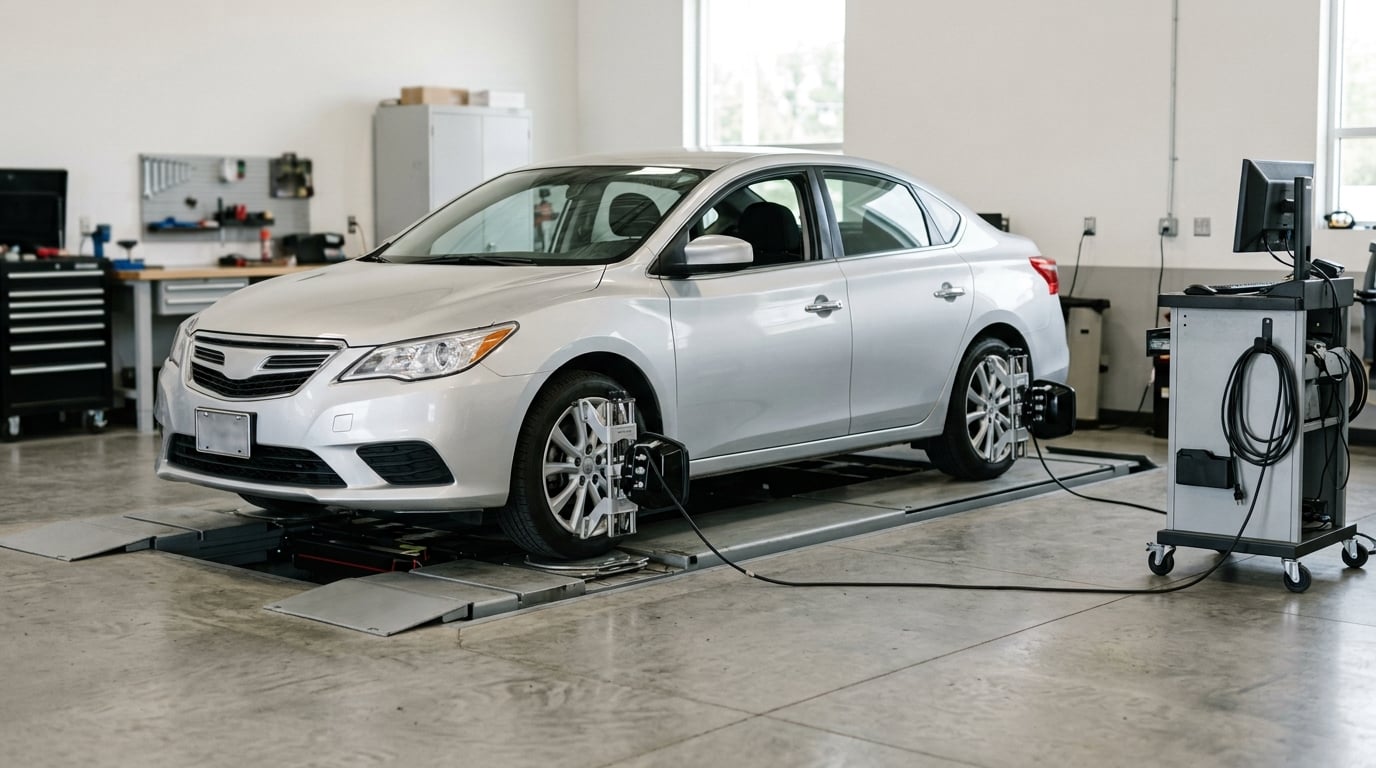
A standard wheel alignment in the US typically lands somewhere between 90 and 250 dollars, and a four-wheel job runs more than a front-only one. This guide covers wheel alignment symptoms and cost: the signs that tell you a car is out of spec, what a shop actually adjusts, and the handful of things that push a quote up. Prices quoted here are typical US ranges that shift by region and change over time, so treat them as a yardstick rather than a menu.
Table of Contents
- Wheel Alignment Symptoms and Cost at a Glance
- What Affects the Price
- How to Lower the Bill Without Skipping Important Work
- How to Read the Printout Before You Pay
- When Alignment Symptoms Need a Professional Inspection
- Frequently Asked Questions
- What are the most common wheel alignment symptoms?
- How much does a wheel alignment cost in the US?
- Is a front-wheel alignment cheaper than a four-wheel alignment?
- How long does a wheel alignment take?
- Can I drive with bad wheel alignment symptoms?
- Do I need an alignment after replacing tires or suspension parts?
- What to Do First
Wheel Alignment Symptoms and Cost at a Glance
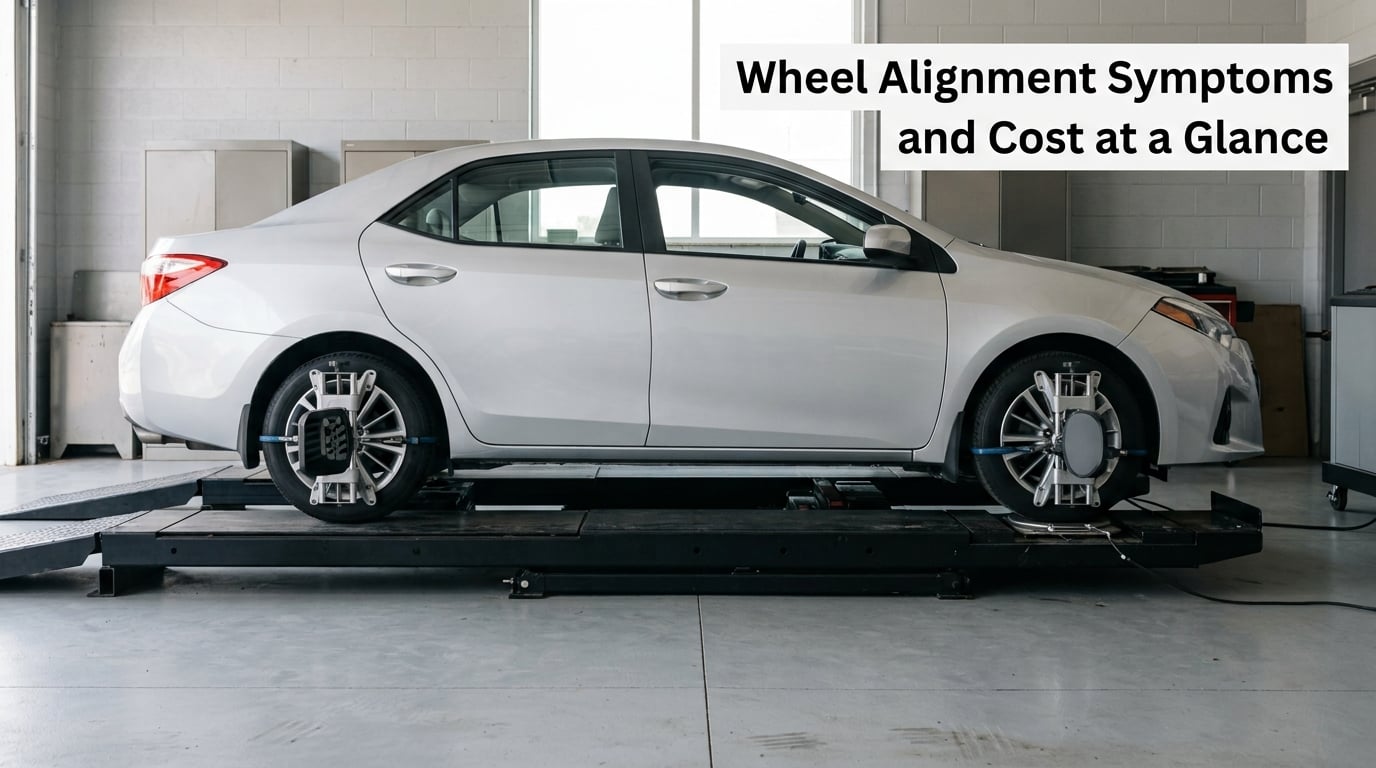
Before the numbers, the short version of the symptoms. A car that wanders, steers crooked, wears one edge of its tires thin, or hums at highway speed is telling you something about its geometry. Not every one of those complaints is alignment, and that distinction is where most wasted money goes.
| Service | What it covers | Typical US range | When it makes sense |
|---|---|---|---|
| Front-only (two-wheel) alignment | Steering and the two front wheels, toe and caster plus front camber | About 90 to 150 dollars | Older front-wheel-drive cars and trucks with a solid rear axle where the rear geometry cannot be adjusted |
| Four-wheel alignment | All four wheels, including rear camber and toe where the suspension allows adjustment | About 130 to 250 dollars | Independent rear suspension, nearly all SUVs and crossovers, and anything that pulls badly at the rear |
| Alignment plus steering or suspension repair | New tie rods, ball joints, control arms, bushings or struts, then the alignment | Repair varies widely by part; alignment adds about 100 to 150 dollars on top | Printout shows a reading the shop cannot adjust without worn parts first |
| Sensor calibration after alignment | Camera and radar recalibration on vehicles with driver assistance systems | Often 150 to 400 dollars on top of the alignment | Newer vehicles where the manufacturer requires calibration after geometry changes |
Road crown is the other thing that gets mistaken for a fault. Most roads are banked slightly for drainage, so a car that tracks a fraction to the left on a crowned highway and runs straight on a flat section of parking lot is behaving normally, not badly.
Common Wheel Alignment Symptoms and What Each One Fixes
These seven show up most often, roughly in the order drivers notice them.
- The car pulls to one side. Strongest single signal, and it usually points at caster mismatch rather than toe. Check it on a flat, straight road before blaming the alignment, because road crown and tire pressure both mimic it.
- The steering wheel sits crooked or off-center. The car goes where it is pointed, the wheel just does not look centered. One side of the front toe is usually wider than the other.
- Uneven tire wear. Faster wear on one outer or inner shoulder points to camber. Feathering, where the tread looks like the edge of a saw blade across the tire, points to toe.
- Vibration through the wheel or seat at highway speed. Often a balance problem rather than an alignment problem, though a bent wheel from a pothole can look identical from the driver seat.
- The car wanders or drifts and never settles. The driver keeps making small corrections and tires through the sidewalls. This is common with looseness in steering components as much as with geometry.
- Squeal on turns, or a noisy, worn-feeling ride. Often a suspension bushing or strut, not an angle setting. Alignment cannot fix a worn joint.
- Poor fuel economy and vague, imprecise handling. The subtlest symptom. A crooked tire creates rolling resistance, and geometry that never settles forces the driver to work the wheel constantly.
Toe error wears tires but rarely causes a pull, camber error wears shoulders, and caster error causes the pull. That mapping is worth remembering before a shop starts quoting parts.
What Affects the Price
Two quotes for the same job can differ by more than the job itself. These are the reasons that happen most often.
Front-only or four-wheel
Four-wheel work takes longer, needs all four wheels measured and often adjusted, and on independent rear suspension there is more to bring into spec. That is the single biggest cost difference between two otherwise identical quotes.
Vehicle size and suspension design
A compact car with a torsion beam rear axle is quick, because the rear cannot move much. A midsize sedan on four-link or multi-link rear suspension takes longer, because the technician has real adjustments to make at the back.
Worn steering and suspension parts
An alignment can only set what the hardware allows. If a tie rod end, ball joint, control arm bushing or strut is loose, the reading will not hold, and the honest answer is that the part gets replaced before the geometry is set. Suspension repair is a separate bill from alignment, and it is fair for a shop to quote it separately.
Adjustment versus major repair
Moving a wheel from a slightly out-of-spec reading to a slightly out-of-spec reading is routine. Replacing a warped control arm on a car that has been neglected is a different job with a different price. The tell is how far the numbers have drifted from the manufacturer’s specification.
Shop type and labor rate
Dealer pricing for the same work is routinely double an independent shop, and independent shops sit below national chains and mobile services in most regions. Owners report paying several hundred dollars at a dealership for what a local garage charged under a hundred. That gap is real, and it comes down to overhead and brand premium, not work quality.
Newer vehicles with driver assistance systems
Manufacturers increasingly require camera and radar recalibration after geometry changes. Some shops do it in house, some send it out, and either way it lands on the invoice as a separate line. On an electric vehicle with a high-mounted sensor stack, expect the alignment plus calibration to run well above what the same car would cost as a combustion model, because access and sensor placement make the job slower.
One more factor people forget: tires. If the front tires are worn past their limit or mismatched in size, the alignment will not hold and the shop will say so. That is a legitimate refusal, not an upsell.
How to Lower the Bill Without Skipping Important Work
None of this involves cheap specifications. Wrong numbers on an alignment rack produce a car that wears tires faster than doing nothing, so the savings come from scope, shopping and preparation, not from cutting corners.
Get two written estimates
A written quote should itemize the type of alignment, whether an inspection is included, what parts are being replaced if any, and whether calibration is needed. Two quotes with the same itemization tell you the market rate in your area. A quote that refuses to break anything down is a quote to walk away from.
Check the tires before you book
Walk around the car and look at all four tires. Note even wear versus one-shoulder wear, any feathering, and whether the tires are a matched set of the same size and type. Finding a problem this way before the shop has the car on the rack saves the argument about why the reading will not hold.
Ask directly whether front-only is right for your car
For an older car with a solid rear axle, a front-only alignment is the correct service and paying for four-wheel is a waste. For anything with independent rear suspension or a noticeable rear-end feel, do the whole thing. This one question is the easiest money to save or to lose.
Turn down the add-ons you did not ask about
It is common to be offered balancing, a tire rotation plan, a lifetime alignment program, or suspension parts during the visit. Some of that is reasonable, some is not. Ask for a printed alignment report either way, with before and after numbers, and treat any part recommendation that is not supported by an out-of-spec reading with healthy suspicion.
Bundle only when the work is actually related
Combining an alignment with a tire rotation or a balancing is sensible and usually discounted. Combining it with a brake job or a suspension repair just to reach a package threshold is a different proposition, since those items may be needed on their own timeline anyway. Our related guides on what a floating brake rotor is and what happens when you overtighten a bolt cover two jobs owners often get quoted alongside alignment work.
How to Read the Printout Before You Pay
Every decent shop hands you a report. It shows the current reading for each wheel, the specification range from the manufacturer, and the reading after the adjustment. Three things to look at: the difference between the two sides of an axle, whether the after column sits inside the spec band, and whether anything is flagged as non-adjustable.
A reading that is technically inside spec but at the far end of the band is worth a question, especially if the car still feels loose. If the report shows front readings that will not hold because a component is worn, that is a parts conversation, not an alignment conversation.
And if the car still pulls after a report full of green numbers, ask the shop to re-check it with you on a road that is not crowned, and to swap front tires side to side to rule out a tire problem. Some drivers report paying for a correct alignment and still feeling a pull, and the honest next step is diagnosis rather than a second paid alignment.
When Alignment Symptoms Need a Professional Inspection
Deciding whether to keep driving is less about the reading and more about how the car behaves. Here is a simple triage.
Keep driving, but schedule it
A tire wearing slightly faster than the others, a wheel that looks a little off-center, or a faint wander on a highway is not an emergency. Book the inspection for a week when you can, and note which side the car pulls toward and whether the pull is worse at speed or at a stop.
Get it inspected soon
Pulling hard, rapid tire wear, a steering wheel that is clearly off-center, or a persistent vibration are worth an appointment in the next few days. The tires are the expensive part here, and alignment problems shorten tire life faster than most people expect.
Stop driving and have it towed or recovered
A loose or visibly damaged steering component, a wheel that is visibly bent or cracked, a tire with a sidewall bulge or exposed cord, or any change in braking or steering feel that makes the car unpredictable should not be driven. These are conditions where a technician needs to look at the car before it moves again.
Always follow the service procedures and specifications in your owner manual, and have any work that affects handling or braking done by a qualified automotive technician.
Frequently Asked Questions
What are the most common wheel alignment symptoms?
The big three are a car that pulls to one side, a steering wheel that sits crooked or off-center, and uneven tire wear. Feathering across the tread, wandering that never settles, and highway vibration are also common, though vibration is often a balance or bent wheel issue rather than alignment. Road crown can mimic a pull, so confirm on a flat surface before booking.
How much does a wheel alignment cost in the US?
A standard alignment usually falls between about 90 and 250 dollars, depending on scope and shop type. Front-only work sits at the low end, four-wheel work at the high end, and dealer pricing commonly runs double an independent shop. Sensor calibration, suspension repairs and tire replacement are quoted separately and are not part of the alignment line.
Is a front-wheel alignment cheaper than a four-wheel alignment?
Yes, usually by 40 to 100 dollars, and sometimes more on a car that needs rear work. The saving is real only when your car is the kind that does not need rear adjustment, such as an older front-wheel-drive car or a truck with a solid rear axle. Independent rear suspension almost always justifies the four-wheel price.
How long does a wheel alignment take?
A routine two-wheel or four-wheel alignment takes about 45 to 90 minutes. A four-wheel job on a vehicle with independent rear suspension takes longer, and any car needing suspension parts replaced before alignment can add hours. Shops are also slower on new vehicles that require sensor calibration, so ask for a time estimate when you book.
Can I drive with bad wheel alignment symptoms?
You can usually drive carefully to a shop if the car only wanders slightly or wears tires unevenly. Do not keep driving if the steering feels loose, a component is visibly damaged, braking or handling has changed, or a tire has a bulge or exposed cord. Alignment affects tire life and handling but it is rarely the reason a car becomes unsafe overnight, so use your judgment on handling feel.
Do I need an alignment after replacing tires or suspension parts?
After new tires, an alignment is worth doing, since a worn set can leave the car pulling and the new tires will wear the same way. After replacing struts, tie rods, control arms or ball joints it is required, because the geometry is disturbed by the work itself. Many manufacturers specify an alignment as part of the repair, so check your owner’s manual or ask the shop what the procedure requires.
What to Do First
Do one free thing before you call anyone: drive the car on a flat, straight stretch of road and confirm the pull, then look at all four tires. That two-minute check tells you whether you have an alignment problem, a balance problem, or a road-crown illusion, and it keeps you from paying for the wrong service. After that, get two written quotes with itemized scope, ask for the printed before-and-after report, and treat any part recommendation that is not tied to an out-of-spec reading as a separate conversation.