

If you want the short version: synthetic oil is the better-performing lubricant, and conventional oil is the cheaper one. Both do the same job when they carry the approval and viscosity your engine actually asks for, so the owner’s manual beats any label, ad, or mechanic’s habit of mind.
That is really the whole argument in synthetic vs conventional oil explained form, and the rest of this article is the detail behind it. I have poured oil into enough cars to know that the label on the bottle is the least interesting part of the decision, and that a perfectly good engine can be ruined by oil that misses the spec.
Below we go through how each type is made, how it behaves when cold, hot, and under load, what BMW actually asks for, and what switching between them really does.
Table of Contents
- Synthetic vs Conventional Oil Explained at a Glance
- What Is Synthetic Motor Oil?
- What Is Conventional Motor Oil?
- How Do Synthetic and Conventional Oils Behave?
- Which Oil Provides Better Engine Protection?
- Synthetic vs Conventional Oil for Performance Driving
- Does Synthetic Oil Work Better in Cold Weather?
- What Viscosity Does Your BMW Require?
- Can You Switch Between Conventional and Synthetic Oil?
- What Are the Cost and Maintenance Differences?
- Which Should You Choose?
- Frequently Asked Questions
- Conclusion
Synthetic vs Conventional Oil Explained at a Glance
| Criterion | Fully synthetic | Synthetic blend | Conventional |
|---|---|---|---|
| Base oil origin | Chemically built base stocks, tightly controlled | Blend of synthetic and conventional base stocks | Mineral base stocks refined from crude |
| Viscosity behaviour | Very stable across a wide temperature range | Between the other two | Shifts more as temperature changes |
| Flow at cold start | Excellent, pumps quickly on the first turn | Good | Thicker when cold, slower to reach bearings |
| High temperature stability | Resists thinning and breakdown under sustained load | Improved over conventional | Thins faster in hard heat and sustained RPM |
| Oxidation resistance | Longest lasting, holds its chemistry over time | Middle of the road | Degrades sooner in hot, stop-and-go use |
| Sludge and deposit control | Best with the right detergent package | Fair to good | Depends heavily on short-trip use |
| Seal compatibility | Good with modern elastomer seals | Good | Good |
| Oil consumption | Lowest in worn engines, because less burns | Middle | Can be higher in a leaky engine |
| Relative cost | Highest per quart | Middle | Lowest per quart |
| Best suited to | Turbocharged, high-compression, modern, high-mileage, severe service | Everyday driving where you want some margin without top-tier cost | Older, low-mileage, budget-minded engines the manual allows |
One column worth reading twice is the last one. None of these oils is wrong for an engine. They are simply built for different jobs.
What Is Synthetic Motor Oil?
Synthetic oil starts with base oil molecules that are built to a specification rather than scooped out of the ground. A refiner takes crude-derived molecules and rebuilds them, or assembles them from scratch, so every molecule is close to the same shape and size. That consistency is the whole point.
Because the molecules are uniform, an additive package can do a better job. Detergents suspend soot instead of letting it stick to a piston ring, anti-wear additives stay properly balanced, and viscosity stays where the label says it should across a much wider temperature span.
Not every synthetic is identical, and this is where marketing gets slippery. The common categories are:
- Group III — hydrocracked, heavily refined mineral oil. Very good, and often the base stock in bottles labelled full synthetic.
- Group IV — polyalphaolefin, or PAO. Built from scratch, excellent cold flow and high temperature stability.
- Group V — esters. Used as a blend component because they handle extreme heat and seal well.
Two bottles both labelled full synthetic can have different base stocks, different additive chemistries, and different results. The approval marking on the bottle tells you far more than the word synthetic does.
What Is Conventional Motor Oil?
Conventional oil is made by distilling and refining crude oil. The molecules come out of the ground as a wide mix of shapes, sizes, and impurities, and the refiner separates what it can without rebuilding the rest. What is left is a mineral base oil, then a conventional additive package is blended in.
That variation is not a defect. Conventional oil has lubricated engines since internal combustion engines existed, and for a calm engine on a mild duty cycle it is genuinely enough. You see it in older and lower-compression designs, and in manuals that never asked for anything fancier.
The weakness shows up under stress. Molecules of different sizes have different responses to heat, so the oil thins unevenly, and the impurities that refining did not remove are the ones most likely to form deposits, varnish, and sludge. On a cold morning the oil is also thicker, so it takes longer to pump to the bearings in the seconds before oil pressure comes up.
How Do Synthetic and Conventional Oils Behave?
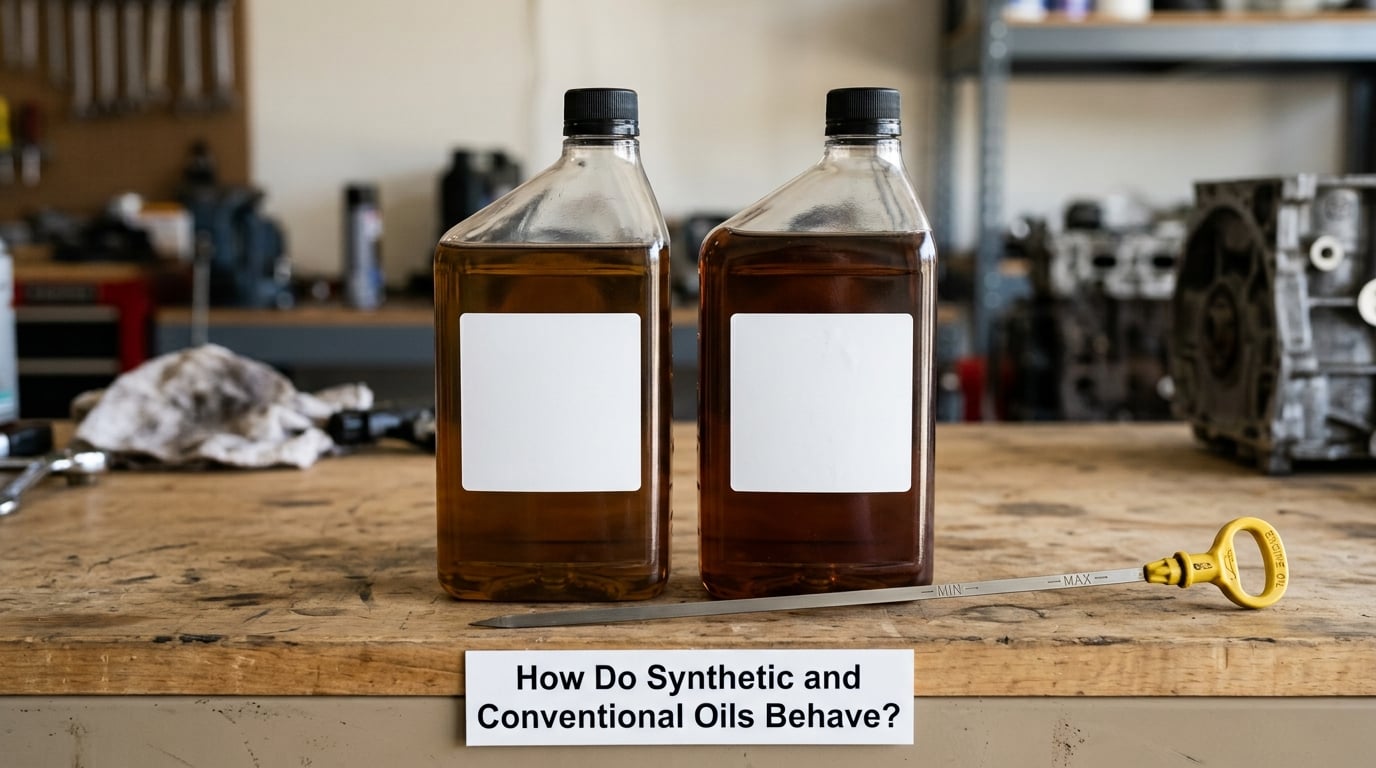
The practical differences show up in a handful of measurable behaviours. Viscosity is the clearest. Conventional oil changes viscosity more across the temperature range, so the same bottle is noticeably thicker on a cold morning and thinner on a hot highway. Synthetic holds a steadier viscosity, which means the oil reaching the bearings keeps closer to its rated thickness when things heat up.
Volatility is the second. Some of what shows up on your dipstick between changes is oil that burned past the rings or the valve seals. Synthetic has less to burn, so high-mileage engines on it often settle down over a few thousand miles. You will hear owners say synthetic reduced their oil consumption, and they are usually describing a real effect rather than a coincidence.
Pour point and cold pumping are the third. A −30 grade behaves differently at deep cold than at mild cold, and the difference is not only the number on the label. The base stock matters as much as the additive package, which is why two 5W-30 synthetics can feel different on the first cold start of the season.
Deposition is the fourth, and it is the one people feel over years rather than days. Oxidation, coking, and varnish all grow with time and temperature. Oil that resists oxidation keeps cleaner ring packs and cleaner intake valves, and cleaner surfaces are the difference between an engine that pulls smooth and one that hesitates above 3500 rpm.
Where each type has the advantage
Conventional has the edge in one place: price, and a warm engine driven gently on a schedule of longer drains. In a low-mileage older car driven a few miles at a time, the difference in cost per thousand miles is real and the difference in protection is small.
Synthetic wins almost everywhere else. Deep winter starts, sustained Autobahn speed, a turbo engine, a pickup towing a fifth-wheel, or a car that sits for weeks between drives. Those are the cases where oil that stays stable stops being a nice-to-have.
Which Oil Provides Better Engine Protection?
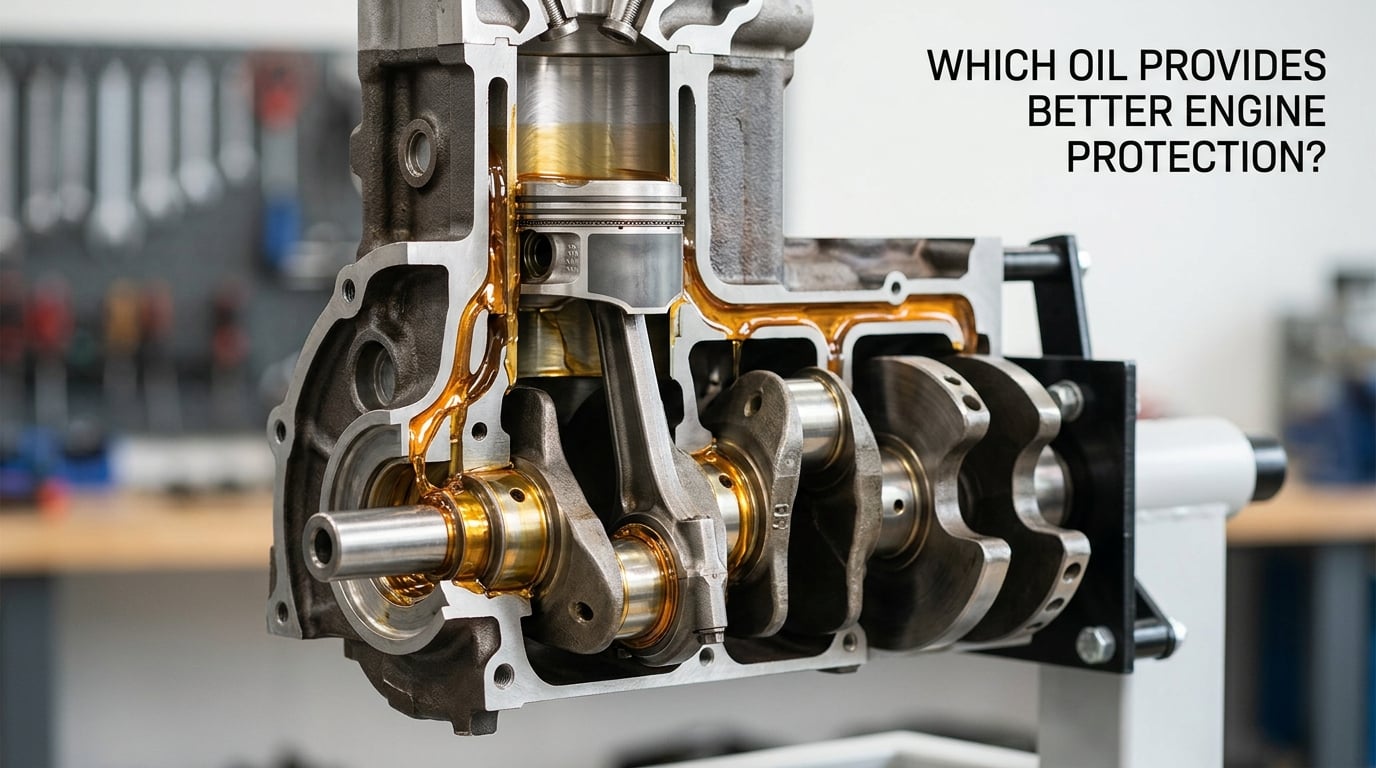
Protection is not one thing, and the honest answer is that oil approval, correct viscosity, and the right fill level do more for your engine than the base stock type does. Synthetic simply has more margin in the situations that stress oil hardest.
Cold starts versus warm starts
The most damaging wear in an engine happens in the first seconds after a cold start, before oil pressure reaches the rod and main bearings. This is where high-mileage oil and good base stock genuinely help, because the oil reaches the metal faster and carries a stable film sooner.
If your car lives outside in winter and you start it most mornings, that is a real advantage for synthetic and it shows up over a long ownership, not on day one.
Highway cruising versus short trips
Sustained high-speed driving heats the oil and holds it hot for a long time. Synthetic holds viscosity better in exactly that condition, which is why long Autobahn stretches and summer towing are situations where the difference is not subtle.
Short trips are the harder case for any oil. An engine that rarely reaches full temperature burns fuel and moisture into the oil without cooking it off, so deposits build whether the oil is synthetic or conventional. If your driving is mostly short hops, the oil type matters less than the change interval does.
Stop-and-go traffic and extended idling
Stop-and-go is the most common daily use for most people and the roughest on oil chemistry. Heat cycles and fuel contamination drive oxidation. Oil that oxidises slowly stays cleaner, and cleaner oil keeps the sludge that clogs a turbo pickup tube from forming in the first place.
Synthetic vs Conventional Oil for Performance Driving
Under hard use, the difference is mostly about how much the oil holds together rather than how much power it makes. Sustained high RPM, repeated wide-open throttle, and track sessions push oil temperature and shear hard, and synthetic base stocks are built to resist thinning and to evaporate less under that load.
I have seen the effect most clearly in the check interval. Pull a used sample after a hard drive from an engine on conventional and it can come back dark and thin; the same drive on synthetic usually comes back darker-looking but still within grade, because less of the oil itself burned off.
What synthetic will not do is add horsepower by itself. If a turbo is laggy, a throttle response is flat, or an engine is down on compression, the oil is not the problem. A turbocharger or a high-compression engine will happily run conventional for a long time, so the money is better spent on a compressor check or a compression test than on a jug of the more expensive oil.
One honest caveat: in engines that burn oil by design or by neglect, the high-mileage synthetic formulas with seal conditioners are the ones to look at, not the plain performance synthetic. More on that below.
Does Synthetic Oil Work Better in Cold Weather?
Yes, generally, and the reason is flow at start-up rather than some magic anti-freeze property. Cold oil is thick. Thick oil takes longer to pump through the galleries and reach the bearings, and those first seconds are when the metal is least protected.
Two separate things are often confused here. Pour point is the lowest temperature the oil will still flow, and viscosity grade describes how it behaves across a range. A 0W-30 is rated for cold cranking and pumping; a 5W-30 starts a bit thicker. The grade tells you the shape of the curve, the base stock tells you how cleanly the oil actually follows it.
That is why two 0W-30s can behave differently on a January morning. If you live somewhere with real winter, the owner’s manual viscosity grade and the manufacturer approval are the deciding factors, and the base stock type is the tiebreaker.
What Viscosity Does Your BMW Require?
BMW engines have tight oil passages, variable valve timing, and in many cases oil-cooled pistons. The viscosity is not a suggestion, and the approval standard is not a suggestion either.
Where to find the spec
Check the owner’s manual under engine oil or maintenance schedules. It lists the required viscosity, the required approval, and in some models the oil quantity including a fill from the filter housing.
The oil filler cap often has the same information molded or printed on it. The manufacturer service information and the build sheet will also list the oil the car was filled with at the factory, which tells you the approval it was born with.
Reading BMW long-life approval markings
BMW historically used its own long-life approvals on top of the industry standards, because their oil specification is stricter about soot load and drain interval than a generic passenger car rating. Older models list an LL approval, newer models list LL-01, LL-02, LL-03, LL-04, and LL-05 with a fuel and emissions version, then more recent engines list LL-06 and LL-07 for the newest specifications.
Use the approval the manual names, at the viscosity it names. Do not substitute a lower-spec oil because it happens to be cheaper, and do not assume a different viscosity is fine because the oil feels the same on day one. Wrong oil on a turbocharged BMW can lead to timing chain rattle, and that is not a repair you budget for casually.
For anyone working on other European or Japanese cars, the same logic applies with different markings. If you want the general socket and fastener reference for a weekend job, see metric vs SAE sockets explained, and for the tool that handles the fasteners properly, impact wrench vs impact driver difference.
Can You Switch Between Conventional and Synthetic Oil?
Generally, yes. Filling a conventional-recommended engine with oil that meets a higher specification is safe, and switching down after a synthetic run is also fine as long as the new oil meets the manual’s spec. Modern elastomer seals have no trouble with either.
What a switch can reveal
The myth that synthetic causes leaks is old and it does not hold up with modern seals. What actually happens sometimes is that a neglected engine has varnish, sludge, or hardened seal faces that were quietly holding oil in. Fresh oil loosens that material and the leaks show up again. The oil did not create the problem; it removed the plug.
That is a useful signal, not a reason to stay on conventional. Watch the level for a few hundred miles after the change, and if a drip appears, the engine needs cleaning or seal work rather than a weaker oil.
Going back to conventional
Going back after a long synthetic run works, with one caveat: the engine has not been cleaned by running conventional, so deposits stay exactly as they were. If you want to return to conventional for cost reasons, drain the oil, replace the filter, and refill with the grade and approval the manual calls for.
Topping off is a different question. Mixing a quart of conventional into a synthetic fill, or the reverse, is not a disaster and modern additive systems tolerate it. Just match the viscosity grade and keep the fill level correct, which is the part that actually matters.
What Are the Cost and Maintenance Differences?
Per quart, synthetic costs more. Whether that matters depends entirely on how many miles you drive and how often you change the oil, so the number to think in is cost per mile, not cost per container.
A rough way to run it: take the cost of a full fill for your engine, divide by the interval you are allowed to run, and compare that figure between the two types. If you drive 6000 miles a year and change twice, a more expensive oil that lets you skip a change and consume less is often closer than the bottle price suggests. If you drive 8000 miles a year on short trips, you are changing on schedule either way and the price gap shows up directly.
On maintenance, the difference is narrower than the marketing suggests. Longer drain intervals are a real benefit of the base stock, but they are not automatic permission. The interval your manufacturer states takes priority, and many manufacturers will not extend it based on oil type alone. The documented exceptions are usually a maintenance mode that extends the interval only when the car is in a genuine severe-service pattern, and a fuel quality requirement that many drivers never meet.
One more long-term item: oil that oxidises less keeps engines cleaner inside, and a clean engine at 200,000 miles is worth more than the saving from a cheaper jug at 100,000.
Which Should You Choose?
Older and high-mileage vehicles
Check the manual first, because a few older engines genuinely required conventional. Where synthetic is allowed, a high-mileage synthetic with seal conditioners and a higher-micron filter is usually the better pick. The seal conditioners and the reduced burn rate are what cut oil consumption, not the base stock on its own.
Modern, turbocharged, and high-compression engines
Synthetic, no debate. These engines run small oil passages, hot turbochargers, and tight timing chains that depend on correct oil arriving fast. The manual will almost certainly require an approval you cannot buy in a conventional bottle.
Mixed city driving and short trips
A synthetic blend in the specified grade is the sensible middle. You get better cold flow and better oxidation resistance than conventional, and you skip the top of the price range. Change it on the normal schedule because your engine never gets hot enough to cook off moisture.
Extreme cold or extreme heat climates
Synthetic both ways. In deep cold it pumps faster on the first start of the day. In sustained high heat it resists thinning when your commute turns into a two-hour motorway run. Same answer in Minnesota and in Arizona, for different reasons.
Towing, hauling, and sustained highway use
Synthetic at the specified grade, and a genuine severe-service interval if the manual allows one. Loads of that kind keep oil temperature high for long stretches, which is exactly where a stable synthetic base stock earns its cost.
Whichever you land on, two rules do most of the work. Meet the approval and the viscosity the manual specifies, and keep the level correct with a level check a few hundred miles after every change. Everything else is preference.
Frequently Asked Questions
Is synthetic motor oil better than conventional oil?
Synthetic performs better in the conditions that stress oil hardest: cold starts, sustained high RPM, extreme temperature, and extended idling. It resists thinning, oxidises slower, and burns less. But if the oil meets your manufacturer approval and viscosity rating, a conventional oil will still protect an older, gently driven engine correctly. Check the manual, not the marketing.
Does synthetic oil prevent engine leaks?
No, and the old claim does not hold with modern elastomer seals. What often happens is that fresh oil loosens hardened varnish or sludge that had been masking a worn seal, so an existing leak reappears. Treat that as useful information about the engine rather than a reason to stay on conventional oil. Watch the level after a change and address anything that shows up.
Can I mix synthetic and conventional motor oil?
A top-off mixing the two is fine. Modern additive packages are compatible, and the engine will not be harmed. The important rule is not about type but grade: keep the viscosity rating the manual specifies, follow the quantity the engine needs, and never run the level low. A proper oil change means draining, replacing the filter, and refilling with one consistent oil.
Does synthetic oil allow longer oil-change intervals?
Only if the manufacturer allows it. Better base stock resists oxidation, so oil stays in specification longer, but most manuals set an interval that assumes the specified oil and a normal driving pattern. Some cars have a maintenance mode that extends the interval in severe service, and many require a fuel quality that limits how often it triggers. The manual takes priority over the bottle.
Is synthetic oil required for a BMW?
Most modern BMW engines require oil meeting a BMW Long Life approval, and turbocharged models with timing chains are the strictest. That approval is generally only available in synthetic form, so conventional is not a substitute. Use the viscosity and approval listed in the owner’s manual or on the oil filler cap, and do not substitute a different spec to save money.
How often should high-mileage conventional oil be changed?
Follow the interval in the owner’s manual, which for a high-mileage engine is usually the shorter of time or distance and often assumes gentle driving. Short trips, extended idling, and stop-and-go traffic are harder on oil than the distance suggests, so consider changing sooner in those conditions. If the engine burns oil, check the level regularly between changes rather than only at them.
Conclusion
Synthetic is the better lubricant, and for most cars on the road today it is the right call. Conventional still does the job on an older, low-mileage engine that the manual was happy with, at a lower cost per fill.
Your first move is simple: open the owner’s manual, find the required viscosity and approval, and buy oil that meets both. Then do the change on the manufacturer’s interval, keep the filter fresh, and check the level a few hundred miles afterward. Get the specification right and the type almost stops mattering.