
Learning how to flush coolant properly in a BMW comes down to matching the process to the car in front of you. Most BMWs hold somewhere between 7 and 10 liters once the heater circuit is counted, run on a low-SLLC blue coolant, and bleed through a filler port or bleed screw rather than a pressurised radiator cap. Work cold, drain low, fill high, and bleed until the temperature gauge settles.
That last part is where most DIY jobs go wrong. A BMW cooling system holds air in places a simple drain-and-fill never reaches, and a trapped air pocket shows up a few miles later as a gauge that swings, a heater that blows cold, or a puddle under the front bumper. The plan below is built around avoiding exactly that, and it follows the order the BMW service procedures use.
One caveat before you start: BMW sold cooling systems with several coolant specifications over the years, and the correct one changes by model, year and market. A blue coolant on most cars, green on a Mini and on some earlier models. Check your manual before buying a single jug.
Table of Contents
- What You Need
- Step-by-Step: How to Flush Coolant Properly in a BMW
- Common Mistakes
- Frequently Asked Questions
- Can I use distilled water when flushing coolant from my BMW?
- How much distilled water should I use to flush my BMW cooling system?
- Should I flush the heater core when changing BMW coolant?
- How do I get rid of air bubbles after flushing BMW coolant?
- Is it safe to flush coolant with tap water?
- What type of coolant should I use in my BMW?
What You Need
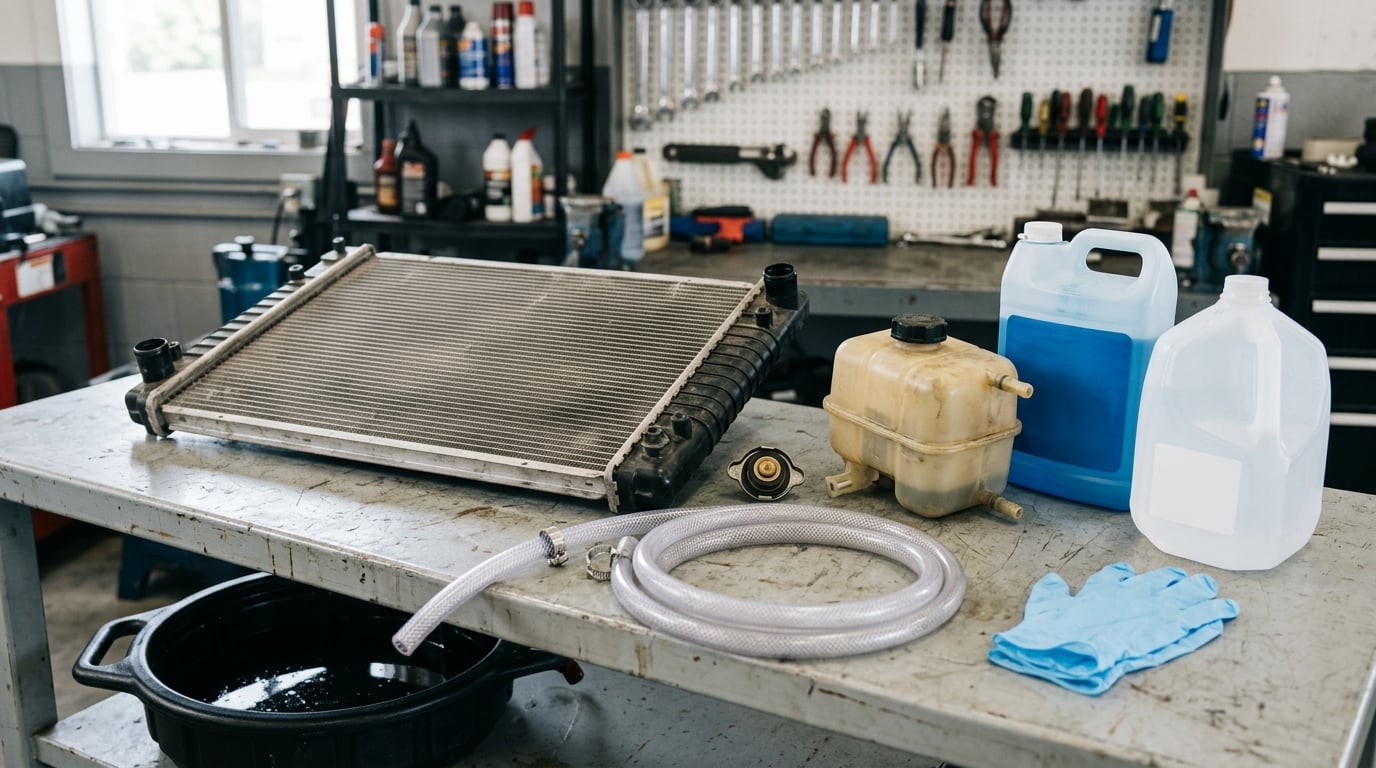
Most of the kit for this job is cheap and half of it is safety gear. Have everything on the bench before you pull the cap, because a half-finished flush with a hot engine and no drain pan is how people end up with glycol across a driveway.
- The owner’s manual or a service manual for your exact chassis code. You need the coolant specification, the refill volume, and the bleed procedure for your engine. A generic BMW procedure is a starting point, not a substitute.
- The specified coolant in the right form. Premixed 50/50 saves you measuring; concentrate has to be mixed with distilled water at the ratio your manual calls for. Never plan to top up with whatever generic blue you have left in the garage.
- Distilled water for the rinse cycle and for mixing concentrate. Several liters.
- A drain pan of at least 8 liters. Small pans overflow mid-drain and coolant on the floor is toxic.
- Channel-lock pliers and a flat-blade screwdriver for the radiator hose clamp, plus a bucket for overflow.
- Nitrile gloves and safety glasses. Coolant is a poison, it stains, and it is absorbed through skin.
- A plan for the old coolant. Nearly every auto parts store will take used coolant in sealed containers. It never goes down a storm drain, onto the ground, or into household trash.
If your BMW has a factory bleed funnel, borrow or buy one. The spill-free style with a shutoff valve costs a few dollars more than a plain funnel and saves the carpet in your footwell.
Step-by-Step: How to Flush Coolant Properly in a BMW
Budget 45 to 90 minutes for most cars, longer if the engine block drain bolt is difficult to reach. Work through the steps in order. Skipping the bleed is the single most common reason a flush ends badly.
1. Confirm Your BMW’s Coolant Procedure
Start by identifying what you actually own. The VIN or the chassis plate on the door jamb tells you the G-series or E-series platform, and that decides the coolant spec, the capacity, and whether the engine has a bleed screw at the thermostat housing.
Then find three things in the manual: the coolant specification, the total refill volume, and the bleeding procedure. BMW capacity figures usually include the radiator, the engine block and the heater circuit, and they assume the heater control is open and the air is bled out. If you fill to the MAX mark and stop, you will be short by a liter or more.
This is also the moment to check the drain point. Many BMW radiators have no petcock, which means the lower radiator hose at the radiator itself is the drain. A few engines add a block drain bolt for a more complete flush, usually near the front of the block; on some cars it sits directly above the oil pan, so put the pan in place before you loosen a single thing.
2. Work on a Cool Engine
Let the engine cool completely. A BMW cooling system holds pressure at operating temperature, and the cap is there to keep it that way. Opening a hot system gets you a scalding spray across the engine bay, and the steam does real damage to the paint and plastic around it.
Park the car on level ground so the system drains toward the pan and the level reading in the expansion tank is true. If your manual calls for the battery to be disconnected before working in the engine bay, do it, because a fan can start without warning.
Give the car more time than you think. After a long drive the coolant can take an hour or more to drop, and the electric auxiliary water pump on later BMWs can keep circulating coolant after you shut the engine off, so the system stays warm well past the point where the gauge reads cool.
3. Drain the Old Coolant
Open the radiator cap or the coolant filler cap while everything is cold. If it is slow, that is normal air pressure, not a seized cap. Set the cap somewhere you will not lose it.
Put your pan under the drain point, then loosen the lower radiator hose clamp at the radiator and slide the hose off. Working the hose off straight and down rather than yanking sideways helps you avoid twisting the radiator neck. Some cars have a drain plug on the radiator itself, which is faster and tidier if yours has one.
Let it drain fully, which usually takes 10 to 15 minutes, and watch the colour as it runs out. Brown, sludgy or gritty coolant means the old fluid has already started failing. Clear blue or pink means you caught it in time. You will still drain the same amount either way.
The hose at the radiator empties the radiator and part of the circuit. The engine block holds a large share of the total volume and keeps it unless you flush the block as well, which is the whole reason for the rinse cycle in the next step. If you want the volume your manual specifies, a drain alone will not get you there.
4. Flush the Radiator and Heater Circuit
Refill the system with distilled water, and open the heater control all the way to hot with the blower on high so the heater circuit actually takes water. Then start the engine, let it idle to warm up until the upper radiator hose goes from cool to hot and the electric fan cycles, and shut it off to drain. A second rinse cycle removes more of what is left behind.
That is the flushing step, and it is deliberately gentle. Water at idle pressure moves more coolant than a plain drain-and-fill ever will, without any of the risk of aggressive chemical flushes.
On chemical additives: BMW does not require one, and forum reports of heater core failures on high-mileage cars shortly after a chemical flush are exactly the kind of anecdote worth taking seriously. Use a chemical treatment only when your manual or a technician calls for it, never as a way to shortcut a dirty system. The same goes for high-pressure flushing equipment, which can collapse soft hoses and crack a radiator neck.
If your BMW has a block drain bolt, and you have the torque wrench and the manual number, drain the block as well between rinse cycles. That is what separates a real flush from a quick one. If the bolt is corroded into the block, stop and hand that step to a shop.
Keep an eye out for white or green gel in the drained water. Gel formation means two incompatible chemistries have been mixed in the car for some time, and a plain flush will not undo it. A coolant test strip dipped into the drained fluid gives you a pH reading in a few seconds, and anything below neutral is a reason to flush harder than a single drain.
5. Refill the System Without Creating an Air Lock
Have your coolant mixed before the engine goes back together. If you are using concentrate, combine it with distilled water at the ratio your manual specifies, usually 50/50. If you bought premixed, use it straight from the jug.
Fit the lower radiator hose, clamp it, and fill slowly through the radiator filler or the expansion tank, aiming the last part of the fill through the bleed port if your car has one. Slow is the operative word. A fast pour aerates the coolant you are adding, which gives you the same trapped-air problem you are trying to avoid.
Start the engine, set the heater to maximum heat, and leave the blower on high. Watch the level in the expansion tank. Air leaving the system takes up volume, so the level usually drops in the first few minutes, and you top up while the engine runs until it holds steady. Keep filling until the level is where the manual says it should be, which for most BMWs is at or just below MAX.
Many BMWs bleed at the radiator filler port rather than through a pressurised cap, and several engines have a bleed screw at the thermostat housing or in the heater inlet. A screw gets a few slow turns and stays open while the engine warms. Once the hose is hot, the fan has cycled and the level holds, close it and check again.
If the bubbles will not stop, that is a signal to stop working and re-check the vacuum rather than keep topping up. A steady stream of air can mean the heater circuit is not open, a hose is still disconnected, or the system has a leak drawing air in.
6. Check for Leaks and Recheck the Level
With the engine warm, look everywhere the fluid could escape. Start with the drain point you opened, then the hose clamp you reseated, then the radiator neck and cap area, the water pump weep hole at the front of the engine, the heater hoses where they enter the firewall, and the small plastic bleed screw you just opened.
Fix a weeping hose clamp before you drive. Water pump housing gaskets and plastic tank cracks often show up in the first few minutes of warming up, when the system is at pressure, rather than after the car has cooled.
Now let the car sit until it is completely cold again, which usually takes several hours or overnight. A BMW expansion tank level is read cold, with the car on level ground, and the fluid contracts as it cools so the level falls. If it dropped between hot and cold, fill it to the middle of the MIN and MAX marks while the engine is cold, not above MAX.
Overfilling is as damaging as underfilling. A tank filled to the brim pushes coolant out of the overflow neck as the engine warms, and it leaves marks on the hood that look exactly like a leak and send you chasing a problem you do not have. Our guide on how to top off coolant correctly walks through the cold-level check in more detail.
7. Verify the Flush Worked
A good flush shows up in how the car behaves over the next few drives. Watch four things: the temperature needle holds steady around operating temperature instead of drifting, the heater delivers hot air within a few minutes of starting, the expansion tank level is still where you left it after a drive, and no warning light comes on.
At the final check, the fluid coming out of the radiator should be the colour of what you poured in. Old brown fluid and new blue fluid separating in the tank means the flush did not reach everything, and it is worth running another rinse cycle rather than living with a mixed charge.
Persistent airlock symptoms need correcting, not tolerating. If the gauge swings wildly under load, if the heater stays cold, or if the level keeps dropping between cold and hot, stop and repeat the bleed with the engine idling and the heater wide open. Deteriorating coolant is the least likely explanation. A fluctuating needle that comes and goes with elevation and load is classic air, and air will find a hot spot in the block if you leave it there.
Common Mistakes
Almost every BMW cooling problem I have traced back to an avoidable step. These are the ones worth checking your work against.
- Using the wrong coolant. Blue LL-51 blue-silicon coolant is the common current specification, and Mini and some earlier cars call for green. Check the manual and the reservoir label. The fix is to drain and refill with the specified fluid rather than hoping it mixes out.
- Mixing chemistries. Green and blue are not interchangeable, and mixing incompatible inhibitor packages can leave gel and deposit inside the radiator and heater core. Never top up with a different type between services. Drain to the bottom of the heater core and refill to the specified colour instead.
- Draining from one point only. The lower hose empties the radiator and part of the circuit, not the block. That is why the distilled water rinse and warm cycle exist, and why a full flush exchanges closer to all of the fluid than a drain-and-fill.
- Opening a hot system. Pressurised coolant at operating temperature sprays and scalds. Let the car sit for hours, and remember the auxiliary water pump can keep the system warm after shutdown.
- Failing to bleed the heater circuit. If the heater control is on cold while you fill and run the engine, the heater core stays full of old coolant and holds air, which shows up as no cabin heat. Heat on, blower on high, from the start of the bleed to the end.
- Overfilling the expansion tank. The level is read cold, between MIN and MAX. Filling it to the top and pushing coolant out of the overflow neck makes a mess and can be mistaken for a leak. Recheck cold and settle the level in the middle of the range.
- Ignoring the stated refill volume. The level in the tank is not the whole system. Topping up to MAX on a cold engine usually leaves the car a litre short of the manual’s figure, with air where the missing coolant should be.
- Rinsing with tap water and leaving it in. Tap water for the rinse cycle is a shortcut that deposits minerals in a system full of aluminium castings. Distilled water in, distilled water out, and coolant in after the last drain.
- Pouring new coolant on top of old. It works for a top-up of the same product in a sound system. It does not flush anything, and it stacks different chemistries in the same tank. If you want a flush, drain first.
- Pouring used coolant down a drain or onto the ground. It is toxic to animals and children and it contaminates groundwater. Seal it in containers and take it to a parts store that accepts used coolant. If a hose clips a clamp and you spill on the driveway, how to clean up a coolant spill in the driveway covers the clean-up properly.
Frequently Asked Questions
Can I use distilled water when flushing coolant from my BMW?
Yes. Distilled water is the right choice for the rinse cycle, because it carries no minerals that can scale up inside the radiator and the aluminium block. Use it for flushing and for mixing concentrate. It is not a substitute for coolant, though, so never leave the system filled with water even for a short drive. Your manual should always confirm the ratio for mixing concentrate.
How much distilled water should I use to flush my BMW cooling system?
Enough to fill the system to the MAX mark with the heater valve open, which on most BMWs is roughly 7 to 10 liters across the radiator, block and heater circuit. Use a second full load for a second rinse cycle. Your manual states the exact figure for your engine, and that number is the one to trust, because filling only to the tank level leaves the system short.
Should I flush the heater core when changing BMW coolant?
Yes, and the method is simply the one in the procedure. Run the distilled water flush with the heater set to maximum heat and the blower on high, then let the engine reach operating temperature before draining. The heater core holds coolant that no single-point drain ever reaches, so a car flushed without it will run old fluid through the cabin heater and air can stay trapped in the small passages.
How do I get rid of air bubbles after flushing BMW coolant?
Fill slowly through the bleed port or filler neck, run the engine with the heater wide open and the blower on high, and let the upper hose go hot and the electric fan cycle. Keep topping up the expansion tank while the engine idles until the level holds steady, then fit the cap and recheck cold. If bubbles continue in a steady stream, look for an open heater valve, a loose hose, or a leak drawing air in.
Is it safe to flush coolant with tap water?
For a one-time rinse of a system you are about to drain completely, tap water works and most people do it without consequence. The problem is what it leaves behind. Tap water carries calcium and other minerals that deposit on hot aluminium surfaces and radiator fins once you fill with coolant. Use distilled water for the flush, and never fill a BMW with tap water and drive it.
What type of coolant should I use in my BMW?
Most current BMWs take the blue low-SLLC coolant meeting the LL-51 specification, and it is normally supplied premixed 50/50. Mini Coopers and some earlier vehicles call for green, so check the manual and the filler neck before buying. Never mix the two colours, and never rely on colour alone to identify a fluid, because brands differ within the same chemistry.
Start at step one, not at the drain pan. Confirm the coolant specification and the refill volume for your model and year, gather what you need, and give the car the full evening of cooling it takes. If the drain, the rinse cycle and the bleed are done in that order, how to flush coolant properly stops being a gamble and becomes a job you can repeat on any BMW in your driveway.