
You can remove a dent without paint damage when the metal underneath is still sound and the clear coat on top has no cracks, chips or missing sections. The trick is working from the gentlest method upward, using small controlled movements, and stopping the moment the finish gets stressed. A shallow door ding takes 20 minutes; a deep parking-lot dent is a different job entirely.
Here is the honest version: most dents people photograph online are not one repair, they are four. A body shop prices them separately, so knowing which one you have saves you from buying the wrong tool or turning a small ding into a crease.
The rest of this guide walks through the whole process in order: inspect, clean, try the easy stuff, escalate only if you have to, and check your work under good light. Updated for 2026, because the clear coat on an older car behaves differently than the one on a new one, and that difference is the main thing that causes paint damage.
If you are new to body work, spend a few minutes on the inspection step. Every expensive mistake in this process starts with someone skipping it.
Table of Contents
- What You Need
- Step-by-Step
- Frequently Asked Questions
- Can I remove a car dent without damaging the paint?
- What kind of dents can be removed without repainting?
- Is it safe to use a heat gun or hair dryer on car paint?
- Can you pull a dent out from the outside of the car?
- Will a glue puller remove a car dent?
- When should I see a body shop instead of trying to fix a dent myself?
- Conclusion
What You Need
You do not need a full toolbox for this. Most of the essential items are cheap and the optional tools only matter for specific methods.
For inspection and setup
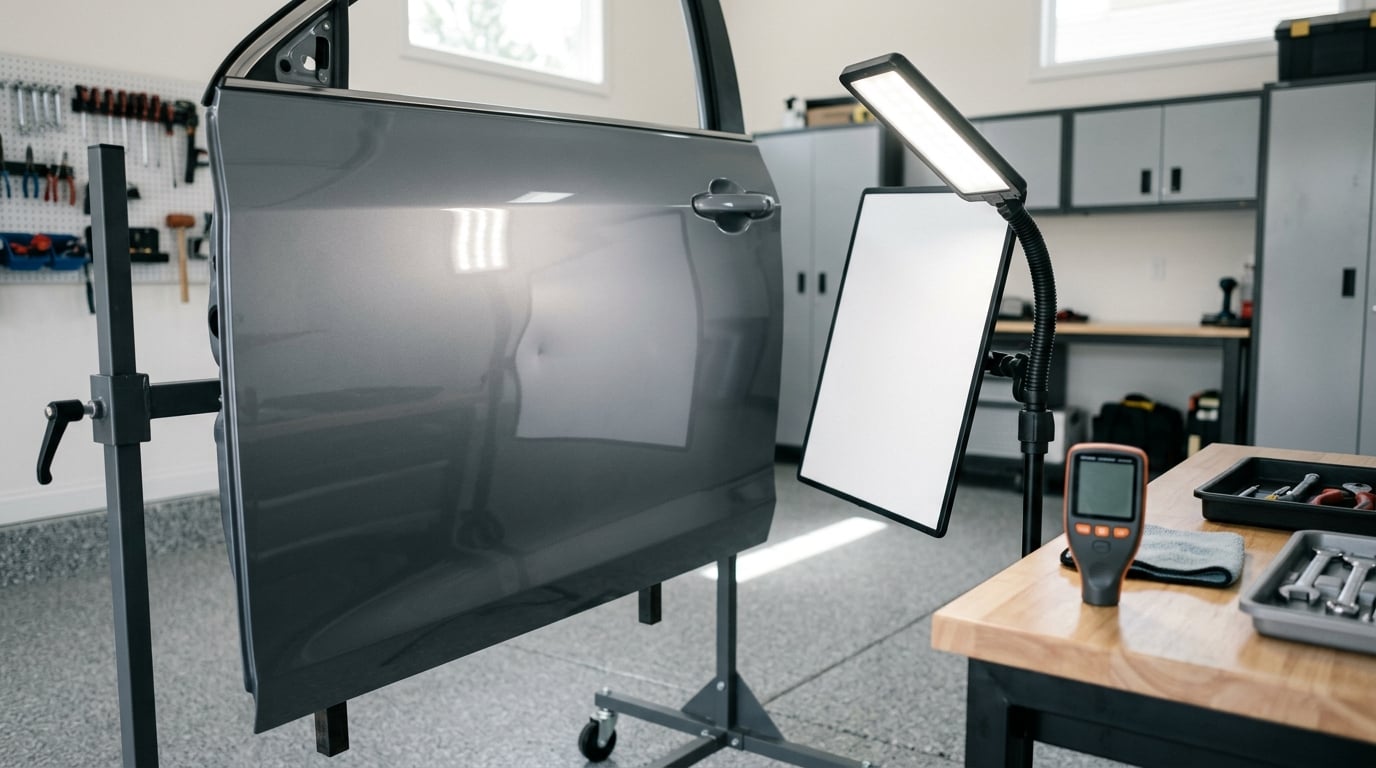
- A bright, directional light source. A large white foam board or a piece of cardboard painted white works as a reflection board, and a long LED work light is even better. This is how you read the shape of the dent instead of guessing at it from the front.
- A paint depth gauge. It tells you how much clear coat is left before you ever press on the panel, which is the difference between a repair and a repaint.
- Clean microfiber cloths, a pail, and car-safe shampoo.
- Isopropyl alcohol or a dedicated glue release agent for cleaning residue off the finish later.
- Masking tape and a plastic card to protect adjacent trim, badges and rubber seals.
For the low-risk methods
Nothing more than your hands, a towel to grip the panel edge, and a kettle. A hair dryer adds a little more control than boiling water because you can heat a small area and stop.
For the glue pull
A hot glue gun with automotive glue sticks, a small plastic tab or puller handle, and gloves. Many kits bundle the tab, the lifter handle and a hammer-style puller in one box, and the bundled version is fine for a first attempt.
For pushing from behind
A PDR rod or a long plastic pry tool with several tip sizes, plus a small body hammer or nylon tapper for knocking down the high spots you create along the way. Household substitutes people use include a wooden dowel, a plastic pick and a rubber mallet, and they work far better on shallow dings than most people expect.
Whichever method you choose, the panel is the fragile part, not the tool. Check the owner’s manual for anything on a panel with sensors, a camera, a badge or a special finish, and skip the paint-adjacent work entirely if the manual says so. Our guide to removing a stripped lug nut without damage covers the same principle in a different corner of the garage: the wrong force in the right place turns a five-minute job into a damaged part.
Step-by-Step
1. Inspect the Dent and Check the Paint
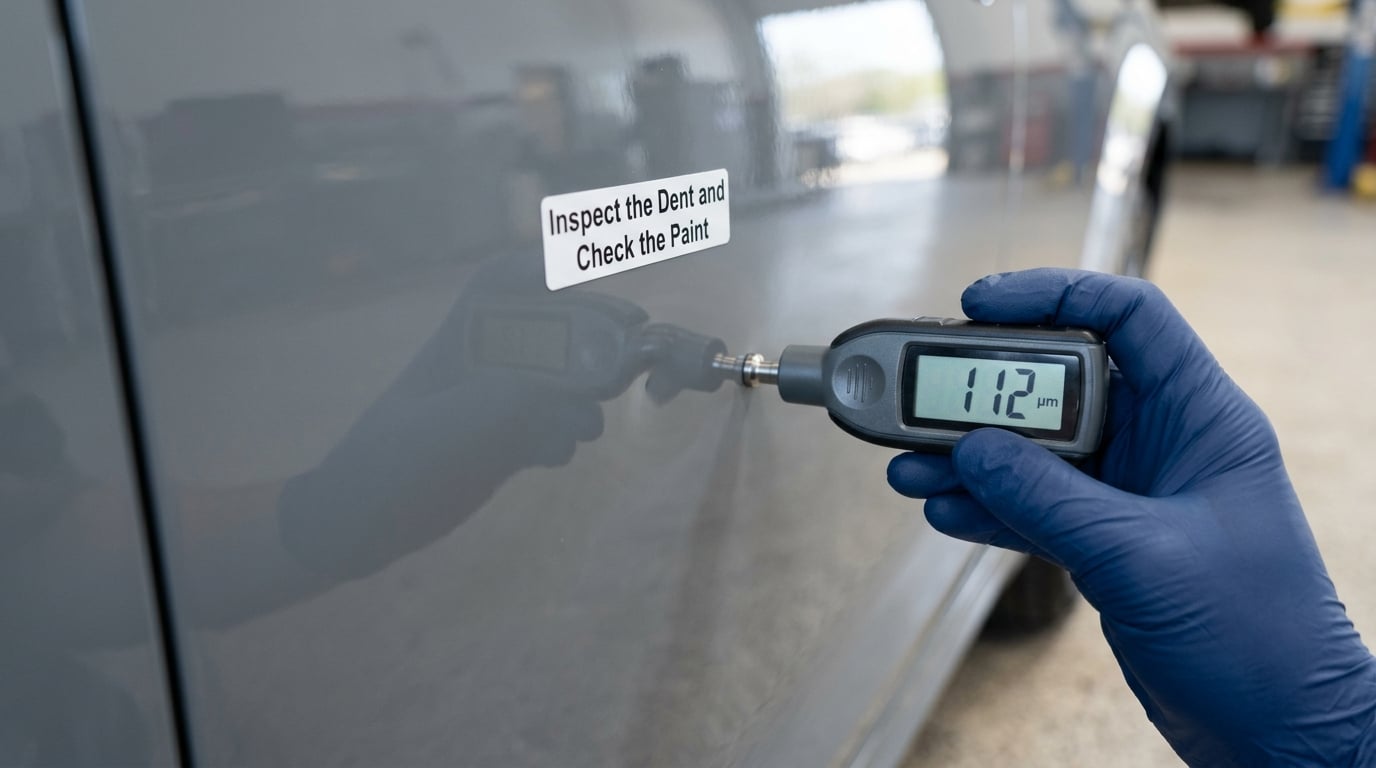
Start by parking somewhere with even light and a clean floor, then look at the dent from an angle rather than straight on. Straight on, a dent hides. At a 45-degree angle with a reflection board behind the panel, the low spot draws a visible line.
Move the light along the panel and watch the line bend. Where the line pinches inward, that is the low point. Where it bulges outward after a push, that is a high spot, and high spots are normal, not damage.
Now check the three things that decide whether this is a DIY job.
Is the paint intact? Run a fingernail lightly across the dent. If you feel a crack, a chip, a scuff that has broken through the color, or a cloudy area where the clear coat is gone, stop. Loose or missing clear coat will lift, peel and spread with any heat or tension, and from there the only repair is a repaint.
Is it a dent or a crease? A dent is a smooth low area where the metal still curves. A crease is a sharp line where the metal folded, and a crease cannot be pushed out flat. A practical test: sight along the panel from the edge and check whether a highlight runs smoothly through the damaged area. Smooth means dent. Broken, doubled or shadowed means crease.
Can you reach the back? A dent you cannot push on from behind may still be glue-pullable, but you should know this before you start. Door cards clip into the panel and break easily. Quarter panels are often double-skinned with a brace behind them. Roof rails, sail panels and structural sections are welded. Hoods and fenders are usually the easiest first projects for that reason.
The practical size guide most people use is a business card. If the damaged area is smaller than that and the paint is intact, it is a strong DIY candidate. Sort what you are looking at into one of three buckets before you touch a tool:
- Green light. Shallow, smaller than a business card, paint intact, backside reachable. DIY first: push from behind, glue pull, or gentle heat.
- Yellow light. Deep, sitting near a body line, on a double-skinned panel, or past a crease, but the paint is still intact. Try carefully or call a technician.
- Red light. Cracked or missing clear coat, sharp crease, exposed metal, or stretched metal that oil-cans under a finger. Body shop, every time.
That last red-light item, oil-canning, deserves a closer look. Press a thumb firmly into the panel. If the metal feels soft and springy instead of firm, the panel is stretched and thinning. No DIY method fixes that, and any attempt will make it worse.
2. Wash, Dry, and Protect the Area
Work on a clean panel or the glue will not bond and you will be chasing dust scratches later. Wash with car shampoo, rinse, and dry fully with a microfiber towel.
Test any cleaner on an inconspicuous spot first and leave it a few minutes before you wipe it, which is the habit that prevents surprise chemical spotting on soft-touch or matte finishes.
Tape off anything next to the dent. Badges, chrome trim, rubber weatherstripping and parking sensor covers all suffer first when a pull snaps back. A plastic card slipped under the tab is a cheap guard for paint edges.
Set up somewhere with room to move, a stable light source and no wind. Glue pulls and heat both behave unpredictably in a hurry, and half of the paint damage stories in the forums come from working in a cramped driveway at dusk.
3. Try the Low-Risk Massaging Methods First
Push from behind the panel first. Reach in with your fingers, an edge of cloth for grip, or a plastic pick, and press gently at the deepest point of the low spot. Small pushes, several seconds each, then let go and re-read the reflection line.
You are looking for the metal to give a little and stay given. If it springs back every time, the panel is doubly skinned or braced and no amount of arm strength will change that.
Heat helps some panels and does nothing for others. Warm water on the area, or a hair dryer held at a distance and kept moving, softens the panel slightly and can make it more willing to move. A kettle of near-boiling water poured over the dent and immediately blotted is the version most people try. Honest verdict: it occasionally works on a shallow dent in a thin panel in warm weather, and it does essentially nothing on a cold, thick or double-skinned panel. It is a free thing to attempt, just keep expectations honest.
Cooling is the counterpart, used after heat. A can of compressed air held against the warmed area makes the panel contract, and contraction can help push a low spot back out. The most debated trick in the hobby, the hair dryer and compressed air combination, is a real technique with a narrow range: small shallow dings in thin metal, warmed evenly, cooled fast, repeated slowly. It is not a magic fix for a shopping cart dent, and blowing air on overheated paint is exactly how clear coat gets damaged. r/PaintlessDentRepair describes itself as no gimmicks, no tricks, and that attitude is right.
Signs it is not working: no change after five or six slow attempts, or a ridge forming at the edge of the low spot. Ridges mean a high spot, and that is your cue to stop, not to keep pushing.
4. Use a Glue Puller for a Small Dent
A glue pull is the best DIY answer when you cannot reach behind the panel. It grabs the paint surface and pulls the low spot outward, so it works on door skins, quarter panels and anything else facing you.
Clean the dent area and let it dry completely. Glue bonds to contaminants and to wax, and a weak bond means the tab lets go halfway through the pull, which is the classic way to lift clear coat or take a paint chip with it.
Heat the glue stick and lay a tab over the center of the dent, slightly bigger than the low spot. Press it on with a warm fingertip or a cloth for 30 to 45 seconds so it cools as a solid piece rather than a skin.
Wait. Most tab instructions call for several minutes, and giving it the full time is what makes the difference between a clean release and a repair job. Then attach the lifter handle or puller and pull straight outward along the panel normal, in a slow steady motion.
Never pull at an angle and never yank. Angle the force and the tab peels at one edge, which drags across the finish. The pull should be firm, continuous and controlled enough that you are still in control of it when it lets go.
Wear gloves. The tab is hot and the release is sudden, and the injury risk here is real even though the dent is small.
To remove residue, press a plastic card flat against the panel and scrape gently, then wipe with isopropyl alcohol on a microfiber cloth. Do not rub with a cloth in circles, which is how you turn a clean repair into a hazed swirl mark. If a small adhesive patch is left behind, leave it rather than scrubbing.
Glue pulls can remove a dent from the outside, and they are the right first escalation for panels you cannot access. They will not pull a crease, and repeated pulls on the same spot eventually take the clear coat with them.
5. Use a PDR Rod for Paint-Dent Repair
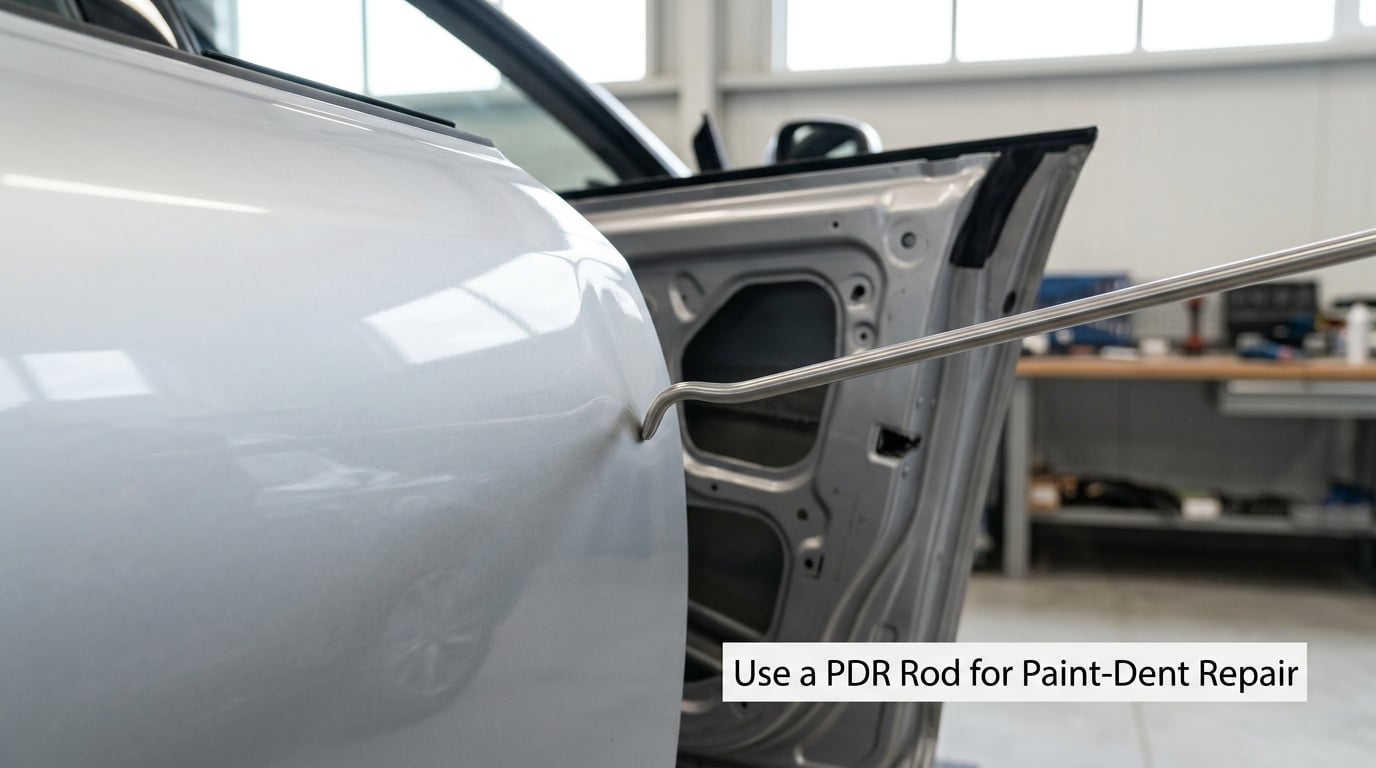
The rod method is what technicians use, and it gives you the most control with the least force. It also demands the most access work, so budget 30 to 60 minutes to get at the back of the panel on a door.
Remove the door card carefully. The plastic trim clips along the top edge are the ones that snap first, and a broken clip costs more than the dent did. There are walkthroughs for common fasteners on our oil filter removal guide if you want the general approach to prying trim off without marking it.
Choose a tip that spreads the force. A wide flat tip spreads the push over a larger area, which is gentler on the paint from the inside. Save narrow tips for tight spots where nothing else fits.
Set the rod against the deepest point of the low spot, just inside the panel, and make small pushes. The mental image that works for beginners: imagine tapping the dent out from the inside so the middle rises slightly above the surrounding metal. That slight overshoot is normal and expected, because you are about to knock it back down.
Work in a spiral, from the outer edge of the dent toward the center, a few pushes at each stop, then re-read the line. Experienced hobbyists on Mighty Car Mods describe the same outside-in, take-your-time approach with a flat-faced body hammer, and the advice holds for a rod too.
Watch the clear coat continuously. Any whitening, hazing or a texture change under the paint means you are loading the finish too hard. Back off, change the tip angle, and try a different approach.
Braces and double panels are the real blocker. If the rod lands on a brace instead of metal, nothing happens no matter how hard you push. Doors on larger vehicles, quarter panels, sail panels and anything near a roof rail fall into this category, and for those the glue pull or a professional is the sensible route.
6. Check the Result and Decide Whether to Stop
Read the panel again with the same light you started with. Walk the reflection line the full length of the dent and then past it into the surrounding factory body line, because the part that matters most is how your repair blends into the untouched panel next to it.
If the line runs straight through, you are done. If there is a small ridge or high spot, tap it down with the body hammer or nylon tapper on the outside, working from the outside of the high spot toward its center. Light taps, constant contact, no swinging.
Check the panel from several angles and in daylight if you can. Dents that look fixed under a garage light often show up in sunlight, and the opposite is also true, so a second look in daylight is worth the walk around the car.
Stop and hand off to a professional paintless dent repair tech when: the panel has a crease you cannot feel out, clear coat is cracked or whitening, the metal oil-cans under a thumb, you are fighting a brace or double panel, or the dent sits on a body line. Body lines are unforgiving because a technician has to keep the highlight perfectly continuous across the ridge, and that is a skill measured in hours, not minutes.
A technician, or a mobile PDR service that comes to the car, can usually do a door ding in under an hour while keeping the factory finish and the resale value that comes with it. Compare that against sanding, filler, primer and a repaint before you spend an afternoon forcing a dent that should have been left alone.
Common Mistakes
Pulling too hard, too fast, or at an angle. This is the number one way to lift paint. Fix: pull straight out along the panel normal, in one slow continuous motion, and stop the instant the tab releases rather than continuing the movement.
Using excessive heat. Clear coat softens before you feel it, and baked paint is a repaint. Fix: keep a hair dryer moving at a distance, use warm rather than near-boiling water, and never leave a heat source parked on one spot.
Working on cracked or already damaged paint. Any tension or heat spreads the crack. Fix: check the clear coat first, every time, and stop immediately if you see a chip, a scuff through the color or a cloudy patch.
Pulling from the wrong side. Pushing a dent that sits next to a brace just loads the brace. Fix: before applying any force, confirm there is metal behind the low spot and a clear path to reach it.
Ignoring high spots. The overshoot you deliberately create to lift the middle must be knocked down, or you have traded a dent for a ridge that reads worse in sunlight. Fix: finish every pass with light outside tapping from the edge inward.
Continuing after the metal gets soft. Stretched metal that flexes under your thumb cannot be fixed at home. Fix: test it early, and if it feels spongy, stop.
Rubbing glue residue instead of lifting it. A cloth in circular motions hazes the clear coat you spent the whole repair protecting. Fix: scrape flat with a plastic card, then wipe with isopropyl alcohol on a clean microfiber.
A few closing habits. Practice on a junkyard hood or fender before touching your own car, which is the advice the DIY community gives most often. Read the panel under good light before you start, not just at the end. And hold the sunk-cost thought in mind, because a botched attempt on a car that then needs a full repaint costs many times more than the technician would have.
Frequently Asked Questions
Can I remove a car dent without damaging the paint?
Yes, if the metal underneath is still firm and the clear coat has no cracks, chips or missing areas. That process is called paintless dent repair, or PDR, and it reshapes the metal back toward its original shape using gentle pushes, pulls and taps with no sanding, filler or repaint. If the clear coat is already damaged or the metal is stretched, no home method will work without causing more damage.
What kind of dents can be removed without repainting?
Shallow dents with intact paint, especially ones smaller than a business card, are the best candidates. Door dings, parking lot dings, hail dents and cart marks on a door, hood, fender or quarter panel usually qualify. Deep dents, creases, dents on a body line, dents blocked by braces or double panels, and anything with cracked paint should go to a professional paintless dent repair tech instead.
Is it safe to use a heat gun or hair dryer on car paint?
A hair dryer is fairly safe when you keep it moving, hold it at a distance and stay well below the temperature that bakes the clear coat. A heat gun is a different tool entirely and can damage clear coat in seconds, so it is not a DIY option. Warm water is gentler than either. If the panel whitens, hazes or the finish turns dull, stop and let it cool on its own before looking again.
Can you pull a dent out from the outside of the car?
Yes. A glue pull is exactly that method: a hot glue tab bonds to the paint surface and pulls the low spot outward when you apply steady tension. It works well on shallow dents in panels you cannot reach from behind, such as quarter panels and door skins. It will not pull out a crease, and pulling the same spot repeatedly risks taking the clear coat with the tab.
Will a glue puller remove a car dent?
For a shallow dent with intact paint, often yes on the first or second pull, especially when the metal is accessible from behind as well. Deep dents and dents on double-skinned panels may only improve partially. The most common failure is a weak bond from wax, dust or not waiting long enough for the glue to set, so the tab peels at one edge and drags across the finish.
When should I see a body shop instead of trying to fix a dent myself?
Stop and go to a body shop when the clear coat is cracked or missing, when you can feel a sharp crease, when the panel oil-cans under a firm thumb press, or when the dent sits on a body line where the highlight has to run perfectly straight. Panels blocked by braces, double skins or roof rails are also technician work. A professional paintless dent repair is fast and keeps the factory finish, which protects resale value.
Conclusion
The safest order of operations never changes: inspect the finish, clean the panel, start with the least invasive method, use small controlled movements, and stop the second you see a crack, a crease or a soft spot in the metal. That sequence is how to remove a dent without paint damage, and skipping the first step is how people end up paying for a repaint they did not need.
Your first action takes two minutes. Park in good light, put a reflection board behind the panel, and run a fingernail across the dent. Intact clear coat and a smooth low spot means you have a DIY job. A broken highlight, a crack or a soft spongy panel means you stop there and book a technician, which is the cheapest possible outcome.