
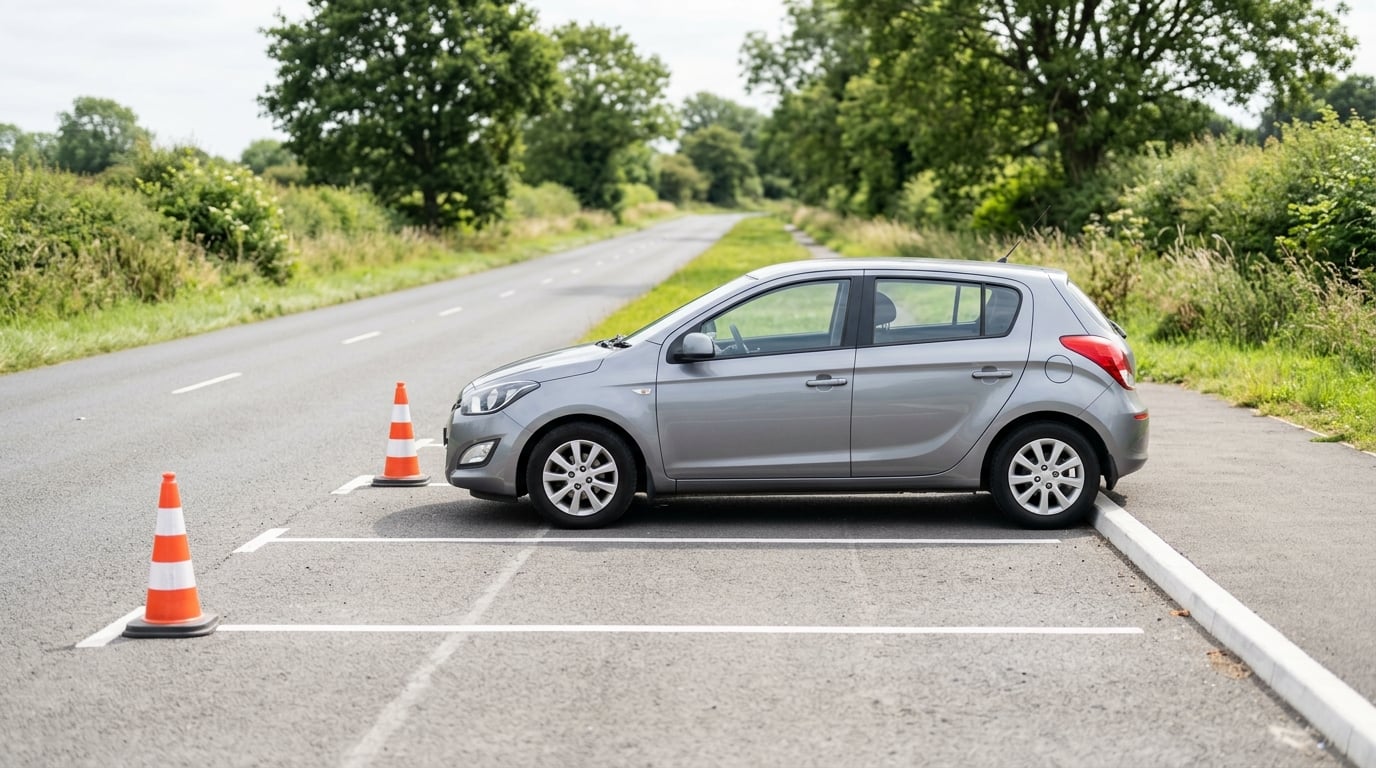
Practice parallel parking in an empty, quiet car park, mark out a bay about two car widths wide with cones or empty milk jugs, and repeat the backing maneuver at walking pace until the steering feels automatic. That is the honest answer: no amount of reading replaces reps done slowly with nobody watching.
Most people learn this skill in a crowded street on their first attempt, at dusk, with an examiner in the passenger seat. It is a hard way to build a habit that should be boring.
This guide sets up the practice space first, then walks the maneuver in the order it actually happens, then fixes the seven mistakes that stop beginners from getting there. It takes about an hour to read and a couple of sessions to make stick.
Table of Contents
- What You Need to Practice Parallel Parking
- The Step-by-Step Maneuver
- Common Mistakes When You Practice Parallel Parking
- Frequently Asked Questions
- How long does it take to get good at parallel parking?
- Should I line up my front bumpers or my rear bumpers?
- Can I practice parallel parking without cones?
- What are the most common mistakes when parallel parking?
- Do I fail my driving test if I cannot parallel park?
- How do I fix a crooked park once I am already in the space?
- How to Practice Parallel Parking
What You Need to Practice Parallel Parking
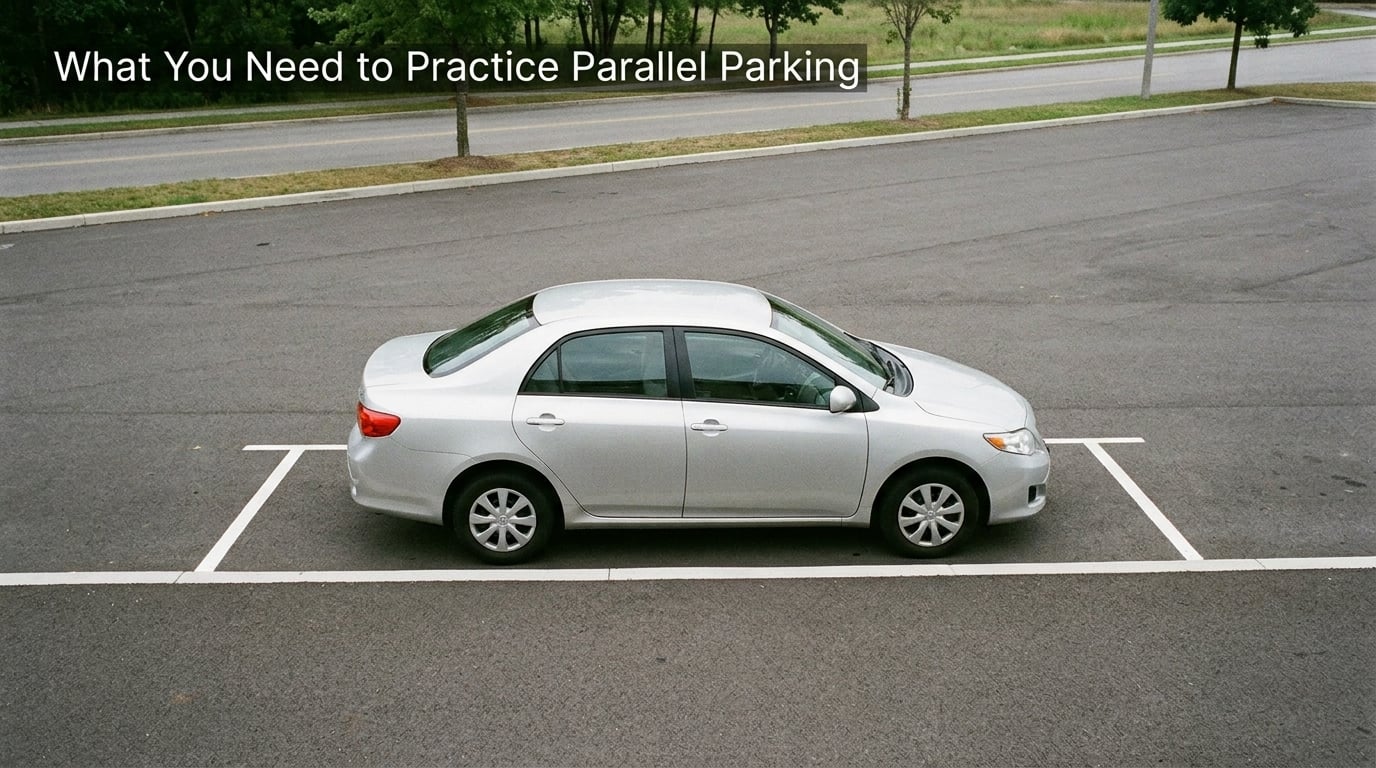
Parallel parking practice needs less equipment than most people assume. You need a car, somewhere flat and empty, two markers, and a reference point written down somewhere you can reach it from the driver’s seat.
The car matters more than people expect. A long wheelbase and a wide turning radius in an SUV or a bulky sedan swing the rear end much further than a small hatchback does, so the same reference point fails. If your car is hard to place, practice in that car, not in a friend’s compact.
For the practice area, an empty supermarket car park on a weekday morning is the classic answer. It is flat, free, and nobody will ask you to move. A quiet residential street with a long run of kerb works too, as long as you pick a stretch where nobody is likely to pull out in front of you.
For markers, cones are the obvious choice and cheap. Without them, empty milk jugs, cardboard boxes, or a couple of parking tyres stand in well. You are marking a gap roughly one and a half car widths long, so anything that creates a visible end to the space does the job. Painter’s tape on the ground works if the surface allows it.
Then write down your reference point. Before you start the engine, note exactly what you will look at and when you will act on it, because improvising a new cue every attempt is why progress stalls. We get to the specific points below.
Last, safety. Check all six mirrors and both blind spots before every move, even in an empty lot with no traffic, because the habit is what matters on the day. Keep your foot ready on the brake. If a spotter is available, a second person watching your blind spots from the kerb is worth more than any instructor video.
The Step-by-Step Maneuver
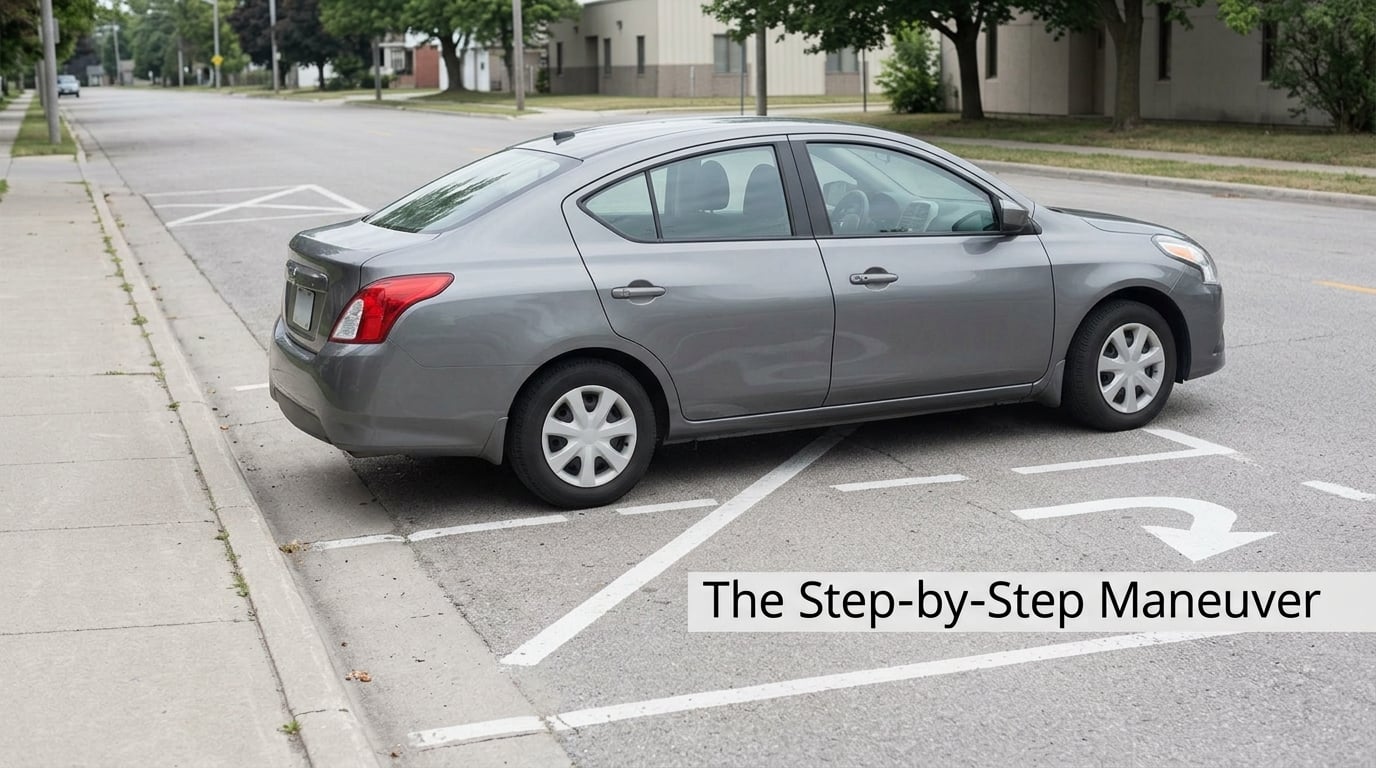
Run the sequence the same way every time. Consistency is what builds muscle memory, and muscle memory is what carries you through a tight gap with traffic behind you when your head is too busy to think.
Set the Reference Point
A reference point is simply a fixed spot on your car that lines up with a fixed spot outside it, telling you to turn or straighten. Pick one and never change it during practice.
Three points work for most cars, and they are used at different moments. The rear quarter of your car appearing in the side mirror tells you when to begin the turn. The kerb appearing low in the side mirror tells you to start straightening the wheel. Your front bumper reaching the rear of the car in front tells you when to stop reversing.
Two things to settle now, because they are the arguments every instructor has. Some say line up your front bumper with the other car’s front bumper; others say match rear bumpers. The rear-bumper method is the one that works with fewer corrections, because it leaves the front of your car further along, giving the rear a wider arc to swing into. Pull up alongside the car in front until your rear bumper is roughly level with theirs.
Whatever you choose, write it down. Get out of the car, look at where the other car’s back end sits against your rear quarter panel, and memorise that. The cue has to live in the car, not in your head at the moment of panic.
Create Enough Space to Practice Parallel Parking Safely
Pull alongside the car in front and leave a door’s width between the two cars, about three feet. Any closer and you will clip something; any further and the math stops working and you cannot fit in.
Check both mirrors and your blind spot before you select reverse. Then look over each shoulder, because the mirror alone shows you the rear quarter window, not the kerb and not a child, a bike, or a low post behind you.
Reverse at walking pace. If you cannot walk beside the car while it moves, you are going too fast. Learners who rush the first two feet of the maneuver are the ones who end up crooked.
Turn and Cross the Reference Point
As you reverse, watch the side mirror until your rear quarter panel lines up with the marker you set. At that instant, turn the steering wheel the full amount toward the kerb, and keep turning until your car sits at roughly a 45 degree angle to the kerb.
Hold that angle and keep reversing. You are aiming for the front of your car to swing wide of the car behind while the rear tucks in toward the kerb. If the front swings too far, you turned too late; if it will not clear the car behind, you turned too early or pulled up too far forward.
Straighten the Wheels
This is the part learners report they get wrong most often, and it is a judgement call rather than a memory trick. The kerb appearing low in your side mirror is your cue: begin unwinding the wheel straight away, slowly, while still reversing.
Do not wait until the car is straight to straighten the wheel, and do not slam it over in one movement. Turn it back gradually. If the kerb is running down toward the bottom of the mirror window, straighten faster; if it has already disappeared, the car is angled out and you need a little more lock.
Correct the Final Position
Keep reversing until your front bumper comes even with, or slightly ahead of, the rear bumper of the car in front. Then select drive, move forward gently, and turn the wheel the full amount away from the kerb.
The car should end up roughly parallel to the kerb and about 30cm, or 12 inches, from it. Far enough that your door clears the car behind, close enough that you did not leave a gap you could fit a bicycle into.
If it comes out crooked, fix it in the space. Select drive, pull forward until your rear wheels clear the car in front, select reverse, and repeat short corrections. Small forward and reverse shuffles are a normal part of the maneuver, not a sign you have failed. Examiners grade control and observation, so a controlled shuffle reads better than forcing one attempt and hitting a wing mirror.
Common Mistakes When You Practice Parallel Parking
Nearly every learner makes two or three of these in their first ten attempts. Each has a cause and a specific correction, which matters more than the mistake itself.
- Pulling up only halfway. Many driving schools teach you to stop with the middle of your car level with the other car’s rear bumper. That leaves too little room for the swing and forces a correction every time. Pull up further than feels natural, until your rear bumper is level with theirs.
- Turning too early. The rear clips the car in front while the front is still swinging wide. Your reference point is firing late. Start reversing a foot or two further before you turn, and turn promptly when it appears.
- Turning too sharply or too late. The front corners the car behind or the rear ends up far from the kerb. Ease off the wheel slightly and use the kerb in the mirror to correct rather than holding maximum lock.
- Watching only one mirror. One mirror plus two shoulder checks is the routine. Alternating glances every second keeps you moving slowly and avoids the sudden stop that signals loss of control.
- Reversing faster than you can steer. Speed and steering have to arrive together. If the wheel is still turning while the car coasts, the result will be crooked no matter how good your reference point is.
- Stopping mid-maneuver. A full stop in the middle of the swing means you have to restart from a position you did not plan for. If you have lost the angle, creep forward until it looks right again.
- Letting vehicle size pick the reference point for you. A long SUV needs a different cue than a small hatchback. Find your own point in your own car, and do not copy a cue from a video shot in a different vehicle.
Learners on forums like r/LearnerDriverUK ask whether it is simply a case of repeating it until it becomes natural. Largely yes, with one addition: repeat it the same way each time. Ten attempts with a different cue built into each one teaches ten half-skills.
Frequently Asked Questions
How long does it take to get good at parallel parking?
Most people need two or three practice sessions of about 20 minutes to make the maneuver feel normal, though a handful of reps per session is enough to stop making the same error twice. Treat your first ten attempts as training rather than a test. You should be able to complete two clean parks in a row at walking pace before you add traffic, and if that takes a month, a month is a normal answer.
Should I line up my front bumpers or my rear bumpers?
Line up your rear bumper with the rear bumper of the car in front. The front-bumper method is widely taught and it works, but it leaves your car further back, which gives the rear a wider arc to swing and usually costs you an extra correction. Whichever one you pick, use the same point every attempt and verify it once by getting out and looking.
Can I practice parallel parking without cones?
Yes, and most people do. Empty milk jugs, cardboard boxes, a couple of parking tyres or a strip of tape on the ground all mark the ends of the space. Place them about one and a half car widths apart with the kerb line as one edge. The markers only need to be visible through the side window, which is exactly the view you will be using during the maneuver.
What are the most common mistakes when parallel parking?
Pulling up only halfway alongside the car in front, turning too late or too sharply, and reversing faster than you can steer account for most failed attempts. Watching one mirror only and making a full stop mid-swing are close behind. Each has a fix: pull up further, act on your reference point promptly, creep at walking pace, and alternate mirrors with shoulder checks.
Do I fail my driving test if I cannot parallel park?
Not for being unable alone. In most jurisdictions you are allowed to take your time, readjust and restart the maneuver, and the assessment is on control, observation and how you correct yourself rather than on a perfect first attempt. A bad park that ends in an unsafe position or a collision is what causes problems. Practise the corrections until they are part of the maneuver.
How do I fix a crooked park once I am already in the space?
Select drive and pull forward slowly until your rear wheels clear the bumper of the car in front, then select reverse and repeat the maneuver. Keep the movements short, a couple of feet at a time, so you stay inside the space instead of swinging wide. Alternating small forward and reverse adjustments is normal technique, and the kerb in your side mirror tells you which way you need to go.
How to Practice Parallel Parking
Start in an empty car park, on one side of the bay only, for ten slow repetitions. Write your reference point on a card taped to the dash so you stop reinventing it, and drive the same sequence every time: pull up alongside, rear bumpers level, a door’s width of space, full lock when your rear quarter appears in the mirror, straighten when the kerb shows, stop when your front bumper reaches the car behind.
Session two, add a second pair of markers so the gap varies slightly, and practise parking on both sides. Session three, move to a quiet kerb with real parked cars, where the reference points shift because you are judging gaps you did not set up yourself.
If a rep goes wrong, note the single thing that went wrong and adjust only that on the next attempt. And if your hands are shaking on the first try in traffic, that is normal. Start over, take your time, and finish it properly.