
To plan a long road trip drive, you set the destination and a realistic daily driving limit, build a route with fuel and rest stops already on it, check the weather, and then put the vehicle through a real pre-trip inspection. Budget two or three hours of prep time the week before, and a few more hours in the driveway the morning you leave.
Most planning guides stop at the itinerary. That is the easy half. A trip rarely falls apart at the planning desk; it falls apart on the road, because of a tire nobody checked, a tank that ran dry one exit early, a stretch of no signal, or a driver who hit their limit two hours before the overnight stop. This guide covers both halves, and gives more weight to the part that decides whether you actually arrive.
A note before we start: almost every number here is a starting point, not a rule. Your car’s owner’s manual beats anything I write, and the conditions on the day beat both of us.
Table of Contents
- What You Need
- How to Plan a Long Road Trip Drive Step by Step
- 1. Set the route, daily distance, and arrival time
- 2. Build a route with practical fuel and rest stops
- 3. Check weather, road conditions, and seasonal risks
- 4. Complete a vehicle readiness check
- Tires first, because they are the failure most likely to end a trip
- Then fluids, brakes, and everything else
- 5. Confirm fuel range and service intervals
- 6. Plan lodging, parking, and overnight security
- 7. Pack food, water, documents, and roadside essentials
- Food and water
- Documents and money
- Roadside kit
- 8. Review the itinerary and share it with someone
- Common Mistakes
- Frequently Asked Questions
- Conclusion
What You Need
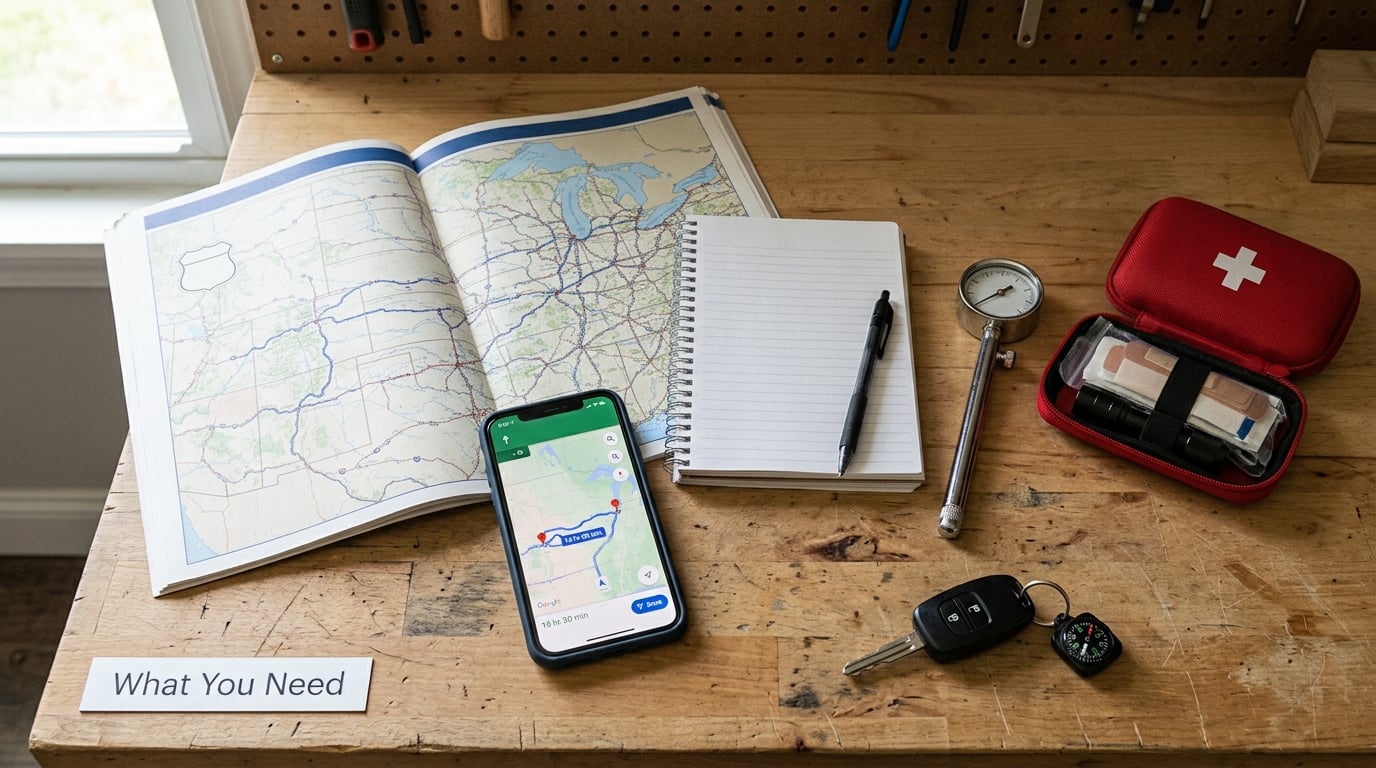
Most people start a long drive planning with a map and run out of road the third hour. The tools list is short, and most of it you already own.
Information and documents
- A final destination and a realistic date range, even a rough one.
- Driver’s license, registration, proof of insurance, and any required permits or international driving permit for cross-border travel.
- Roadside assistance membership details, including the phone number and what the plan actually covers (towing distance, whether it’s tied to a specific vehicle, and whether your rental car is excluded).
- Emergency contacts for someone who is not on the trip.
Planning tools
A phone with a maps app is the minimum. Add a second navigation option, because a phone that dies or loses signal at the same moment your route does is a real failure mode that people report often. Download the region for offline use before you leave, not when you need it.
Worth having: a paper map or printed route summary as a last resort, a note of the fuel range your vehicle can actually cover between stations, and a small note of which rest areas and fuel stations exist along your route. In a desert or mountain stretch, that list is the whole ballgame.
Vehicle equipment to check or carry
- A working tire pressure gauge. A gauge that reads zero when you test it is worse than none.
- The spare tire, jack, and lug wrench, physically present and known to fit your vehicle.
- Jumper cables or a portable jump pack.
- Reflective warning triangles or a vest, and at least one flashlight that works.
- Washer fluid, a scraper or brush, and a small supply of engine oil of the correct weight.
- A first aid kit and any prescriptions in the car with you, not in a suitcase you might not open.
- A phone charger plus a 12-volt USB adapter, since cigarette lighter outlets are often the only charging point on the road.
Before you load the car
An empty car and a full car handle differently. If you are towing, hauling, or carrying three passengers and a cooler, tell your route planner, because the time and fuel estimates change. People routinely plan a solo route, then load a family and a roof box, and the arrival time quietly slides two hours later.
How to Plan a Long Road Trip Drive Step by Step
Eight steps, in the order that actually saves time. Do them in sequence and each one makes the next one faster.
1. Set the route, daily distance, and arrival time
Start with the arrival time, not the mileage. Decide what time you want to be at your destination, then work backwards. The number that matters is a conservative daily driving limit, and the most useful guidance in the whole SERP is also the simplest: about six hours of driving per day is a good target, and anything past eight is a bad idea for most people.
That limit exists because your real time is not the sum of your driving time. Add roughly 15 to 20 percent as a cushion for traffic, construction, and the fuel and food stops you did not plan. Add more than that on mountain roads, in heavy city traffic, or across a border, where waits are measured in hours rather than minutes.
You also have to respect daylight. A seven-hour drive that ends at 9pm is fine in June and genuinely dangerous in December. If the math only works with a night arrival, either shift the start earlier or split the day in two. This is the single most common planning error I see, and it is the easiest to fix at the planning stage and the most expensive to fix at mile 400.
How you know it worked: every driving day on your itinerary is a number of hours, not a number of states, and none of them requires you to be behind the wheel after dark.
2. Build a route with practical fuel and rest stops
Plot the route and then treat stops as part of the route, not as interruptions to it. A rest stop every two hours of driving is the widely used pattern, and a short break of 15 to 20 minutes is genuinely more useful than a 45-minute stop every four hours. Get out of the car. Walk. Standing around at the driver’s door does not do it.
Mark fuel stops on the map the same way, with a margin. If your usable range is 300 miles, plan the fill at 200, not at 280. That gap covers a slower climb, a wrong exit, a detour for a closed pass, or a truck stop that adds fifteen minutes.
Every route needs a backup. On a phone that means saving an alternate path, and knowing in advance which segments have no signal. On a paper map it means the same. Also decide your toll and seasonal-closure preferences now, because changing them mid-drive is how people end up on an unexpected mountain road at dark.
Map apps underestimate time on dirt and gravel by a wide margin, sometimes twenty percent or more. If any part of your route is unpaved, add the cushion yourself rather than trusting the estimate.
You should finish this section with a named alternate route saved, stops marked roughly every two hours, and a first fuel fill placed well before your range gets tight.
3. Check weather, road conditions, and seasonal risks
Check the forecast twice: once several days out to see the shape of the trip, and again the morning you leave, because forecasts that far out are a trend, not a prediction. Look at the whole route, not just your destination, since the interesting weather is usually on the pass you have not reached yet.
Run through the full list, because each behaves differently. Rain cuts visibility and increases stopping distance. Snow and ice remove your options entirely and often close the pass. High wind affects a tall vehicle or an open trailer badly, and gusts are the reason a healthy-looking day gets cancelled. Extreme heat is a cooling and tire-pressure problem before it is a comfort problem. Wildfire smoke is an air-quality problem that looks like a hazy day on the forecast and is not. Flooding means the road under the water is gone, not slow.
Set the decision rule while you are still rested, not once you are tired and hungry. My rule: if visibility drops below what I can see the road markings at, or if conditions are outside what the vehicle and driver are rated for, I stop and wait. Delayed beats rerouted beats stuck. The cost of a lost afternoon is always lower than the cost of a slide off an icy overpass.
Seasonal closures and chain requirements are worth checking on official state highway sites, because the map app does not always show them. If you are not used to driving in conditions you have never seen, that is a reason to pick a different route, not a reason to be more careful.
When the check is done, you have a go or no-go call made before you were tired, and you know who to publish road conditions for each state you cross.
4. Complete a vehicle readiness check
This is the step that decides the trip. Do it on level ground, in daylight, with the engine off and cold for the fluid checks, and give it about an hour.
Tires first, because they are the failure most likely to end a trip
- Pressure: check cold, before driving more than a mile or two. Use the number on the driver’s door jamb placard, not the maximum on the tire sidewall, which is a different number for a different purpose.
- Tread: look across the tread and check the wear bars in the grooves, plus the inner edge of the front tires.
- Age: find the four-digit date code on the sidewall. Rubber ages whether you drive on it or not, and old tires crack on the sidewall even with tread remaining.
- Condition: look for cuts, bulges, and anything stuck in the tread. Check the spare while you are at it, and confirm the jack and lug wrench are actually in the car.
Check all five, including the spare, on every trip. Inflation pressure is a leading cause of tire damage on long highway drives, and heat builds faster than most people expect at highway speed. If you want the detail on tread wear bars and date codes, I wrote up how long tires last in years and miles.
Then fluids, brakes, and everything else
- Engine oil on the dipstick, at the level between min and max.
- Coolant at the reservoir, and a visual look for weeping stains under the car. Never open a hot cooling system, on a trip or any other time.
- Brake fluid and power steering fluid at their marks, plus a look at the brake pedal feel and whether the car pulls to one side.
- Battery: check the terminal signs of corrosion, and note the battery’s age if you can find it. A battery near the end of its life is cheap to replace before a trip and expensive to replace on one.
- Belts and hoses: look for glazing, fraying, or cracking, especially anything that has gone slack.
- Wipers and washer fluid, then every exterior light: headlights, brake lights, turn signals, and the license plate light.
Use the owner’s manual as the reference for every interval and every reading, and hand anything you are not sure about to a shop before you leave. Then do the same inspection again the morning you leave, on tires that have sat overnight. A slow leak shows up as a tire that looks low the next morning, and that is a much cheaper thing to find at home.
One warning: do not treat a roadside repair as your plan. A tire change on a dark shoulder at mile 500 is a completely different proposition from one in a lit parking lot on your own street. Practice the change once on your own driveway if you have never done it, and know where your roadside coverage starts and stops.
Everything on that list needs a reading or a visual pass, and anything questionable gets fixed or explained in your plan before departure.
5. Confirm fuel range and service intervals
Your car’s stated range on the dashboard is a best case. It assumes good conditions, level ground, and mild weather. At highway speed with the air conditioning running, cold tires, a headwind, or a climb, treat the real number as 10 to 20 percent lower. Plan from your worst realistic figure, not the display.
On mountain routes, watch the climbing side of every grade. On a long descent, stay in a lower gear and let the engine do the slowing, which protects the brakes and reduces the chance of brake fade on the next climb. It is one of the most useful habits on a long drive, and it is also why the brake check matters.
Pull up what the car is due for before you start. Oil, coolant, brake fluid, transmission fluid, belts, and tires all have intervals, and a 900-mile trip is exactly the kind of mileage that turns a marginal tire into a shredded one. Confirm that everything on that list is current and take the manufacturer’s intervals as the reference. If anything is due within a few hundred miles of your trip, do it before you leave, not in a town you happen to pass through, and if a fluid is low, finding out why matters more than topping it up, since low coolant or low brake fluid usually points at a leak or worn component. Brake fluid is the one people forget, because it ages in the bottle even sitting on a shelf; there is a good write-up on how long brake fluid lasts in the bottle if you want to check a date before you go.
A car that has been sitting for months with only short drives here and there brings its own problems: stale fuel, a 12-volt battery that has gone flat on its own, and rubber components that have not flexed in a long while. If your car rarely gets driven, treat that as a pre-trip item in its own right rather than an afterthought, and read up on maintaining brakes on a car you rarely drive before you add miles.
You should finish this section knowing your conservative range, your first planned fill, and the last service date for every item on the list.
6. Plan lodging, parking, and overnight security
Book lodging before you leave for anywhere popular, in peak season, or when the event calendar is full. Walking up on a holiday weekend is how a 500-mile day becomes a 700-mile day with an added detour.
Call ahead and confirm three things: that your vehicle fits their parking, whether there are size or weight restrictions, and where you can safely leave it overnight. If the property has a secured lot, use it. If it does not, ask where guests park versus where staff and delivery vehicles go, because that difference tells you a lot about lighting and visibility.
Consider the vehicle itself. Leave valuables out of sight before you arrive rather than after. Know whether your hotel has EV charging or a covered space if the weather is bad, and check whether your route has a spot where you can safely sleep if plans slip. Camping and staying with friends are both fine, and both need the same answer to the same question: is the vehicle somewhere you would want it overnight?
By the end of the step, every night on the trip has a confirmed location and the vehicle situation is settled before you arrive rather than discovered when you get there.
7. Pack food, water, documents, and roadside essentials
Pack for the forecast, not for the trip’s reputation. Layers beat a single heavy jacket, because a desert night and a desert afternoon are different problems.
Food and water
Water for more people than you think, plus extra for the car. Food that does not need cooking, because the interesting stops rarely have kitchens. Bring more than one day’s worth between planned grocery stops, and keep a cooler for anything perishable. Long gaps between services are the reason a sandwich you packed in a gas station bathroom is part of the plan.
Documents and money
- License, registration, insurance card, and any permit or international driving permit.
- Paper copies of your itinerary and confirmation numbers, in case a phone dies.
- Some cash. Card readers fail, and rural areas and rural fuel pumps are where that happens.
- Printed medical information and prescriptions if anyone has something ongoing.
Roadside kit
- Spare tire, jack, lug wrench, and the knowledge to use them.
- Jumper cables or a jump pack, plus a flashlight with fresh batteries.
- Reflective triangles or a high-visibility vest.
- A multi-tool, a small bottle of washer fluid, a few wipes, and a roll of tape.
- A basic tool kit: a socket set or wrench set, a tire-pressure gauge, and a small pry bar.
- A tow strap, but know that a strap is for getting a car out of soft ground, not for towing a car.
The spare deserves a specific mention. Many people assume a spare exists because the car has a space for one, and some cars ship with a repair kit instead, or with a temporary spare that is limited to about 50 miles at reduced speed. Find out which one you have, where it is, and whether your car is even equipped for it.
Done properly, the kit is in the car, not in a suitcase on the roof of your mental list, and you could change a tire in a parking lot without thinking about it.
8. Review the itinerary and share it with someone
Put everything in one place: the route and its backup, the daily hours, fuel stops, rest stops, lodging confirmations, and who to call. This can be a photo of a note, an actual document, or a shared note in a messaging app, and it should exist in a form that works with no signal. A screenshot of the route on your phone is a reasonable second copy.
Download the maps for the whole region while you still have WiFi, and download audio for the same reason, because podcast data and streaming video eat a phone battery fast. Bring a car adapter and a power bank. A phone that is also your map, your music, and your contact list has no redundancy at all, which is why the paper copy matters.
Then send the plan to someone who is not on the trip. Include your route, your daily stops, and the time you expect to be off the road each night. Agree on a check-in, and agree on what happens if one is missed, so that a missed signal is a procedure rather than an emergency. For a solo driver this is not optional. There is no one to hand the wheel to, so the plan has to do more of the work: avoid the isolated stretches after dark where you can, share your live location with someone, and pull over for the night early rather than pressing on.
If the step worked, someone who is not in the car could read your plan and know where you were supposed to be.
Common Mistakes
Every one of these shows up in planning threads again and again, and each has a straightforward fix.
Overloading the day
Planning nine or ten hours because the map says the drive is eight. The map does not know about the construction delay, the fuel stop you had to queue for, or the fact that you have been awake since five. Fix: cut the day to six hours of driving and let the extra time become slack, not sightseeing. If you are banking the first day’s distance by starting early, keep the finish realistic anyway.
Planning fuel too late
Running the tank to a quarter or lower because the next station is on the map. Then the exit you needed closes, or the station on the other side of the pass is closed for the season. Fix: fill at two-thirds, not one-seventh, and know your conservative range.
Having no backup route
One path, no alternative, and a phone with no signal. Fix: pick a second route before departure and save it. Know which segments have no coverage so a dead phone is expected rather than alarming.
Ignoring weather until the morning of
Checking the forecast at the destination instead of along the whole route, and only once. Fix: check the entire route, twice, and set a delay rule in advance. A pass closure discovered at the last rest area costs you the whole day.
Scheduling a late-night arrival
The worst mistake on this list and the most common. Fix: work backwards from the arrival time, not forwards from the departure time, and if the math requires driving after dark, split the day.
Skipping the vehicle check
Oil and tires only, and a spare that has never been looked at. The car-prep discussion on r/askcarguys from a 4,000 km trip puts oil and tires as the non-negotiables and then asks what else is worth the time. My answer: fluid levels, brakes, battery, belts and hoses, every light, the wipers, and the spare.
One more: many people plan a road trip, then leave the itinerary so detailed that any delay breaks it. Leave a whole afternoon unscheduled on the long days. It is the difference between a trip that adapts and one that unravels.
Frequently Asked Questions
How far should I drive each day on a long road trip?
About six hours of driving per day is a solid target for most people, with eight hours as a hard ceiling. Add roughly 15 to 20 percent to the map estimate for traffic, construction, and stops. If you can hand the wheel to another driver, longer days become easier, but solo drivers should stay well under the ceiling and stop every two hours regardless of how far they planned to go that day.
How often should I stop during a long road-trip drive?
Every two hours, for 15 to 20 minutes, is the pattern most drivers and safety groups use. Short and frequent beats long and rare: two 20-minute stops usually leave you fresher than one 45-minute stop, and getting out of the car matters more than sitting in it. Use the walk around the parking lot or a rest area, keep water with you, and treat yawning, heavy blinking, or drifting within your lane as a reason to pull over now rather than at the next planned stop.
Do I need a full vehicle inspection before a long road trip?
Yes, if the drive is more than a few hours and the car has not been looked at recently. Spend an hour on tires, fluids, brakes, battery, belts, hoses, lights, wipers, and the spare, using your owner’s manual for intervals and readings. Anything due within a few hundred miles of the trip is worth doing first. Then repeat the check the morning you leave, since a slow leak shows up overnight as a tire that looks low at home.
What should I do if the weather changes during my road trip?
Delay first, reroute second, and only then press on. Pull into a safe place away from traffic, pull up the official state road conditions for the route ahead, and check whether a pass or highway is closed rather than just slow. If visibility or traction is worse than you have handled before, wait it out. Build a spare hour into each driving day specifically so weather delays do not force a decision made by a tired driver at dark.
What is different when planning a long road trip in a rental car?
You cannot inspect the car the way you inspect your own, so lower your expectations and raise your awareness. Photograph the tires, wheels, glass, and body before you leave so damage is not charged to you later, and ask the counter about roadside coverage, since your own membership may not apply. Check the spare or repair kit situation, confirm the fuel type and the mileage limit, and plan stops and fuel more conservatively because the car is unfamiliar.
Conclusion
Planning a long road trip drive comes down to a short list you can finish this week: destination and daily hour limit, route plus a backup, fuel and rest stops marked, weather checked twice, the vehicle inspected and anything due handled, lodging confirmed, the kit in the trunk, and the plan sent to someone at home.
If you do only four things, make them these. Confirm the route and lock in a daily driving limit that does not need a night drive. Put a real hour into the vehicle check, including the spare, the fluids, and the tires read cold off the door jamb placard. Check current road conditions and forecasts across the whole route the morning you leave. And download the maps, the audio, and the backup route before you turn the key, while you still have WiFi.
The itinerary gets people excited. The preparation is what gets them home.