
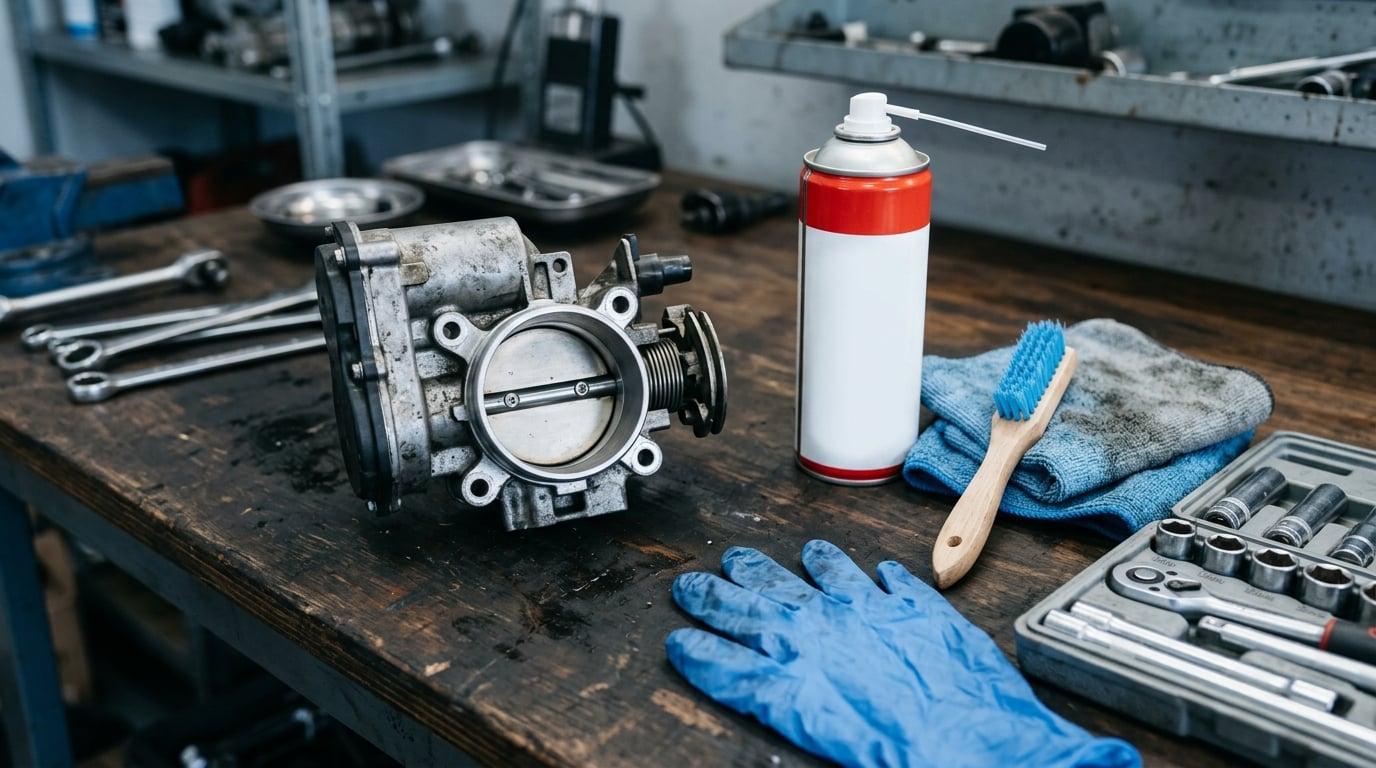
To clean a throttle body, disconnect the negative battery terminal, take the air intake boot off, hold the accelerator pedal down while someone turns the key to open the butterfly plate, then spray throttle body cleaner onto a microfiber rag, scrub the plate and bore with a soft nylon brush, wipe everything down, reconnect the battery and complete an idle relearn. Most owners finish in under an hour with basic hand tools.
On a BMW that job usually means a six-cylinder or turbocharged engine with a drive-by-wire electronic throttle body, so the throttle plate is moved by the ECU instead of a cable. That single fact changes how you work, and it is where most DIY attempts go wrong: someone grabs the butterfly plate with their fingers to open it wider and the throttle position sensor goes out of calibration.
I have cleaned these on older turbo cars where the idle wandered and the car felt lazy off the line. The result depends almost entirely on whether the throttle body is the actual problem, so the inspection in step 5 matters more than the scrubbing. If carbon is thin and the idle still misbehaves afterwards, look at the PCV valve and the crankcase venting instead.
Table of Contents
- What You Need
- Step-by-Step
- 1. Confirm Whether You Need to Remove the Throttle Body
- 2. Prepare the Vehicle and Work Area
- 3. Label and Disconnect the Components
- 4. Remove the Throttle Body if Necessary
- 5. Inspect the Throttle Body Before Cleaning
- 6. Clean the Throttle Plate and Bore
- 7. Clean and Reinstall the Throttle Body
- 8. Check for Leaks, Idle Problems, and Throttle Response
- Common Mistakes
- Frequently Asked Questions
- Can I clean a throttle body without removing it?
- What product is safe for cleaning a throttle body?
- How often should I clean a throttle body?
- Should I move the throttle plate while cleaning it?
- Will cleaning the throttle body fix a rough idle?
- Do I need to relearn the throttle position sensor after cleaning?
- Conclusion
What You Need
Start by reading the section of your owner’s manual covering intake air routing and the electronic throttle body. On a BMW that usually sits in the maintenance or engine chapter, and it tells you whether the intake ducting is clipped, bolted or secured with a screw clamp.
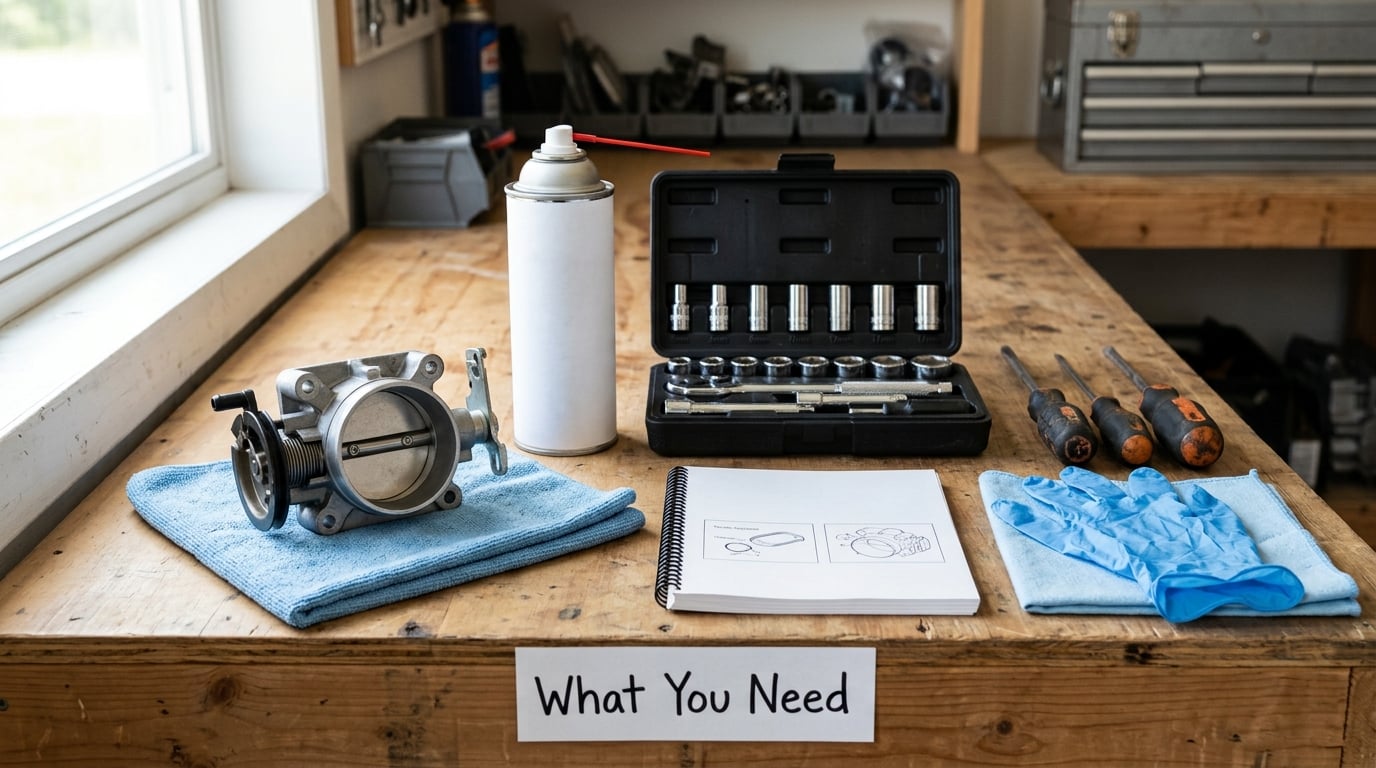
Gather these before you touch anything:
- Throttle body cleaner or a good carburetor cleaner. A dedicated throttle body cleaner is the safer choice because it is formulated to rinse off sensors and seals.
- Microfiber rags or lint-free cloths, at least three. Cheap ones leave fibres in the bore.
- Soft nylon brush or an old toothbrush for the idle passages and the edges of the plate.
- Socket set and a flat screwdriver for the intake hose clamp, which is often a spring clamp you need pliers for.
- Safety glasses and nitrile gloves. The aerosol goes everywhere, including places you were not aiming.
- Torx and hex bits matching the throttle body bolts on your engine.
- A drip tray or old towel to catch runoff so it does not end up on the exhaust or in the charge air pipe.
- Your owner’s manual and, if you have one, a scan tool. Read the fault codes before you start, not after.
One more thing worth having is a small jar to catch the throttle position sensor connector if you do end up removing the unit, because road grit gets into open connectors faster than people expect.
Step-by-Step
1. Confirm Whether You Need to Remove the Throttle Body
Clean it in place if the intake boot comes off easily and the plate opens far enough for your brush. Remove it only when the buildup is heavy enough to hide the plate edges, when the throttle plate is physically stuck, or when a leak test shows gasket failure you intend to fix with a new seal.
Most experienced DIY guidance is blunt about this: there is little reason to pull a drive-by-wire throttle body just to clean it, because removal disturbs the plate position and invites a throttle position relearn fault. That warning is worth taking seriously. That said, plenty of owners remove an intake manifold on a high-mileage turbo car to reach deposits that cleaning in place cannot touch, and the process works when you are careful and expect a relearn afterwards.
Whichever route you pick, the owner’s manual and your engine’s layout decide it, not a forum post. If you have never done intake work on the car, in-place is the lower-risk starting point.
2. Prepare the Vehicle and Work Area
Park on level ground, engage the parking brake, and let the engine cool. Pop the hood fully and prop it so it stays up on its own; a throttle body job takes longer than you think if the hood drops on your forearm.
Turn off every electrical load in the car: lights, radio, climate fan, heated seat. Then work at the battery and disconnect the negative terminal first. Isolate the loose end so it cannot arc against the positive post.
Lay a towel under the throttle body opening so stray cleaner does not run into the intake manifold or onto hot exhaust parts. Give yourself light. A headlamp clipped to the strut beats guessing at residue colour in a shadow.
Keep parts in order. Set bolts into a magnetic tray or a labelled container as they come off, and never rest a connector where it can swing into the fan or the belt.
3. Label and Disconnect the Components
Photograph the throttle body before touching a single clip. Take two or three angles, one wide enough to identify the TPS connector and its latch, one close up on the wiring. That photo is your map if the connectors do not have labels.
Disconnect the throttle position sensor electrical plug by pressing its locking tab and pulling straight off the pins. Never pull the wire bundle itself; the pins are held in the connector body and will come out with it.
On some engines an idle air control valve sits on or beside the throttle body with its own connector and sometimes a coolant line. Unclip both, and if any coolant line is involved, drain or clamp it as your manual describes before you pull anything apart. Mark hose positions with tape if you are working blind around them.
Note the throttle body mounting bolts and their positions before removal. Photograph the throttle body gasket area too, so you can tell on reassembly whether the sealing face is sitting flat.
4. Remove the Throttle Body if Necessary
Loosen the intake ducting first. On many BMW engines the air intake hose pulls off the throttle body with a clamp and the duct clips into the charge air pipe, so squeeze or pry the clips gently and work the hose loose along its axis rather than twisting it.
Support the throttle body as you free it. The bore is thin cast alloy and the mounting studs snap easily, which is how an in-place job turns into an intake manifold job. Unbolt it in the pattern your manual lists, usually in a criss-cross sequence so the sealing face lifts evenly.
As soon as the unit is free, support the butterfly plate so it cannot drop open on its hinge or swing past its normal stop. Handle it by the body, not the plate or the linkage. Keep the gasket with the throttle body if it looks reusable, and treat it as single-use if it lifts out of shape or feels brittle.
5. Inspect the Throttle Body Before Cleaning
Look before you spray. A healthy throttle plate is dark metal or slightly grey, with a uniform film at worst. Trouble shows up as hard black-brown crust built up along the trailing edge of the plate and in the bore just behind it, which is the idle airflow path.
Check the idle bypass passages with your flashlight and toothbrush. Carbon narrowing those channels is what causes the idle to hunt after warm-up.
Look at the throttle position sensor connector and the sensor body itself for greenish corrosion or a green wire in a white housing. That is a wiring problem, not a cleaning problem, and scrubbing it will not help.
Check the gasket surfaces and the bore walls for scoring or gouges. Deep scratches mean the housing is damaged and no amount of cleaner will fix airflow. Run a finger along the sealing face and confirm it is flat and free of carbon lumps, because those lumps are what cause the post-service vacuum leak and the idle that gets worse instead of better.
6. Clean the Throttle Plate and Bore
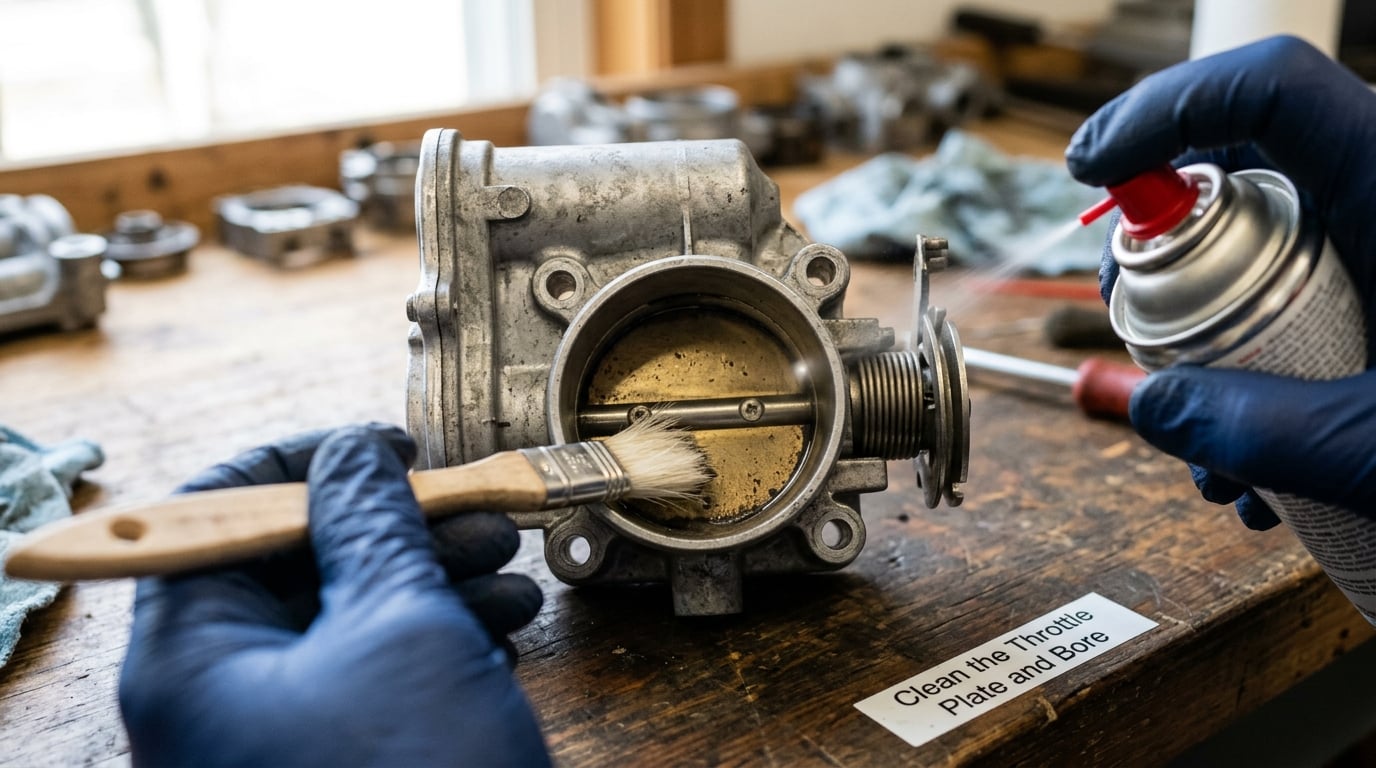
Put on the glasses and gloves, and work in short bursts. Spray the cleaner onto your microfiber rag rather than straight into the bore, then wipe the plate and bore with the damp side. Repeated light passes remove soft residue without driving grit into the casting.
For crust that will not shift, spray a small amount directly onto the plate only, wait about a minute to soften it, then work the soft nylon brush across the bore and around the trailing edge of the butterfly valve. Stay inside the throat of the housing and keep the nozzle clear of the throttle position sensor.
Do not force the plate fully open and do not pry it. If the bore needs more movement than the key-on pedal-hold method gives you, clean what you can reach, reassemble and reassess rather than forcing the mechanism.
Open the idle air control passages with the toothbrush and flush them with cleaner until you see metal. Rinse with a second pass of cleaner and a clean section of rag, then move the plate gently through its travel a few times to clear residue from both halves of the bore. Let everything air dry for several minutes, which prevents diluted cleaner from being pulled into the intake manifold.
While you are in there, a MAF sensor downstream should be sprayed onto a microfiber cloth and wiped, never blasted with aerosol or touched. The same goes for any pressure or temperature sensor mounted on the intake. A contaminated MAF will undo everything you just cleaned.
7. Clean and Reinstall the Throttle Body
Confirm the sealing face is clean and flat, fit a new gasket if yours came apart or looks compressed, and install the throttle body with the bolts started by hand. Tighten in the criss-cross sequence and the torque figure in your manual. Over-tightening a thin alloy housing cracks it, and the crack will not show up until you have a misfire to chase.
Move the plate by hand through its full travel before you connect anything. It should move smoothly with light spring resistance and no gritty catch. Binding here means a scratch or a bent linkage, and it is far cheaper to find now than at road-test speed.
Reconnect the throttle position sensor plug until the latch clicks and give it a gentle tug to confirm it is seated. Reattach any idle air control valve connector and coolant line, then refit the intake ducting, tightening every clamp along the route from the air filter to the intake manifold. An unfitted clamp or a hose pushed in halfway is the single most common cause of a vacuum leak after this job, and it sounds like a tuning problem, not an air leak.
8. Check for Leaks, Idle Problems, and Throttle Response
Reconnect the negative battery terminal. Start the engine and let it idle for five to ten minutes without touching the pedal, which is the basic key-on relearn most BMWs will run on their own. If the idle is still hunting after that, do an ignition-off period of the same length with the key on and then start again.
Listen for a hiss at every intake connection while the engine runs, and check for an unsteady idle that changes as you gently turn the steering or switch the climate fan on, since both add load the ECU has to compensate for.
Finish with a short road test: a slow crawl in traffic, a stop and go, then a steady highway speed. Hesitation off the line that persists after the relearn points at a vacuum leak or an uncapped port rather than at the throttle body.
Stop driving and get a proper diagnosis if the check engine light comes back, if the engine stalls when you come off idle, or if throttle response stays inconsistent. A P2101, P2119 or P0506 code is information, not a nuisance: it points at throttle actuator control or idle control performance, and it deserves a scan-tool read rather than another round of cleaning.
Common Mistakes
Hand-opening the butterfly plate on a drive-by-wire unit is the mistake that causes the most new problems. Without the battery disconnected, your fingers tell the ECU the plate is at an angle it never saw. Disconnect the battery, and if you need more opening than the pedal-hold trick gives you, clean in stages rather than forcing the mechanism.
Spray cleaner onto sensors and connectors instead of onto a rag. Throttle position sensors, MAF sensors and idle air control valves do not tolerate direct aerosol, and residue from cheap solvents can drift into a bore you just cleaned.
Using the wrong chemical. Do not use WD-40, silicone spray or brake cleaner on a throttle body. WD-40 leaves an oily film that traps fresh carbon and can slip on the plate seal; brake cleaner is a harsh solvent with no lubrication for the seals. Owner after owner flags WD-40 as a mistake in the DIY write-ups on this job, and it is the chemical people reach for most often for no good reason.
Forgetting the idle relearn. On many BMWs, disconnecting the battery or moving the plate resets what the ECU knows about closed throttle. Skip the relearn and the car may idle high, hunt, or set a throttle actuator code and drop into reduced power. That five to ten minute key-on cycle and the short drive afterwards are part of the job, not a finishing touch.
Not checking for intake leaks afterwards. A loose clamp or a hose not fully seated produces an idle that is worse than before you started, and it sends people looking for a cleaning problem that does not exist.
Cleaning a throttle body that was never dirty, and ignoring the crankcase venting. Carbon that returns within a few thousand miles usually comes from blow-by through a worn PCV valve or a failed one, not from the throttle body. If you clean it twice in a year and the buildup comes back, that is an engine ventilation problem to diagnose on its own.
Frequently Asked Questions
Can I clean a throttle body without removing it?
Yes, and on a BMW drive-by-wire engine that is the safer route. With the negative battery terminal disconnected, take off the air intake boot, turn the key on and have someone hold the accelerator down so the ECU opens the plate. Spray throttle body cleaner onto a microfiber rag, scrub the bore and butterfly valve with a soft nylon brush, and reassemble. Removal is only worth it when buildup is severe enough to hide the plate edges.
What product is safe for cleaning a throttle body?
A dedicated throttle body cleaner is the safest option, because it is formulated to rinse off without leaving a film on the throttle position sensor. A good carburetor cleaner also works. Avoid WD-40, silicone spray and brake cleaner. WD-40 leaves an oily layer that traps carbon, and brake cleaner is too harsh around the sensor and seals. Always spray onto a microfiber rag rather than into the bore.
How often should I clean a throttle body?
For most gasoline BMWs, cleaning is not routine maintenance on a schedule. Check it when symptoms appear, or as part of intake work such as replacing intake manifold gaskets or injectors. A car driven hard in stop-and-go traffic or used for towing will build carbon faster than one that is not, and it will usually show it somewhere in the 80,000 to 120,000 mile range.
Should I move the throttle plate while cleaning it?
Do not hand-move the plate while the battery is connected. On a drive-by-wire throttle body, your fingers move the throttle position sensor to an angle the ECU did not command, and that is what sets relearn faults. With the battery disconnected, move it only gently through its travel to loosen residue, and never force it fully open. If the plate is stuck, clean what you can reach instead of prying.
Will cleaning the throttle body fix a rough idle?
Sometimes, and the honest answer is that it fixes a minority of rough idles. Carbon in the idle bypass passages genuinely restricts airflow, so a heavily affected throttle body will idle better once cleaned. But worn PCV valves, failing idle air control valves, vacuum leaks and ignition problems cause the same symptoms. If the buildup you found was thin, keep diagnosing instead of cleaning again.
Do I need to relearn the throttle position sensor after cleaning?
Plan for it. Disconnecting the battery and moving the plate resets what the ECU knows about closed throttle on most BMWs. Start the engine and let it idle for five to ten minutes without touching the pedal, then do an ignition-off period of the same length, then complete a short drive that includes a slow crawl and a steady highway speed. A P2101 or P0506 code after cleaning usually means the relearn did not complete.
Conclusion
Look before you clean. Open the intake, hold the pedal so the ECU positions the plate, and judge how much carbon is actually there, because thin buildup on a misbehaving idle usually means the real problem is elsewhere.
If you do clean it, use a dedicated throttle body cleaner or good carburetor cleaner on a microfiber rag, work the bore and idle passages with a soft brush, keep every spray away from sensors and connectors, and never force the butterfly plate open by hand on a drive-by-wire engine.
Reassemble carefully, tighten the clamps along the whole intake route, then complete the idle relearn and a short drive before you treat the car as normal. If the idle is worse afterwards, chase the vacuum leak first and read the codes second.