
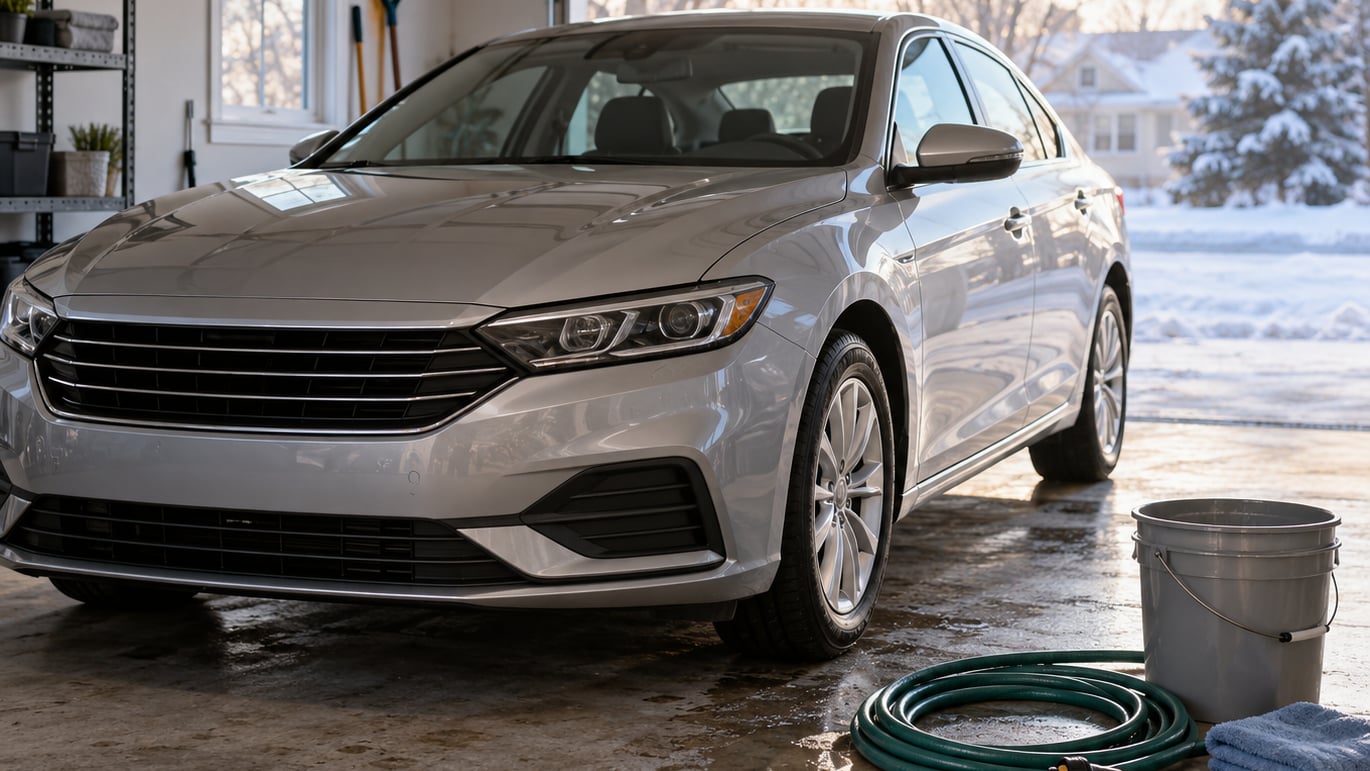
Wash your car in winter on a day when the temperature stays above freezing from start to finish, ideally around midday, and get it completely dry before the cold returns. Once the temperature drops toward freezing, water left on paint, inside door jambs or around the locks turns to ice, and the rinse you started with becomes the damage you did not want.
That is the whole rule, and everything else in this guide is detail. Below freezing you cannot rinse and dry a car safely outdoors, so the honest options are a garage, a coin-op bay, a heated touchless wash, or a rinseless wash you do in a sheltered spot. Get the timing right and a winter wash takes twenty minutes with a hose. Get it wrong and you end up with a car with water spots, a frozen lock, or salt you just moved around.
Salt is the reason any of this matters. It does not sit politely on the paint. It creeps into wheel wells, under the rocker panels and along brake and fuel lines, and it keeps working on metal long after the road dries. Drivers in salt country who wash after every real storm cut their corrosion risk dramatically, and if you drive a BMW or anything else with brightwork and tight panel gaps, the drying step matters more than the soap.
What You Need
The list is shorter than most people expect, because winter washing is mostly about discipline rather than gear. If you already own a hose, a bucket and a decent mitt, you are most of the way there.
- A wash soap rated for cold water. A pH-neutral shampoo or a rinseless concentrate both work below freezing. Household dish detergent is not on this list, for reasons covered later.
- Two buckets and a grit guard. One bucket for clean solution, one for dirty mitts. The grit guard sits in the bottom and traps the grit that causes swirl marks.
- A microfiber wash mitt or rinseless sponge. A flat sponge holds grit against the paint. A mitt or a sponge designed for rinseless work lets debris fall away instead of staying trapped.
- A hose, a pump sprayer, or a pressure washer. Below freezing, a hose you can disconnect and drain beats a pressure washer you cannot store indoors.
- A foam cannon or a hand pump sprayer. Snow foam needs a few minutes of dwell to soften road film. In freezing weather a pump sprayer is often more practical because there is no lance to freeze in the driveway.
- A drying setup. At least two large microfiber towels, ideally a twisted-loop drying towel, and a blower or a tarp or blanket to lay the car on so trapped water cannot freeze onto the paint.
- Wheel and undercarriage access. A wheel brush, a dedicated bucket for wheels, and either a driveway ramp or a coin-op bay with an undercarriage spray.
- De-icer for the locks and seams. A lock de-icer that is safe on paint, used before the door freezes shut rather than after.
What you do not need is hot water. Lukewarm is enough to keep wax and sealant moving, and anything near hot water on glass that has been sitting at 20 degrees is a good way to crack a windshield or backlight. If you want the broader technique, our guide on washing a car without scratching the paint covers the grit logic in detail.
If your car lives outside and you have a spare hour before the season starts, preparing your car for winter covers the sealant and inspection side of things. On brightwork, protecting chrome trim in winter is worth a read, because chrome pits faster than paint once salt gets to it.
Step-by-Step
1. Check the weather and choose a safe washing time
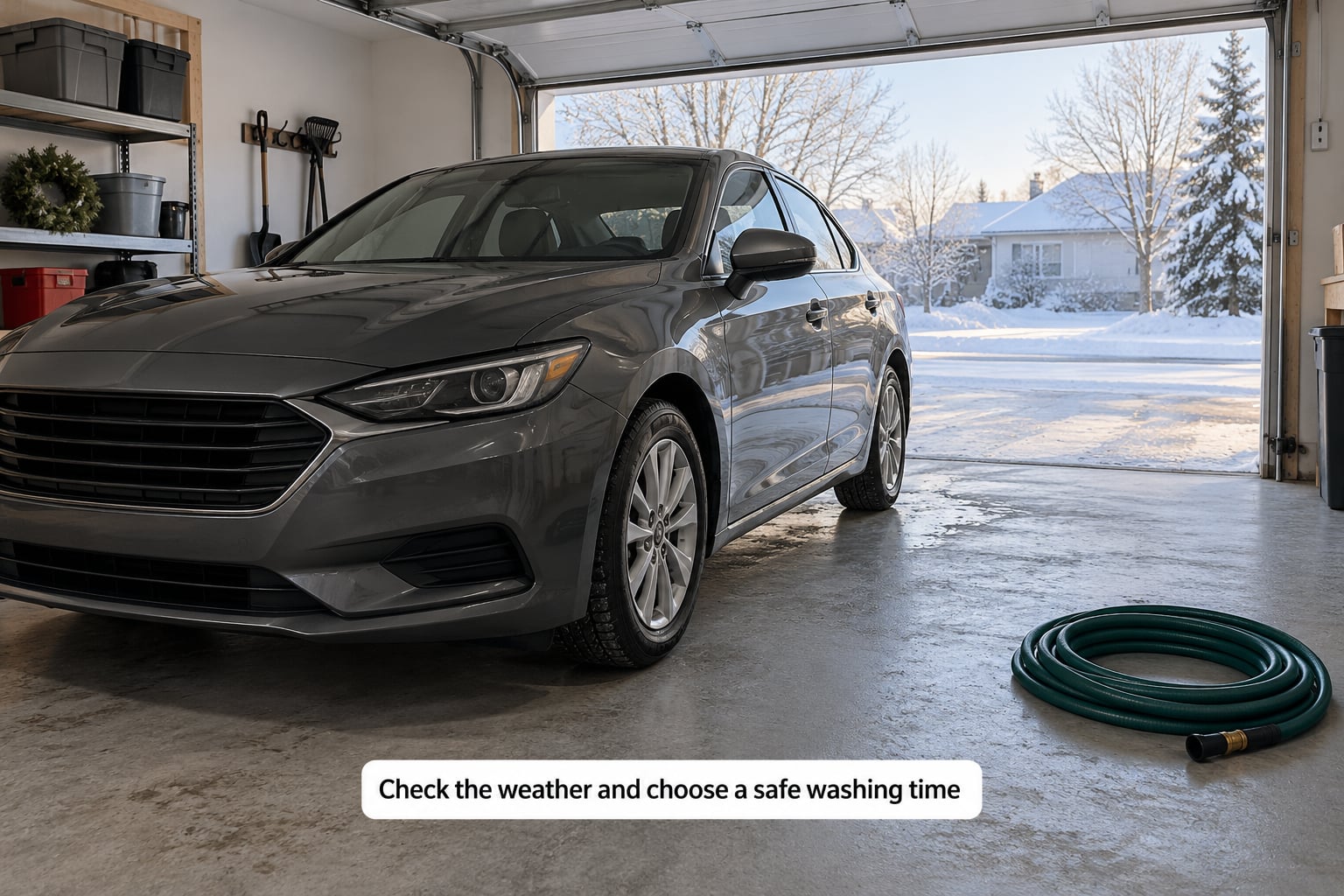
The temperature decides everything, so read the forecast for the whole window, not just the moment you step outside. You want air temperature above freezing and rising, ideally with the warmest part of the day ahead of you rather than behind you.
Look for a dry stretch of two or three hours after the wash is done. A sunny day with a cold wind is worse than an overcast calm one, because wind drives water into jambs and seams where it freezes fast. Skip washing entirely when freezing rain or wet snow is in the forecast, because that is salt solution arriving after you cleaned.
A good test: if you can stand in the driveway comfortably in a t-shirt for five minutes without shifting your weight, you are fine. If you cannot, you are guessing.
Before you start, take a quick look at the road. Fresh sand, stacked salt piles at the curb, or a run of brown slush at every intersection means the undercarriage rinse is the priority, not the shiny paint on the roof.
2. Prepare the car and protect vulnerable areas
Clear snow off the car before any water touches it. A plastic shovel or a soft brush is fine; a metal shovel edge dragged across paint in cold weather will take the clear coat with it every time.
Then handle loose grit. Grit sitting on a wet panel under a mitt is exactly how you scratch a car in winter, because the grit has not been washed away yet. Rinse the whole car down first with plain water, working from the roof toward the sills so the dirt runs off panels you have not cleaned yet.
While everything is wet and clear, a few small things are much easier than later. Close the windows and sunroof fully. Pull the wiper arms back a few inches if the forecast calls for overnight freezing, so a frozen blade is less likely to stick to the glass.
Treat the plastic trim before the wash if you have a dressing that tolerates cold. Trim will stain pale, and salt on textured plastic turns white and chalky fast.
3. Mix the soap and wash from the top down
Mix your cold-rated shampoo or rinseless concentrate in lukewarm water until the foam holds. Lukewarm matters more than hot. It softens road film without shocking cold glass, and it keeps any sealant you applied earlier from sealing itself to the panel mid-wash.
Foam the car and let it dwell. Five to eight minutes of dwell is where most of the work happens in winter, because the alkaline foam lifts the salt film while you are still inside. Do not scrub a foamed car while the foam is working. Rinse it off and it will tell you where the stubborn patches are.
For the wash itself, use the two-bucket method. Dunk the mitt, wipe from top to bottom in straight lines, and never go back over a panel you already cleaned. Your wash lane moves left to right and back, same as in warm months.
Rinse with plenty of water, not a light mist. A thin film of water is what leaves spots. If the car is only lightly dusty, a rinseless wash with good-quality towels is enough. If the paint has real road film on it, an actual rinse with soap is worth the extra ten minutes.
Keep the wash inside the garage whenever you can. A garage at 35 degrees outside is the difference between a comfortable job and a race against the thermometer.
4. Rinse thoroughly without freezing equipment
Rinse the upper surfaces before the lower ones so you are not dragging dirty water down over clean paint. Flush the wheel wells, the rocker panels, and the underside last, and use the undercarriage spray or a driveway ramp if the salt is heavy.
Drain the hose after you finish, every time. A hose left connected with water inside is a split hose by morning, and it can crack a spigot if it freezes with the valve open.
If you use an electric pressure washer, bring it inside before you start. Outdoors it will freeze solid and pump fluid can destroy the pump seals. If it has to stay outside, run it dry and disconnect the water first, and only use it on an outlet with a ground fault interrupter and a proper outdoor-rated cord, in the dry.
Gloves are not optional at these temperatures. Wet hands lose fine motor control within a few minutes, and dropping a metal wheel brush while standing on ice is how people end up in an emergency room instead of the driveway.
5. Dry the car completely
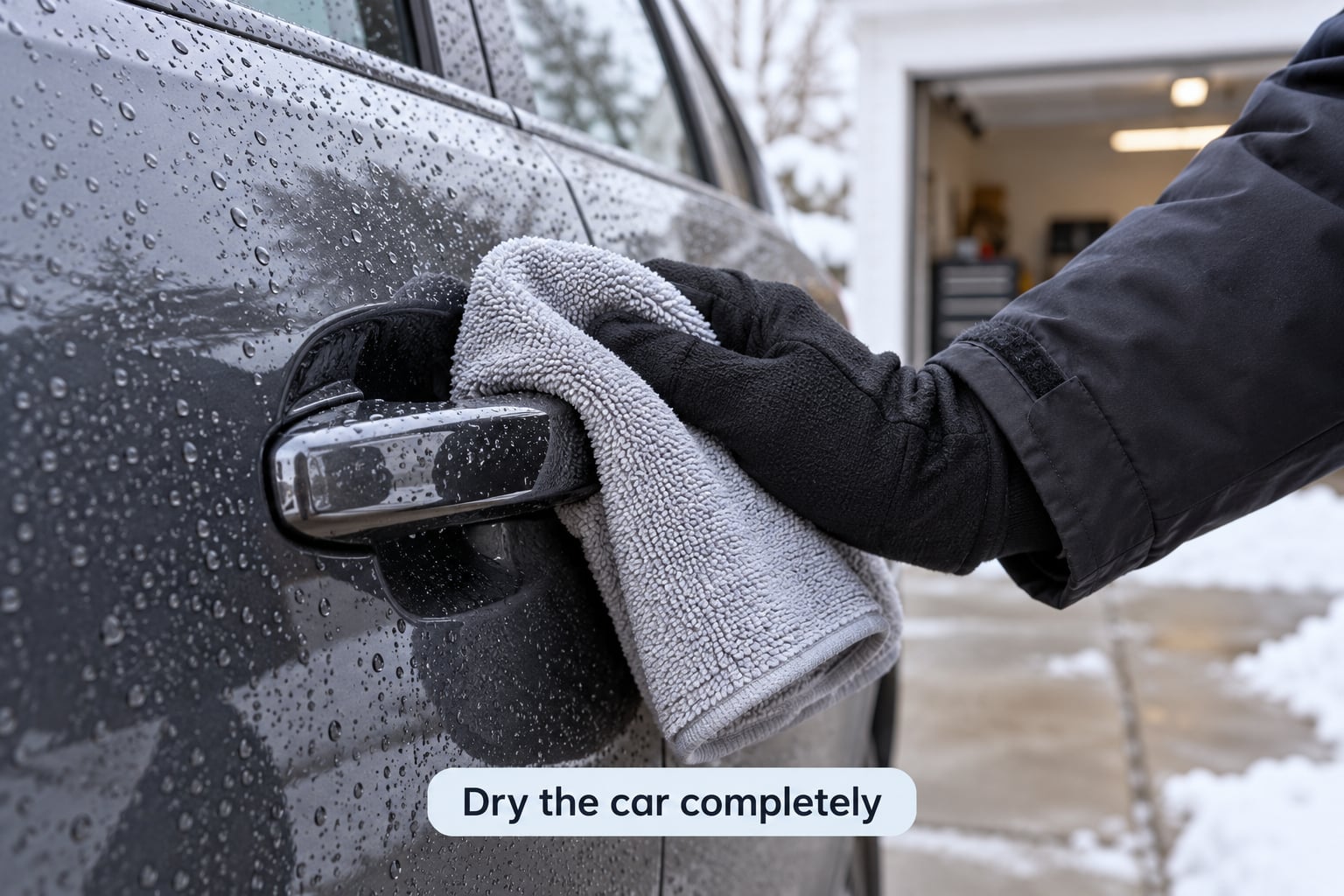
Drying is the step people rush, and it is the one that causes ice, water spots, and frozen locks. Start with the blower or a leaf blower on low, from about a foot away, to push water out of the wheel wells, the mirrors, and the seams along the hood and trunk.
Then towel the flat panels with a large microfiber towel, working from the top down and patting rather than dragging. A twisted-loop towel moves more water per pass than a folded terry cloth, and it is far less likely to scratch if you do drop grit back onto the paint.
The freeze-up trouble spots are the small ones. Work the door jambs, the inside of the door seals, the hood and trunk lips, the fuel filler area, the mirror housings, and around each lock cylinder. Water hiding in a jamb can freeze solid and hold the door open or shut against the seal.
Once a lock has frozen, do not force the key and do not use boiling water. A lock de-icer applied while the lock is still slushy is the easy fix. Forcing a frozen cylinder is how people snap keys and damage cylinder pins.
How do you know you are done? Run a dry hand along the rockers, jambs, and mirror edges. If your glove comes away damp, keep going. Any water you leave behind becomes a water spot or an ice patch when the temperature drops.
6. Apply a water-repellent or sealant for protection
A hydrophobic sealant does real work in winter because it lets water bead and roll off instead of sitting in a flat sheet where it can freeze and where salt can sit on the surface. If the car has a ceramic coating, its maintenance wash and drying routine matter more than any product brand.
Timing matters. Apply the sealant to fully dry paint, in shade, following the product instructions, and give it the cure time the label asks for. Applying a sealant over a damp panel traps water under the layer, which is the one outcome that makes protection worse than none.
Spray sealants and quick waxes are the practical winter option because they work in cold, damp conditions and do not need a long cure. They will not last a year, so expect to reapply every few washes. A paste wax or a hard sealant applied right before winter is the longer-protection option if you have a warm garage and time.
None of this replaces regular washing. A coated car that sits through six weeks of road salt will still corrode underneath, because the coating protects the paint, not the metal behind it.
Common Mistakes
Washing before rinsing the grit away. The mitt picks up what is on the panel and grinds it into the clear coat. Rinse the whole car first, every time, no matter how clean it looks.
Using dish soap or household detergent. It strips sealant and wax, leaves a sticky film that attracts road film, and it is hard on coated wheels. Use a pH-neutral shampoo or a rinseless concentrate made for cars. On a ceramic-coated car the two-bucket method matters more than the brand on the bottle.
Washing below freezing. There is no way to make this work outside. Water films on the glass, freezes in the seams, and your hose is a casualty. Move to a garage, a coin-op bay, or wait for a warmer day.
Skipping the undercarriage. This is where the salt actually does its damage. Without an undercarriage rinse you are cleaning the part of the car that stays visible while the clean part gets dirty again.
Leaving doors, jambs, and locks wet. Water in a door jamb freezes and can hold a door open against the rubber or shut against it. Towel the jambs and the lock area every single time.
Storing a wet hose or a pressure washer outside. Drain the hose and store it coiled in the garage. Bring the pressure washer in, or accept that you will be replacing pump fluid and seals.
Hot water on cold glass. Lukewarm is plenty. Hot water on a windshield that has been sitting at 20 degrees can crack it, and the same thermal shock hits sensor housings and camera modules on newer cars.
Forgetting the charge port on an EV. A frozen or salt-packed charge port will not latch, and the door seal around it holds moisture. Wipe it down, keep it dry, and apply de-icer around the seal, not inside the connector.
A last practical tip: wash the car right after a storm when the salt has softened but before it re-freezes, and keep a dedicated winter wash kit in the trunk so you are not hunting for the mitt in a parking lot.
Frequently Asked Questions
Can you wash a car when it is below freezing outside?
Not outdoors with a hose. Below 32 F the water films on the paint, freezes in door jambs and seams, and the result is water spots and stuck doors. Below freezing, change methods instead: wash in a garage, use a coin-op bay or heated touchless wash, or do a rinseless wash with warm water in a sheltered spot where nothing can freeze.
How cold is too cold to wash a car at home?
Above freezing and falling is workable if you dry fast. A steady 35 F or above gives you comfortable margin. Between 25 and 34 F you can manage with a garage, lukewarm water and a lot of drying discipline. Below 25 F, skip the driveway and use a bay, a heated touchless wash or a rinseless wash.
Is a coin-op or touchless car wash better than washing at home in winter?
In cold weather they usually are, because the bay is sheltered and the blow dryers remove water before it freezes. The quality depends on the wash. Touchless removes road film reasonably well but leaves a light salt film, and you need the undercarriage spray added. Always pay for the undercarriage rinse option, and follow with a quick rinseless wipe if you can.
Can road salt be removed with plain water?
Plain water alone is not enough. Salt film holds onto paint and underbody metal, and rinsing without soap mostly just spreads it around while lowering the freezing point so it stays wet longer. Use an alkaline snow foam or pre-wash with several minutes of dwell, then a proper shampoo or rinseless wash. Rinse from the top down so the dirt runs off clean panels.
How often should I wash a car during winter?
Wash after every significant storm, and at least every two weeks in salt-heavy months. Think of it as keeping salt wet and mobile rather than letting it dry and sit. Skipping a wash is fine when the car stays parked on a treated surface and stays clean, but a daily driver that drives salted highways every day needs more attention than that.
Is Dawn dish soap okay to wash a car?
Not for a regular wash. Dish detergent is a strong degreaser, so it strips sealant and wax and leaves a sticky film that grabs road grime, which is the opposite of what you want in winter. Use a pH-neutral car shampoo or a rinseless concentrate instead. Dish soap belongs in the engine bay and the wheel wells, not on the paint.
Conclusion
The safest first move is to wait for a day that stays above freezing and rising, with a couple of dry hours behind it. Then rinse the grit off before you touch the paint, wash with a cold-rated product from the roof down, hit the undercarriage, and treat drying as a real step rather than an afterthought.
Once you know how to wash a car in winter, the routine is not complicated. It is just the same wash you already do, done at the right temperature, with more attention on the underneath and on the small places water hides.