
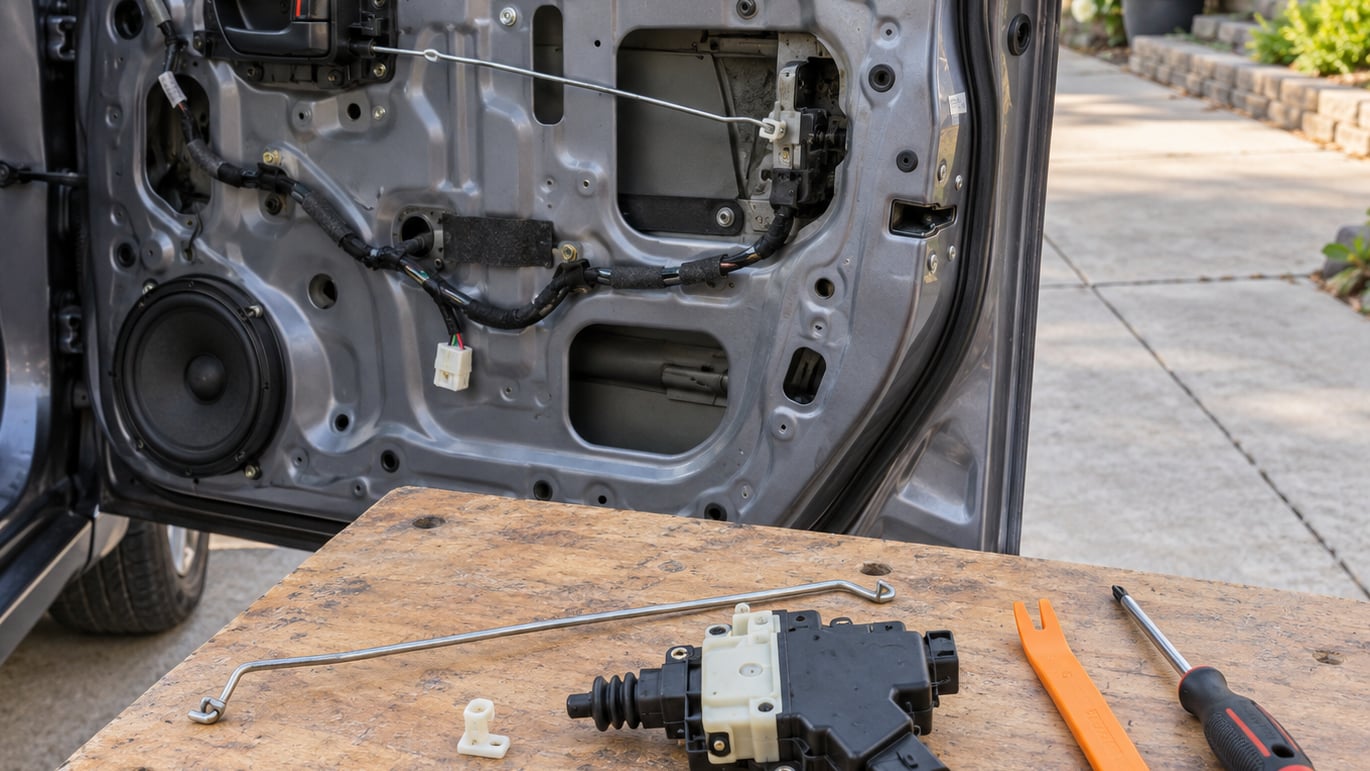
If your car door won’t open from the inside but still works fine from the outside, the failure sits in the interior release path: a child safety lock switched on, a broken interior handle, a linkage rod or lift cable that came unclipped, or a door lock actuator that gave up. Start with the child lock and the handle, then open the panel.
Your inside handle does not open the door directly. It pulls a rod or cable that connects to the door lock actuator, and the actuator is what releases the latch. Break any link in that chain and the handle still swings while the door stays shut, which is exactly why this fault confuses so many owners.
How to fix a car door that won’t open from inside is mostly a process of elimination. You are working from the cheapest, least invasive checks to the ones that mean pulling a trim panel, and that order matters. If your door opens from the outside and still locks and unlocks normally, the key cylinder is not your problem, so do not start there.
Rear doors fail far more often than front doors because they carry the child lock, the most common and most easily fixed cause. Most fixes on a front door take under an hour once the panel is off.
Table of Contents
- What You Need
- Step-by-Step: How to Fix a Car Door That Won’t Open From Inside
- Common Mistakes
- Frequently Asked Questions
- Can I get out of a car door that will not open from the inside?
- Why does one car door open from the outside but not the inside?
- Does a child lock stop a front door from opening from inside?
- Is it safe to remove a car door panel to fix an interior handle?
- How much does it cost to fix a car door that won’t open from inside?
- Why won’t my car door open from the inside or outside?
- Conclusion
What You Need
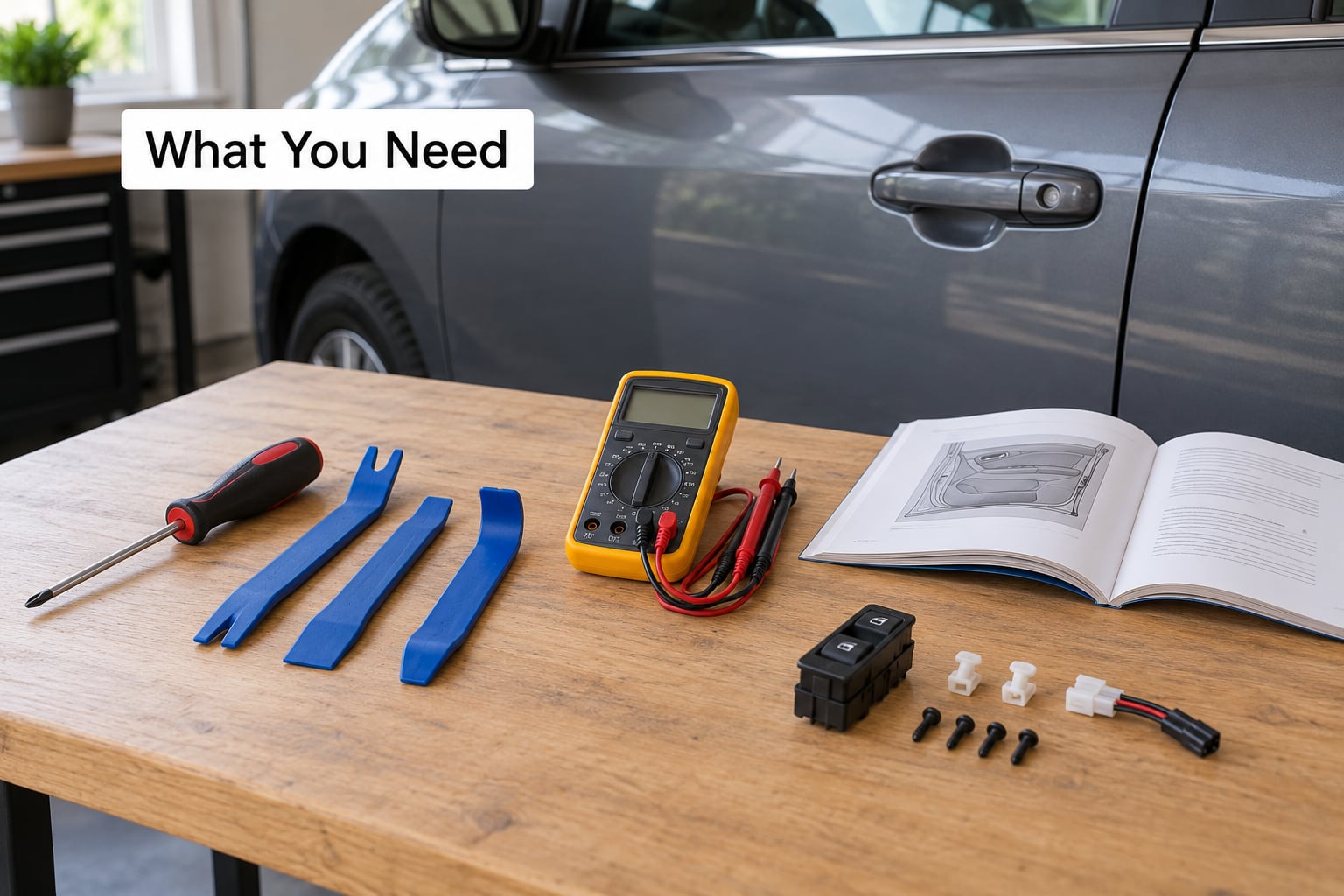
None of the diagnostic steps need more than hand tools, but the trim tools matter more than most people expect. A metal screwdriver will gouge the door card on the first pry.
- Plastic trim pry tool or a plastic wedge set for popping the door card and the handle bezel off without scratching.
- Torx and Phillips bit set. Interior door bolts are usually Torx, commonly T20 or T25, with a couple of Phillips screws holding the handle and courtesy light.
- Socket set or nut driver for the mirror fasteners, if you need to reach the front upper corner of the door.
- A flashlight or headlamp. Work inside a door at dusk more often than you would like to admit.
- A small bag or magnetic tray for trim clips. They come out fine and go missing forever.
- A multimeter with continuity and resistance ranges if the door has power locks and you plan to test the switch or actuator.
- Penetrating oil or silicone spray and a rag for frozen or corroded mechanisms.
- Your owner’s manual, and vehicle service information if the door carries a wiring diagram or a child lock that is controlled by a switch rather than a manual slider.
Have replacement parts on hand only after you have confirmed which part failed. The most common ones are the interior handle, the plastic or metal linkage rod with its rod clip, the lift cable on newer vehicles, the child lock switch, and the door lock actuator. A latch assembly is the priciest of the group and the least often needed.
Stop and hand the job to a qualified automotive technician if the failure involves the door’s airbag or curtain airbag wiring, if the door frame or the striker on the body is bent or damaged, or if the repair requires programming the Body Control Module. Those are not weekend projects, and the airbag one is genuinely dangerous to guess at.
Step-by-Step: How to Fix a Car Door That Won’t Open From Inside
Before you remove anything, spend five minutes watching and listening. What the handle does and what the door makes while you pull it tells you where to start.
| What you notice | Most likely cause | Start here |
|---|---|---|
| Handle moves normally, door stays shut, no sound | Disconnected rod, lift cable or rod clip | Open the panel, look at the linkage |
| Handle moves, harsh clicking sound, door stays shut | Failed lock actuator, or a rod clipping against the housing | Test the actuator electrically, then pull the panel |
| Handle does not move at all | Broken handle or broken pivot shaft | Replace the handle assembly |
| Rear door only, exterior handle works | Child safety lock engaged | Flip the child lock off the jamb |
| Handle stiff, works after warming it or spraying it | Frozen or corroded mechanism | Penetrating oil, then regrease the pivot |
| Every door fails, or the fob does nothing | Fuse, wiring short, or a module fault | Check the fuse first, then the harness |
| Only one door, outside handle dead too | Key cylinder, latch, or the door’s own wiring harness | Pull the panel and inspect the latch |
How to Check Child Locks and Door Handles
The child safety lock is a small switch on the door jamb edge, at the latch end of the door, and it only ever affects rear doors. Flip it to the position that lets the inside handle move and try the handle again. This is the single most common cause of a door that opens from the outside but not the inside, and it costs nothing to check.
Newer vehicles replace that slider with a switch or a setting in the instrument cluster. If yours does, the child lock shows up in the vehicle settings on the centre screen or as a telltale, and it clears the same way. Owners on forums frequently describe a rear door that opens perfectly from the outside, still locks, and refuses to open from inside with nothing blocking the handle, and the child lock is where most of those threads end up.
Then test the handle itself. Push and release it a dozen times. A handle that swings freely but never releases the door points downstream at the rod, cable or actuator. A handle that will not move at all, or that moves a fraction of its normal travel and stops, is usually a broken handle, a stripped pivot pin, or a failed handle-to-door link.
Compare it with the outside handle and the lock cylinder. If the key cylinder, the exterior handle, and the power lock button all still work, the entire outside half of the latch is fine and you can rule out the cylinder. That single comparison saves a lot of guessing.
If you are sitting inside right now with a dead inside handle, you have a better option than disassembly. On most cars you can push down on the lever that connects to the outside handle through the gap in the door card, and the latch will release. Mechanics on forums describe exactly this as a workaround for a disconnected internal latch, and it also works on some cars from the cargo area or trunk once you fold the rear seat. Use another exit whenever one is safely available, and never force the door.
How to Inspect the Door Latch and Linkage
Pop the door card off with the plastic pry tool, working from the bottom corner nearest the hinge and clipping each retainer as you go. On most cars a Torx bolt or two near the ends of the door secures the card itself, and the handle bezel is held by a Phillips screw behind it.
Lift the card away from the top first so you do not snag the wiring connector for the window switches, the courtesy light, or the door speaker. Disconnect those plugs at the door, not at the module, and note which connector goes where before you pull anything loose.
Now look at the linkage. You are looking for a plastic rod or a metal rod running from the interior handle to the latch mechanism, a lift cable on newer cars, and a small plastic rod clip that holds the rod to the actuator lever. A rod clip that has jumped off, or a rod that has worked loose in its bushing, is the most common mechanical cause and the cheapest repair there is.
The sound tells you a lot. Weak buzzing that fades away usually means worn gears in the actuator or a rod partly engaged. Rapid clicking with no movement means the actuator is being commanded but cannot throw the latch, often a binding bolt or a bent striker. Silence with a moving handle means the signal is not reaching the actuator at all, so look for a broken rod or a failed switch. A rattle inside the card usually means the child lock switch has come loose from its mounting.
Check the latch itself and the striker on the body while you are in there. The latch should move freely by hand with the rods disconnected, and it should show even paint wear on the striker face. A bolt that has backed out of the striker, or paint rubbed bare on one side, points at alignment rather than at the door. Reconnect the rods, then cycle the handle a few times.
If you need the full handle procedure rather than just diagnosis, our guide to replacing a car door handle walks through the card removal and the bezel in detail. Replace the latch assembly only when the latch will not move freely by hand, the claws are worn or rounded, or the actuator housing is cracked. Swapping in a new actuator while leaving a bent striker in place just moves the problem a month down the road.
How to Test Door Switches and Wiring
If your car has power door locks, the inside handle, the exterior handle, and the lock cylinder all feed into a door switch inside the latch housing, and that switch tells the Body Control Module what the latch is asking for. When the switch or its wiring fails, the handle can move and the latch can be fine, yet the module never sends the unlock command. One owner described a handle that returned to normal and then began making a harsh clicking sound while the door still opened only from outside, which fits a switch or actuator problem more than a broken handle.
Park on level ground, switch off the ignition, and disconnect the negative battery terminal before you work around the door wiring harness. Removing the battery first means you cannot accidentally energize the actuator with the door card off, and it stops the door switch from being held by the module while you probe at it.
With the panel removed, follow the harness from the switch to its connector and back to where it passes through the hinge area. Look for chafed insulation, a connector with green or white corrosion inside it, or wires that are pinched against the body. Water gets into a door through the window gap and the speaker and vapor openings, and it does not always dry out, so a door that has had a wet interior deserves a longer look.
Set the multimeter to continuity for the mechanical checks and follow the vehicle’s electrical guidance for anything powered. A door-open switch should show a change in state as you work the latch by hand, and the actuator should receive power briefly when you command a lock or unlock. Follow the service information for your specific vehicle on the test sequence and pin locations rather than guessing at pin order, because connector layouts are not universal.
If the switch, the connector and the harness all test good and the module still refuses to command the lock, the fault is upstream in the module or its programming. That is a technician job. The same goes for a humming or clicking that follows road speed or comes from under the dash rather than the door, which is a different fault entirely and worth reading about in our piece on humming noise that changes with speed.
Common Mistakes
Almost every DIY job that goes wrong here does so in one of a handful of predictable ways.
Forcing the handle or prying against the latch bar. A handle that will not move is usually a broken pivot, not a tight one, and leverage on it bends the plastic housing. If the mechanism is stuck from cold or corrosion, spray it, wait, and try again rather than loading it.
Prying trim with a flat metal screwdriver. This is how door cards get cracked and clips get sheared off in the door. Use the plastic pry tool, work from the corner nearest the hinge, and pop each retainer deliberately instead of levering the whole edge at once.
Tearing the vapor barrier. The plastic sheet and its butyl tape seal the door from water and road spray. Pull it off slowly along one edge and keep the adhesive face, because the same tape will not reseal properly and you will be chasing wind noise and damp carpet later. Our guide on getting ice out of a door lock without damage covers the cold-weather side of the same seal.
Rerouting the wiring harness through the pinch flange. The harness has to sit in the factory channel below the door so it can move when the door opens and closes. Squeeze it up between the door and the body and the first swing will cut it through.
Replacing the handle when the latch is the actual fault. A handle that moves freely is telling you the problem is downstream. Replacing it costs you money and leaves you with the same broken door.
Ignoring rust and water damage. Green corrosion on the latch or on the connector means the failure will return after the repair unless you clean it, treat it, and reseal the door properly.
Working near door wiring without disconnecting the battery. The actuator can fire the moment the module wakes up. Take the negative terminal off, and read the manual before you touch anything near the airbag harness.
Before you button everything back up, cycle the handle with the card off and confirm the latch releases on the first pull, every time. Then refit the card, close the door, and test from inside, outside, with the fob, and with the interior lock button.
Frequently Asked Questions
Can I get out of a car door that will not open from the inside?
First check whether a rear child safety lock is engaged and try the handle again. If the handle or latch is visibly broken, push down on the lever that connects to the outside handle through the gap in the door card, which releases many latches. Use another exit whenever one is safely available, and never force the door. If the vehicle is parked in traffic or you are on a highway, call roadside assistance instead of working on it.
Why does one car door open from the outside but not the inside?
The interior and exterior handles release different parts of the same latch system, through a rod or cable into the door lock actuator. A failed interior handle, a loose rod clip, a disconnected cable, or a misaligned latch can prevent only the inside release while the key cylinder and outside handle keep working. Check the child lock on a rear door first, then open the panel and look at the linkage.
Does a child lock stop a front door from opening from inside?
Almost never. The manual child lock is a slider on the jamb of rear doors only, and it disables the interior handle while the outside handle still works. Some vehicles add an electronic child lock set in the instrument cluster or centre screen, which can be turned off there. If a front door refuses to open from inside, look instead at the handle, the rod or cable, the latch, or the door switch and its wiring.
Is it safe to remove a car door panel to fix an interior handle?
Usually, as long as the vehicle is parked on level ground, the ignition is off, the negative battery terminal is disconnected, and you use plastic trim tools. Disconnect the switch, speaker, and courtesy light connectors at the door and label them before pulling the card away. Stop and use a technician if airbag or curtain airbag wiring is involved, or if the body-side striker or door frame is damaged.
How much does it cost to fix a car door that won’t open from inside?
It depends entirely on which part failed, and the spread is wide. A child lock switch or a linkage rod clip is among the cheapest car repairs there is, and most of the cost is the part. An interior handle or a door lock actuator sits in the middle, while a latch assembly is a larger job. An independent shop usually charges less than a dealer or locksmith, and the labour line dwarfs the part cost on most vehicles.
Why won’t my car door open from the inside or outside?
When neither side releases the latch, the problem is in the latch mechanism itself, the key cylinder, or the striker alignment rather than in the interior handle. A worn or misaligned latch, a bent or backed-out striker bolt, or a failed latch assembly can jam the door closed completely. Test both handles and the key cylinder first to confirm, then inspect the latch and striker before ordering any parts.
Conclusion
The first action is always the cheapest one. Flip the rear child safety lock off the jamb, then pull the interior handle a dozen times and watch what it does: no movement means the handle, normal movement with a click means the actuator or switch, normal movement in silence means the rod or cable.
Only once that tells you where the fault lives should you pull the trim panel, and then you are looking for a rod clip, a cable, or a corroded connector. Replace the latch when the latch will not move by hand, repair the harness when the wiring is chafed or green, and hand the job to a qualified automotive technician when it involves airbag wiring, a bent striker, or module programming.
Treat a door that will not open from inside as a safety problem rather than a convenience one. Until it is fixed, keep the child lock off that door and use a different exit.