
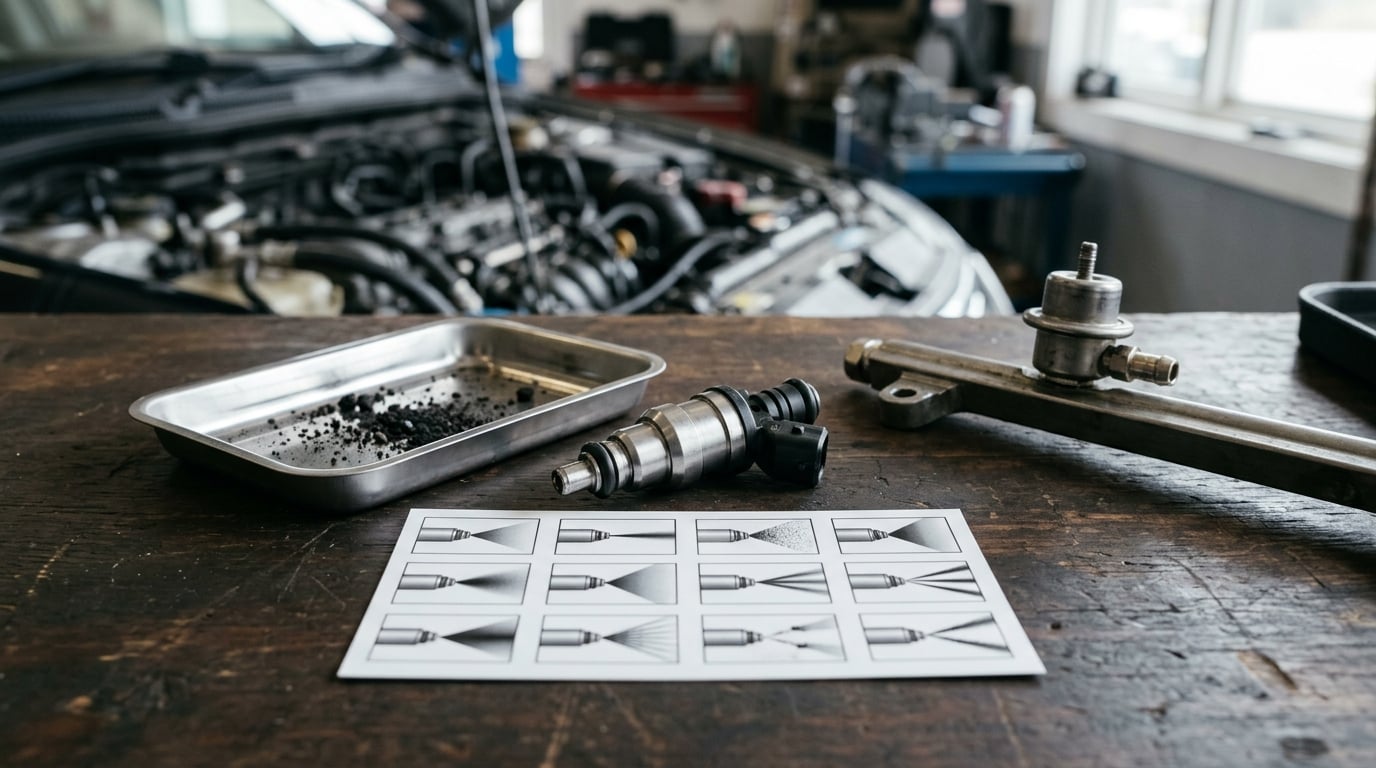
Do fuel injector cleaners actually work? Yes, but only for one narrow problem: carbon and varnish physically blocking an injector tip. If the symptoms on your BMW come from a vacuum leak, fouled plugs, a tired fuel pump, or a dead coil, pouring a bottle in the tank fixes nothing. Updated for October 2026.
That distinction matters because the bottle is cheap, the promise is vague, and the most common cause of rough idle and hesitation on a modern turbocharged six is not a dirty injector at all. Ask a dozen owners and you will get a dozen stories, most of them describing a car that felt fine both before and after.
Table of Contents
- What Do Fuel Injector Cleaners Actually Do?
- What Problems Can Fuel Injector Cleaning Fix?
- How to Tell If Your Injectors Are Actually Dirty
- Do Fuel Injector Cleaners Work on BMW Engines?
- What Fuel Injector Cleaner Is Safe to Use?
- How to Use a Fuel Injector Cleaner Safely
- What Happens If the Cleaner Does Not Fix the Problem?
- Fuel Injector Cleaning vs. Professional Service
- What Owners and Mechanics Actually Say
- Frequently Asked Questions
- Conclusion
What Do Fuel Injector Cleaners Actually Do?
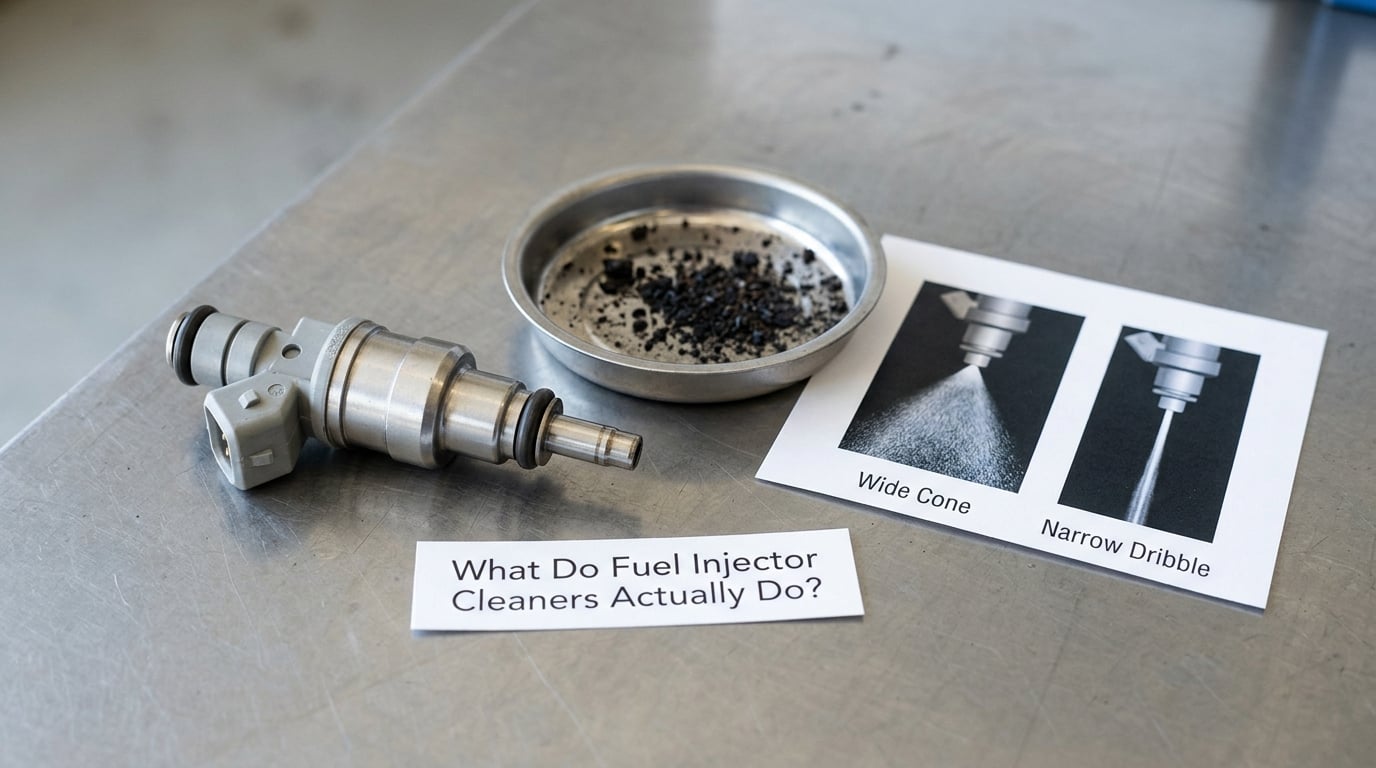
A fuel injector cleaner is a detergent added to your fuel. Its job is chemical, not mechanical: it softens the carbon deposit on the injector tip and carries the loosened material away.
The detergent rides along in the fuel from the tank, through the pump, the filter, the high-pressure line and the rail, then through each injector. Once it reaches the tip, it breaks the bond between the deposit and the metal, and the residue burns off in the combustion chamber.
That is the whole mechanism. There is no scrubbing, no pressure, no disassembly. It is chemistry doing a slow chemical job, and that single fact explains both why it works and why it cannot work.
Modern products are usually built around polyetheramine, often listed as PEA. It is a detergent that holds carbon and varnish in suspension in the fuel instead of letting it settle out. Some formulas use PIBA, a related polymer, as the active detergent instead.
What Problems Can Fuel Injector Cleaning Fix?
Only problems caused by restricted flow. Here is the short list of symptoms a genuinely deposit-restricted injector can produce, and the reason each one appears.
- Mild rough or unsteady idle at a stop. A partially blocked injector delivers an inconsistent volume each cycle, so the idle speed hunts instead of settling.
- Hesitation under light acceleration. Atomization degrades before flow drops much, so the first thing you feel is a stumble in the 2,000 to 3,500 rpm range rather than a power loss.
- Fuel consumption creeping up. A cylinder running slightly rich or slightly lean still burns, but it burns less efficiently, and the difference shows up at the pump.
- Misfire codes that keep coming back. A badly restricted tip can fail to deliver an ignitable mixture under load, and the ECU will log it on that cylinder.
Note what is not in that list. A check engine light by itself, a stumble off the throttle, a rough cold start, or a general loss of power are not injector-deposit symptoms until you have ruled out the simpler causes.
How to Tell If Your Injectors Are Actually Dirty
Carbon buildup on injectors is much less common than the packaging implies. Engines with direct injection and tight emissions control spray fuel into a well-flushed chamber, and most modern gasoline formulations carry enough detergent to keep tips relatively clean.
Where deposits do accumulate is on older port-injection engines, on cars with a history of neglected fuel filters, and on vehicles that spend their lives in short cold trips. Mileage alone is a poor predictor. A diesel that has run 250,000 kilometres of highway with clean fuel can have cleaner tips than a petrol car driven 90,000 kilometres around town.
Before you buy anything, run these checks in this order.
- Scan for stored and pending codes. Look specifically for injector balance or injector circuit codes, not just the generic misfire code. A pending code that clears itself after a drive is worth more than a vague description of how the car feels.
- Watch the lambda readings per bank. If the upstream oxygen sensors on one bank sit noticeably richer or leaner than the other, that points at the injectors on that bank, or at something feeding them.
- Check long-term fuel trims. Small positive trims are normal compensation for altitude and temperature. Trims that are large and asymmetric across banks are a real signal.
- Ask for an injector balance test. This is the decisive one. Each injector is bench-tested and compared against the others and against the flow rate spec. A healthy set of injectors on one bank falls within a tight percentage of the other bank.
- Look at the tips. On a port-injection engine a borescope through the throttle body is a quick look at the injector tips and the intake valves behind them. Black, hard deposit is visible. On a direct-injection engine you are looking at the valves, which is a different problem entirely.
If steps one through three come back clean, pour the bottle. If they come back dirty, fix what they point at first. An additive treats a symptom category, not a fault.
Do Fuel Injector Cleaners Work on BMW Engines?
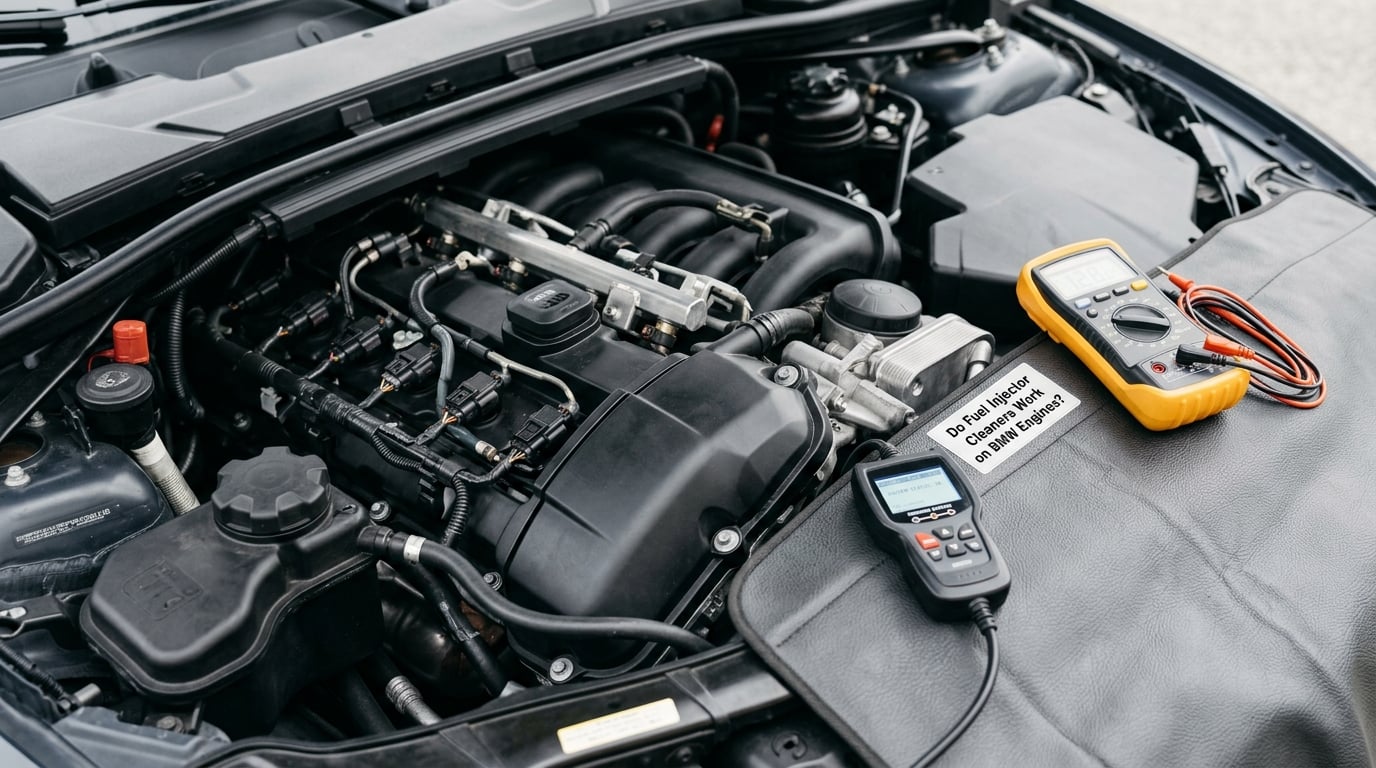
They work on a BMW in the same way they work anywhere else. What changes is how much deposit your engine accumulates in the first place, and that comes down to where the fuel is sprayed.
| Injection type | Typical BMW applications | What a tank additive can reach |
|---|---|---|
| Port injection | Older M-series and six-cylinder petrol engines | Injector tips, fuel rail, lines, pump, tank, and the intake valves behind the injectors |
| Direct injection | N54 and N55 turbo petrol engines, most modern B-series petrol engines | Injector tips and the combustion chamber only. The intake valves sit in the airflow path and never see fuel-borne detergent |
| Common rail diesel | N57 and later diesel engines | Injector tips and chamber. The additive must be a diesel-rated formula, and the emissions equipment around it is a separate consideration |
That middle row is the one that produces the most disappointment. On a direct-injection engine, fuel is sprayed into the combustion chamber, and the intake valves sit upstream in the intake tract where gasoline never reaches. A BimmerFest owner put it plainly: anything poured into the fuel burns in the chamber and never touches the valves.
Do fuel injector cleaners actually work on a GDI engine?
Partially. On a GDI engine the additive reaches the injector tips and the chamber deposits, so it can still help with a misfire caused by a restricted tip. It cannot help with intake valve carbon, which is the deposit BMW owners are most often told they have, and which needs a valve cleaning service instead.
Does premium fuel make the cleaner unnecessary?
Not quite, and not the way people assume. A higher octane rating is a resistance to knock. It says nothing about how much detergent the fuel carries, so premium does not clean an injector tip, and switching to it will not dissolve a deposit that already exists.
What good fuel does do is limit the deposits that form in the first place, because a clean-burning fuel with a decent detergent load leaves less varnish behind as it passes the tip. That is worth something over the long haul. It is not a substitute for a treatment once a tip is already caked, and if the only change you make is a higher octane, you will not feel anything.
On a BMW that requires premium, use premium regardless. Treat the additive as a separate question, not a substitute for the fuel the engine asks for.
On a turbocharged or high-compression engine, treat the label as the limit. Follow the manufacturer’s stated octane, service intervals and additive guidance for that specific model, and do not assume a stronger formula is a better one. Higher detergent load and higher solvent load are not the same thing.
What Fuel Injector Cleaner Is Safe to Use?
Judge the product, not the marketing. Four things matter, and you can check all of them before you open the bottle.
- The named active ingredient. PEA or PIBA should be listed with a concentration, not just described as a powerful detergent. Products that never name the chemistry are telling you something.
- A published safety data sheet. It should list the composition, the flash point and the hazard classifications. A manufacturer that publishes one is telling you what is in the bottle and what it does to rubber, plastic and sensors.
- Seal and material compatibility. Your fuel system uses nitrile rubber O-rings and seals, plus plastic rails and connectors. A product that leaves residue, or that is heavy on aggressive solvents, is the one to avoid.
- Clean burn. Whatever does not dissolve has to burn cleanly through your catalytic converter and oxygen sensors. Products sold as octane boosters and injector cleaners together are often doing less on the injector side than a dedicated formula.
Commonly stocked options include Chevron Techron, Sea Foam, BG44, Red Line SI-1, Lucas, STP, Valvoline and Royal Purple. They are not interchangeable, and the labels differ in what they claim to do. Read the one in your hand.
Walk away when the bottle has no listed active chemistry, no safety data sheet, or a flash point and hazard statement that reads like a solvent. That is the cheap store-brand end of the shelf, and the forum consensus on it is consistent: enough owners have seen rubber and sensors suffer to treat it as a gamble.
How to Use a Fuel Injector Cleaner Safely
- Read the owner’s manual first. Check the fuel specification, the required octane and any additive guidance for your engine. If the manual defers to a specific product, follow that.
- Time it with a fuel stop on a nearly empty tank. Concentration is the whole trick. The same dose in a full tank is diluted to a level that does nothing; in a low tank it reaches the concentration the product was tested at. Do not add it to a completely dry tank on a diesel with a heated intake.
- Use the labelled dose, and only that. A first treatment is usually one full bottle or the amount the label specifies for your tank size. Ongoing maintenance doses are smaller and are meant for a nearly full tank, which is the opposite of the first treatment.
- Fill up with the octane your engine requires. The additive is not a substitute for fuel quality. Premium fuel does not clean an injector, and the additive does not protect you from knock.
- Drive the full tank out over 20 to 30 minutes of mixed driving. Gentle idle will not move the detergent where it needs to go. Steady road miles at moderate load are what you want, and long highway stretches are ideal.
- Fill up again and keep driving before judging it. One tank is rarely enough to see a change in a caked tip. Give it two full tanks, then reassess.
For interval afterwards, match it to how you drive. Short-trip city and stop-and-go drivers create deposits faster and should treat roughly every 3,000 miles. Highway drivers can stretch that toward 5,000. Treating every tank is unnecessary on a modern engine and is the fastest way to overdose.
What Happens If the Cleaner Does Not Fix the Problem?
Nothing surprising. You treated a deposit problem you did not have. These are the faults that produce the same symptoms and are far more common on a BMW of any age.
- Dirty mass airflow sensor. A contaminated MAF reads low, the engine runs lean, and it feels like hesitation and lost power under load.
- Spark plugs or ignition coils. A coil packing on a 100,000-mile six is a routine item, and it produces hesitation and misfires that feel exactly like a bad injector.
- Vacuum leak. A cracked intake manifold or a tired brake booster hose gives you a rough idle, an unstable idle, and a lean code that no amount of detergent will touch.
- Low fuel pressure. A tired high-pressure pump on a direct-injection engine starves the rail, and that reads as misfire and hesitation under load.
- Clogged filter or failing fuel pump. The tank filter and the high-pressure filter are cheaper to replace than any treatment, and a restricted supply mimics deposit restriction.
- Wiring and connectors. Corroded injector connectors and chafged harness runs cause cylinder-specific misfires that look identical from the driver’s seat.
- Mechanically failed injectors. A pintle stuck open, a coil open, or an internal leak cannot be dissolved. These need bench testing and replacement.
That is the argument for the pre-treatment checks. The cleaner is cheap insurance against one specific fault, and it is a bad substitute for diagnosis.
Fuel Injector Cleaning vs. Professional Service
| Option | What it fixes | What it costs you | When it makes sense |
|---|---|---|---|
| Tank additive | Carbon and varnish on injector tips, light tank and line varnish | A bottle and a tank of fuel, done in your driveway | You have symptom evidence, or a preventive habit and a high-risk driving pattern |
| Professional ultrasonic cleaning | Hard deposit on tips, including deposits too thick for chemistry to move | The rail comes off, the injectors come out, the car stays in the shop | The balance test shows real flow deviation, or symptoms came back after a full treatment |
| GDI intake valve cleaning | Carbon on direct-injection intake valves | Intake tract work, sometimes with the head off, sometimes not | You have a direct-injection engine and valve carbon, which no tank additive reaches |
| Injector replacement | Electrical failure, stuck pintles, internal leakage | Parts and labour on every cylinder that fails | The balance test shows a dead or badly leaking unit, or you want new units on a high-mileage car |
| Software, wiring, or fuel system repair | Faults that mimic dirty injectors | Diagnostic time, and a real answer | Codes point there, or nothing you have tried has moved the trims or the balance numbers |
The decision is about evidence, not optimism. A bottle is the right first move when the codes and the balance test point at deposits. It is wasted money when the fault is electrical, and it is a distraction when a GDI engine’s valves are the real problem.
One more thing worth knowing: a dealer recommending injector cleaning on a low-mileage car is describing a sales item, not a diagnosis. Ask what test result prompted it.
What Owners and Mechanics Actually Say
The forum split on this question is real, and both camps are partly right. Worth reading in full before you spend anything, because the sceptics are usually talking about modern engines with no symptoms and the believers are usually talking about older ones with a genuine problem.
On r/MechanicAdvice, the recurring line is that these are cleaning products, and cleaning products cannot clean an injector that is not dirty or repair a defective part. A long-running thread on the same sub goes further and calls them a way for companies to get an extra buck, with the caveat that most of the time they are not needed.
A ScannerDanner forum poster reports the opposite experience, describing BG fuel injection cleaner working alongside another additive to solve a misfire problem. ToyotaNation threads split the same way, with one member noting that at best additives do little and at worst they can cause harm.
The BimmerFest thread is the one most relevant to this article, and it is specific to direct injection. It is why the GDI caveat above is not a footnote.
Read together, the pattern is consistent: a bottle helps when a car has symptoms that trace back to deposits, and does nothing when it does not. That is not a scandal. It is a product doing one narrow job.
Frequently Asked Questions
Is there a fuel injection cleaner that actually works?
Yes, and the one that works is the one built on a named detergent, usually polyetheramine (PEA). It dissolves carbon and varnish off injector tips and is carried through the whole fuel system by the fuel itself. It works on deposits. It does not repair a failed injector, a dead coil, or a vacuum leak, and it cannot reach intake valves on a direct-injection engine.
What are the signs of dirty fuel injectors?
Look for mild unsteady idle, hesitation at low-to-mid throttle rather than at full load, gradual loss of fuel economy, and recurring misfire codes on the same cylinder. Confirm them with stored codes, per-bank oxygen sensor readings and an injector balance test. If the trims and the balance numbers are clean, the symptoms almost certainly come from somewhere else.
Is adding fuel injector cleaner worth it?
Worth it when you have evidence of deposit restriction, or as prevention if you drive short cold trips and stop-and-go traffic on an older engine. Not worth it as a routine habit on a modern direct-injection engine with clean diagnostics. In that case it is maintenance for a problem you do not have, and nothing will visibly change.
Does fuel injector cleaner work right away?
No. The detergent has to reach the injector tips, soften the deposit, and let the loosened carbon burn off through two full tanks of driving. Judge it after the second tank, not the first. If you expect an immediate difference in idle or throttle response, you will be disappointed even when the product is working correctly.
Can fuel injector cleaner damage an engine?
Used at the labelled dose in a modern engine, no. Overdosing or repeatedly using a harsh solvent-only formula is where risk appears, since those can swell nitrile rubber seals, raise combustion chamber temperature, and leave residue that passes through your catalytic converter and oxygen sensors. Check the safety data sheet and stay with a published PEA content.
How often is it safe to use fuel injector cleaner?
For short-trip and stop-and-go drivers, roughly every 3,000 miles. For mostly highway driving, about every 5,000 is reasonable. Treat a nearly empty tank for a corrective dose and use a smaller maintenance dose in a nearly full tank. More often than that is unnecessary on a modern engine and raises the odds of an overdose.
Conclusion
The verdict, stated once more plainly: fuel injector cleaners work, and only for deposit-restricted injectors on an engine that accumulates deposits. It matches the r/MechanicAdvice consensus exactly: they cannot clean injectors that are not dirty, and they do not repair defective parts.
Here is the order I would do it in. Read the codes and the per-bank oxygen sensor data first. If the numbers are clean, spend the money on an injector balance test before you spend anything on chemistry. If the balance test shows a real deviation, treat a nearly empty tank with a PEA-based product, drive the tank out, and reassess after two tanks.
And if you own a direct-injection BMW and the goal was intake valve carbon, save yourself the trip. No additive you can pour in the tank will ever get there.