
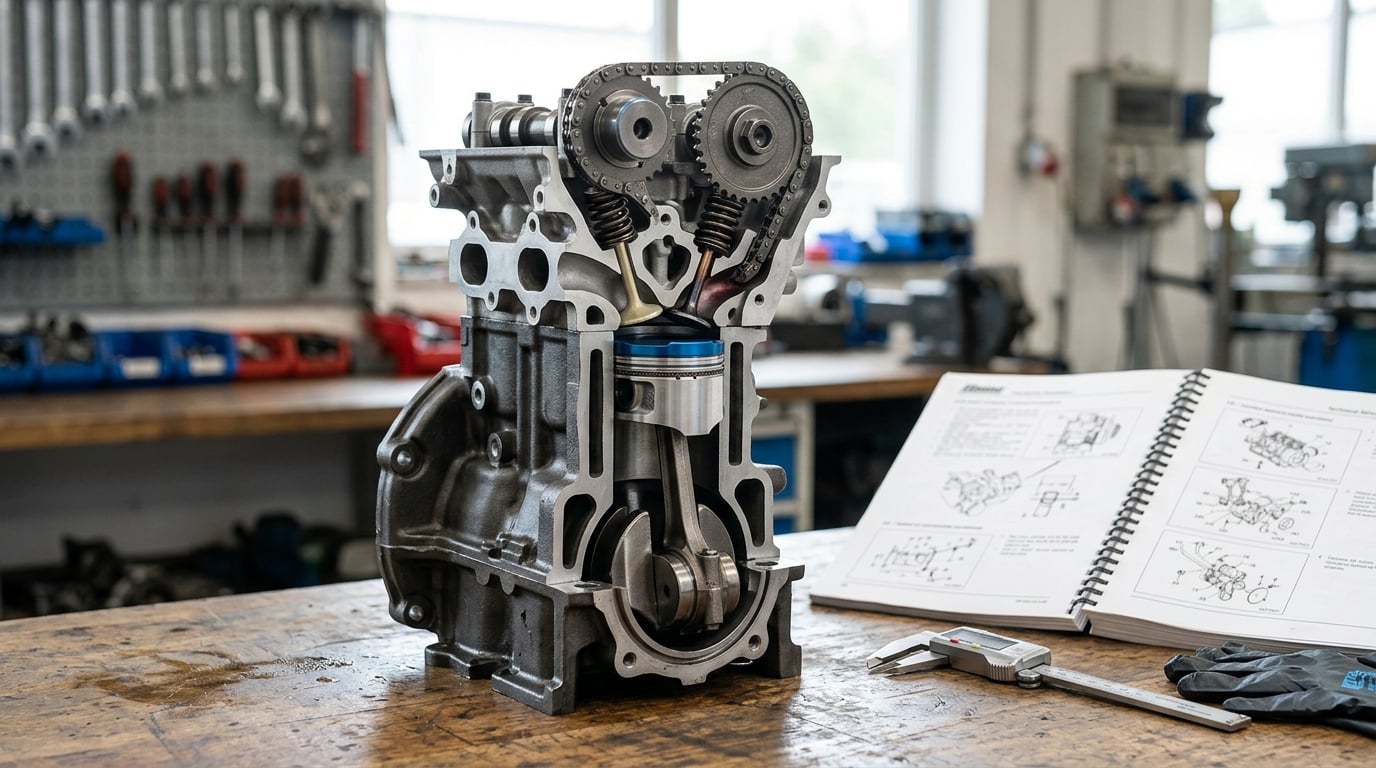
An interference engine is a four-stroke engine built so the open valves hang down into the space the piston travels through, which means the piston and valves can strike each other the moment engine timing slips. That single design choice turns a cheap belt swap into a head rebuild.
If you are shopping a used car with a gap in its service history, or you just heard a rattle from the timing area and are trying to work out how worried to be, this is the thing to understand first. Everything else — the noise, the codes, the repair bill — follows from it.
We have pulled this together from service specifications, parts-catalog data, and the questions owners actually post on r/MechanicAdvice, r/AskAMechanic, r/subaru and Cartalk. The aim is plain: figure out what design you own, what the warning signs mean, and when a repair is worth doing.
Table of Contents
- What Is an Interference Engine?
- How Does an Interference Engine Work?
- What Happens When the Timing Chain or Belt Fails?
- How Can You Tell If an Engine Is an Interference Engine?
- What Symptoms Do Timing Problems Cause?
- Can You Fix an Interference Engine?
- How Much Does It Cost to Repair an Interference Engine?
- How Do You Prevent Timing Problems on a BMW?
- Frequently Asked Questions
- Are all car engines interference engines?
- Why would an engine be designed with interference?
- Is a timing chain replacement always enough on an interference engine?
- How do I know whether a used BMW has an interference engine?
- Can an interference engine be repaired without replacing the entire engine?
- What should I do if I hear a rattling noise from the timing area?
- The Simple Answer to Take Away
What Is an Interference Engine?
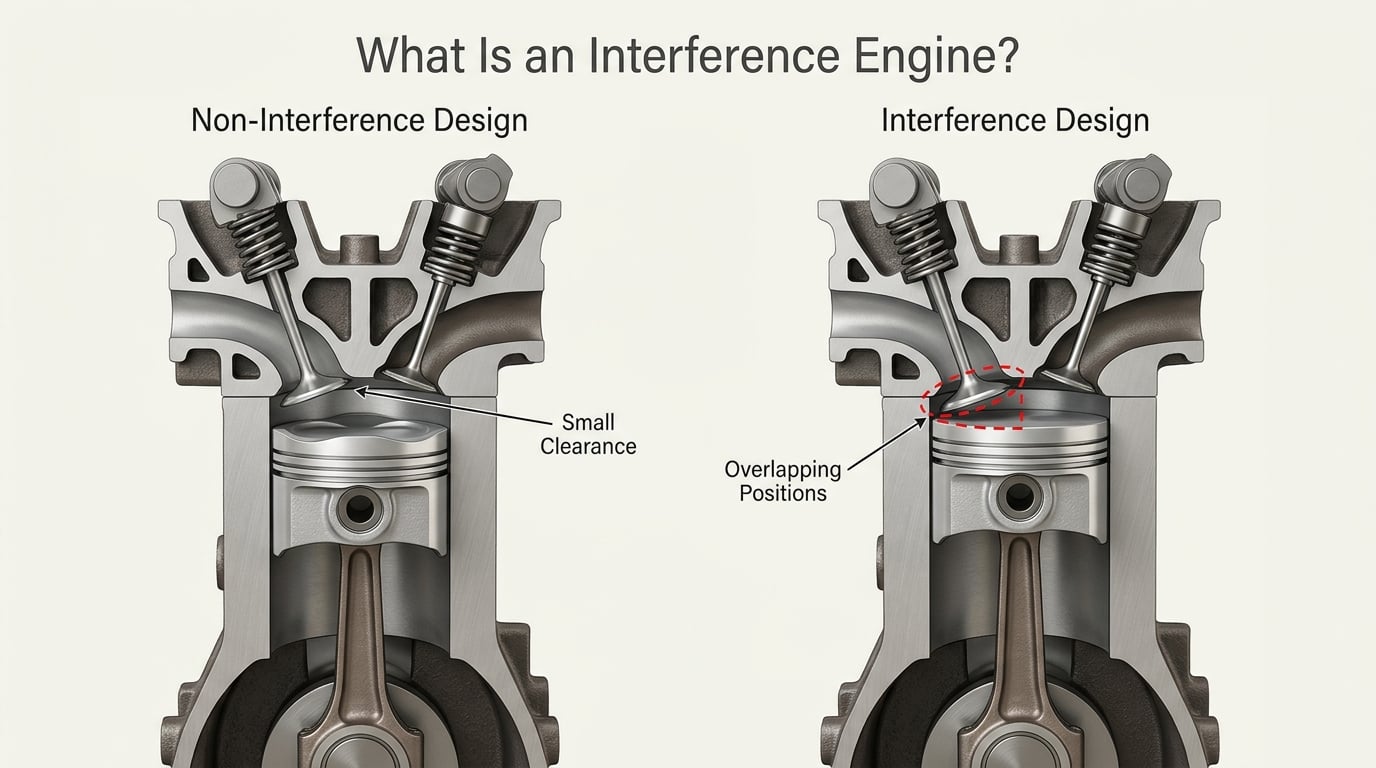
An interference engine is a piston engine in which one or more valves, when fully open, extend into the area the piston sweeps through. Timing is what keeps them apart. Lose the timing and metal meets metal.
Picture a cylinder at top dead center, the very top of the piston’s travel. In a non-interference engine the flat top of the piston is dished, and the open valve hangs down into that dish with real clearance underneath it. Same engine, same top dead center, but the piston is domed or the combustion chamber is small enough that the open valve is physically in the piston’s path.
That overlap is deliberate. It buys a tighter combustion chamber, a higher compression ratio, and better efficiency, which is why almost every modern four-cylinder, turbo four, and many V6 and V8 engines are built this way.
One thing worth separating right away: interference is a design characteristic, not a fault. The engine is not broken when it is built this way. It is only a problem when the timing drive stops doing its job.
How Does an Interference Engine Work?
Three things happen in order, and each one depends on the one before it.
- They share space. The valves open into the volume the piston occupies, so nothing physical stops a collision.
- They are synchronized. The crankshaft turns a timing belt, timing chain, or gear set, which turns the camshaft at exactly half crankshaft speed for a four-stroke cycle.
- Timing is the only separation. The lobe profile is shaped so each valve closes shortly before its piston arrives at top dead center, and reopens after the piston has moved away.
Because the valves open late and close early, you get a deliberate overlap around top dead center. That overlap is what scavenging and volumetric efficiency come from, and it is the same feature that makes the valves vulnerable once the chain or belt is loose.
The margin at the top of that overlap is small enough that chain stretch, a failing hydraulic tensioner, or a belt that slips a tooth can put a valve and a piston in the same place at the same time. On a non-interference engine, a timing failure just kills the engine. On an interference engine, the crank keeps turning because of momentum and finishes the job.
And yes, they still make them. Higher compression ratios, tighter emissions packaging, and variable valve timing through cam phasers all push more engines toward interference designs, not fewer.
What Happens When the Timing Chain or Belt Fails?
When timing fails, the crankshaft and camshaft stop being in phase. Valves open when nothing expects them to, or stay closed while the piston arrives.
What an interference engine failure does to the cylinder head
The contact is usually the intake or exhaust valve face striking the piston crown. Because the piston is aluminium and moving fast, the valve is what bends, and the head is where you feel the money.
The damage usually shows up in stages:
- Valves bent, springs broken or retainers damaged.
- A cracked cylinder head, often on the combustion chamber face or around a valve seat.
- Impact marks or a gouged piston crown you can see once the head comes off.
- Coolant in the oil or oil in the coolant, and in bad cases a hole through the piston.
There are lucky outcomes. Forum owners on r/AskAMechanic describe engines that died with bent valves, and r/MechanicAdvice has the opposite story, an engine that stopped dead with nothing damaged at all, usually because the chain jumped just enough to kill it without a collision.
Not every symptom means a failure happened. A belt that slips a tooth under load can throw the cam off and leave a no-start with damage, and a worn tensioner can make noise for thousands of miles without a single bend. Test before you condemn.
How Can You Tell If an Engine Is an Interference Engine?
You need the design, not a guess. Four paths work, in rough order of how fast they give you an answer.
- Check the service information for your exact year, make, model, and engine code. Workshop manuals and manufacturer documentation list the valve arrangement and the timing drive type. This is the most reliable answer and takes a few minutes.
- Call a parts counter with the engine code. Ask whether the replacement head for that engine is a bare casting or a complete head, and whether the piston has a valve relief or a domed crown. Parts catalogs are built from the manufacturer’s own drawings, so a counter has the answer even when a generic search does not.
- Use a parts-catalog cross-reference. Listing diagrams for the cylinder head show whether valves are splayed and how far they reach into the chamber, which is a direct read on interference.
- Look at the piston and valve geometry directly. A domed or crowned piston with a small chamber, or long splayed valves, points one way. A heavily dished piston with stubby valves points the other.
What does not work: taking the valve cover off and looking. You will see pushrods, rockers, or a cam, and you will learn nothing about piston clearance. The overlap exists down in the chamber, and the only way to see it is with the head off or with a borescope through the spark plug hole.
What Symptoms Do Timing Problems Cause?
Sort what you are hearing by severity, because the noise from a chain-driven engine can sound identical to the noise from a healthy one for a long time.
- Rattling or ticking that lasts a few seconds on a cold start and then quiets down. Frequently posted as “is this normal.” On a chain-driven interference engine it is worth taking seriously, because it usually means the chain is riding against the tensioner or guides.
- Rattling that does not go away. The tensioner is not holding, and chain stretch is now in the conversation.
- Sudden power loss while driving, or a shudder followed by no power. This is what a chain that jumped or a belt that snapped sounds like at speed.
- Rough running, misfires, and big power loss. A bent valve will not seal, so the cylinder burns badly or not at all.
- Check engine light and codes such as P0016 or P0019, which point at crank-to-cam correlation or cam position.
- Coolant loss with no visible leak, or oil in the coolant. A cracked head from the collision.
- Metal-on-metal clatter followed by silence. A rod or head failure in progress. Stop driving.
One warning that belongs here because it causes real damage: do not crank or start an engine that has suffered a suspected timing failure to “see what happens.” A dry or half-dry start after a collision can turn a bent-valve repair into a thrown rod. Check compression and do a leak-down test first.
Can You Fix an Interference Engine?
Often yes. The answer depends entirely on what the failure actually did, and that is a question for measurements, not guesses.
- Timing drive only. If the belt or chain jumped with no contact, replacing the kit, tensioner, guides, and seals restores the engine fully. This is the good scenario.
- Bent valves, head intact. A cylinder head rebuild with new valves, springs, seals, guides, and a machined surface. Often the sensible repair on a four-cylinder, and frequently quoted in the four figures once labour and machine work are counted.
- Cracked head or damaged piston. A replacement head plus a careful check of the block, the crank, and the oil system before it goes back in. Here the labour dominates the quote.
- Both head and bottom end. An engine assembly swap, or a full rebuild. On a car worth what most used cars are worth, this is where people start talking about parting the car out.
Before you buy any parts, confirm the diagnosis properly: a compression test per cylinder, a leak-down test to see which cylinder is leaking to where, a valve gap check with the head off, and a look at the oil system for metal. Get the manufacturer’s clearance figures rather than a generic spec sheet, because lift and lash vary by engine and by year.
How Much Does It Cost to Repair an Interference Engine?
A timing belt job on a belt-driven interference engine is genuinely affordable: the belt kit, tensioner, water pump, and a few hours of labour. That affordability is exactly why the interval matters so much, and exactly why skipping it is tempting. By the time a chain-driven engine is making noise at every start, you are usually past the easy fix and into tensioner, guide, and sprocket territory.
The bill jumps at the moment you know valves are bent, because a head off a bench, measured, machined, and reassembled with new components is serious machine work. Add a cracked head or a damaged piston and you are into replacement-head pricing, which is where four-figure quotes come from. The final number depends on your region, the shop, and how much labour the specific engine’s packaging allows.
| Situation | What is involved | Where it lands |
|---|---|---|
| Timing drive replaced before any contact | Belt or chain kit, tensioner, guides, seals, fresh oil, several hours of labour | Most affordable outcome, the one worth planning for |
| Bent valves, head serviceable | Head removed, valves, springs and guides replaced, surface machined, leak tested | Four-figure territory on most cars |
| Cracked head or gouged piston | Replacement head or engine assembly, plus block, crank and oil system checks | Often beyond what the car is worth |
| Airbag control modules and coolant damage | Secondary systems checked after a hot under-hood collision | Can add a second layer on top of the engine work |
These are typical shapes of repair, not a quote. Prices vary by region and change over time, and two shops in the same city can be a full engine apart.
Then there is the insurance question nobody wants to ask. Once a bent-valve or head repair reaches a share of the vehicle’s value, the insurer treats it as a total loss rather than a repair, and the car is gone. Get a written estimate before you start, and ask about the total-loss threshold on the spot, because that number decides the outcome faster than the repair quote does.
How Do You Prevent Timing Problems on a BMW?
Prevention here is boring and specific, and it comes straight from the owner’s manual and the service schedule rather than any universal interval.
- Follow the oil-change interval in your manual. Engine oil is what lubricates the chain and drives the hydraulic tensioner. Shortened trips and hard cold starts are harder on the same oil, so many manuals allow a shorter interval under those conditions.
- Treat a rattle that lingers past a few seconds of warm-up as a service item, not background noise. On r/subaru and Cartalk this is the single most repeated question, and the answer is consistently the same: get the tensioner and guides checked before they take a chain with them.
- Replace the timing chain kit on the schedule the manual gives for your engine code. Never a universal interval copied from another model. Manufacturer figures for belt services commonly fall in a 60,000 to 104,000 mile range, and chains are usually framed differently.
- Replace the belt, tensioner, and water pump together when the interval comes due. A new belt on a tired tensioner is a job you will pay for twice.
- Watch the coolant level and the oil condition between services. A slow drop in coolant with no visible leak is a head crack until proven otherwise.
- Respond to check engine lights and cam-position codes early, and do not clear a P0016 or P0019 without finding the cause.
Frequently Asked Questions
Are all car engines interference engines?
No. Most modern four-cylinder, turbo, and many V6 and V8 engines are interference designs, but plenty of older and some current engines are not. Common non-interference examples include several Honda and Toyota four-cylinder families, the older Pushrod small-block Chevrolet, and many Mazda engines. Engine design varies even within one model range, so confirm the engine code rather than the badge.
Why would an engine be designed with interference?
Because overlap between the intake and exhaust valves around top dead center improves how much fresh air gets drawn in and how thoroughly exhaust gas is swept out. That lets a manufacturer run a tighter, higher compression chamber for more efficiency and power in less packaging space. The same overlap leaves no physical margin, which is why a timing failure on these engines turns a simple belt job into a head rebuild.
Is a timing chain replacement always enough on an interference engine?
It is enough when the chain jumped or stretched and nothing touched. Then replacing the chain, tensioner, guides, sprockets, and seals restores the engine, though a chain that has stretched is already at the end of its life. If the pistons struck valves, the chain kit is the smallest line on a much larger invoice, and the head work is what decides whether the repair is worth doing.
How do I know whether a used BMW has an interference engine?
Identify the exact engine code first, because several engines appear across BMW model lines with different designs. Then check the service information for that code, or call a parts counter and ask what the replacement cylinder head and piston look like. Give the shop the VIN, expect a written answer, and treat a seller who cannot produce service records as a risk factor worth pricing into your offer.
Can an interference engine be repaired without replacing the entire engine?
In many cases yes. If the head is not cracked, a bench service with new valves, springs, guides, and seals fixes it, and an engine assembly is rarely the first option. The repair stops being practical when the head is cracked, the piston is damaged, or the cost crosses the point where your insurer would total the car rather than repair it. Measurements decide this, not the sound the engine makes.
What should I do if I hear a rattling noise from the timing area?
Note when it happens. A rattle that fades after a few seconds on a cold start and is silent warm usually points to a tensioner or guide, not an imminent failure. A rattle that persists needs a shop to check chain tension and wear before long trips. Either way, do not ignore it to the point of a road trip, and do not attempt to start an engine that has already suffered a suspected timing failure.
The Simple Answer to Take Away
An interference engine is normal engineering, not a defect. The risk comes entirely from timing, so the buying and owning decisions are about timing and nothing else.
Find out the design first, from the engine code and the service information. Then treat any timing symptom as something to investigate before you assume a repair is needed, and never start an engine that has already taken a suspected timing hit. Before you commit to a car with a service gap, get a mechanical inspection and a written estimate, and ask where the total-loss line sits. That conversation costs almost nothing and has saved people a lot of grief in 2026.