
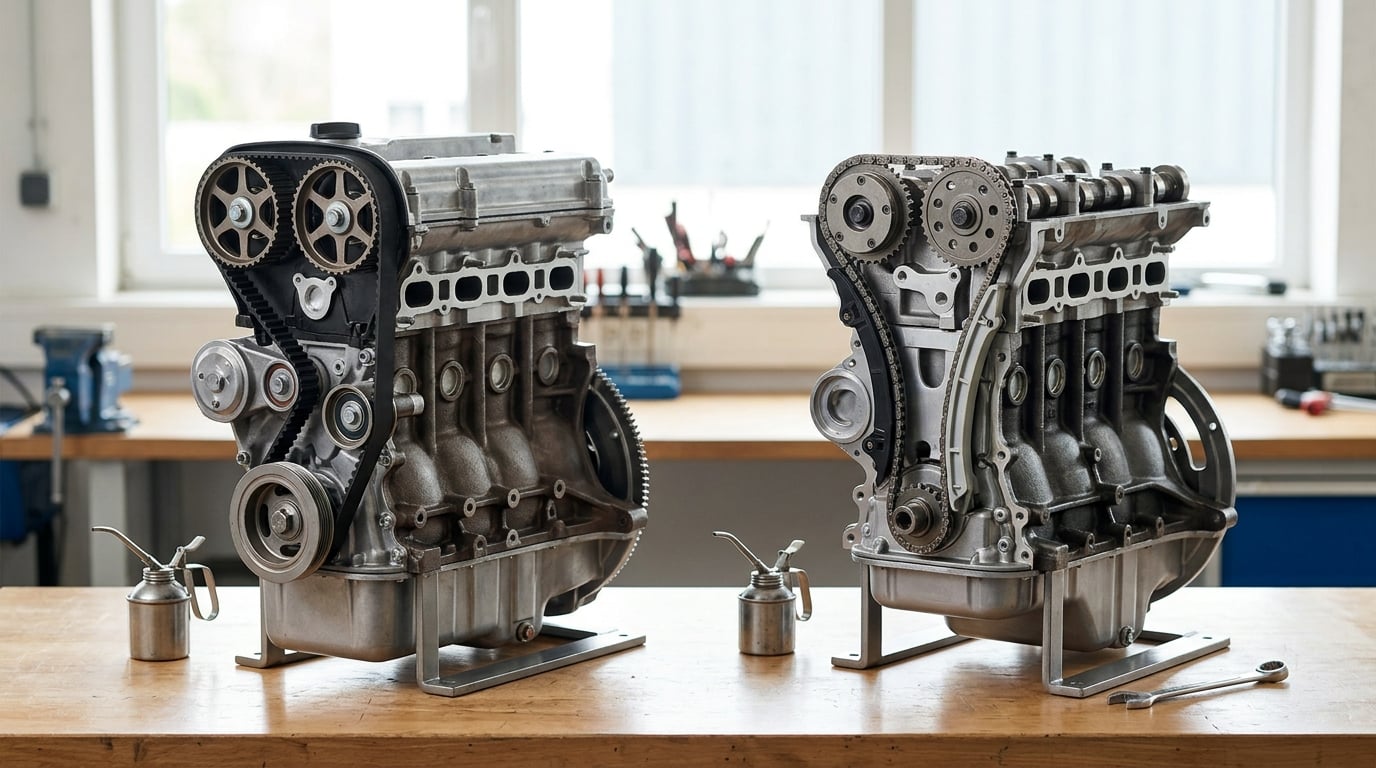
If you have owned a car with a timing belt, you have probably tracked the replacement interval in your head the whole time you owned it. With a timing chain, most owners never think about it at all, and that is usually the right instinct. The short version of the timing belt vs timing chain question: a chain is quieter to maintain, runs inside the engine where oil keeps it lubricated, and is normally built to last the life of the engine, while a belt is lighter, cheaper to replace, and completely dependent on a schedule you actually follow.
Neither one is maintenance-free, and plenty of chains have ended engines early. The details that decide the outcome are the engine design, the oil change history, the tensioner and guides, and whether the car is an interference engine. This guide walks through the timing belt vs timing chain differences that actually matter, then shows you how to identify which one your car has before you buy any parts.
Table of Contents
- Timing Belt vs Timing Chain at a Glance
- What Is the Difference Between a Timing Belt and a Timing Chain?
- How Do Timing Belts and Timing Chains Work?
- Timing Belt vs Timing Chain: How Lifespan and Wear Compare
- Which One Is Quieter: a Timing Belt or a Timing Chain?
- Which One Needs Less Maintenance?
- What Happens if a Timing Belt or Chain Breaks?
- How Do Cost, Weight, and Repair Difficulty Compare?
- Do All BMWs Use a Timing Chain?
- Which Should You Choose?
- How to Tell Whether Your Car Uses a Belt or a Chain
- Frequently Asked Questions
- Can a timing chain last longer than a timing belt?
- Does a noisy timing chain mean it needs replacement?
- Is a timing chain always better than a timing belt?
- What happens if a timing belt breaks on an interference engine?
- Can I replace a timing belt or chain myself?
- How often should a timing chain be replaced?
- Conclusion
Timing Belt vs Timing Chain at a Glance
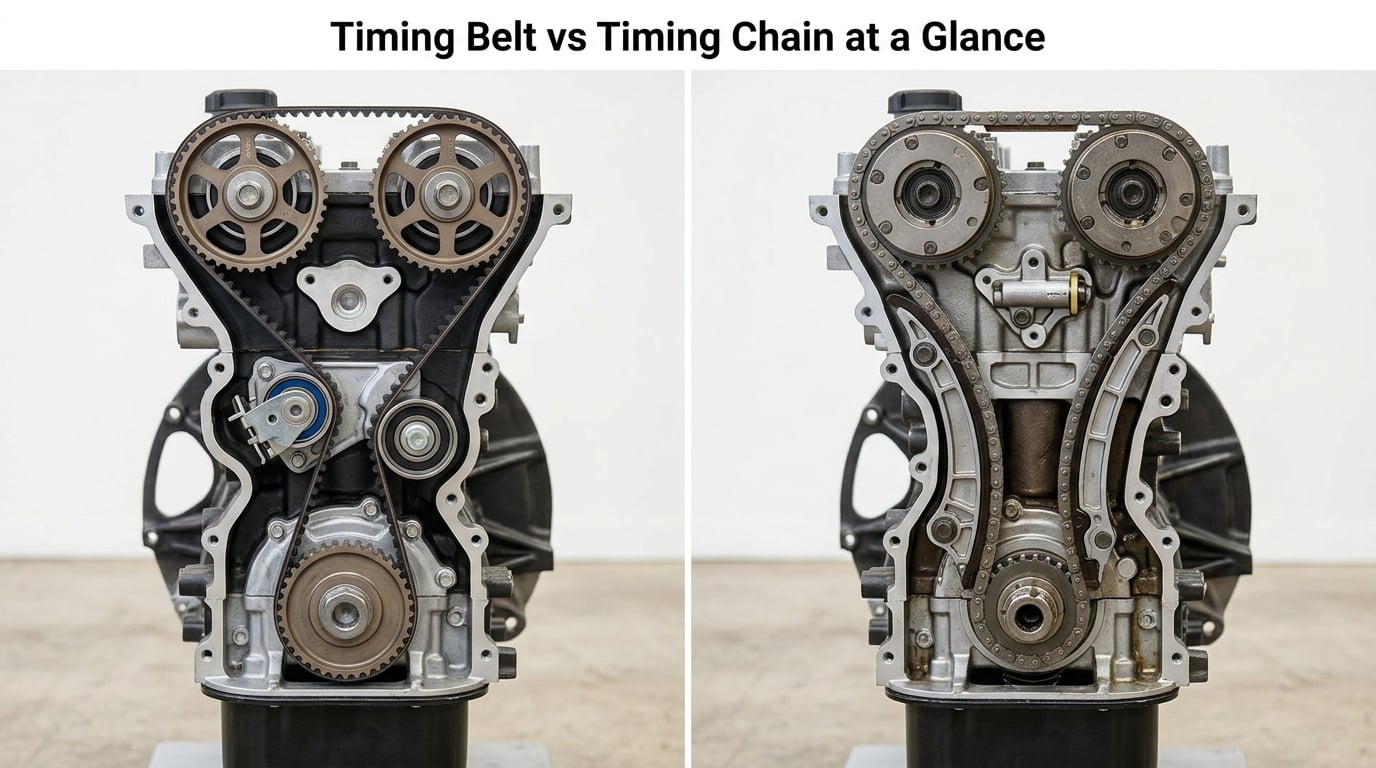
The table below covers the ten differences that come up most often, from where the component lives to what happens when it lets go. Everything here is a general rule, not a specification for your engine.
| Factor | Timing belt | Timing chain |
|---|---|---|
| Material | Toothed rubber or neoprene belt with fiberglass or aramid cord reinforcement | Metal roller chain with hardened links and sprockets |
| Where it runs | Usually outside the engine or under a cover, running dry | Inside the engine case, submerged in engine oil |
| Typical service life | Roughly 60,000 to 100,000 miles on most passenger cars, sometimes rated further | Often designed to last the life of the engine, with real exceptions |
| Replacement schedule | Fixed mileage or time interval, set by the manufacturer | No fixed interval on most engines; inspect and listen instead |
| Noise | Quiet, often inaudible when healthy | Can be quiet; a brief rattle on cold start is common and often normal |
| Lubrication | Runs dry, no oil required | Depends on clean engine oil, so oil change intervals matter more |
| Typical warning signs | Fraying, cracking, a glazed surface, ticking on start-up, a squeal, or frayed strands hanging below the cover | Rattle that does not quiet, visible chain stretch, oily residue around the cover, misfire or a check engine light |
| Weight | Noticeably lighter, which matters little on a road car | Heavier, with more parts to wear out |
| Job difficulty | Often moderate, but many engines bury the front of the engine under covers and require a holding tool | Harder, since the chain case, tensioner and guides usually need to come apart |
| If it fails | Belts are designed to break rather than shred, but on an interference engine the valves still get hit | A stretched chain can jump teeth, and a failure can wreck the chain case, tensioner and guides at the same time |
One column in that table matters more than all the others combined. A belt that snaps on a non-interference engine means an unhappy drive to the shop. The same belt on an interference engine means bent or shattered valves, and usually a full engine rebuild.
What Is the Difference Between a Timing Belt and a Timing Chain?
Both are ways of keeping the crankshaft and the camshaft turning in step with each other. A timing belt is a toothed rubber strap that grips matching toothed sprockets. A timing chain is a metal roller chain that works on the same principle as a bicycle chain, running between the same sprockets.
The job is identical for both: valves have to open and close at the right moment relative to the pistons moving up and down in their bores. What differs is the material, where the component lives, how it is lubricated, how much noise it makes, how heavy it is, how it wears, and how catastrophically it fails when it does.
That last point is worth repeating. People often treat belt and chain as simply quiet versus noisy, or cheap versus expensive. The bigger difference is failure mode. A belt that breaks is a sudden, total loss of timing. A chain often warns you first, by stretching and rattling, which buys time if you pay attention to it.
Why a chain lives inside the engine
Putting the chain in the oil bath is the whole design. The oil is a lubricant, a coolant and a corrosion inhibitor all at once, and the chain is one of the parts that relies on all three. Skip oil changes and you lose the rinse effect that carries metal debris away from the guides, so wear particles build up and the chain starts to grind.
That is also why a chain is not a set-and-forget part. It depends on a fluid you are paying to change, and it depends on guides and tensioner parts that wear before the chain itself does.
How Do Timing Belts and Timing Chains Work?
Rotation starts at the crankshaft, which is where the pistons push. Sprockets are bolted to the front of the crankshaft and to the camshaft or camshafts, and the belt or chain wraps around all of them. In a typical four-stroke engine the camshaft turns at exactly half crankshaft speed, because each combustion cycle takes two crank rotations and the valves act once per cycle.
So the chain or belt is a gear reduction in reverse: it steps the crank speed up to cam speed twice over. A spring-loaded or hydraulic tensioner keeps the slack side tight so the teeth stay seated on the sprockets, and on chain engines, plastic guide rails hold the chain on the correct path so it cannot wander into the block.
Timing accuracy is what makes combustion work. If the valves open a fraction too late, you lose power and emissions get worse. If the cam rotates far enough that a valve is still open when the piston arrives at the top of its stroke, that is contact between two hardened surfaces moving fast enough to destroy both. On nearly every modern engine, those two parts occupy the same space, which is what makes the failure so expensive.
Where variable valve timing fits in
Many engines from the last two decades do not run a fixed cam profile. Variable valve timing systems such as VVT-i, VANOS, VTEC and similar systems let the ECU change the cam angle relative to the crank by using a cam phaser or a sliding cam sprocket. Those systems need a second actuator, and on a chain engine that actuator is often driven by the timing chain or a secondary oil feed, so chain condition affects emissions and fuel economy as well as survival.
Timing Belt vs Timing Chain: How Lifespan and Wear Compare
Belt service life on most passenger cars falls somewhere around 60,000 to 100,000 miles, and plenty of manufacturers publish figures outside that range. Some schedule it by time as well as mileage, because a belt ages even when the car sits. Treat any number you see online, including the ones here, as a general expectation rather than a specification.
Chains are usually designed to outlast the vehicle. Owners across BMW, Honda, Toyota and Subaru forums routinely report chains running well past 200,000 miles with regular oil changes and no drama at all. That is the honest best case, not a guarantee.
The gap exists for a mechanical reason. Belt cords fatigue, the rubber hardens and glazes, and teeth wear from the load of every pull. Chain links roll on needle bearings and ride on a hardened surface, so the wear path is designed to tolerate that load. What wears first on a chain engine is almost never the chain. It is the guides and the tensioner, which are cheap plastic or pressed parts doing a job nobody can see.
Whatever interval you find, the source is your owner manual, matched to the engine code and the VIN. Do not use a forum post, a parts catalog, or the year and model alone to decide. The same badge name has carried different engines across different years, and owners regularly buy the wrong parts because of it.
Which One Is Quieter: a Timing Belt or a Timing Chain?
A healthy timing belt is quieter, and it should be completely silent. A properly lubricated timing chain is also quiet, though it can produce a light mechanical noise at certain speeds. On balance most drivers notice nothing on a healthy chain, which is part of why chain failures surprise people.
The pattern owners ask about most is a rattle on cold start that disappears after a few seconds. On many engines that is normal, because oil pressure takes a moment to reach the chain tensioner on start-up. If the rattle fades and stays gone, that is the tensioner doing its job. Forum threads on this question are full of owners who were braced for the worst and watched the noise vanish within seconds of warming up.
The pattern that deserves attention is a rattle that does not stop. If the clatter continues after the engine is warm, gets louder as you rev, or comes back every single start, treat it as a real fault. A chain stretched just enough to miss a tooth will keep missing that tooth, and the guides will keep chewing on a link until the situation gets much worse.
Before you blame the chain at all, rule out the cheap explanations. Low oil pressure on start-up, worn hydraulic lifters, exhaust leaks near the manifold, and failing water pumps all make noise in the same general area. On belt engines a failing tensioner or idler pulley often squeals, which is a different sound from chain rattle. If the noise appeared suddenly, or comes with a misfire, a check engine light, or metal in the oil, skip the guesswork and get it diagnosed.
Which One Needs Less Maintenance?
The chain needs less scheduled maintenance, and that is not really a contest. There is no interval on most chain engines, and no belt tension to check in a parking lot. The catch is that chain care is reactive and diagnostic rather than scheduled, so a chain engine asks you to pay attention instead.
What a belt job involves:
- Replacing the belt, and usually the tensioner and idler pulleys at the same time
- Replacing the water pump, since it is almost always driven by the same belt and doing that job twice is expensive
- Recording the mileage or date so the next interval is easy to remember
- Checking for a used cover gasket or a leaking seal while the area is open
What a chain engine involves:
- Keeping oil changes on schedule and on the correct specification, since oil is the chain’s only lubrication
- Listening for a rattle that persists past warm-up
- Noticing guide or tensioner symptoms such as a wobble, a ticking hydraulic tensioner, or debris in the oil filter
- Replacing the guides, tensioner and chain together when the job is done, because a new chain on old guides is a false repair
One more difference worth knowing: a belt job on a modern engine frequently needs the intake manifold, coolant, accessory drive or a plastic cover out of the way, and the belt itself is the cheapest part of the job. A chain job needs the whole front of the engine opened up, and the labor is the dominant cost either way. If you want a rough shape rather than a number, read the next section.
What Happens if a Timing Belt or Chain Breaks?
It depends almost entirely on whether the engine is an interference engine. In an interference engine, the pistons and valves share the same space, so losing timing means metal meeting metal. In a non-interference engine, the pistons have clearance around the valves when timing is lost, so the engine usually keeps running badly instead of stopping.
That is the entire difference, and it is why the same failure produces a tow truck on one car and a rough-running engine on the next. Most engines built in the last few decades are interference engines, including nearly every Honda, Toyota and Volkswagen sold in the US since the late 1990s, which is a large part of why belt maintenance gets treated as urgent.
Modern timing belts are also designed to break rather than shred. A quality belt is meant to fail at a tooth, not to throw a rubber mess across the engine bay, and the makers say so in their documentation. The catch is that on an interference engine a clean break still drops the valves straight into the pistons. Belt quality tells you how messy the failure is, not whether it is survivable.
A broken chain is different again. If a chain jumps teeth or parts, it can take the chain case with it, destroy the guides and tensioner, and scatter debris into the oil. A guide that has worn through its plastic and been rubbing metal on metal can shed material into the oil that turns the crank bearings into a second problem. On engines where the guides sit in the oil bath, a chain failure often ends the engine twice over.
How Do Cost, Weight, and Repair Difficulty Compare?
Belt jobs are cheaper in parts and pricier in access. The belt itself is inexpensive, and it is common to replace the belt, tensioner, idler pulleys, water pump and cover gasket as one kit while everything is apart. Labor can still run high on a transverse or turbocharged engine where the front of the engine is buried under brackets, coolant pipes and covers, and some jobs need a holding tool to keep the crank from turning.
Chain jobs are the reverse. The parts kit costs more, since it includes the chain, guides, tensioner, seals and often a front cover gasket or an entire new chain case. The labor runs higher too, because the chain case comes apart, the tensioner has to be reset to spec, and the timing has to be set and verified. On engines that need a full engine-bay disassembly, the teardown and reassembly can dwarf the parts.
On difficulty, both jobs are inside the recommended range for an experienced DIY mechanic with the right tools, and both can ruin an engine if the timing is off by a fraction when the cover goes back on. Common DIY errors include forgetting the torque sealant on the crank sprocket bolt, skipping the new oil and filter after opening a chain case, and losing the factory tension position on a hydraulic tensioner. On a belt car, doing the water pump and the belt in the same visit is a straightforward way to halve the labor later.
One practical note on parts: for a chain job, buy the chain, guides, tensioner and sprockets as a matched kit rather than mixing brands. For a belt job, buy a quality belt and replace the tensioner and pulleys with it. Mixed-brand timing components are the kind of shortcut that looks harmless and ends expensively.
Do All BMWs Use a Timing Chain?
No, and this is exactly the kind of question where a confident general answer causes expensive mistakes. Plenty of older BMW engines, including many of the M-series and older six-cylinder units, ran a timing chain, and owners of those cars are usually told the chain is maintenance-free. But BMW has used belts on some applications too, and the right answer depends on the engine code and the build year of the specific car.
The N20 and the related Mini B-series engines are the ones worth researching carefully if you are shopping used. Owners on BMW and Mini forums report chain guides failing, often at a mileage well short of what the car would otherwise have reached, and the repair can mean removing the entire engine from the bay. On engines where the guides sit in the oil, the same wear can contaminate the oil. Meanwhile, other BMW engines run chains that owners report as boringly reliable. The engine code is the only reliable answer.
Before you buy a belt, a kit, or a service appointment, confirm what is actually bolted to your car. Use the VIN with the manufacturer build record or a dealer parts counter, or have a shop read the engine code. Ask the parts counter to confirm the part against your VIN before the order goes in. That single check takes minutes and prevents the most common sourcing error on these cars.
Which Should You Choose?
Choose by situation, because there is no universal winner. If you are keeping a car long term and your engine came with a chain, that is the better ownership experience: no interval to miss, no belt tearing in a parking lot, and a lower chance of a catastrophic failure from a skipped service. You still owe it regular oil changes and a listening ear, and you still have to know which engine you have.
A belt car is not a bad car to own. If the interval fits how you drive and how you track maintenance, a belt job is routine, well-understood work, and the parts are cheap. What makes a belt car expensive is ignoring the schedule, not having a belt. The owners who get into trouble are the ones who assume a chain is the only failure mode they need to worry about, or who buy a car with a schedule already behind them and never look it up.
When you are shopping used, the smart move is to look up the engine first and the car second. Search the engine code for chain stretch or guide problems, and check whether the timing service records exist. A car with a documented belt service is a safer buy than one where nobody can say when the belt was last changed. For a chain car, the questions are about oil change history and whether any rattle has been investigated.
How to Tell Whether Your Car Uses a Belt or a Chain
Do not open a hot engine to find out, and do not put your hand near a running chain. There are safer ways to identify it, starting with the least invasive.
- Check the owner manual or service records. The maintenance schedule lists the part, and that is the authoritative source for your car.
- Look up the VIN. A dealer parts counter or the manufacturer build record will confirm the engine, and the engine code will confirm the timing system.
- Look at the front of the engine from above with the car cold and off. A wide, flat toothed strap running over smooth pulleys is a belt. A narrow metal roller chain running down into a cover or a case is a chain.
- Check the shape of the cover. A large timing cover bolted to the block usually hides a chain, because the chain lives inside the engine. Belts often sit under a smaller, shallow cover at the front.
- Read the engine code and search it for the timing system. The code matters more than the model name, since one name can cover several engines.
- Ask a parts counter. Give them the VIN and ask which timing kit fits. It is a quick question and the answer is reliable.
Never crawl under a running engine or reach into the chain case, and never start an engine with a cover removed. A chain can be under tension and a belt can be under tension, and both are stronger than people expect.
Frequently Asked Questions
Can a timing chain last longer than a timing belt?
Usually yes, and it is the main reason manufacturers moved to chains. A timing belt on a typical passenger car is scheduled somewhere around 60,000 to 100,000 miles, while a well-maintained chain can run past 200,000 miles. Chains are lubricated by engine oil and do not age the way rubber does, though guides and tensioners can fail first.
Does a noisy timing chain mean it needs replacement?
Not always. A rattle that lasts a few seconds on a cold start and then disappears is common and usually just slow oil pressure reaching the tensioner. A rattle that stays after warm-up, gets louder with revs, or returns every start is a real warning sign. Check your oil level and pressure first, then have it diagnosed rather than guessing.
Is a timing chain always better than a timing belt?
No. A chain removes a scheduled service item, but it depends on oil change discipline and on wear parts like guides and tensioners that are hidden from view. Belts are lighter and cheaper, and on a car with a documented service history they are perfectly reasonable. The deciding factors are your engine, your maintenance habits and the records on the specific car.
What happens if a timing belt breaks on an interference engine?
The pistons strike the valves, which bend or shatter, and the engine usually needs a rebuild or replacement. Modern belts are designed to break cleanly rather than shred, which keeps the damage inside the engine bay, but it does not prevent valve contact. This is why belt service is treated as a hard deadline on most interference engines.
Can I replace a timing belt or chain myself?
A belt job is realistic for a confident DIYer with the correct holding tool, though many engines bury the front of the engine. A chain job is a bigger teardown and depends on setting the tensioner correctly, which is harder to verify at home. If the engine is an interference engine and you have never timed one, the labor is cheaper than the rebuild you would need after a mistake.
How often should a timing chain be replaced?
Most manufacturers publish no replacement interval, because the chain is designed to last the life of the engine. Replace it when it is stretched, when the guides or tensioner are worn, or when it fails, and do all three at once with a matched kit. A sound diagnosis beats an arbitrary interval, and the engine code decides what that diagnosis should look for.
Conclusion
Start by identifying what your engine actually uses, using the owner manual or a VIN lookup rather than a guess. If it is a belt, treat the manufacturer’s interval as a deadline, and do the water pump, tensioner and pulleys in the same visit. If it is a chain, keep the oil changes on schedule and listen for a rattle that does not quiet after warm-up, because a chain that is stretching is telling you before it fails.
Whichever one you own, the records matter more than the part. A car with a documented belt service and a car with clean oil history are both easier to own than one where nobody knows.