
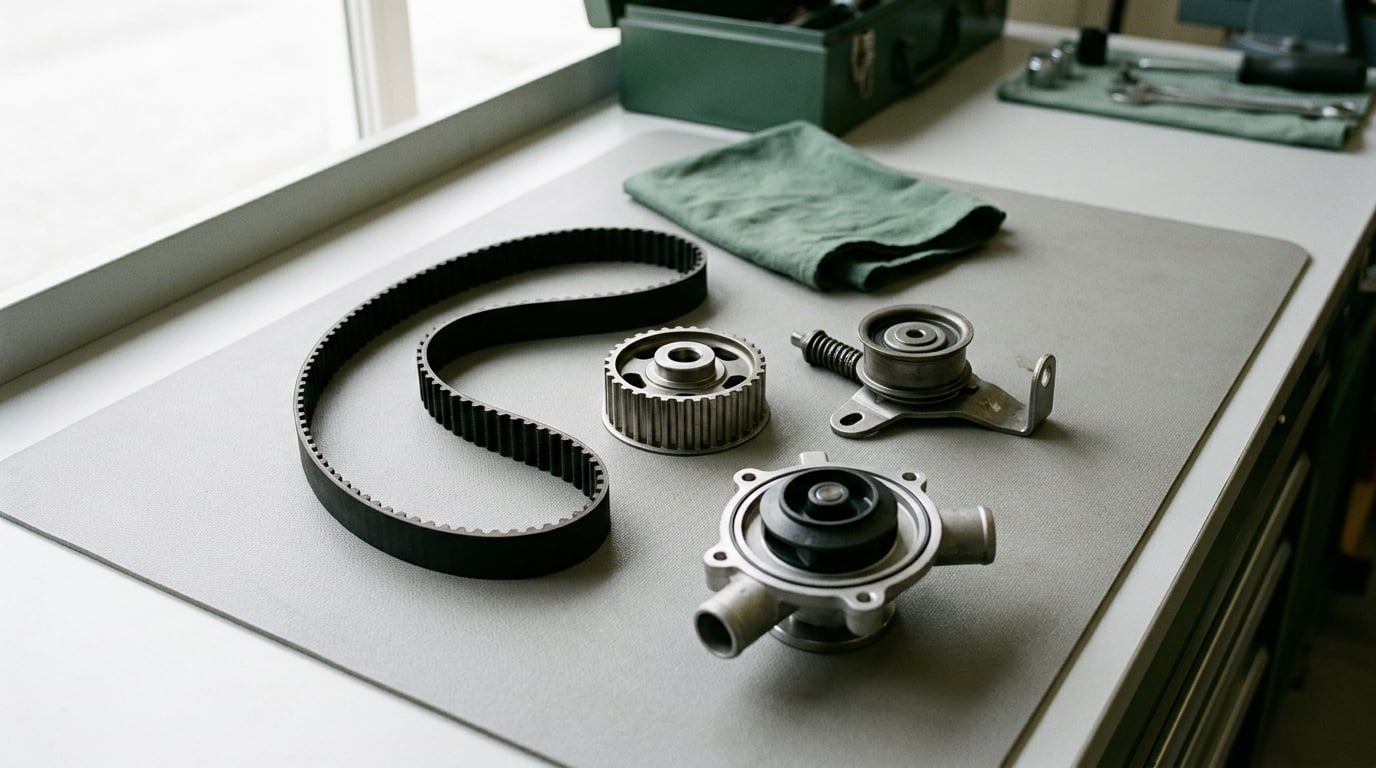
Most timing belts are built to last about 60,000 to 100,000 miles or roughly 5 to 7 years, whichever comes first. The exact number comes from the maintenance schedule for your engine, and that schedule beats any rule of thumb you find online, including this one. The reason it matters: a belt that slips a single tooth puts the crankshaft and camshaft out of sync, and on an interference engine the pistons hit the valves on the way down.
Table of Contents
- How Often Should a Timing Belt Be Replaced?
- Replacement Intervals by Mileage and Age
- Why Timing Belts Fail Before the Scheduled Interval
- How to Know When Your Timing Belt Needs Replacement
- What Happens If the Timing Belt Breaks?
- Timing Belt vs. Timing Chain: Does the Interval Differ?
- Should You Replace the Tensioner and Water Pump at the Same Time?
- How to Prevent an Early Timing Belt Failure
- Frequently Asked Questions
How Often Should a Timing Belt Be Replaced?
How often should a timing belt be replaced on a typical engine?
Replace it at the earlier of two limits, the mileage limit or the age limit. Neither one is a suggestion, and there is no way to tell from the outside which one your belt will respect first.
Rubber hardens on the shelf and in the engine bay long before it looks bad from under the hood. A ten-year-old belt on a car with 12,000 miles on the odometer has the same age problem as a ten-year-old belt on a car with 100,000 miles on it. The mileage has simply not caught up yet.
Here are the four things that actually decide the answer:
- Mileage limit: commonly 60,000 to 100,000 miles, depending on the make, model and engine.
- Time limit: commonly 5 to 7 years from the date the belt went on, even on a car driven very little.
- Interference engine: if the pistons and valves share the same space, a snapped belt usually means a bent valve and a very large repair.
- Water pump service: on many engines the water pump runs off the timing belt, which is why replacing it in the same job usually makes sense.
The owner’s manual maintenance schedule in the glovebox is the document that settles all four. Everything else is context.
Replacement Intervals by Mileage and Age
Here is how the two limits interact, and what each one is really measuring.
| Limit | Typical range | What it measures | Which one hits first |
|---|---|---|---|
| Mileage limit | 60,000 to 100,000 miles | Tooth wear, flexing cycles and pulley heat over distance | Normal suburban driving |
| Age limit | 5 to 7 years, some schedules run to 10 | Rubber hardening, cord embrittlement and seal shrinkage in the time | Low-mileage, older, or lightly used cars |
| Severe service limit | Tighter than the standard schedule | Extra heat, idling, salt, dust and short trips | Towing, commercial use, city driving, extreme climates |
| Combined rule | Whichever comes first | Both the distance and the calendar time the belt has been in service | Nearly every car, and every low-mileage car |
A universal number is the wrong tool, because the manufacturers disagree with each other. One maker schedules a belt at 90,000 miles while another treats the same engine as a 150,000-mile part, and aftermarket belt packaging sometimes prints a third figure that came from a different model year. The packaging number is the least reliable of the three, and it is often the only one an owner sees.
What is not in dispute is the shape of the rule. A belt has a mileage limit, a time limit, and possibly a shorter limit under severe service. Hit any one of them and you replace the belt.
BMW owners run into a version of this too. On many engines the belt is not presented as a dramatic standalone repair, it is folded into the manufacturer’s scheduled service items, so the interval shows up in the service schedule rather than on the parts box. The principle is the same, and the condition-based schedule on some newer engines can call for an inspection of the belt rather than a fixed swap, so check what your manual actually says for your engine.
Why Timing Belts Fail Before the Scheduled Interval
Belts that snap early almost always have a reason, and it is usually visible somewhere in the car’s history.
Age hardening with little use
A car that is driven 2,000 miles a year still burns through the calendar. The belt sits at a temperature far above ambient and slowly loses elasticity, which is why a low-mileage car can have a brittle belt that cracks across the back rather than along the teeth.
Contamination from oil or coolant
A hard oil or coolant leak around the crankshaft seal or cam seal wets the belt, and belt material does not tolerate either fluid. A mist of oil from a weeping crank seal is enough. The same goes for coolant from a weeping water pump gasket, which is one more reason the pump goes in with the belt.
Incorrect tension or a tired tensioner
A belt set too tight wears the edges and bearings. A belt set too loose flails, slaps the pulleys and can jump a tooth. On engines with a hydraulic tensioner, the tensioner itself has a life of roughly the same order as the belt, and a weak tensioner can ruin a brand-new belt within a few thousand miles.
Skipped teeth from an old belt
This is the common one on cars that were already past the interval. A hardened belt jumps a tooth under load, valve timing shifts, the engine runs rough or misfires, and the driver keeps driving it until the next tooth gives up.
Heat, overload and hard conditions
Sustained idling, towing heavy loads, long climbs and stop-and-go city work all hold the belt at a higher temperature than a steady highway cruise. Cold starts after long parking periods do the same damage in reverse, which is why cold-weather breakages show up on older cars in northern climates.
Poor routing or a previous bad installation
A belt installed the wrong way round, twisted during fitting, or routed over a pulley that turns the wrong direction will be worn from day one. If the timing marks were not verified after the last replacement, assume the previous job was not clean.
How to Know When Your Timing Belt Needs Replacement
Your specific answer comes from documents, not from guessing at a sound. Work through these in order and stop at the first one that gives you a number.
How do I find the interval for my engine?
Read the maintenance schedule in the owner’s manual, and use the VIN to identify the exact engine. On a car with several similar versions, the schedule can differ by engine code, and the VIN is what ties the manual to the engine you actually own.
Check the door-jacket sticker and the maintenance booklet. Dealers often record the interval and the interval history there, and a car with a documented belt change is a car you do not need to schedule immediately.
Then read the service records. Look for a line item that says timing belt, cambelt or tooth belt, with a mileage and a date. If you find one, the date resets the age limit and the mileage resets the distance limit. If you cannot find one, assume the belt has been on since the car left the line.
Finally, get a written number from a dealer service department or a reputable independent shop, and ask them to show you which document it came from. If they cannot name the source, the number is a guess.
One more check worth making: confirm whether your engine even has a belt. Some engines of the same model year use a chain and others use a belt, and the answer changes everything that follows.
Once you have the number, write it down as a date rather than a distance. Belts do not care about miles on a car that barely moves, and a calendar reminder is the only thing that catches the low-mileage case.
What Happens If the Timing Belt Breaks?
On a non-interference engine, a broken belt usually means the engine stops and you replace the belt. The valves stay straight, you lose some money on a tow, and the car often runs again once it is fixed.
On an interference engine, the pistons and valves occupy the same space. The moment the belt lets go, the cam stops where the crank no longer expects it, the valves are left open or closed at the wrong point, and the piston strikes them. That is how you get bent valves on a four-cylinder, and a dropped valve on an eight-cylinder leaves a cylinder that will not hold compression at all.
The symptoms of an imminent break are not always subtle. A ticking that only shows up for the first few seconds after a cold start, a chirp or squeal from the belt area, a rough idle, a misfire, or a sudden rattle that goes quiet once the engine stalls.
If the engine suddenly makes a hard mechanical clatter, loses power, or just dies, stop driving and tow it. Do not restart it to see whether it will fire again, because the second start on a partially damaged head is how a repairable head becomes a scrap engine.
Timing Belt vs. Timing Chain: Does the Interval Differ?
Yes, and the difference is large. A chain is not maintenance free, it just moves the work much further down the road and, on most engines, out of reach.
Two quick ways to tell which you have. Lift the oil filler cap with the engine cold and listen while someone cranks it: a chain gives a rattle or hum, a belt gives a brief whine or nothing at all. Or open the hood and look at the front of the engine for a metal chain running down to a crank sprocket covered in an aluminum or plastic cover, which is the giveaway that there is no belt to replace up there.
| Point of comparison | Timing belt | Timing chain |
|---|---|---|
| Replacement interval | 60,000 to 100,000 miles or 5 to 7 years | Often no scheduled interval, but guides stretch long before the chain is normally replaced |
| Serviceability | Routine job at a normal shop rate | Usually a much bigger teardown, frequently with timing cover removal |
| Noise | Quieter when healthy, ticks or squeals as it wears | Rattles on cold start, especially over 100,000 miles |
| Common failure | Breaks or skips teeth, especially past the interval | Stretch, then noisy timing that needs correction |
| Plan for | A dated service item you can shop around for | A larger future job if the rattle starts and the engine makes it overdue |
The mistake to avoid is assuming a chain means you can ignore timing forever. A chain that has stretched past its tolerance already has the engine running off its marks, and the same bent valve outcome is possible when the guides fail. Have the rattle looked at, do not drive through it.
Should You Replace the Tensioner and Water Pump at the Same Time?
Yes, on most engines that is the right call, and the reason is simple arithmetic. The labor is the expensive part of the job by a wide margin, and the belt comes off anyway.
The water pump is the strongest argument. On a large share of engines it is driven by the timing belt, so replacing it later means pulling the whole assembly apart a second time and paying the same access labor again. Owners who have done it report the pump is cheap next to the labor, which is also why it is a good idea to specify a pump with a metal or composite impeller instead of the cheap plastic one when the design allows it.
The tensioner and the idler pulleys sit on the same short list. A tensioner that has already given up is what caused a lot of early belt failures in the first place, and it will do the same to a new belt. Inspect the idlers and spin them by hand, because a rough bearing is audible and it is on the same clock as the belt.
The crank and cam seals are worth a look if the engine is already apart and oil is in the area, particularly on a higher-mileage engine where they are already weeping. Old accessory or serpentine belts and any worn O-rings at the timing cover go in at the same time for the same reason.
Ask for all of it itemized on one invoice. A shop that quotes the belt alone and adds the rest as it goes is the reason timing belt jobs have such a wide spread in quotes.
How to Prevent an Early Timing Belt Failure
Most of what prevents a failure is decided long before anyone touches a wrench.
Set the service date the day the belt goes on. Put the mileage and the month in your phone with a reminder that fires a month before, not a thousand miles before.
Use the belt the manual specifies, with the correct width and tooth profile. Cheap belts are usually a width or compound off the spec, and a belt that does not match the sprockets is a belt that skips teeth.
Fix leaks before the job, not after. An oil mist from a crank seal or a coolant stain from a pump gasket will shorten the life of whatever belt you fit next.
Check tension and routing on the new belt the way your manual describes, and confirm the timing marks are aligned before the cover goes back on. An engine that runs rough with a brand-new belt is an engine that is already off its marks.
Treat a new noise as a reason to look, not a reason to wait. A tick that only appears on a cold start is the earliest sign people get, and it gets dismissed for months.
On a car bought used with no records, assume the belt has never been replaced. That is the cheapest assumption to make and the most expensive one to get wrong.
Frequently Asked Questions
What is the average life of a timing belt?
Most timing belts are designed for about 60,000 to 100,000 miles or 5 to 7 years, whichever comes first. A few manufacturers schedule longer intervals, and a car on the severe service schedule should follow the shorter figure. The number on your owner’s manual maintenance schedule is the one that counts, because engines in the same model year can be built with different belts.
Will a timing belt last 10 years?
Sometimes, and plenty of owners have belts far older than that without trouble. Belts do not fail on a schedule, they fail when the rubber hardens enough to crack, the cords fray, or a tooth shears off. The age limit exists because that hardening is gradual and invisible until it is not, so a ten-year-old belt on a low-mileage car carries the same risk as any other old belt.
Will a timing belt last 200,000 miles?
A healthy belt can occasionally get past 100,000 miles, and some do reach far higher. That is not the same as the belt being rated for that distance. The schedule is written from testing across many engines, not from the luckiest example, and skipped teeth usually show up well before the belt would have worn out completely. Use the extra life as a bonus, not as a new interval.
Can I drive with a bad timing belt tensioner?
Keep it short, because a failing tensioner can let the belt slip a tooth or come off entirely. If the tensioner is squealing or the belt looks loose, glazed, cracked or frayed, avoid highway speeds and long drives, and get the car scheduled. If the engine suddenly clatters, misfires badly or stalls, stop driving and tow it rather than restarting it.
How do I know if my car has a timing belt or a timing chain?
Look at the front of the engine for a metal chain running down to the crank sprocket under a cover, which means a chain and no belt job on your schedule. A toothed belt running to the crank sprocket means the opposite. If the cover hides everything, check the owner’s manual or ask a shop, and say why you are asking, because some models in the same year use different hardware.
Do I need to replace the timing belt if the car has low mileage?
The age limit applies regardless of mileage, and low mileage is not a reason to skip the job. A belt that has only seen 15,000 miles but has been installed five years has the same five years of heat cycles as one on a car driven every day. The sensible move is to treat the age limit as the due date, replace the belt with the water pump and tensioner, and restart the clock from that day.
Do one thing this week: find the maintenance schedule for your engine and write down the date your belt is due, along with whether you have a belt or a chain. If you already know that date has passed, or you have no record of a replacement, call a shop and ask for an itemized quote that includes the water pump and tensioner. If the belt has run well past its interval without complaint, that is a reason to book the job, not a reason to keep waiting for the other one.