
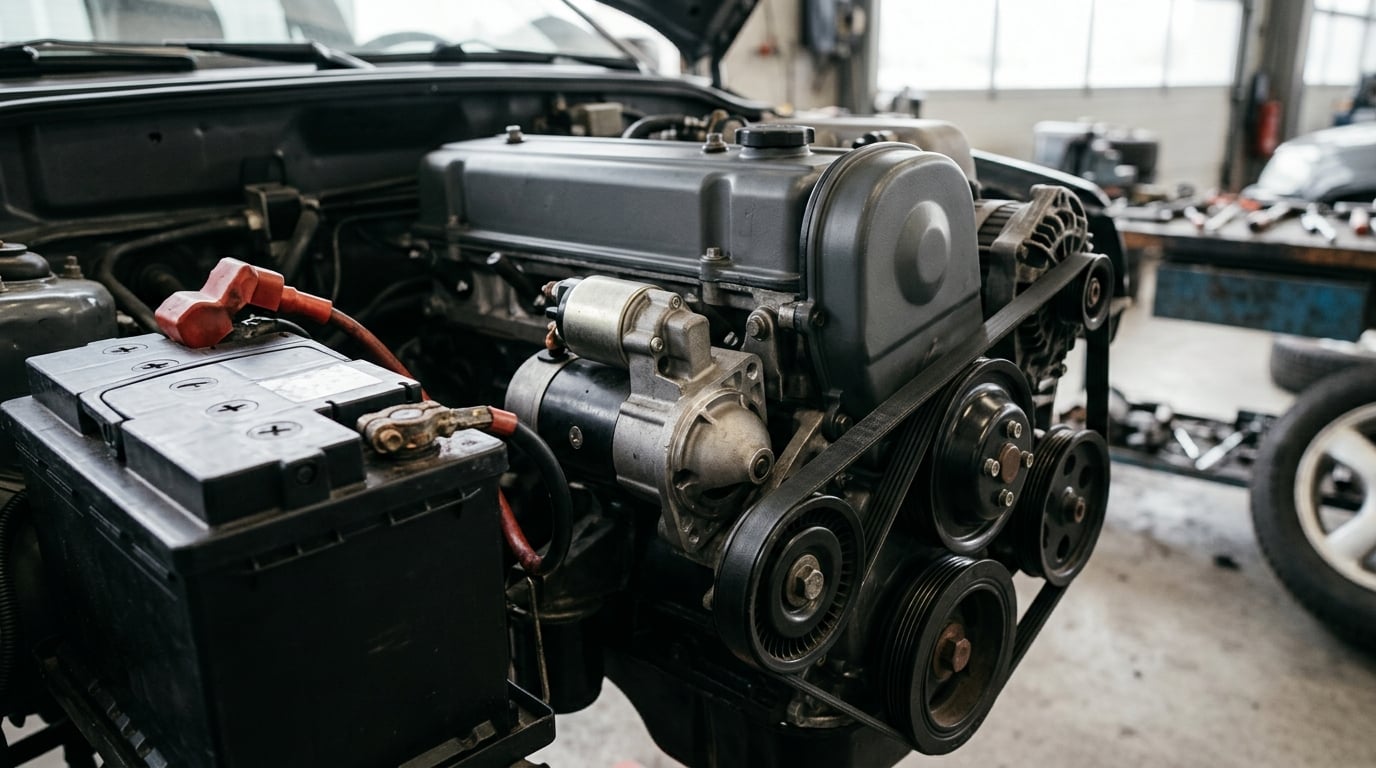
A grinding noise when starting almost always comes from the starter trying to engage the engine. The starter’s drive gear is failing to mesh cleanly with the flywheel ring gear, and the two metal surfaces are scraping instead of gripping.
Here is the short version: the noise is metal on metal, it usually means a worn starter drive, a solenoid that is not pushing the gear all the way in, or a damaged flywheel ring gear. A weak battery makes all three worse. Get it looked at before it stops starting, and stop cranking if the grind gets loud.
The most common causes, roughly in order of how often they turn out to be the answer:
- A weak or discharged battery that drops voltage during cranking
- Corroded or loose battery and ground connections
- A worn starter drive (the bendix gear) that will not extend properly
- A failing starter solenoid that never pushes the pinion gear into full engagement
- Stripped or chipped teeth on the flywheel ring gear or flex plate
- A slipping accessory pulley, belt, or a low fluid condition that changes how the engine sounds at start-up
- A loose exhaust heat shield rattling on cold metal before the engine warms
Table of Contents
- What Does a Grinding Noise When Starting Mean?
- Common Causes of a Grinding Noise During Startup
- A weak or discharged battery makes the crank slow and the grind long
- Corroded or loose battery and ground connections starve the starter
- A worn starter drive grinds on the first turn of the key
- A failing solenoid never pushes the pinion gear all the way in
- A damaged flywheel ring gear is the expensive cause
- Low fluid and slipping accessories get mistaken for starter grind
- A loose exhaust heat shield rattles on a cold start
- Noise Timing and Symptoms Point to the Cause
- Starter Noise vs. Brake Noise
- How to Tell What Is Causing the Noise
- Is It Safe to Keep Driving?
- Frequently Asked Questions
- Is a grinding noise when starting always the starter?
- Can a bad battery cause a grinding sound when the car starts?
- Why does my engine grind for a second and then start?
- Can I drive if my car makes a grinding noise only at startup?
- What does starter grinding sound like compared with a bad alternator?
- Should I replace the starter before checking the battery and wiring?
- What to Do First
What Does a Grinding Noise When Starting Mean?
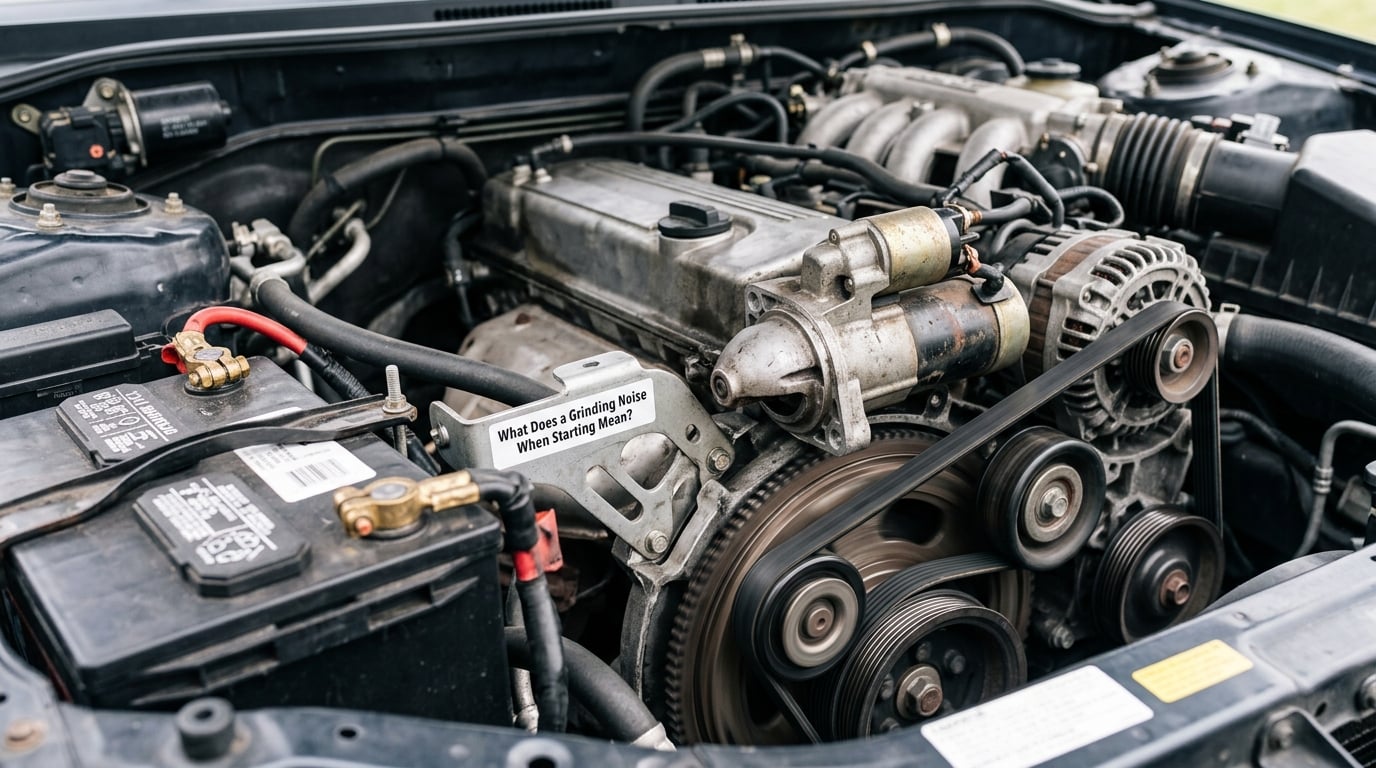
What does a grinding noise when starting mean mechanically? It means the starter pinion gear and the flywheel ring gear are in contact but not engaged. When you turn the key, the starter solenoid pushes the bendix drive forward so the pinion gear slides into the teeth of the ring gear and spins the engine until it fires.
That contact is supposed to be a clean mesh. If the pinion only travels part of the way, if the teeth are worn down to a slope instead of a point, or if the ring gear has chips and missing teeth, the gears buzz and scrape. That scrape is the grind you hear, and it lasts exactly as long as the key is held or the engine takes to start.
Two details separate this from most other noises. First, it is tied to cranking: the sound starts when the key turns and stops the moment the engine fires or you release the key. Second, it comes from low in the engine bay, near where the starter bolts to the block or transmission.
It is worth knowing that a damaged ring gear turns a cheap job into an expensive one. Every second you grind is another fraction of a millimeter taken off teeth that a shop has to machine or replace. If the noise is intermittent today, treat it as a countdown.
A quick decision path, before you take anything apart:
- Grind only on the first turn of the key, then the engine starts: worn starter drive or solenoid, battery fine
- Grind on every attempt and the crank is slow and sluggish: test the battery and the connections first
- Grind on every attempt and the crank speed sounds normal: starter drive or flywheel teeth
- Grind, then the engine catches but the noise continues for a second after it fires: the starter is not retracting and disengaging
- Rattling and clanking from the exhaust area on a cold start only: probably a heat shield, not the starter
If the noise happens while the engine is already running, or only when you brake or shift, you are looking at a different system. That distinction is covered below, and it is the one that saves people the most money.
Common Causes of a Grinding Noise During Startup
A weak or discharged battery makes the crank slow and the grind long
A starter needs a lot of amps for a couple of seconds. If the battery is old, cold, or simply out of charge, the voltage collapses the moment the starter loads up. The solenoid still clicks, the pinion starts to move, and the engine turns over slowly enough that the gear teeth never reach full speed and the mesh sounds like a buzzsaw.
Watch for the cranking speed. A slow, laboured crank that sounds like the engine is being turned by hand points at the battery. Look for headlights that dim noticeably while cranking, a battery that looks swollen or has white and green crust on the terminals, or a car that starts fine after a jump pack but grinds every time on its own.
Corroded or loose battery and ground connections starve the starter
This is the cheapest version of the same problem and it is missed constantly. Corrosion on the positive terminal, a clamp that is only hand tight, or a ground strap that has frayed under the hood will make the starter behave exactly like a weak battery.
The tell is behaviour that changes. The car starts on warm days and grinds on cold mornings, or it starts when you wiggle a terminal but not when you leave it alone. If the noise changes when you touch the battery or the cable, stop shopping for a starter and start cleaning terminals.
A worn starter drive grinds on the first turn of the key
The starter drive, sometimes called the bendix gear, is the little pinion gear on the nose of the starter motor. It has to slide into the ring gear, hold itself there during cranking, and then snap back the instant the engine starts so the starter can spin freely with the engine.
On many starters the drive rides on a one-way roller clutch that is meant to slip during cranking. When that clutch wears, hardens, or loses its rollers, the pinion stays locked to the motor after the engine fires. Now every revolution of the engine is driving the starter motor backwards. The classic symptom is a grinding or whining noise that starts with the key and continues for a second or two after the engine is running.
Stripped pinion teeth produce a different version of the same sound. The gear skids across the top of the ring gear instead of dropping into it, and you get a harsh scrape on every single start, usually without any warning.
A failing solenoid never pushes the pinion gear all the way in
The solenoid is the switch between the battery and the starter motor, and on most designs it also does the pushing. If it energises but does not throw the drive the full distance, the pinion sits half engaged and grinds for the entire crank.
How to tell the two apart: a bad solenoid usually comes with a fast, healthy-looking crank and a click you can hear clearly before the grind. A bad drive or gear usually comes with slower, wandering behaviour that varies attempt to attempt. A solenoid can also fail in the other direction, where it never pulls the drive back after start-up, and the grind lingers after the engine is running.
A damaged flywheel ring gear is the expensive cause
The flywheel is the heavy disc bolted to the back of the crankshaft, and its outer edge carries the ring gear the starter engages. On automatic transmissions the same teeth live on the flex plate, which is bolted to the flywheel. On manual transmissions it is a proper flywheel, and on automatics the flex plate also carries the torque converter, which is why damage there is a much bigger job.
Typical damage: a chipped tooth, a section worn smooth from a starter that was never retracting, or teeth eaten into a wave shape from repeated bad engagement. The sound is louder and chunkier than a solenoid problem, and it repeats identically every single time you crank.
This is the answer that catches people out. Owners on forums repeatedly report replacing the starter two or three times and hearing the same grind, because the ring gear was worn the whole time. A starter cannot fix a damaged flywheel.
Low fluid and slipping accessories get mistaken for starter grind
Not every grind at start-up comes from the starter. Low engine oil, low coolant, or low power steering fluid can change how the engine turns over and what the belts sound like on the first few seconds. A slipping accessory belt, a worn alternator bearing, or an A/C compressor clutch that drags for a moment all produce noise right at start-up.
The difference is timing. A belt squeal rises with engine speed and fades once the engine is running, and it is gone in warm weather. Starter grinding is tied to the key and to the crank itself, and it usually stays until the engine fires.
A loose exhaust heat shield rattles on a cold start
Mechanics on the forums mention this one more often than you would expect. An exhaust heat shield, a muffler bracket, or a loose shield on the catalytic converter expands and contracts with the engine, and on a cold start it clatters for a second or two before the vibration settles.
It sounds similar from the driver’s seat, but the location is different: the rattle comes from behind the engine or under the car, and it fades with warmth. A starter grind does not care about temperature nearly as much as people think, and the engine running or not matters far more.
Noise Timing and Symptoms Point to the Cause
| When you hear it | What else you notice | Most likely cause | How urgent |
|---|---|---|---|
| Every start, first turn of the key only | Crank speed normal, engine starts normally | Starter drive not retracting, or worn pinion teeth | Book it this week |
| Every start, whole crank | Slow, heavy cranking, headlights dim | Weak or discharged battery | Test today |
| Cold mornings mostly | Fine on the second or third try, or after a jump | Cold battery, corrosion, or an aged solenoid | Soon |
| Random, sometimes | Starts more often than it grinds, getting worse | Intermittent solenoid or drive wear | Don’t put it off |
| Grind continues after the engine runs | Brief whine that fades within a second or two | Drive not retracting, often with a worn roller clutch | Book it this week |
| Grind and the engine never starts | Click or grind, no catch, repeat each attempt | Stripped pinion or damaged ring gear teeth | Stop cranking |
| Cold start only, from behind the engine | Rattling that fades as the engine warms | Loose exhaust heat shield | Minor, but easy to secure |
| While driving or braking, not at start | Changes with speed, load, or pedal pressure | Brakes, wheel bearing, transmission, or differential | Different problem entirely |
Read the table from the left. The timing column tells you more than anything else, because a starter-related grind is bound to the cranking event and almost nothing else is.
Starter Noise vs. Brake Noise
A grinding noise that only happens when the engine is cranking comes from the starter and flywheel. A grinding noise that happens when you press the brake pedal, when you slow down, or when you shift gears comes from the driveline or the brakes, and the two have nothing to do with each other.
Here is how to keep them apart:
- Starter grind: begins the moment the key turns, is loudest during cranking, and ends when the engine fires. It does not care how fast you are driving or how hard you press the brake.
- Brake grind: appears as a scrape or squeal at a particular road speed, often when the pads or rotors are worn, sometimes worse on the first press after sitting. The car starts and runs normally.
- Wheel bearing: a low hum that rises with speed and changes slightly as you turn in a parking lot. Nothing about it relates to the key.
- Transmission grind on a manual: a crunch or rasping at a particular gear, only when you change gear, and never while the engine is cranking.
- Differential grind: a growl or whine that changes on turns and is most noticeable on a loose surface.
There is one overlap worth knowing about. On a manual car, a grinding noise right as you release the clutch while pulling away can come from the clutch itself, and it is easy to mishear as engine noise while the car is still settling after a start. If the sound happens while moving rather than while the key is turned, start looking at the clutch, the transmission, or the differential instead of the starter.
How to Tell What Is Causing the Noise
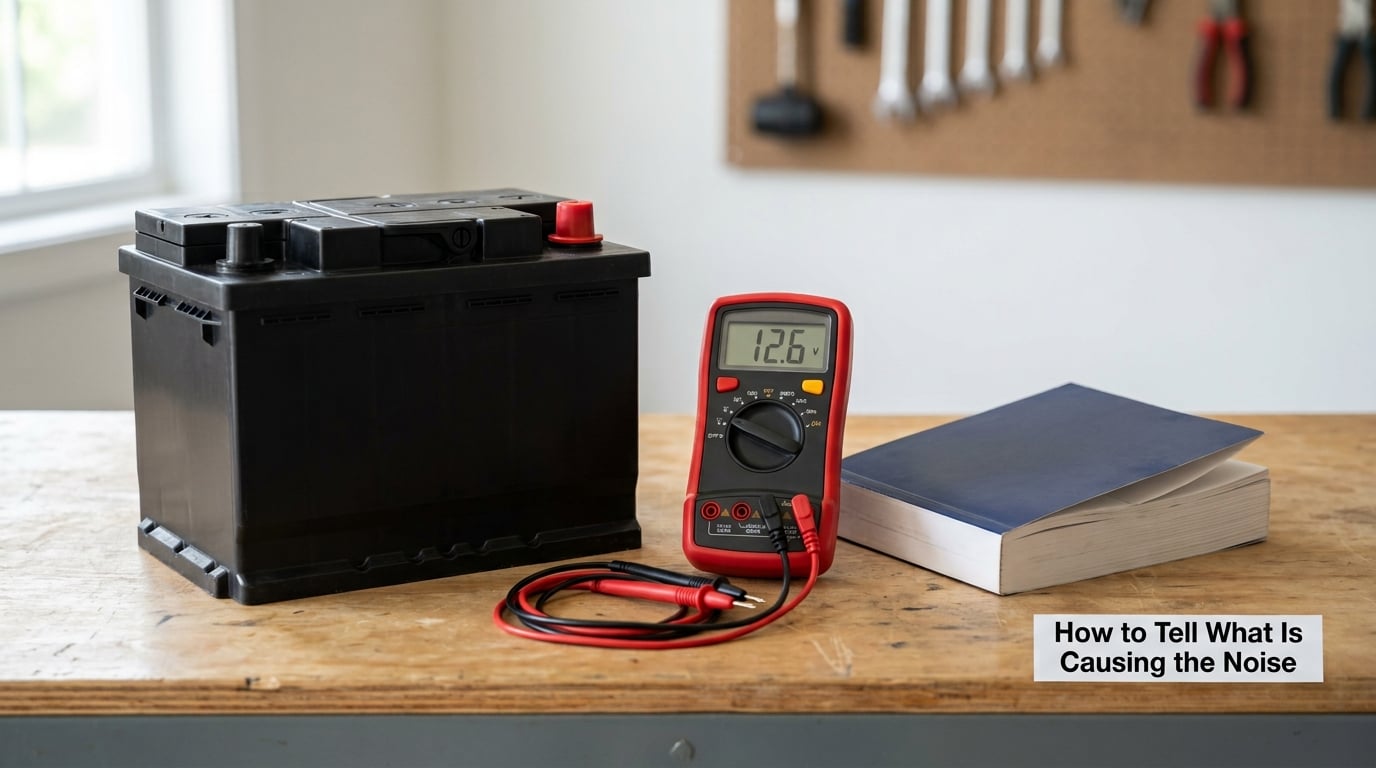
You can narrow this down in about ten minutes without getting your hands dirty in the engine bay. Work in this order, and stop each step as soon as you have an answer.
1. Listen to the crank, not just the grind
Record a start on your phone from outside the car and play it back. Headphones help. You are listening for how fast the engine is turning and whether that speed changes between attempts. A crank that stays strong and fast for three or four seconds before the grind stops is a starter or ring gear problem. A crank that slows and labours is electrical.
2. Check battery condition and voltage
A battery that tests under about 12.6 volts resting, or that sags hard when the starter is engaged, will cause exactly this noise. A multimeter set to DC volts, connected across the terminals while someone turns the key, should stay comfortably above 10 volts during cranking. Well below that and you have your answer before you touch anything else.
If you do not own a multimeter, a jump pack is a rough substitute. Connect it, start the car, and remove the pack while it idles. If the grind vanishes with the pack attached, the battery and the connections are the problem. If the grind stays, look at the starter.
3. Clean and tighten the terminals
Shut the vehicle off, wear eye protection and gloves, and clean the battery posts and the ground strap. Corrosion that looks like blue-green crust eats voltage before the current ever reaches the starter. Watch what happens on the next start. Many intermittent grinds disappear here and never come back.
4. Watch the drive gear through the inspection hole
Many starters have an opening in the mounting flange so you can see the pinion gear with the key turned. If the gear moves partway out and stops short, that is the solenoid. If it extends fully and the engine still grinds, you are looking at the gear teeth or the ring gear. If it extends and stays out after the engine starts, the drive is not retracting.
5. Try a controlled bump test
On some vehicles holding the key slightly past the normal crank position, or applying a very brief press to the pedal while cranking, changes the engine position by a fraction and lets the gear land. If the car starts with that nudge, the drive or the ring gear is worn rather than the solenoid being dead. This test can also damage teeth if the grind is already severe, so use it once, not repeatedly.
6. Check the owner’s manual, then hand it over
Your manual will tell you where the starter sits on your specific engine and what the access points are. If the checks above leave you with a starter that grinds on every start, the diagnosis is a shop job. Ring gear inspection means removing the starter and, on many manual transmissions, the transmission, so stop before that point.
A word on the work itself: battery work is fine for most people, but disconnect the negative terminal first, keep metal tools away from both terminals while the vehicle is on, and remember the vehicle’s alarm and radio settings. Anything involving the starter mount, the flywheel, or the transmission belongs to a qualified mechanic.
Is It Safe to Keep Driving?
Yes, usually, for a short time. A brief grind on cold starts where the engine still starts is not an emergency, and driving the car home or to a shop is reasonable. No-start grinding that gets louder with every attempt is a different situation, and that one can go from a starter job to a flywheel job in a weekend.
Stop driving and do not crank the car again if any of these apply:
- The engine does not start and the grind is getting louder or longer on each attempt
- You see smoke, smell something hot or burnt, or notice a burning plastic or rubber smell under the hood
- There is fluid under the car after an attempt, or a hissing sound
- Your lights, wiring, or the battery area show any sign of heat damage or melted insulation
- The noise happens while the engine is running, or while you are braking, and the car steers or stops differently than normal
- Any warning light is on the dash that stays on after the start
The rule I would follow: three or four attempts is a reasonable diagnostic session. A fifth attempt after a clearly worsening grind is you buying a more expensive repair.
On costs, the honest answer is that the starter side is the cheap half of this problem. Replacing a starter is a parts and labour job that most shops quote in the low hundreds once the part is on the bench, and rebuilt or remanufactured starters cost less than new. A flywheel or flex plate replacement is a different order entirely, because on a manual transmission it usually means pulling the gearbox, and on an automatic it means heavy work on the torque converter. If a shop quotes flywheel work on a car with a loud, repetitive grind, that is not a upsell, it is the correct call. Get the ring gear inspected before any starter is ordered, and ask the shop to show you the damaged teeth.
On high-mileage vehicles, replace rather than rebuild is often the sensible choice. A rebuilt starter on a starter that has already failed once has a meaningful chance of failing again, and the labour is the expensive part either way.
Frequently Asked Questions
Is a grinding noise when starting always the starter?
No. Most of the time it is the starter side of the equation, either the drive gear or the solenoid failing to engage the flywheel properly. But a weak battery, corroded connections, a damaged flywheel ring gear, or a loose exhaust heat shield can all produce a similar sound. The test that separates them is simple: if the crank speed is slow and sluggish, it is the battery or connections. If the crank is fast and strong and it still grinds, it is the starter, solenoid, or flywheel teeth.
Can a bad battery cause a grinding sound when the car starts?
Yes, and it does more often than people expect. A starter draws heavy current for a couple of seconds, and a weak battery cannot hold the voltage up, so the engine turns over slowly and the gear teeth never fully mesh. If the car starts reliably with a jump pack and grinds on its own, the battery and the cable connections are your first suspects. Test resting voltage and cranking voltage before ordering any parts.
Why does my engine grind for a second and then start?
That pattern usually means the starter drive engages late but does engage. The pinion gear either only partially extends, or the flywheel ring gear has a worn low spot that the gear skids across until it catches a good tooth. A one-second grind on a cold start is worth watching, because it tends to progress. If the grind lengthens, or the car takes several attempts, stop cranking and get the ring gear inspected.
Can I drive if my car makes a grinding noise only at startup?
If the engine still starts normally every time and the noise is brief, driving it to a shop is fine. What you want to avoid is extended cranking on a grind that is not catching, because that is what wears the ring gear. Stop driving immediately if smoke, a burning smell, a fluid leak, or any change in braking or steering shows up. Those point at something other than the starter and need a tow, not a drive.
What does starter grinding sound like compared with a bad alternator?
Starter grinding is tied to the key: it begins the instant you crank, is worst during cranking, and stops when the engine fires. A bad alternator usually announces itself after the engine is running, as a whine that rises with engine speed, or as a belt squeal that changes with load. An alternator bearing can sound like a grinding hum that continues while driving, which is why the timing of the noise matters more than its character.
Should I replace the starter before checking the battery and wiring?
No. Always check the battery, its age, and the terminal and ground connections first, because they take minutes to check and they cause the same noise. If the crank is fast and healthy and the grind persists, then a starter is a reasonable next step. Before replacing a starter on a car that has already had one replaced, insist that the shop inspect the flywheel ring gear, because a worn ring gear will not be fixed by a new starter.
What to Do First
Stop turning the key if the grind is loud or the engine is not catching. Then work the short list: test the battery, clean and tighten the terminals, and listen carefully to whether the crank is slow or fast. A slow crank points at the battery and the connections. A fast, healthy crank that still grinds points at the starter drive, the solenoid, or the flywheel ring gear, and that is a mechanic’s job.
If the noise is intermittent, treat it as a countdown rather than a mystery. A brief cold-start grind that has been happening for months will not stay a starter job if you keep cranking through it, and the ring gear is the part that decides how expensive this gets.