
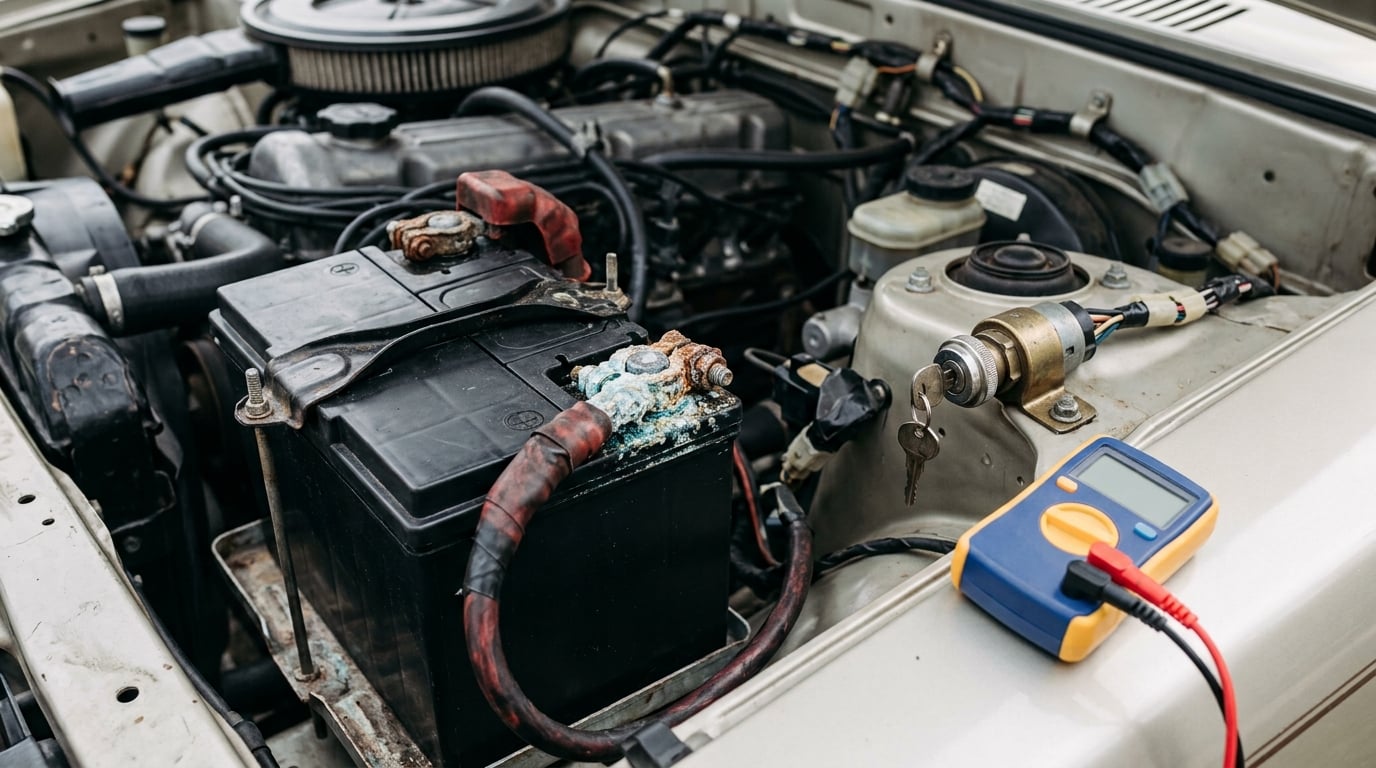
A clicking sound when starting means the starter solenoid is engaging, but the starter motor is not turning the engine over. Repeated rapid clicking almost always means the battery is too weak to deliver cranking power, while a single click can point to a low battery, a worn starter, or an aging ignition switch.
That one sentence covers most of it, but the details matter. How many clicks you hear, how long they last, and what the dashboard does while they happen separate a ten-minute fix from a weekend in the garage. This guide walks through what the click physically is, how to tell the three main suspects apart, and what to do next.
One note before we start: this is general diagnosis information for everyday cars. Your owner’s manual wins over anything here, and any wiring, fuel system or high-voltage work belongs with a qualified technician.
Table of Contents
- What Does a Clicking Sound When Starting Mean?
- Is It the Battery, Starter, or Ignition Switch?
- What Other Parts Can Make a Clicking Sound?
- How to Check the Battery and Connections Safely
- How to Tell Whether the Starter Is Failing
- What Should You Do After Hearing One or More Clicks?
- When Is It Unsafe to Keep Driving?
- Frequently Asked Questions
- Does a clicking sound when starting always mean the battery is dead?
- Can I drive my car if it clicks when starting?
- Is it safe to jump-start a car that makes clicking noises?
- Why does my BMW click when I turn the ignition?
- Why do I hear one click and then nothing?
- What causes clicking while the car is already running or moving?
- Conclusion
What Does a Clicking Sound When Starting Mean?
The click is the starter solenoid doing its job. When you turn the key or press the start button, battery power travels through the ignition switch to a relay, which energizes the solenoid on the starter. The solenoid closes, a small pinion gear on the starter motor lunges forward into the flywheel ring gear, and the engine should begin to crank.
If the battery has just enough charge to close that solenoid but not enough to spin a cold engine, the engine never turns over, the switch opens, and the whole sequence repeats. Each pass through the solenoid is one click. That is why a weak battery produces a machine-gun rattle, and why the sound stops the instant you release the key.
Four components get confused constantly, so here is the short version of each:
- The battery stores the energy. It has to push roughly 200 to 400 amps through the starter cable in a few seconds, which is far more than it can do for a dashboard light.
- The starter motor is the heavy motor that actually turns the crankshaft.
- The starter solenoid is the switch on the starter itself. It is the part making the click.
- The ignition switch is the key cylinder or button contact that tells the rest of the car to wake up and send that power to the starter.
So a click proves the ignition switch, the relay and the solenoid are all being told to work. What it does not prove is that the starter motor got enough current to move, and that is where the diagnosis usually lands.
What Does a Clicking Sound When Starting Mean in Each Case?
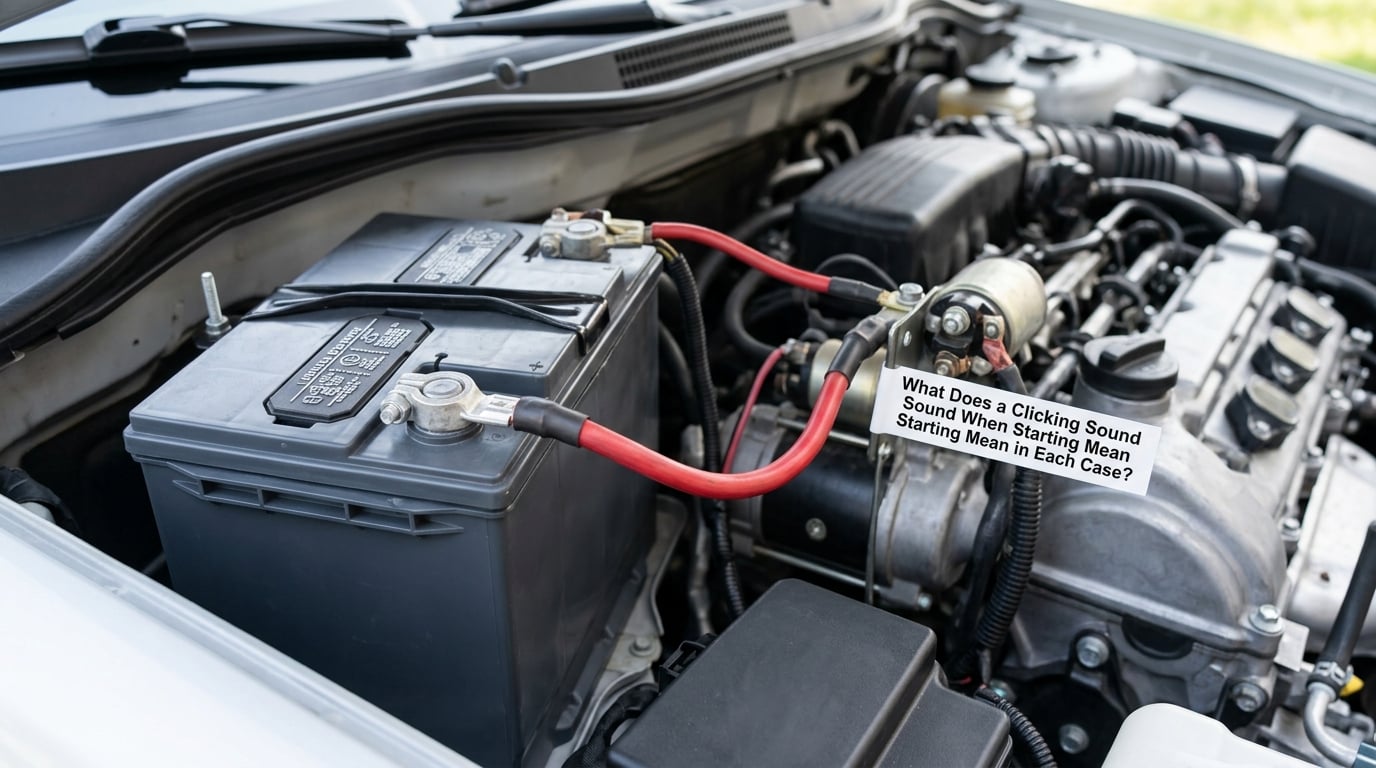
Match what you hear against the row below. The pattern narrows the field faster than any other single test.
| What you hear | What it usually means | First thing to check | Can you drive it? |
|---|---|---|---|
| Rapid clicking, dozens of clicks a second, no engine movement | Battery has enough power for the solenoid but not for the crank | Battery age, terminal condition, resting voltage | Usually no |
| One loud click, then silence | Weak battery, corroded ground, or a starter that gets no current | Cranking voltage with a multimeter | Only if it starts reliably |
| Slow chatter, engine turns over briefly | Battery on its way out, or a marginal connection | Voltage under crank | No, it may strand you |
| Click, then a short crank, then a catch | Usual cold start behaviour on a tired battery | Charge state and battery age | Yes, but book a test |
| One heavy clunk or grinding bang | Pinion gear hitting the flywheel without a full engagement | Starter mounting, flywheel, oil pressure | No, stop driving it |
| Clicking after the engine is already running | Accessory relay, alternator or charging fault, not a starter fault | Charging voltage and drive belt | Yes, but get it looked at |
One case deserves its own note because it sits at the top of the search results: a faint click on the first start after the car has sat overnight, then a normal start every time after. That is usually a battery losing surface charge while it sits, or a marginal connection that only shows up cold. It is not a dead battery, but it is a warning that the margin is thin. A battery test settles it in about five minutes.
Is It the Battery, Starter, or Ignition Switch?
Three suspects account for nearly every case, and each leaves a different fingerprint. The table below is the fastest way to separate them.
| Symptom | Points to the battery | Points to the starter | Points to the ignition switch |
|---|---|---|---|
| Dashboard lights during the click | Stay on, or dim noticeably | Stay bright and steady | May flicker or behave oddly |
| Number of clicks | Rapid, dozens per second | One click, maybe two | One or none |
| Voltage under crank | Drops well below 9.6 V | Holds above 9.6 V | May read low or nothing at all |
| Other electrical oddities | None | None | Wipers, blower, locks or radio cutting out on the same key movement |
| Age of the part | Three to five years is common | Often high mileage or water exposure | High mileage, worn key cylinder |
The battery is the one to rule out first, and a multimeter settles it. A fully charged 12-volt battery rests at about 12.6 V, and it should stay above 9.6 V while the engine is cranking. If it falls under that, the battery cannot do its job and the starter never gets a fair shot. Forum threads repeat this constantly: the battery is strong enough to engage the solenoid, then it collapses, and the click is the relay doing its job while the crank fails.
A starter problem looks different. The battery stays at full voltage, the solenoid clicks once, and the motor either does not move or drags. The starter draws enormous current, so a failing one can pull voltage down hard too, which is why a voltage test alone is not a verdict on the starter.
The ignition switch is the quiet third suspect and the one people miss. On many BMWs and other modern cars, the ignition switch feeds several systems at once, so a switch that is worn internally can drop the starter, the blower motor, the wipers or the central locking all in the same movement of the key. If other accessories stutter at the same moment, suspect the switch. Do not bridge, bypass or modify the ignition circuit to test it. That is a job for a technician with the right diagnostic equipment, because the wiring layouts differ a lot between models.
What Other Parts Can Make a Clicking Sound?
A dead battery is the common answer, not the only one. These are the causes that come up again and again, especially in cars that still click after a new battery went in.
- Corroded terminals and ground points. The negative cable to the body or engine ground rots faster than most people expect, and corrosion there mimics a dead battery exactly. This is the single most common reason a freshly installed battery still produces rapid clicking.
- A sulfated battery. If a battery has sat discharged for weeks, lead sulfate builds up on the plates. The battery reads full after a surface charge and then fails the next morning.
- Loose terminal clamp. A clamp that moves by hand can be intermittent, which explains clicking that comes and goes with vibration.
- The starter solenoid itself. A solenoid that energizes but never passes current to the motor gives you one clean click and nothing else.
- Corroded wiring or a damaged harness. Rodent damage near the starter connector, or a harness that rubs on a bracket, interrupts current without tripping a fuse.
- Accessory relay chatter. Clicking that continues after the engine starts, or happens with the key off, is not a starter fault. It is usually a relay cycling, an aftermarket alarm or immobiliser attempting to authenticate, or a charging system fault.
- A failing crank position sensor. The module can command a start and then cancel it, producing a click with no crank. It usually brings a warning light with it.
Timing is a useful shortcut. A sound that only happens when the key is moved belongs to the starting circuit. A sound that continues while the car is moving belongs to something else entirely, and treating it as a starter fault wastes a lot of money.
Diesels and hybrids add two branches. A diesel that ticks briefly on a cold start before the glow plugs take over is normal. A hybrid or EV has no starter motor cranking at all, so a click from under the bonnet is the 12-volt battery or a high-voltage relay, and the orange high-voltage cables are strictly off limits.
How to Check the Battery and Connections Safely
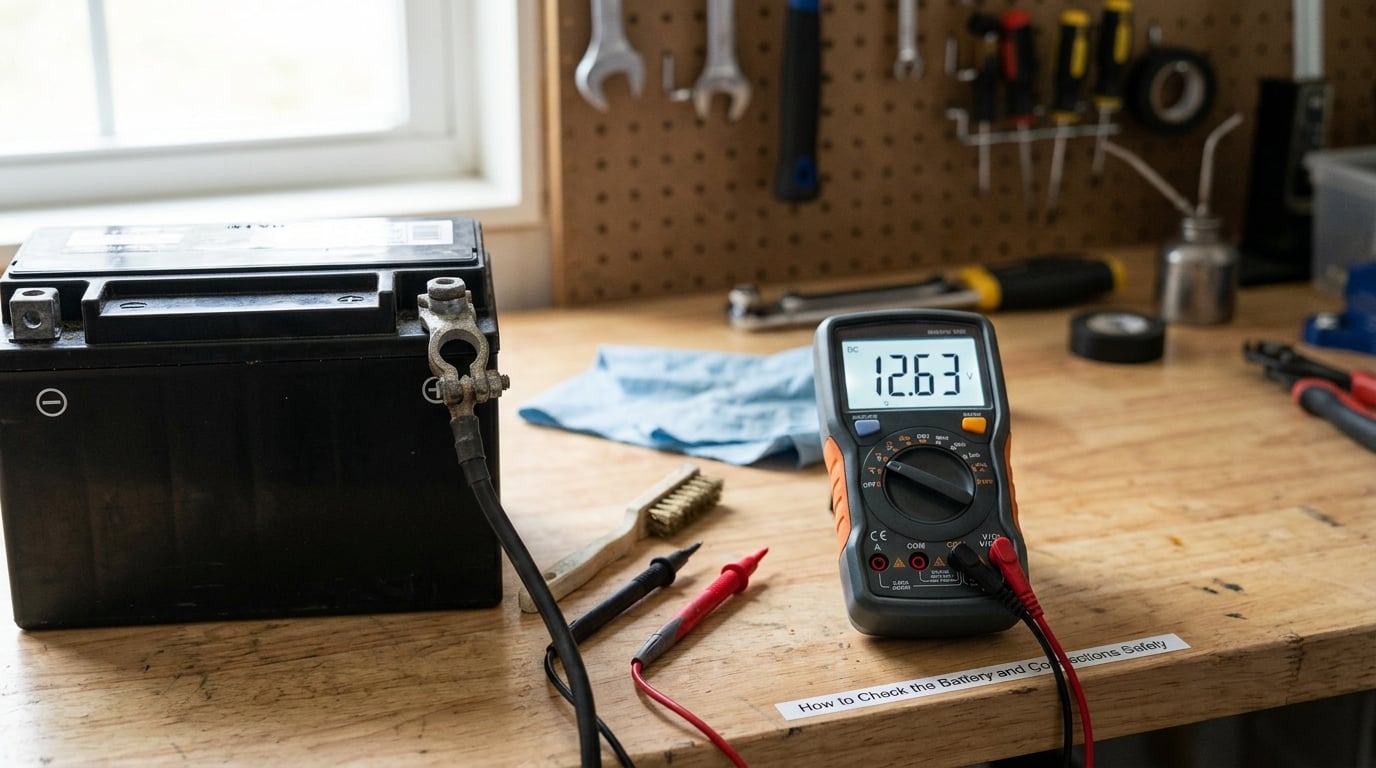
Work in the order of cost: connections first, then the battery, then the starter. The following sequence stays inside what an owner can do safely, and it follows the order most technicians would use.
- Identify the battery. Check the label for the type, the cold cranking amps rating and the manufacture date. A four or five year old battery deserves suspicion on its own.
- Look at the terminals before touching anything. Blue-green or white crust, a swollen case, or a damp smell means stop and handle with gloves.
- Check the ground cable. Follow the negative cable to the body or engine block and look for the same crusting. Clean it the same way you clean the terminal.
- Clean the terminals. Disconnect the negative first, then the positive. Scrape the crust away, wash with a mix of baking soda and water, rinse with plain water, and dry fully before reconnecting. A small terminal brush or a wire wheel on a drill makes it quick.
- Reconnect and tighten. Positive first, negative last. Clamps should not move by hand.
- Measure resting voltage. With the car off and the key out, a meter across the terminals should read roughly 12.6 V. Around 12.4 V is serviceable. Below that, the battery is discharged or worn.
- Watch the meter while cranking. Have someone turn the key while you hold the probes. It should not drop under 9.6 V.
- Test state of charge. If you have a battery tester or a scan tool, run it. It also reports the age and cranking performance of the cell.
Safety comes before diagnosis here. A lead-acid battery vents hydrogen gas, and hydrogen is explosive. Wear eye protection and gloves, keep metal tools and jumper cable clamps from touching both posts at once, and work somewhere ventilated. No sparks, no open flame, no rings or watches on your wrist.
Use your owner’s manual for the specific procedure on your vehicle, because disconnecting a battery on some cars resets clocks, radio codes and window auto-up features.
How to Tell Whether the Starter Is Failing
If the battery and connections check out and the click continues, the starter is next. A failing starter behaves in four recognisable ways.
The starter does not engage at all
You hear one click or nothing, and the engine never turns. That means the solenoid is getting power but the motor is not, or the motor is getting power and the pinion gear is jammed. This is the most common starter failure pattern.
The starter cranks slowly
The engine turns over at a lazy crawl, sometimes for a full second or two before catching. That points at a weak battery, a bad ground, or a starter motor that is dragging internally. Measure voltage under crank before you condemn the starter, because the readings look similar.
The starter runs continuously
The engine keeps cranking after you release the key, or the starter stays engaged after the engine starts. That is a stuck solenoid or a sticking ignition switch, and you should switch the engine off rather than let it crank.
The starter engages but the engine does not start
The engine cranks normally and simply does not fire. That is not a starter fault at all. It is a fuel, spark or compression problem, and chasing the starter here is the most common expensive mistake.
Intermittent starter faults deserve special mention. A starter that works in the driveway and fails in the rain or on a bumpy road is very hard to test and even harder to prove. If the cause is not obvious, have a technician measure the draw on the starter cable and the control signal rather than ordering a part on a hunch.
There is one more trick worth naming, though it is a temporary measure and not a repair. Tapping the body of the starter with a wrench while the key is held in start sometimes gets a sticking solenoid to release. If that works, your starter is on its way out. Treat it as a countdown, not a cure.
What Should You Do After Hearing One or More Clicks?
Here is the decision path, roughly in the order I would work it.
- Turn the ignition off and stop holding the key. Every extra attempt pulls more current from a battery that is already struggling.
- Count and time the clicks. Rapid versus single, and how long they last, is the single most useful piece of information you can hand to a technician.
- Look at the lights. Dimming headlights and a dimming dash during the click point to the battery. Steady bright lights point toward the starter or solenoid.
- Check the battery age and the terminals. This costs nothing and catches the most common cause.
- Measure the voltage if you have a meter, following the sequence above.
- Consider a jump-start only after confirming the battery and connections are in a safe condition, and only by following the instructions in your owner’s manual or the jump starter’s manual.
- Arrange service if the pattern stays the same after a charge or a jump. Repeating the same start attempt does not fix a solenoid, a ground or a charging fault.
If the car does start after a jump, the battery, cables and charging system still need a proper test. A new battery fitted on top of a faulty alternator will fail the same way, usually sooner.
When Is It Unsafe to Keep Driving?
Sometimes a click is a warning, sometimes it is a nuisance. These signs mean pull over and stop using the car.
- A swollen, bulging or leaking battery. Stop driving it. Take it to a shop, not a public place, and keep away from your face.
- A burning or acrid smell during or after a start attempt. That is wiring, not a battery.
- Rapid clicking with the lights going dim every cycle. The battery is being drained faster than it can recover, and each attempt can damage the starter.
- Repeated stalling while driving. If the engine dies at low speed, at a light, or when you lift off, the charging system or the ignition switch is involved and the car can strand you.
- Any clicking while the vehicle is moving. That is not the starter. Something in the charging or accessory system is cycling, and it needs to be identified before it strands you at the wrong place.
- A heavy clunk or grinding bang on start. That can mean the pinion gear is striking the flywheel without engaging properly, which can damage both parts.
When the car is showing these signs, stop in a safe location, switch it off, and arrange roadside assistance or a tow rather than driving it to a shop on the chance that it starts once more.
Frequently Asked Questions
Does a clicking sound when starting always mean the battery is dead?
No. Repeated rapid clicking almost always means a weak battery or a bad connection, because the solenoid has power but the crank does not. A single click with a fully charged battery points more toward the starter motor, the starter solenoid or the ignition switch. If the car still clicks after a new battery, corroded terminals and a rotten ground cable are the usual culprits, not a second dead battery.
Can I drive my car if it clicks when starting?
Only if it starts reliably and nothing else is wrong. A faint click on the first start after the car has sat overnight, followed by a normal start, is worth a battery test but usually not a tow. Rapid clicking, a heavy clunk, dimming lights, repeated stalling or any warning light mean stop driving and get it checked. Never rely on a car that may not start at the next junction.
Is it safe to jump-start a car that makes clicking noises?
It is safe once you have confirmed the battery is not swollen, leaking or badly corroded, and you follow the instructions for your vehicle and for the cables or jump starter. Wear eye protection, connect the negative post last, keep metal tools away from both posts, and work somewhere ventilated because a lead-acid battery gives off explosive hydrogen gas. Never jump-start a battery that is visibly damaged.
Why does my BMW click when I turn the ignition?
Most often the 12-volt battery is not holding enough charge, or a terminal or ground connection is corroded, and the same three suspects apply as on any other car. BMWs add a wrinkle worth checking: the ignition switch feeds several systems at once, so if the blower, wipers or central locking stutter at the same moment, a worn ignition switch is a real possibility. Have a technician test it rather than bridging or modifying the wiring.
Why do I hear one click and then nothing?
One click means the solenoid engaged but the starter motor never got enough current to move, or the motor itself is dead. Check the battery terminals and the ground cable first, then measure cranking voltage with a multimeter. A healthy battery stays above 9.6 V while cranking. If the reading holds and you still get a single click, the starter motor or its solenoid is the likely part.
What causes clicking while the car is already running or moving?
Clicking that continues after the engine starts is a different problem. The usual causes are a cycling accessory relay, a weak alternator or failing charging system, an aftermarket alarm or immobiliser repeatedly trying to authenticate, or a body control module cycling a relay. None of these are starter faults. If the engine also stalls while driving, stop the car in a safe place and have the charging system tested.
Conclusion
Start with the count. One click and silence sends you to the starter and solenoid, while rapid clicking sends you to the battery and its connections. Check the battery’s age and look at the terminals and ground strap before you buy anything, because a rotten ground cable imitates a dead battery and it is the usual reason a new battery does not fix the click.
Stop repeating start attempts once the pattern stops changing. Each one drains a battery that is already low and can overheat a starter that is already struggling. If the sound persists, or you see a swollen battery, a burning smell, dimming lights or stalling while driving, hand it to a qualified technician with the details of what you heard. That 30 second description saves a lot of guessing.