
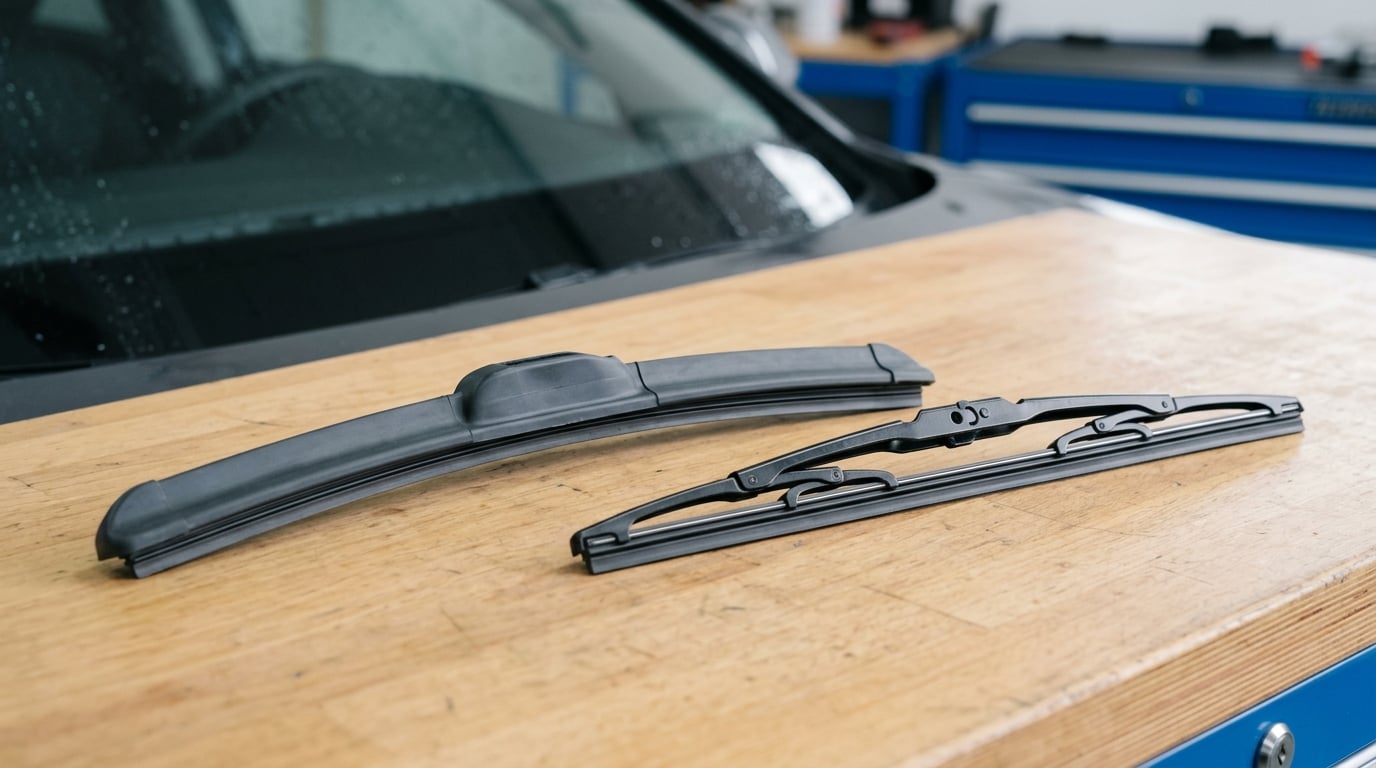
Winter wiper blades are better only if you drive in sustained cold with snow, sleet or freezing rain. In a mild climate, a fresh all-season or hybrid blade beats a stiff winter blade hand down. So the honest answer to winter wiper blades vs regular blades comes down to your climate, not the label on the box.
Regular rubber hardens as temperatures drop, so a blade that swept cleanly all summer can start skipping, streaking and chattering at 28 degrees. Winter blades are built to avoid that, at the cost of feeling stiff and noisy in warm weather.
I have swapped blades on enough cold-morning vehicles to know the failure I care about most: a blade that freezes to the glass and never re-seats. Everything below is organized around whether that happens to you, and what to do about it.
Table of Contents
- Winter Wiper Blades vs Regular Blades at a Glance
- What Are Winter Wiper Blades?
- What Are Regular Wiper Blades?
- Winter Wiper Blades vs Regular Blades in Cold Weather
- Which Type Handles Snow and Ice Better?
- How Do Noise, Streaks, and Durability Compare?
- Winter Wiper Blades vs Regular Blades: Price and Maintenance
- Which Should You Choose?
- Frequently Asked Questions
- Bottom Line
Winter Wiper Blades vs Regular Blades at a Glance
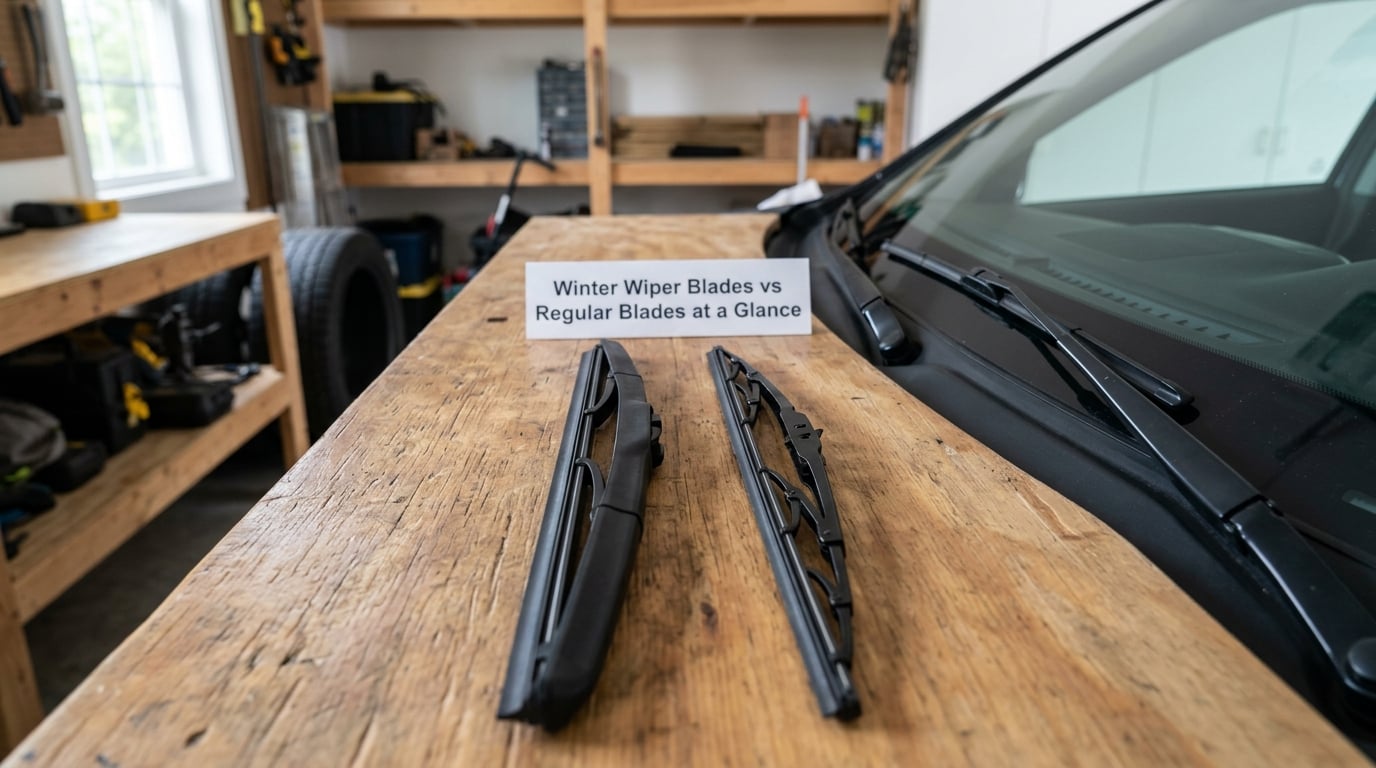
The table below puts the three common types side by side so you can see where each one wins before reading further.
| Attribute | Winter Blades | Regular Framed Blades | Hybrid / All-Season Blades |
|---|---|---|---|
| Rubber compound | Cold-rated, stays flexible below freezing | Standard compound, stiffens in cold | General-purpose, moderate cold tolerance |
| Frame and hardware | Bridge and fittings wrapped in a rubber boot | Open metal frame, exposed hardware | Often a beam design with few exposed parts |
| Snow and ice | Ice has no exposed metal to bridge across | Slush packs into the frame and can freeze the blade down | Better than framed, still collects some ice |
| Below-freezing flex | Keeps full contact with cold glass | Skipping and streaking are common | Varies by model |
| Freezing rain and slush | Strongest option | Weakest option | Adequate for occasional events |
| Noise in warm weather | Louder, more chatter | Quiet on fresh rubber | Closest to a regular blade |
| Wet-weather wiping | Fine, not its strong suit | Excellent when new | Excellent when new |
| Relative cost | Highest of the three | Lowest | Mid-range |
| Best fit | Snowbelt, mountain and freezing-rain driving | Mild climates, light seasonal snow | Year-round use in variable climates |
| Service life | About the same, roughly a year | About the same, roughly a year | About the same, roughly a year |
What Are Winter Wiper Blades?
Winter wiper blades are a distinct style of windshield wiper built for sustained cold. They use a rubber compound that stays flexible below freezing, and they cover the frame, bridge and hardware in rubber so ice and slush have nowhere to collect and bond the blade to the glass.
That rubber covering is usually called a sheath, boot or ice-guard, depending on the brand. Owners on the forums describe the same construction consistently: a rubber sleeve stretched over the spine of the blade, with every metal fastener tucked inside it. Rain-X, Anco, Bosch, Trico and PIAA all sell versions built this way, in framed or beam styles.
They are a real product category, not a marketing trick. If you see a blade described as a winter or cold-weather blade, expect the covered bridge and a cold-rated compound. That is the whole difference.
What Are Regular Wiper Blades?
Regular blades come in two shapes. Conventional framed blades have a visible metal or plastic frame with a hinged rubber insert, and hybrid blades are the common middle ground: mostly frameless beam construction with a small connector at the top.
Both are built for mild and warm conditions, and both wipe beautifully in ordinary rain when the rubber is new. Owners running beam designs report they feel markedly better than the factory blades their vehicles came with, in rain as much as anything else.
The limit is temperature. Once the glass is cold, the rubber hardens and needs more downward pressure to stay bent against a curved windshield. You get skipping at the edges first, then streaks, then noise. That is a wear-and-temperature problem, not a design problem.
Winter Wiper Blades vs Regular Blades in Cold Weather
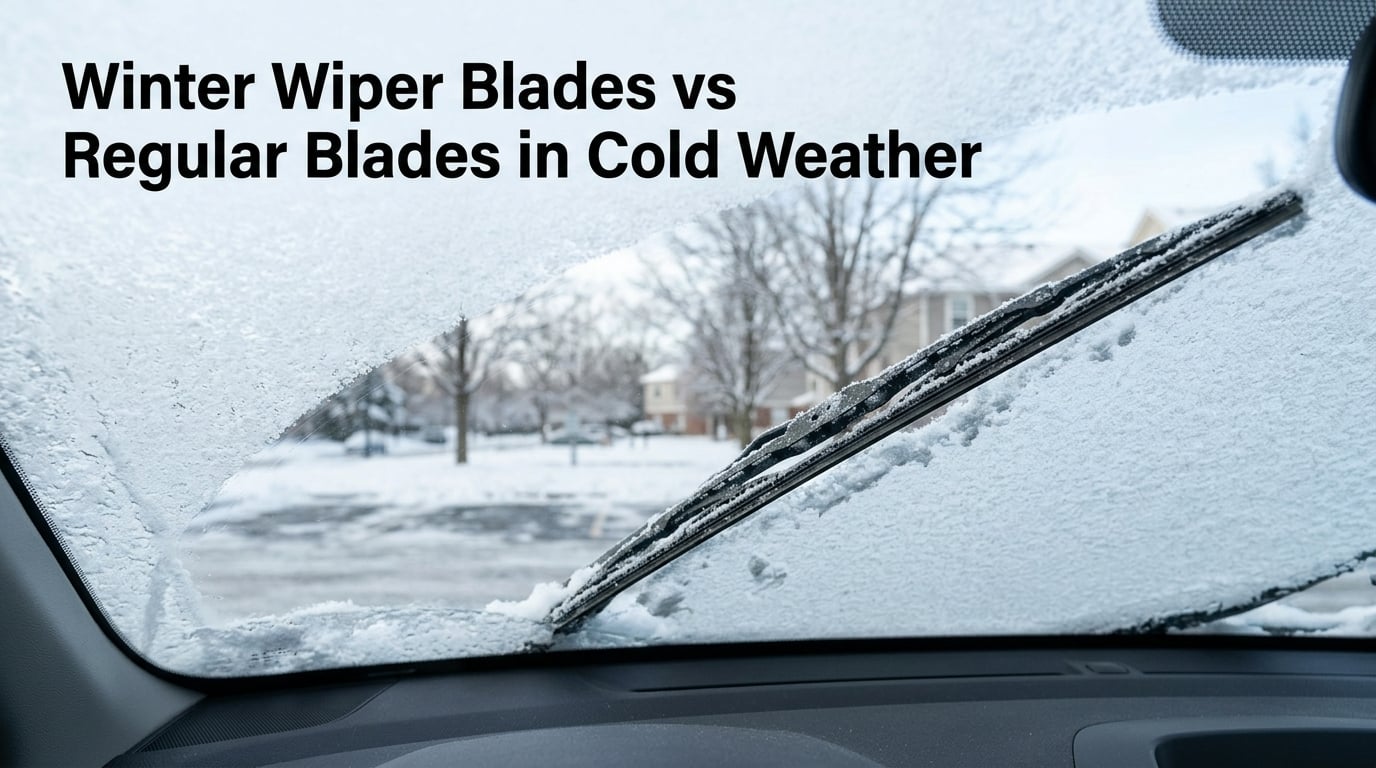
Cold weather makes the difference real because both failure modes show up at once. Rubber gets stiff, and moisture turns to ice. A regular framed blade has somewhere for that ice to sit; a winter blade does not.
Worth being straight about the beam design caveat: self-aligning beam blades have a specific winter weakness. Once ice builds on them, they can deform and go out of shape, and an out-of-shape beam blade does not lie flat anymore. One owner put it plainly on a VW forum: self-aligning wipers are never really good for winter conditions.
There is a second, sneakier failure with a heated windshield. Owners report that too much heat melts snow, which then refreezes on the blades and glass and makes the sticking problem worse, not better.
So in cold weather, winter wiper blades vs regular blades is really a choice between keeping contact with the glass and risking chatter when it warms up.
Which Type Handles Snow and Ice Better?
Winter blades handle light snow and slush best, and freezing rain better than anything else you can fit. The reason is mechanical: slush needs somewhere to go, and a rubber-sheathed bridge gives it nowhere to pack in.
None of them removes built-up ice. If you wake up to a quarter inch of ice on the windshield, a plastic scraper or a defroster clears it, and no blade type on the market changes that. The blades are for the pass after the glass is clear.
After a plow or a storm has left slush, the order of preference is winter blades first, hybrids a close second, conventional framed blades last. Rated on freezing rain specifically, winter blades win and the other two are close to a coin flip.
How Do Noise, Streaks, and Durability Compare?
Chatter is the honest downside of winter blades, and almost every owner who complains about it says the same thing: they are stiff, so they skip on warm glass. Friction chatter on a hot summer afternoon is the reason people take them off in spring.
Streaks tell a different story. Streaking on a warm day is usually a worn blade, not a winter blade. Streaking and skipping on a freezing morning, on a blade with less than a year on it, is a cold-flexibility problem, and that is where winter or hybrid construction earns its keep.
On durability, the three types last about the same. Road grit, salt, sap and UV attack soft winter compounds faster than they attack hard all-season rubber, so plan on replacing winter blades on the same annual schedule as anything else. Keep the rubber and the glass clean, and change them before the season rather than during it.
Installation matters as much as blade type. A blade sitting at the wrong angle or on the wrong adapter never contacts the glass properly, and no compound fixes that.
Winter Wiper Blades vs Regular Blades: Price and Maintenance
Winter blades cost noticeably more than plain framed blades, and hybrids sit in between. Typical US prices vary by region and change over time, so treat any number you see as a snapshot, not a quote.
The more useful comparison is cost per season. Since all three last about the same, the annual figure depends on whether you buy one set of winter blades and run them all year, or keep two sets and swap. Two sets cost more up front and give you a fresh regular blade in summer.
Adapters are the hidden cost. Frames, side-pin, top-lock and bayonet fittings do not interchange, and the wrong one is a trip to a parts counter. Budget a few minutes per blade and check the connector type in your owner’s manual first.
Refresh inserts are the cheapest seasonal strategy and plenty of owners use them, changing the cheap rubber insert at the start of winter rather than buying whole blades. It works, as long as the frame is not rusted or bent.
If your vehicle uses a full wiper assembly where the plastic cover and motor are part of the unit, the replacement jumps well past a simple blade swap. That is a different job with different tools.
Which Should You Choose?
Severe-winter regions: go winter blades, or hybrids if you want one set year-round. If you see freezing rain, lake-effect bands or sustained snow through December and March, this is the clearest case in the whole comparison.
Mild climates with occasional light snow: a fresh hybrid or all-season blade on new rubber is plenty. Owner consensus on the forums is blunt about this: any new blade beats an old one, and replace them more often.
Older vehicles with conventional framed wipers: winter blades are an easy swap, since the frame style is what you are already running. Just verify the length and connector.
Modern vehicles with beam wipers, camera systems or a heated windshield: hybrids are the sensible middle. Read your owner’s manual before fitting anything, because some of these vehicles monitor the wiper system and the arm has to seat correctly.
Budget owners: buy the best fresh regular blade you can, replace it on a schedule, and spend the difference on washer fluid rated for your lowest expected temperature. In a lot of climates that single change matters more than the blade.
BMW owners and anyone with a European or import fitment: measure first. Check the blade length stamped in millimeters on the existing blade and the connector style, because some of these vehicles take a different interface than a domestic equivalent of the same size.
Frequently Asked Questions
Are winter wiper blades really necessary?
Only if you drive in sustained cold. If your winters bring regular snow, sleet or freezing rain and you park outside overnight, winter blades are worth the extra cost because their covered frames and cold-rated rubber keep the blade sweeping. If your winters are mild or you only see occasional light snow, a fresh all-season or hybrid blade on new rubber does the same job.
Can all-weather wiper blades replace winter blades?
In most climates, yes. Modern hybrid and beam blades handle slush, light snow and near-freezing temperatures well, and many owners run them year-round without ever noticing a difference. They fall short in sustained heavy snow or freezing rain, where the rubber stiffens and ice can build on the blade. That is the point where a dedicated winter blade earns its extra cost.
Will winter wiper blades remove ice from a windshield?
No. No wiper blade removes built-up ice, winter or otherwise, and forcing one across a frozen windshield can scratch the glass and damage the rubber. Clear ice first with a plastic scraper or the defroster, then use the blades on the wet, cleared glass. Winter blades help with the slush and freezing drizzle that follow, not with the solid sheet of ice underneath.
Are winter wiper blades compatible with BMW vehicles?
Usually, yes, but the fit depends on the model year and connector style. Many BMW vehicles use a side-pin or a specific bayonet-style fitting, and some import-market cars take a different interface than a domestic vehicle of the same blade length. Check the length stamped on your current blade in millimeters, confirm the adapter type, and consult the owner’s manual before buying.
How often should wiper blades be replaced?
About once a year, and sooner if you notice skipping, streaking or a lip in the rubber. Replace them before winter rather than during a storm, so you are not debugging visibility in bad weather. Winter tires get swapped in September or October for the same reason. If your blades still smear cleanly at that point, you can stretch the interval, but a year is a sensible ceiling.
How do I choose the right size and adapter for my car?
Check two things: the blade length and the connector. The length is stamped on the blade you are removing, usually in inches for domestic blades and millimeters on many import blades. The connector is the fitting that slides onto the wiper arm, such as side-pin, top-lock or bayonet. Match both, and never force a blade that does not slide on without tools.
Bottom Line
Check four things before you buy: how often your temperature actually drops below freezing, what condition your windshield is in, which adapter your arms take, and what your vehicle’s manual says about wiper compatibility. Get those right and the choice narrows fast.
Snowbelt and freezing-rain drivers, winter blades. Everyone else, a fresh hybrid or all-season blade changed on a schedule. The blade type matters far less than having rubber that is actually new.