
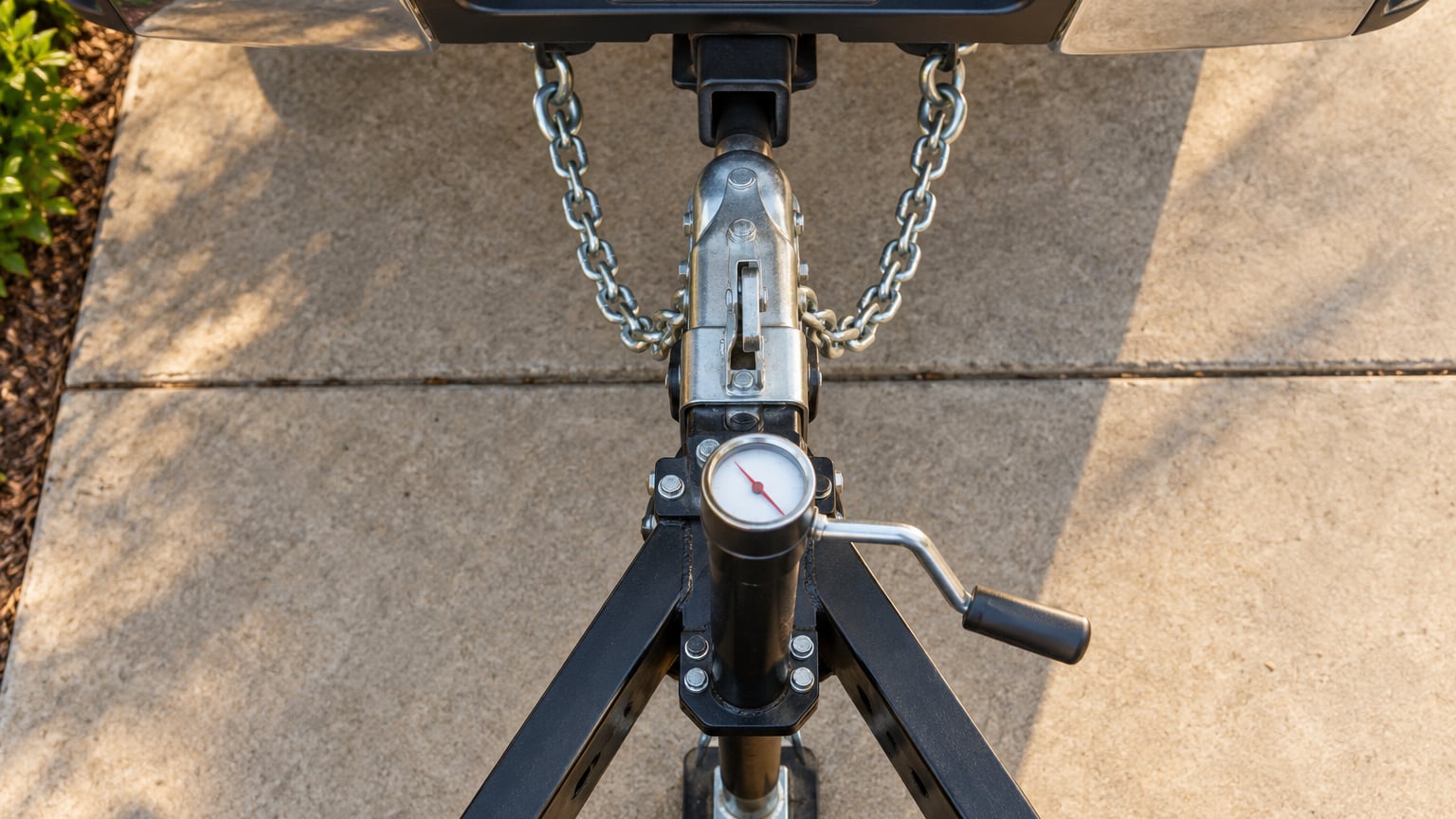
To calculate towing capacity, take your vehicle’s Gross Combined Weight Rating (GCWR) and subtract everything it carries: curb weight, passengers, cargo, accessories and tongue weight. The lowest rating anywhere in the chain wins, and that number is usually well under the headline tow figure in the brochure.
That gap is where most towing accidents come from. A half-ton pickup advertised to pull 13,000 lb might have 9,000 lb of usable capacity once two adults, the hitch, and a fully loaded trailer are counted.
The six steps below take about 30 minutes with your owner’s manual and a trailer spec sheet. If the numbers still disagree with each other, a qualified trailer dealer or a mobile weighing service can settle it in ten minutes.
Table of Contents
- What You Need Before You Start
- What Each Weight Rating Means
- How to Calculate Towing Capacity Step by Step
- Step 1: Find your vehicle’s exact maximum towing rating
- Step 2: Check payload, passengers and cargo
- Step 3: Confirm the trailer’s loaded weight
- Step 4: Verify hitch, ball and coupler capacity
- Step 5: Account for tongue weight and weight distribution
- Step 6: How to Calculate Towing Capacity for Your Own Rig
- Worked example: a half-ton pickup and a 25-foot travel trailer
- How to measure tongue weight at a truck scale
- US trailer brake rules that affect your setup
- Common mistakes that overload a towing setup
- Frequently Asked Questions
- Conclusion
What You Need Before You Start
You can work through this with paper and a pen. Everything you need is either printed on your vehicles or measurable at a truck scale.
- The owner’s manual for your tow vehicle, matched to the exact model year, engine, drivetrain and trim. Tow ratings change with configuration, so a manual for a different axle ratio will give you a number that does not apply to your truck.
- The Federal Certification Label on the driver’s door jamb. This sticker lists GVWR, GAWR for front and rear axles, and the combined weight rating if the vehicle is approved for towing.
- The trailer’s VIN plate or compliance plate, which carries the trailer GVWR, unloaded weight and, on some models, the empty weight including full propane.
- The hitch rating placard on the receiver or ball mount, giving its class and its maximum pull weight.
- Access to a truck scale or public weighbridge if you want measured numbers instead of brochure estimates.
- Your real cargo list, including passengers, hitch hardware, fuel, tools, water, propane, batteries and anything in the bed or on the roof.
The rule underneath all of this is simple. Every vehicle, hitch and trailer in the combination carries its own rating, and the lowest-rated component sets the safe limit. A 16,000 lb truck does not help you if the trailer’s plate says 7,500 lb.
What Each Weight Rating Means
Most confusion in this topic comes from mixing up abbreviations that all end in the same letters. These are the ones that matter, and where each number physically lives.
| Rating | What it means | Where to find it |
|---|---|---|
| GVWR (Gross Vehicle Weight Rating) | The most the tow vehicle may weigh, fully loaded, including passengers and cargo. It is a vehicle limit, not a towing limit. | Door-jamb label and owner’s manual |
| GCWR or GCVWR (Gross Combined Weight Rating) | The most the tow vehicle plus its trailer may weigh together. This is the number your real towing capacity comes from. | Door-jamb label, manual, manufacturer towing guide |
| GAWR (Gross Axle Weight Rating) | The per-axle limit, front and rear. The rear figure is the one that fails first when tongue weight is too high. | Door-jamb label |
| Payload | Everything you can put on the vehicle: people, cargo, hitch, fuel, accessories. It equals GVWR minus curb weight. | Door-jamb label or GVWR minus curb weight |
| Curb weight | The vehicle as it sits at the dealer: full fuel, no cargo, no passengers. A starting point, never a loaded weight. | Owner’s manual, window sticker, or a scale |
| Tongue weight | The share of the trailer’s weight carried by the hitch ball, typically 10% to 15% of a loaded travel trailer. | Scale, coupler label, or trailer documentation |
| Tow rating | The maximum trailer weight a properly equipped vehicle may pull, and only with the rated hitch, brakes and tow package present. | Manual and manufacturer towing guide |
| Braked vs unbraked rating | Trailer brakes change the rating dramatically. Published unbraked limits in the US are usually 1,000 lb or less. | Trailer VIN plate and brake rating sticker |
| Hitch class | The receiver’s own capacity, from Class I at 2,000 lb through Class V at 18,000 lb, with matching tongue weight limits. | Placard on the hitch |
| Tire load rating | The maximum weight each tire can carry. Four tires can limit a heavy half-ton before the axles do. | Moulded into the tire sidewall |
Note the distinction that trips people up: GVWR is about the vehicle alone, GCWR is about the vehicle plus trailer. GCWR versus GVWR is the difference between a number that looks comfortable and a number you can actually use.
How to Calculate Towing Capacity Step by Step
Six steps, in order. Do not skip step two, because measured loaded weight is almost always different from the number in the brochure.
Step 1: Find your vehicle’s exact maximum towing rating
Start in the owner’s manual, in the towing section, and look for the conventional trailer rating for your exact configuration. Match engine, drivetrain, axle ratio, cab size and whether the factory tow package is fitted, because the same truck in two-wheel drive and four-wheel drive is often rated differently.
Then read the door-jamb label and record four numbers: GCWR, GVWR, rear GAWR and payload. Write them down in one place. If the tow rating is not listed anywhere, your fallback is GCWR minus curb weight minus roughly 20% of curb weight held back for people and cargo, which is deliberately conservative.
If the sticker is faded and no manual exists, a VIN lookup against the manufacturer towing guide for that model year can recover the rating. It is worth the ten minutes.
Step 2: Check payload, passengers and cargo
Available payload for towing equals payload rating minus everything else that rides on or behind the tow vehicle. People first, then the hitch and its wiring, then cargo, then accessories such as a bull bar, bed cover, drawer system, roof rack or a long-range fuel tank.
Worked sub-example: a truck with a 2,000 lb payload rating carrying two adults at 350 lb each, 250 lb of gear, 60 lb of hitch and wiring, plus 1,000 lb of tongue weight uses 2,010 lb. That truck is already over its payload limit before the trailer moves.
Also check the rear GAWR and tire load ratings, because payload can look fine while a single axle or tire is already at its ceiling. If your truck squats noticeably under load, the rear axle is usually telling you something the payload number has not yet caught up with.
Step 3: Confirm the trailer’s loaded weight
A trailer GVWR is a ceiling, not a typical weight. The number on the plate is the most the trailer is certified for, and plenty of owners quietly exceed it, which is exactly what the certification is there to prevent.
Build the real figure instead: empty weight from the VIN plate, plus propane at its full 20 lb tank weight, plus water and waste, plus batteries, plus gear, furniture and anything in storage compartments. That sum is the trailer’s loaded weight, and it is the number you compare against the vehicle’s remaining capacity.
Uncertainty here is worth resolving. If you are near a limit, a scale pass on the loaded trailer gives you a measured number instead of a sum of estimates, and it usually takes less time than the argument you would have about which estimate is right.
Step 4: Verify hitch, ball and coupler capacity
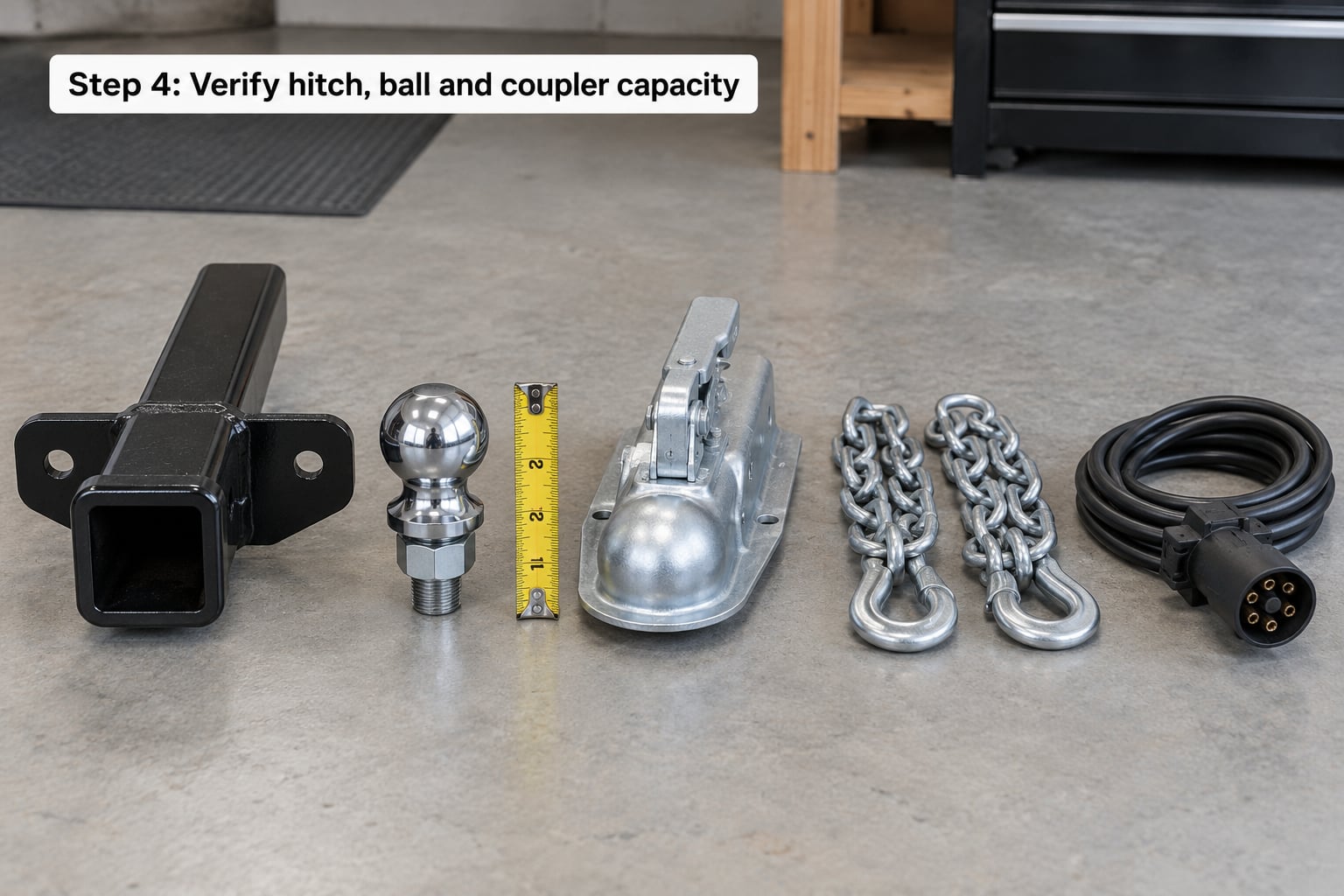
The weakest link decides the combination. A Class III receiver capped at 5,000 lb of pull weight turns a 13,000 lb tow rating into a 5,000 lb setup, no matter what the truck sticker says.
| Hitch class | Maximum pull weight | Maximum tongue weight |
|---|---|---|
| Class I | 2,000 lb | 200 lb |
| Class II | 3,500 lb | 350 lb |
| Class III | 5,000 lb | 500 lb |
| Class IV | 10,000 lb | 1,000 lb |
| Class V | 18,000 lb | 2,000 lb |
Also match the ball size to the coupler, check the coupler’s own stamped rating, confirm the safety chains and their anchors are rated for the load, and size the electrical connector and brake controller correctly. Weight-distribution hitches move load forward to the front axle and improve handling, but they increase no certified rating on their own.
Step 5: Account for tongue weight and weight distribution
Tongue weight is not a rounding error. It is roughly 10% to 15% of a loaded travel trailer, closer to a quarter on a dual-axle boat trailer, and up to about a third on a single-axle boat trailer carrying a motor.
Too little tongue weight makes the trailer sway and can cause a loss of control at highway speed. Too much overloads the rear axle, lifts the front tires off the steering and braking line, and can fail before the payload rating is even reached.
Estimate at 15% for a heavily loaded conventional trailer, then measure if you can. The hitch, ball and receiver must all be rated above the tongue weight you carry, and the rear GAWR must still hold with that load added.
Step 6: How to Calculate Towing Capacity for Your Own Rig
Put every limit side by side and take the lowest number. The governing limit is whichever of these is smallest:
- The lowest of GCWR minus your vehicle’s actual loaded weight, or GVWR minus curb weight minus your load
- Rear GAWR, once tongue weight is added behind the axle
- Hitch class pull weight and tongue weight rating
- Trailer GVWR and the trailer’s real loaded weight
- Tire load ratings on both vehicles
- The tow rating for your exact configuration, if the tow package or brake controller is missing
Then leave yourself a margin. Grades, headwinds, cold tyre pressure, a detachable hitch in the bed and heavier loading than planned all eat into the number you calculated on paper. Working near 80% of a governing limit leaves room for a bad day.
Worked example: a half-ton pickup and a 25-foot travel trailer
Here is a full calculation in pounds, with every intermediate number shown so you can audit it.
The tow vehicle is a half-ton pickup with a factory tow package: curb weight 5,300 lb, GVWR 7,300 lb, payload 2,000 lb, rear GAWR 4,800 lb, GCWR 16,000 lb, published conventional tow rating 13,500 lb. The trailer is a 25-foot travel trailer with a GVWR of 8,000 lb and an unloaded weight of 5,600 lb, loaded with water, propane, batteries and gear to 7,400 lb.
| Line | Calculation | Result |
|---|---|---|
| Trailer tongue weight | 15% of 7,400 lb | 1,110 lb, round to 1,100 lb |
| People and cargo | 2 adults at 350 lb, 250 lb gear, 60 lb hitch and wiring | 960 lb |
| Payload used | 1,100 lb tongue + 960 lb load | 2,060 lb against a 2,000 lb rating, over by 60 lb |
| Loaded tow vehicle | 5,300 lb curb + 2,060 lb | 7,360 lb against a 7,300 lb GVWR, over by 60 lb |
| Combined weight | 7,360 lb + 7,400 lb trailer | 14,760 lb against a 16,000 lb GCWR, headroom 1,240 lb |
| Usable capacity by GCWR | 16,000 − (5,300 + 1,100 + 960) | 8,640 lb of trailer |
| Published tow rating | Advertisement | 13,500 lb |
Two lessons. First, the GCWR path says 8,640 lb but payload says 2,000 lb, and payload is the binding limit, so the real answer is lower than either. Second, four passengers and a full tank of firewood would take this setup past its payload and GVWR limits while GCWR still looked comfortable.
Fixing it is simple: leave some gear behind, or set the trailer up to 7,000 lb instead of 7,400 lb, and the same truck has room to spare.
How to measure tongue weight at a truck scale
The method most owners on RV forums recommend is the two-weigh subtraction, and it is easy to do at any public weighbridge or truck stop scale.
- Load the tow vehicle completely. Everyone in the seats, all cargo, hitch installed, fuel at driving level. This is the weight you would actually pull from.
- Weigh the tow vehicle alone. Drive onto the scale, stay in the cab, record the total. Call it A.
- Back onto the scale with the trailer attached. Keep the same driver and the same setup, record the total. Call it B.
- Subtract. B minus A is the weight the trailer puts through the hitch ball.
- Convert to a percentage. Divide by the trailer’s measured or computed loaded weight to get your true tongue weight percentage.
Two details matter. Weighing twice in the same session on the same scale removes most of the fuel and tyre-pressure variance. And if you weigh the trailer alone as a third measurement, the difference between the combination and the trailer gives you the vehicle’s actual loaded weight, which you can check against GVWR.
US trailer brake rules that affect your setup
Federal Motor Vehicle Safety Standard 121 requires brakes on trailers with a GVWR of 1,000 lb or more, which covers most anything you would hitch to a car or light truck. Many states add a combined-weight trigger on top of that, commonly at a GCWR of 3,000 lb.
This matters for more than legality. A tow rating that assumes trailer brakes does not apply to a combination without them, and a brake controller has to be matched to the trailer’s brake rating. It also matters at claim time: many insurance policies treat an overloaded or unrated combination as excluded, and that argument only happens after the incident.
Common mistakes that overload a towing setup
Using the brochure number without accessories. A bull bar, bed cover, drawer system, roof rack or long-range tank is added weight the factory figure never saw. Weigh the truck as you will actually use it.
Double-counting the trailer in the GCWR math. GCWR already covers vehicle plus trailer. Subtract your loaded vehicle weight, add the tongue weight, and compare the trailer’s own weight separately. Counting the full trailer twice makes the answer look worse than it is and sends people down the wrong path.
Treating trailer GVWR as a typical weight. It is a certified maximum. Assume you will be near it and load for it.
Ignoring payload until the truck squats. Payload, not towing capacity, is usually the first limit to fail, and squat is the visible warning that it already has.
Overloading the ball or ignoring tongue weight. More tongue weight is not safer. It pushes the rear axle past GAWR and takes steering grip away.
Forgetting that a tow package is not transferable paperwork. The rated tow figure assumes the rated hitch, wiring, brake controller and cooling. Aftermarket parts do not restore it.
Skipping the recheck before departure. After adding a canopy, a second battery, firewood or a bike rack, run the numbers again. The trip you planned is not always the trip you load.
Frequently Asked Questions
What is the formula for calculating towing capacity?
Subtract your tow vehicle’s actual loaded weight from its Gross Combined Weight Rating. Usable capacity equals GCWR minus curb weight, passengers, cargo, accessories and tongue weight. The result must also stay within your rear GAWR, hitch class rating, trailer GVWR and tire load ratings, and the lowest of those numbers is what governs.
Where do I find my towing capacity?
Check the driver’s door-jamb Federal Certification Label first, then the towing section of your owner’s manual for your exact engine, drivetrain and axle ratio. If both are gone, look the model year up in the manufacturer towing guide or by VIN. Read the rating for conventional trailers and confirm the tow package is actually fitted, because the number assumes it.
How do I calculate tongue weight?
Multiply the trailer’s loaded weight by 0.15 for a heavily loaded conventional trailer, or use the 10% to 15% range. Dual-axle boat trailers run closer to a quarter of the loaded weight, and single-axle boat trailers carrying a motor can reach a third. For a real number, weigh the tow vehicle alone, weigh it coupled, and subtract.
How much can I tow if my GVWR is 7,000 lbs?
It depends on your curb weight, which a GVWR alone does not tell you. With a curb weight near 4,200 lb you have roughly 2,800 lb of payload. Subtract two adults, gear and hitch hardware, say 800 lb, and you are left with about 2,000 lb, minus tongue weight. At 15% that puts a realistic loaded trailer near 1,700 lb.
What is the 80% rule for towing?
It is a self-imposed margin, not a law or a factory rule. Staying at or under 80% of your lowest governing limit leaves room for grades, wind, tyre pressure changes and load you did not plan for. If your calculated limit is 8,000 lb, plan to tow about 6,400 lb in ordinary conditions.
Can a half-ton truck pull an 8,000 lb camper?
Only if the numbers line up, and the camper’s own GVWR is rarely the number to use. Compare its real loaded weight against your usable capacity after passengers, cargo and hitch are counted, then check tongue weight against payload and rear GAWR. Many half-tons manage it; many of the same trucks with four adults in the cab cannot.
Conclusion
Start with the tow vehicle’s exact tow rating from the door-jamb label and the manual for your configuration. Subtract passengers, cargo, accessories and tongue weight from your payload, confirm the trailer’s real loaded weight and the hitch class rating, then use the lowest of those limits with a safety margin on top.
Where specifications conflict or a sticker is missing, check the owner’s manual and ask a qualified trailer professional before you hitch up. Guessing costs far more than a scale ticket.