
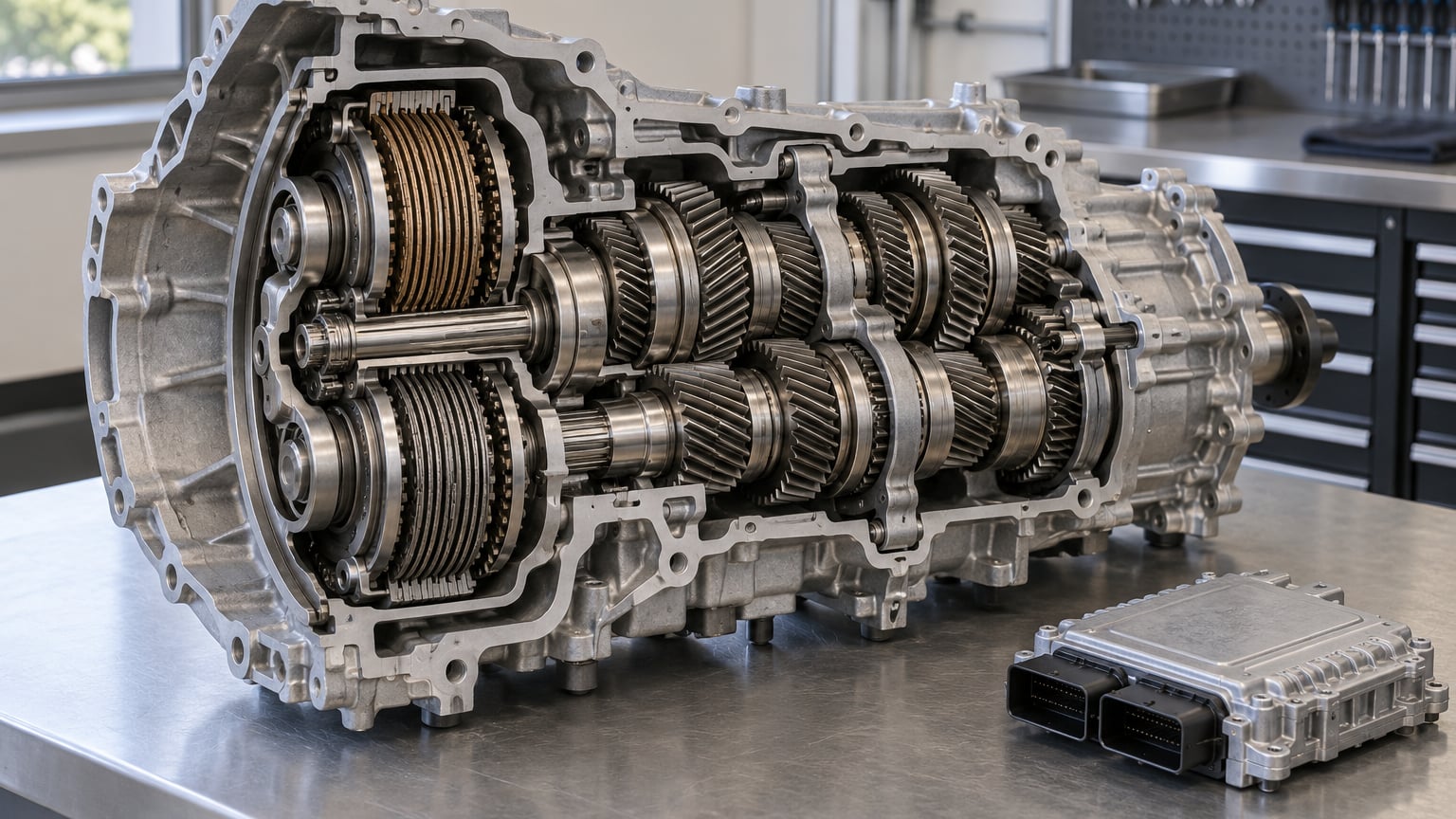
A dual clutch transmission is an automated manual gearbox: two separate clutches sit on two concentric shafts, one carrying the odd gears and one carrying the even gears, so the next gear can be selected and held ready before the driver asks for it. Because one clutch opens as the other closes, torque keeps flowing to the wheels throughout the change. That single idea explains both the near-instant shifts and the low-speed jolt people either love or complain about.
This is the dual clutch transmission explained the way a mechanic would walk you through it on a lift, without the marketing language. It is current for 2026 models and covers the engineering, how it feels from the driver’s seat, what service it needs, and the faults worth acting on early.
Table of Contents
- How Does a Dual Clutch Transmission Work?
- What Is the Difference Between Dual-Clutch and Traditional Automatic Transmission?
- Why Does a Dual Clutch Transmission Shift So Quickly?
- How Do Drivers Use a Dual-Clutch Transmission?
- Is a Dual Clutch Transmission Reliable?
- What Maintenance Does a Dual Clutch Transmission Need?
- What Problems Do Dual Clutch Transmissions Have?
- Frequently Asked Questions
- Is a dual-clutch transmission automatic or manual?
- Why does my dual-clutch transmission jerk or hesitate?
- Does a dual-clutch transmission use more fuel?
- How often should dual-clutch transmission fluid be changed?
- Can I drive normally when a dual-clutch warning light is on?
- How does a dual-clutch differ from a manual transmission?
- Conclusion
How Does a Dual Clutch Transmission Work?
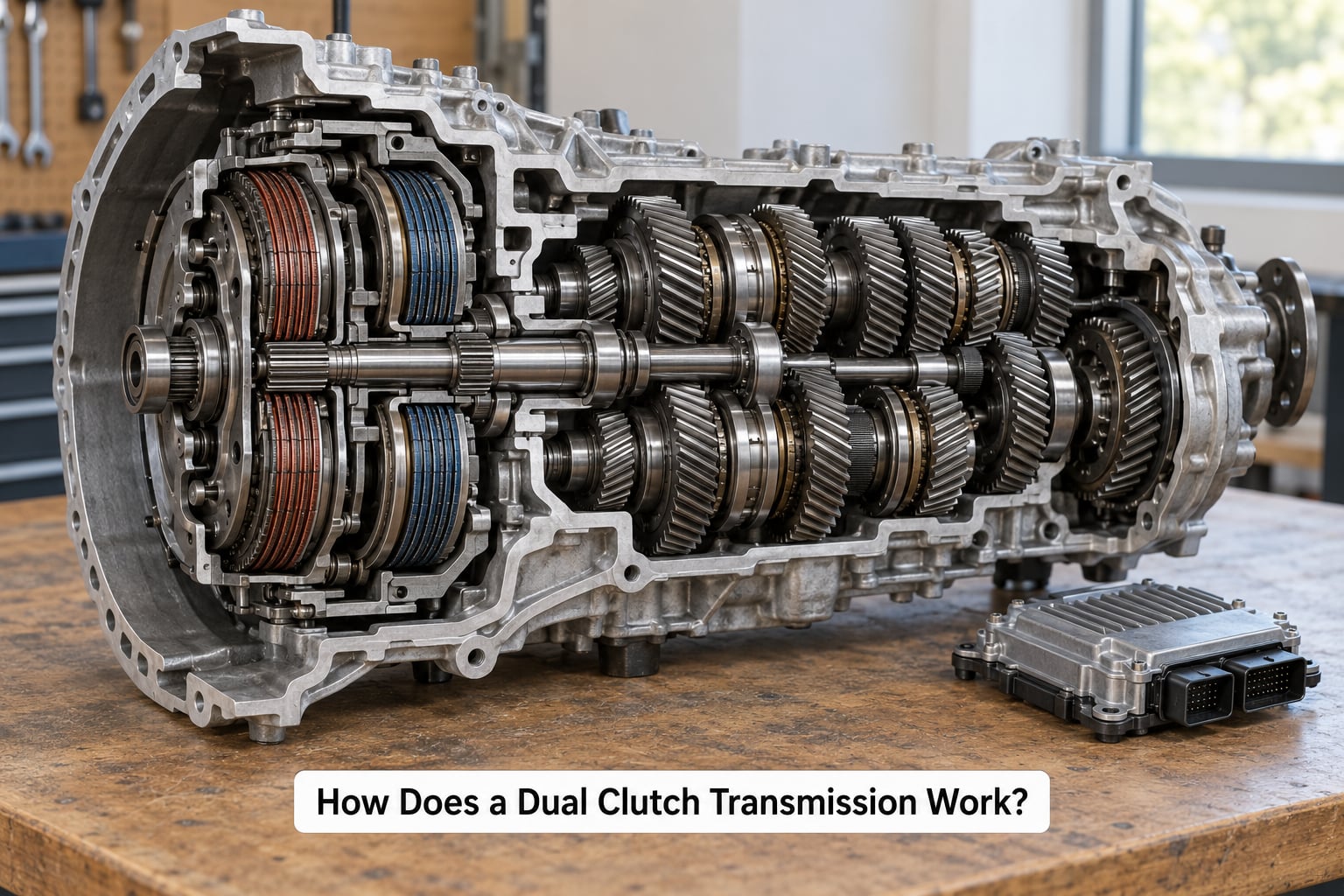
The dual-clutch setup at a glance
- Two clutches, two jobs. Each clutch connects the engine to one set of gears, and the gearbox can only drive through one at a time.
- Concentric input shafts. A hollow outer shaft carries the outer clutch; a solid inner shaft runs inside it and carries the inner clutch.
- Odd and even split. First, third, fifth and seventh sit on one shaft. Second, fourth and sixth sit on the other.
- One output shaft. Both input shafts drive the same output shaft through dogs, so power leaves the gearbox the same way regardless of which clutch is closed.
- A transmission control unit (TCU) reads pedal position, wheel speed, throttle and gear signals, then commands shift forks and hydraulic actuators.
- A mechatronic module in many designs combines that controller with the solenoids and actuators, turning electrical commands into clutch pressure.
Strip the packaging away and the gearbox is two manual transmissions living in one housing. You can hear this in the mechanical layout rather than any clever trick: the gears are ordinary straight-cut helical gears, the shafts are concentric rather than side by side, and the whole assembly is bolted to the engine through a dual-mass flywheel.
That flywheel matters more than people expect. In a manual, the clutch slips while the engine matches speed to the car. Here, engine rpm never has to drop to a crawl and catch back up, which is where the fast response and the fuel economy gain both come from.
Gear ratios differ a lot between manufacturers, so treat published torque capacity figures with care. Supplier units for passenger cars are quoted around 750 Nm, while units built for heavier torque demand are quoted as high as 1,250 Nm. BorgWarner, Getrag, ZF, Tremec, Ricardo, LuK and Hyundai Transys all build units in this family.
What the controller does during one gear change
Say you are in third and ask for fourth. Third is an odd gear, fourth is an even gear, so the shift crosses between the two clutch packs. Here is the sequence, and it is usually already finished before you notice it happening.
- Pre-selection. While you were in second and third, the TCU already commanded fourth into place on the even shaft. The gear is physically meshed and waiting.
- Pre-loading. The even clutch was brought close to bite with just enough pressure to hold the shaft steady, ready to take load instantly.
- Overlap. The odd clutch releases and the even clutch applies at the same time. Torque transfers across with no open moment, which is why there is no interruption in acceleration.
- Confirmation. Output speed, engine rpm and slip are checked. If they do not line up, the controller flags a fault and may fall back to a protective mode.
- Same-gear shifts. Going from first to second or third to fourth stays on one shaft. One pack opens, the other closes, and the dogs swap the drive path.
What Is the Difference Between Dual-Clutch and Traditional Automatic Transmission?
The real difference is how torque gets from the engine to the gearbox. A traditional automatic uses a torque converter, a fluid coupling that multiplies engine torque at low speed and allows slip. A dual clutch has no converter at all. It has two friction clutches that lock mechanically, which is why the response feels like a manual with an automatic’s convenience.
Side by side, the two layouts differ in a handful of ways that show up in everyday driving:
- How power is delivered. A dual clutch uses two friction clutches on concentric shafts. A converter automatic uses a fluid coupling driving a planetary gear set.
- Typical gear change. Roughly 100 milliseconds on a dual clutch, noticeably longer and softer by design on a converter box.
- Fuel economy effect. Often 6 to 20 percent better than a comparable converter box, because part-load converter slip is gone.
- Low-speed feel. Minimal creep, and a possible lurch on a careless start. A converter box has strong creep and a very smooth pull-away.
- Tow and heavy load. Depends on torque capacity, and many dual clutch units are heat-limited. Converter automatics are generally stronger at low speed.
- Where wear concentrates. Clutch packs, actuators, mechatronics and fluid on one side; clutch packs, valve body, fluid and converter on the other.
That trade is the whole story. You get faster shifts and better economy, and you give up the converter’s forgiving, slip-heavy behaviour. Stop-and-go traffic is where that difference shows up most, because a dual clutch is repeatedly closing and opening small plates at low speed instead of idling a fluid coupling.
A continuously variable transmission sits in a different category entirely. A CVT varies pulley ratio rather than stepping through fixed gears, so it is smooth and cheap to build but puts high belt loads through a drivetrain that feels nothing like a manual. Comparing a CVT to a dual clutch is really a comparison of two different compromises.
Why Does a Dual Clutch Transmission Shift So Quickly?
Because the work is done before you ask. The gearbox is always one gear ahead, sitting in neutral on the clutch you are not using, with the next gear already meshed and that clutch pre-loaded to just under bite. When the shift command arrives, it is a pressure change rather than a mechanical event, and pressure changes are fast.
A manual gearbox typically takes somewhere around 200 to 400 milliseconds to complete a gear change with two pedal inputs and a human decision. A dual clutch manages it in roughly a tenth of a second, and a well-calibrated sports version can do it faster again. That is where the gap in acceleration figures comes from, particularly where a converter automatic is still waiting for the torque multiplication phase to wind down.
Two honest caveats. Shift speed is a calibration outcome, not just hardware, so a softer factory mode will be slower than a sportier mapping on the same unit. And under hard acceleration, a launch or a low-speed full-throttle request, the gearbox may hold a gear longer or allow more clutch slip to protect itself from heat. Slowness in those conditions is usually the system protecting the clutches, not a fault.
How Do Drivers Use a Dual-Clutch Transmission?
Daily use is close to an automatic, with manual override available when you want it. Most units of this type carry drive modes such as Eco, Normal and Sport, and many have steering-wheel paddles that hand you sequential control without interrupting the automatic logic.
Using the paddles properly matters more than most owners expect. A single tap usually requests one gear, and holding the paddle requests the lowest gear the current road speed allows. Ask for a gear the gearbox cannot deliver and it will downshift aggressively, which is unsettling on a damp road. The logic is designed around what a manual driver would do, so thinking one step ahead keeps everything smooth. Our guide to driving a manual transmission smoothly applies here more than you would expect.
The habit to change is crawling. A torque-converter car creeps on its own, and drivers happily feed that slack. A dual clutch barely creeps, so the same habit means repeated clutch engagement, wear on the discs, and heat in a unit that is already tight on cooling. Holding the brake, selecting a gear, and rolling off deliberately is kinder to the gearbox than a slow start in dense traffic.
How a dual clutch transmission handles a hill start
It needs a little more driver input than an automatic and it gives back something useful. There is no torque multiplication, so a hill start is a genuine clutch event. On a manual you would use the clutch and a bit of throttle; here the system does the balancing, but it still wants you to hold the brake, choose first, feed in throttle deliberately, and let the clutch take up rather than leaning on the pedal.
What a healthy box feels like is unremarkable: crisp engagement, no pause when the throttle goes down, no flare on upshifts, and a gentle idle crawl if you leave it in drive. If the car surges, hunts between gears or shudders when pulling away, that is information rather than personality. We covered the difference in more detail further down.
Paddle use on a road car is fine. Repeated full-throttle launches, track days and drag-style standing starts are the use case that wears these units fastest, because every launch dumps energy into clutch plates and flywheel as heat. If your car has launch control, treat it as an occasional feature rather than something to try on every red light.
Is a Dual Clutch Transmission Reliable?
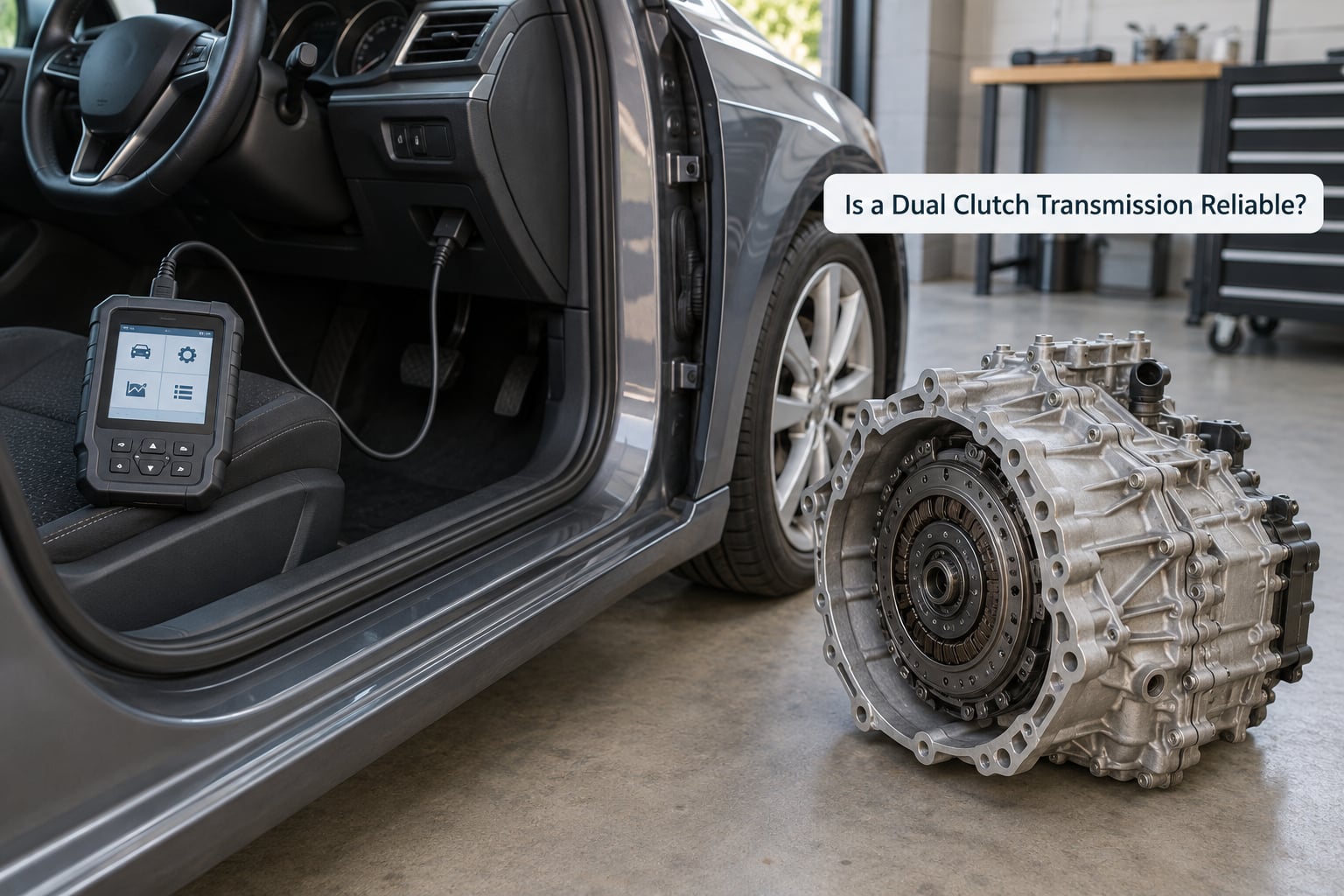
Broadly, yes, and a properly serviced one can outlast the car around it. There is no torque converter to fail and no planetary gearset to wear out. The friction parts are straightforward discs and plates, and the shafts are conventional. The complication is that almost all the intelligence lives in software, sensors and the mechatronic module rather than in the metal.
That split is why opinions on dual clutch reliability swing so hard. Owners of Porsche PDK units frequently report the gearbox outlasting rival systems when fluid services were done on schedule, and that is a common pattern. On the other side, long-running debates on r/Hyundai and r/KiaNiro centre on whether the Hyundai and Kia 7DCT dry-clutch design is fundamentally flawed, with owners describing shudder and hesitation well before the odometer is impressive. Ford owners on r/FordFocus and focusfanatics tend to raise a different concern: quotes for a full transmission replacement on cars with only moderate mileage.
Rather than ranking brands, the useful pattern is this. Design quality, fluid service history and software maturity matter more than the badge. Early implementations were built to a price and later ones were not. Vehicles with a documented fluid service history, even when done outside the dealer, generally fare better than those with none.
One more structural point. Some cars pair a dual clutch with a torque converter instead of a flywheel, which trades a little shift speed for a lot more launch smoothness and low-speed tractive effort. It is a sensible compromise, and it means the label alone tells you very little about how the car drives.
What Maintenance Does a Dual Clutch Transmission Need?
Fluid is the item that matters most, and it is not interchangeable with ordinary automatic transmission fluid. Many units need a dedicated DCT fluid with a specific friction characteristic; some are fill-for-life by design and are not intended to be serviced. Check the owner’s manual before anything is drained, because our piece on the transmission fluid lifetime fill myth explains why that wording is so often misunderstood.
A practical checklist:
- Confirm the interval first. Manufacturer schedules vary widely, from fill-for-life to scheduled changes. Treat the manual as the source and the interval as guidance, not opinion.
- Change fluid and filter together. On units that are serviced, a drain-and-fill with a fresh filter is the minimum worth doing.
- Use the specified fluid only. The wrong friction modifier shows up as shudder, slip or harsh engagement, and it accelerates wear in the clutch plates.
- Have the mechatronics checked. A scan for adaptation and fault codes during service costs little and can reveal a solenoid or actuator working early.
- Apply software updates when offered. Shift calibration and clutch-pressure management are refined over the life of a model, and a service visit is the right place to ask.
- Note the symptoms while driving. Write down when a shudder or hesitation happens, at what speed and in which gear. That log makes diagnosis dramatically faster.
Timing is worth mentioning because owners repeatedly report a noticeable change after servicing around the 50,000 mile mark. That is a useful data point, not a rule, and it reinforces the general habit of following a published schedule rather than waiting for a symptom. If you want a worked example of how interval documentation is normally organised, our BMW E46 maintenance schedule explained guide walks through the method.
Anything involving removing the gearbox, programming the mechatronics or bleeding the clutch actuators belongs with a qualified technician. This is not a weekend job.
What Problems Do Dual Clutch Transmissions Have?
Almost every complaint you will read about a dual clutch falls into one of a handful of families, and each has a recognisable signature. The difficulty is that a healthy gearbox can imitate a rough one, so it helps to separate character from fault.
- Shudder or vibration at low speed. A light tremor between standstill and around 20 mph, often worse in cold weather, usually points to fluid condition or clutch plate wear. Fluid is the cheap thing to rule out first.
- Hesitation on pull-away. A pause before the car moves, sometimes with a flare afterwards, generally comes from a clutch that is not pre-loading cleanly or from worn actuator seals.
- Hunting or aggressive downshifts. The gearbox searching between gears or dropping several gears when you ask for one is a calibration or adaptation problem, and sometimes an approaching sensor fault.
- Warning lights and limp mode. A transmission warning, a check engine light and reduced shifting usually mean the controller has detected a mismatch and put itself into a protective mode. The car still drives, but the information is stored.
- Noise. A whine that rises with road speed, a grinding sensation or a rattle on engagement points to bearings, dog engagement or actuator hardware rather than the control software.
- Slipping under load. Engine rpm climbing without matching road speed, usually with a flare on upshift, is the one symptom to treat seriously. It is heat and friction damage happening in real time.
There is also a pattern owners describe repeatedly: normalising a jolt as simply what a dual clutch does, then finding genuine wear later. The distinction is mostly about trend. A single odd sensation on a cold morning is not a fault. The same sensation getting stronger over a few months, appearing on a warm day, or coming back after a fluid service is.
Slip, a burning smell, or a warning light that stays on are reasons to stop driving the car normally and have it inspected. Hesitation and mild shudder are reasons to book an appointment and mention the mileage. That distinction is the difference between a few hundred dollars of service and a much larger conversation, and it is also why reading a fault code is worth more than describing the noise from memory.
Frequently Asked Questions
Is a dual-clutch transmission automatic or manual?
Both, mechanically speaking. The gears and clutches are manual-transmission parts, and the driver can select gears with paddles. But a transmission control unit handles the clutch pedal and gear lever for you, so there is no clutch pedal in the car. That is why the technical term is automated manual transmission.
Why does my dual-clutch transmission jerk or hesitate?
Usually one of three things: fluid that has lost its friction characteristic, a clutch pack or actuator that is wearing, or a calibration and sensor issue causing the controller to misjudge engagement. A light shudder under about 20 mph in cold weather is common and often improves with correct fluid. Hesitation that worsens over months is a genuine fault.
Does a dual-clutch transmission use more fuel?
No. Removing the torque converter eliminates the fluid coupling that wastes energy, and the controller keeps the engine nearer its efficient point instead of letting it lug. Compared with a comparable converter automatic, a dual clutch is commonly quoted at roughly 6 to 20 percent better fuel economy. Driving style still matters more than a few percent of gearing.
How often should dual-clutch transmission fluid be changed?
It depends entirely on the design. Some units are fill-for-life and are not meant to be serviced, while others have published change intervals and filter schedules. Check the owner manual for your specific vehicle before draining anything. On units that are serviced, owners commonly report a noticeable improvement following a change around the 50,000 mile mark.
Can I drive normally when a dual-clutch warning light is on?
A protective or limp mode usually means reduced shifting, so gentle driving to a shop is generally reasonable. Do not drive normally in the sense of using launch control, hard launches, or sustained high rpm. If the warning comes with slipping, a burning smell or a flare on upshift, stop using the car normally and have it inspected as soon as practical.
How does a dual-clutch differ from a manual transmission?
A manual gives the driver a clutch pedal and a gear lever, and it is the driver’s job to match engine speed to road speed. A dual clutch keeps manual-type gears and clutch plates but replaces the driver’s inputs with a controller, shift forks and hydraulic actuators. The result is manual-like response with fewer tasks for the driver, at the cost of more electronics to fail.
Conclusion
A dual clutch transmission is two manual gearboxes in one housing, with a controller that picks the next gear before you need it. That arrangement gives quicker shifts and better fuel economy than a torque-converter automatic, and it puts wear into clutch packs, fluid and electronics instead of into a fluid coupling.
If you own one, start by checking the service history for a documented fluid change, then the condition of the fluid if it has never been serviced, then how the shifts feel in each gear, and finally whether any warning message has been stored in the control module. That sequence tells you far more than the badge on the boot does.