
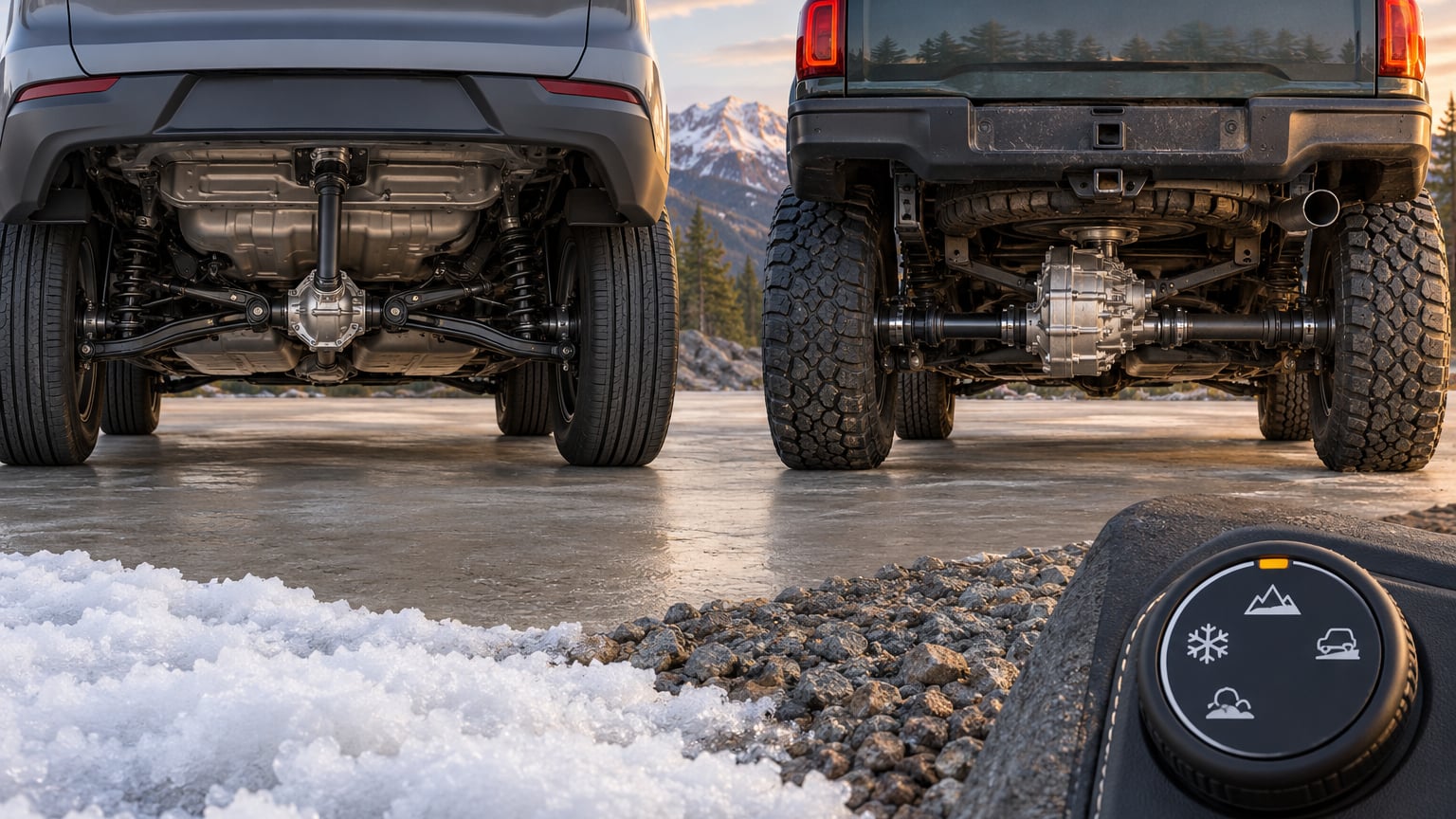
All-wheel drive (AWD) sends torque to all four wheels automatically through a center differential, while four-wheel drive (4WD) uses a transfer case the driver engages, usually with a low range for serious terrain. If you drive mostly on pavement and want help in rain, snow and on gravel, AWD is the smarter buy. If you tow, work unpaved roads or climb trails, you want 4WD with real gearing.
If you came here for AWD vs 4WD explained, that is the whole argument in two sentences. Everything else below is the mechanical detail behind it, because the two terms get blurred together constantly and buyers end up paying for hardware they will never switch on.
One thing up front: a drivetrain is a traction aid for going, not for stopping. Wheels do the braking, and no axle ratio changes that. If you take one idea from this article, take that one.
Table of Contents
- AWD vs 4WD Explained at a Glance
- What Is AWD?
- What Is 4WD?
- How Does AWD Distribute Torque?
- How Does 4WD Distribute Torque?
- Which Drivetrain Has Better Traction?
- How Do AWD and 4WD Affect Performance and Fuel Economy?
- Which Drivetrain Is Better for Towing and Off-Roading?
- AWD vs 4WD Explained for Common Driving Situations
- Which Should You Choose?
- Frequently Asked Questions
- Choose Your Drivetrain by Driving Situation
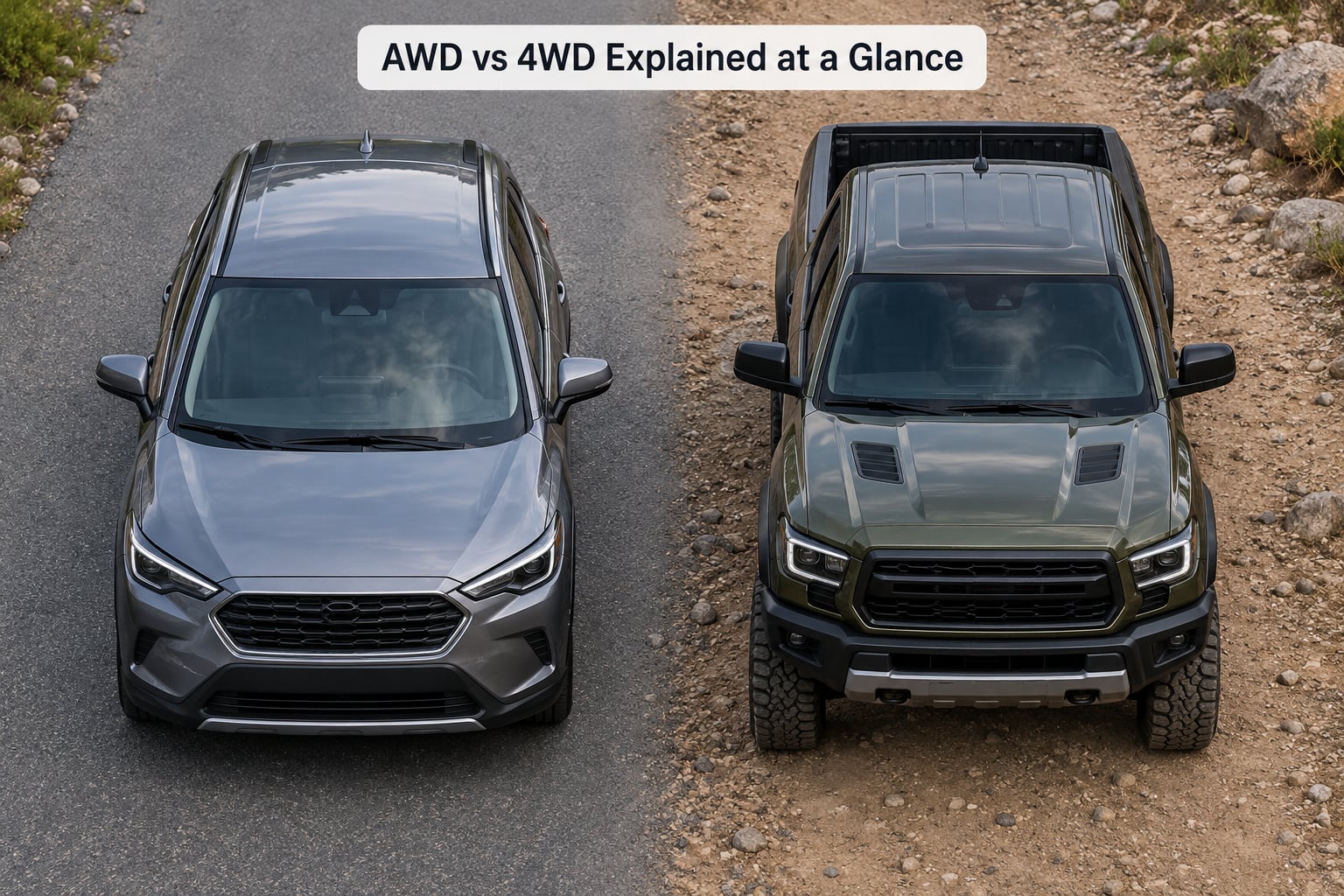
AWD vs 4WD Explained at a Glance
| Attribute | All-wheel drive (AWD) | Four-wheel drive (4WD or 4×4) |
|---|---|---|
| Operation | Always on, no driver input. On-demand systems activate themselves. | Driver selects 2WD, 4WD High or 4WD Low. Part-time systems need a deliberate switch. |
| How it works | Center differential splits torque between the front and rear axles, usually with a bias toward one end. | Transfer case sends torque to both axles and can lock the front and rear driveshafts to one speed. |
| Torque split | Fixed or variable. Common ratios run from a rear bias near 30:70 to a 50:50 split. | High range approximates a straight-through 4WD with no fixed bias. Low range multiplies gearing by roughly 2 to 4 times. |
| Best for | Rain, snow, wet leaves, gravel, long highway commutes, cornering grip. | Deep mud, sand, rock crawling, steep grades, work sites, towing on loose ground. |
| Common vehicles | Crossovers, wagons, sedans, EVs, many SUVs. | Pickup trucks, body-on-frame SUVs, off-road vans, farm and utility vehicles. |
| Mechanics | Center differential, open or limited-slip axle diffs, electronic clutches, sometimes a rear-axle disconnect. | Transfer case, driveshafts, front and rear axles, locking hubs, low-range gearing, sometimes locking diffs. |
| Catch or warning | Heavier, more fuel burned, faster tire wear, more service items. | Using part-time 4WD on dry pavement binds the driveline and can break parts. Never tow a trailer with a part-time system in 2WD. |
One row in that table deserves emphasis before we go further: the warning at the bottom right. It is the single most-repeated piece of drivetrain advice across enthusiast forums, and it is also the one buyers are most likely to ignore.
What Is AWD?
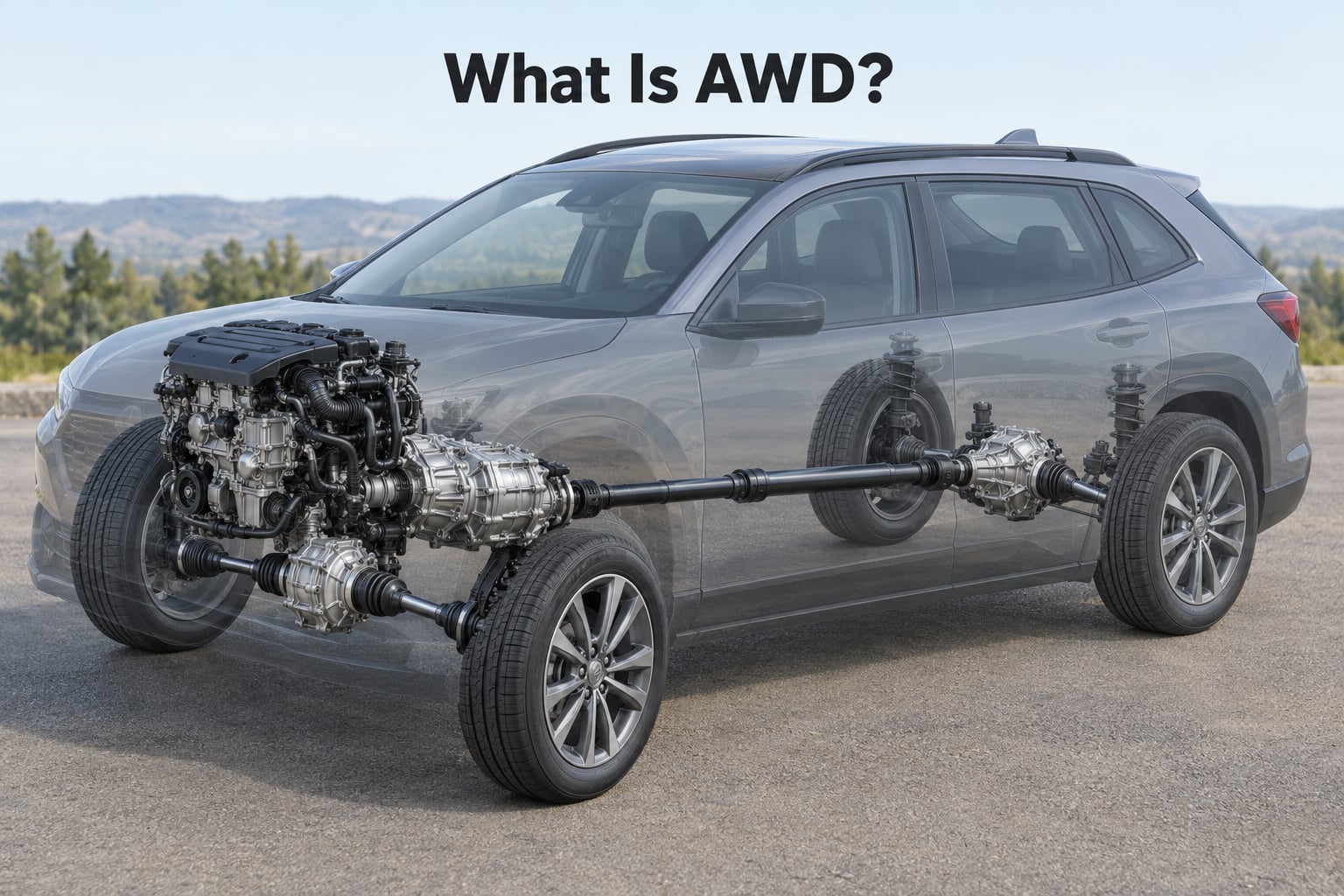
All-wheel drive means engine torque reaches all four wheels, normally through a center differential that allows the front and rear axles to turn at different speeds. The system is normally engaged whenever you start the vehicle, which is why people call it always-on.
That center differential is the part that separates AWD from a solid front axle. A differential lets two wheels on the same axle rotate at different speeds, which the front wheels absolutely need to do in a turn. The center diff does the same job between the front and rear axles.
Permanent AWD vs on-demand AWD
Permanent AWD is wired straight through: torque flows to the rear axle from the moment you pull away. On-demand systems sit in two-wheel drive under light load and bring the rear axle in when the front wheels start to slip, when you ask for it with a button, or when the car notices a hill.
Both are AWD. The marketing sometimes dresses on-demand systems up as something else, and the parts catalogs get blurry, so the badge on the tailgate tells you less than the manual does.
Can you leave AWD on all the time?
Yes. Leaving AWD engaged on dry pavement is normal and safe, because the center differential lets the axles run at different speeds while you corner. The efficiency cost is small, usually a mile or two per gallon, and several manufacturers added rear-axle disconnects to claw some of it back by uncoupling the rear driveshaft at highway speed.
That disconnect is why a modern AWD crossover can return highway numbers that would have been impossible for a permanently driven rear axle. It is also why tire pressure spec sheets matter more, not less.
What Is 4WD?
Four-wheel drive, which is the same thing a 4×4 badge refers to, routes torque from the transmission through a transfer case and out to both axles. The defining feature is not the four wheels. It is the gearing and the locks.
Two arrangements matter here. Full-time 4WD is engaged all the time and is safe on dry pavement, because a center differential allows for the speed difference in a turn. Part-time 4WD has no center diff, so in 4WD the front and rear driveshafts are forced to the same speed, which is exactly what binds the driveline in a turn.
When to use 4WD High vs 4WD Low
High range is a straight-through 4WD at your normal gearing. Use it on snow, wet gravel and firm surfaces, generally below roughly 15 mph.
Low range multiplies torque at the wheels, usually by two to four times. Use it below walking pace on steep climbs, deep mud, sand and rock crawling, where you need the vehicle to move slowly and predictably rather than fast.
Skipping a rule causes noise. A grinding or humming sensation in a tight turn on dry pavement, especially in part-time 4WD High, is the driveline telling you to select 2WD before the expensive parts arrive.
How Does AWD Distribute Torque?
Torque leaves the transmission, enters the center differential, and gets divided between the front and rear propshafts. The center diff is usually open, viscous, a Torsen unit, or an electronically controlled multi-clutch pack, and each one reacts to wheel speed and load a little differently.
An open center diff splits torque roughly evenly and lets the side with less grip spin. A Torsen unit biases torque toward the slower wheel. An electronic unit reads wheel slip and pre-loads clutches to shift power rearward before the car actually loses momentum. Traction control then works underneath all of it, cutting torque and braking individual wheels.
Named systems make this concrete. Subaru’s Symmetrical AWD uses a viscous coupling in the center and a 50:50 split, with X-Mode remapping throttle and traction control for low-speed terrain. Honda HTRAC is rear-biased and sends power forward when it detects front slip. Toyota offers Dynamic Torque Control, Dynamic Torque Vectoring, and Electronic On-Demand AWD with a rear-axle disconnect. None of them behave identically, which is exactly why comparing badges across brands teaches you nothing.
The result is a system tuned for on-road traction. It is very good at getting a car moving on a wet road and much less interested in crawling a rock ledge.
How Does 4WD Distribute Torque?
Torque enters a transfer case mounted behind the transmission. In 2WD it goes only to the rear. In 4WD High it splits to both axles through driveshafts, and depending on the case it may be open, viscous, or locked solid. In 4WD Low a second gear set in the transfer case multiplies the ratio before it leaves the case.
Locking the front and rear axles together forces both driveshafts to the same speed. On loose ground that is a massive advantage, because all four tires can dig. On dry pavement, a left turn makes the outside tires travel farther than the inside ones, and a locked driveline physically cannot allow that difference.
That is drivetrain bind. The strain lands in the transfer case, the U-joints and bearings in the front driveshaft, and the front differential, which is the part that has to absorb the turning force. A bent front driveshaft and a front differential rebuild are the usual results, and the front diff is where a lot of the money goes. Warners on enthusiast forums are blunt about this: the 4WD-high-on-dry-pavement habit is the fastest way to pay for a driveline you did not damage.
Locking diffs and hill descent control in modern trucks exist because locking everything all the time makes the vehicle hard to steer. You choose your traction with a mode dial or buttons, and the truck makes the rest of the trade-off.
Which Drivetrain Has Better Traction?
Neither one wins everywhere, and the answer changes by surface. The two are built for different problems, and the gap between them shrinks fast once tires and ground clearance come into it.
AWD vs 4WD explained for snow, ice and rain
In snow, modern AWD is usually the better tool. It delivers power to all four wheels continuously and, in most systems, biases it away from the slipping wheel, so you climb a snowy hill without thinking about it. Truck owners on r/4×4 make a related point about 4WD high: with an open system, one front tire and one rear tire are doing the work, which is a thinner margin than people assume.
That is the real advantage, and it stops there. On packed snow, AWD gets you moving and it does not help you stop.
Does AWD help you brake?
No. Braking distance is a function of tire compound, tread, pressure, road surface and speed. A winter tire on an AWD car will out-brake a summer tire on an identical AWD car every single time, and a 2WD car on winter tires will stop shorter than an AWD car on all-seasons in most of the same conditions.
A thread in r/StLouis pushed back on the assumption that AWD and 4WD pickups are exempt from winter traction laws for a good reason: extra driven wheels get you rolling, they do not shorten a stop. A driver who treats AWD as permission to brake later has misunderstood the system entirely. If you want more from your tires, how to read a tire sidewall is worth five minutes of your time.
Gravel, wet leaves and rain are the strongest case for AWD, because those are conditions where power reaching a wheel is the limiting factor rather than grip level. Deep mud, deep sand and rock crawling are the strongest case for 4WD low, because there you need torque multiplication and locked axles, not just drive to all four wheels.
Ground clearance decides more of this than the drivetrain badge does. A crossover with eight inches of clearance loses to a truck with a low-range transfer case and eleven inches every single time, because the crossover’s underbody is the first thing to touch. One r/overlanding poster put it plainly: clearance, not drivetrain, is the limiting factor for basic off-roading.
How Do AWD and 4WD Affect Performance and Fuel Economy?
Both systems add rotating mass. A front differential, a center diff, a transfer case and two extra driveshafts and axles weigh real pounds that the engine has to accelerate, and that drag has to be pushed through air. That is where the fuel penalty comes from, and why an AWD or 4WD version of a vehicle rarely matches its two-wheel-drive sibling’s economy.
The penalty is commonly a mile or two per gallon rather than a collapse. Rear-axle disconnects recover a chunk of it at highway speed by literally breaking the connection to the rear wheels when the road is dry, which is why some AWD vehicles come within a mile per gallon of their front-wheel-drive counterparts. Pickup trucks with part-time 4WD show the biggest gap, because in 2WD they do shed most of the driveline entirely.
Does AWD make a car faster?
Rarely, and not the way people mean. AWD helps off the line when a driven wheel would otherwise spin, so it can feel quicker from a stop on a loose or damp surface. It also improves cornering traction, which lets a car carry more speed through a curve than the same car on two driven wheels. On dry pavement a capable driver usually matches it, because tires limit grip before the driveline does.
Handling changes too. Understeer in a slow corner is a hallmark of a front-drive car, and AWD largely removes it by letting the front tires do their job. Drivetrain mass adds a small penalty in transient responses, so some enthusiasts prefer rear-biased systems that stay closer to two driven wheels.
Tire wear deserves a mention, because nobody asks until they have a set gone early. AWD ties the outside wheels to the inside ones through the axles, so any difference in tire size, pressure or wear shows up as a fight the driveline has to absorb. Four tires on an AWD car wear faster than two on a front-drive car, and mismatched tires are how people end up hunting for drivetrain noises that are really a tire problem.
Which Drivetrain Is Better for Towing and Off-Roading?
For towing, the manufacturer’s tow rating decides, and it is a vehicle-and-configuration figure, not a drivetrain figure. An AWD crossover can out-tow a 4WD truck, and a 4WD truck can tow nothing if the tow package, hitch, brake controller or trailer weight is outside its rating. Read the door sticker and the manual rather than the badge.
Where 4WD separates itself is the drivetrain’s job during the tow. A locked transfer case keeps the trailer and the truck moving as one unit on a loose road, low range gives you engine braking on a descent with a heavy load, and locking diffs keep a wheel from spinning uselessly in gravel. Part-time 4WD in 2WD while towing is the one genuinely dangerous combination, because a trailer that sways can put rotational force through an unlocked front axle.
On trails, low-range gearing and locking differentials are what let you place a wheel deliberately. Articulation depends on diff type: an open diff sends its torque to the wheel with less grip and leaves the loaded wheel doing nothing, while a locker forces both wheels to turn together. Recovery gear still matters, because a vehicle that cannot self-rescue on a steep grade will need a winch, a snatch strap or a second vehicle no matter which axle is locked.
On the ownership side, both systems add service items. A transfer case and every differential have their own fluid, on intervals written in your manual, and they are not optional. On a part-time 4WD truck, the actuators, clutch packs and shift forks that move the system between 2WD, 4H and 4L are the parts most likely to fail, because they work every time you switch. On an AWD car, the center diff fluid, the electronic clutch pack and the rear-axle disconnect are the same story.
The honest summary from owners is that an AWD system is cheaper to ignore and a 4WD system is more expensive when it is wrong. Parts that live behind a closed differential are more labor-intensive to reach, and drivetrain bind damage sits squarely in that category.
AWD vs 4WD Explained for Common Driving Situations
Here is the same question turned into a lookup. Find your row, read the recommendation, and remember that tires and clearance still get a vote.
| Your situation | Better fit | Why |
|---|---|---|
| Daily commute, mixed city and highway | AWD, or 2WD if roads are clear | Convenience, lower fuel use, and it is there when rain arrives. |
| Winter commuting on untreated snow | AWD plus winter tires | Continuous all-wheel traction. Without winter tires the advantage shrinks sharply. |
| Gravel roads, forest service roads, farm tracks | 4WD, AWD acceptable on firm gravel | Loose surfaces reward drive to all four wheels; deeper ruts need low range. |
| Deep mud, sand, rock crawling | 4WD low with locking diffs | Torque multiplication and locked axles, not just all-wheel drive. |
| Towing a trailer on paved roads | Either, if the tow rating allows | Drivetrain matters less than hitch, brake controller and weight rating. |
| Towing on ungraded roads or launching a boat | 4WD | Locked driveline keeps trailer and truck moving together on a slippery ramp. |
| Mountain descents | 4WD low | Engine braking in a low gear; also lean on hill descent control. |
| Dry pavement cornering | Either | AWD adds front grip. 4WD in 2WD is the cheapest, simplest option. |
| Work sites, farm and utility use | 4WD | Durable, serviceable, and built to be worked rather than admired. |
| Long road trips in bad weather | AWD, plus 4WD if trails are on the route | Bad-weather stability at highway speed with no 2WD/4WD decision to make. |
Read that last column again if you are undecided. Several people pay a real premium for low range they will never engage, and r/overlanding is full of owners saying exactly that. Drive your actual life for a month on paper, then buy the system that matches it.
Which Should You Choose?
Choose AWD if you want help in rain, snow, wet leaves and gravel without thinking about it, and you never leave pavement. Choose 4WD if you tow on loose ground, work unpaved sites, or genuinely go where the trail ends and low range earns its cost.
Between them, tires decide more outcomes than the drivetrain. Nobody has ever regretted a set of correct winter tires, and a lot of people have regretted paying for drive systems they never used. If you drive in bad weather, defensive driving techniques are worth more time than the badge debate.
How to tell which drivetrain your vehicle actually has
- Read the VIN window sticker on the driver door jamb or the glovebox. It lists the exact drivetrain your car was built with, in plain code.
- Check the owner’s manual index for the drive system, and read the section on tow rating and on permitted 2WD or 4WD use while towing.
- Look for a mode dial, lever or buttons: 2WD, 4WD High, 4WD Low, Auto, Snow, Sport, Sand, Rock. A single dial with 4H and 4L means a selectable transfer case.
- Look under the hood for a propshaft running to the front differential. Its presence tells you a front axle is driven, even if the system disconnects it on dry pavement.
- Judge the body: a unibody crossover is almost always AWD or on-demand. Body-on-frame trucks are where you will find part-time 4WD and the lowest gearing.
- Confirm it by feel. Turning in a tight parking lot in part-time 4WD High and hearing a hum means the front axle is engaged and needs to come out.
If you are buying used, add two more checks. Ask the seller to show the mode dial working and take a slow tight turn in each mode, and ask whether the front differential or differentials have ever been welded or modified, because a locked front diff is a permanent change to how the vehicle handles and brakes.
For the slippery-surface skills that no drivetrain can hand you, our ice racing beginner guide covers throttle and steering inputs on low-grip surfaces.
Frequently Asked Questions
Is AWD always better than 4WD?
No. AWD is usually better for ordinary road use because it is designed to deliver convenient all-wheel traction in rain, snow and on loose surfaces. 4WD is more useful when a vehicle needs low-range gearing, locked axles, or repeated work on unpaved ground. A 4WD system on a vehicle that never leaves pavement is mostly weight you carry every day.
Do I need winter tires if my car has AWD or 4WD?
Yes. AWD or 4WD improves the traction available to move the vehicle, but it does not change what your tires can do once you are already sliding. Winter tires supply the rubber compound, tread design and pressure behavior that cold, wet, snowy roads require. On packed snow, a winter-tired front-wheel-drive car routinely out-brakes an all-wheel-drive car on all-seasons.
Can AWD stop the car from skidding?
No drivetrain can prevent every skid. AWD and 4WD help maintain forward traction and can reduce wheelspin on a slippery surface, but speed, abrupt steering or braking inputs, worn tires and poor road conditions can still overwhelm them. Both systems help you go, not stop. Distance to a stop is set by tires, road surface and speed, so brake earlier than you would on dry pavement.
Is 4WD only for off-road vehicles?
No. Plenty of pickup trucks and SUVs use 4WD for snow, wet roads, towing, hauling and the occasional rough track. The catch is that a road-oriented vehicle with 4WD may lack the ground clearance, low-range gearing and locking differentials that real off-roading needs. Check the tow rating, the clearance and the gearing rather than the 4×4 badge.
Is it bad to drive 60 mph in 4WD?
It depends entirely on the system. Full-time 4WD is designed to be driven at any speed on any surface, because a center differential lets the axles turn at different speeds in a turn. Part-time 4WD in 4WD High is not: at highway speed through a curve, the locked driveline binds, which grinds components and can damage the transfer case, front driveshaft or front differential. Select 2WD on dry pavement.
Is HTRAC the same as AWD?
Yes, HTRAC is Honda’s all-wheel-drive system, and the terms are interchangeable here. It is a full-time AWD layout with a center differential and a rear-biased torque split, so the rear axle receives more power under normal driving and additional power is sent forward when the front wheels slip. On some Honda vehicles a selectable mode adds a low-range lock, which blurs the line toward 4WD.
Choose Your Drivetrain by Driving Situation
Match the system to where your vehicle spends its week. AWD for wet, snowy and gravelly roads that you drive every day. 4WD with low range for towing on loose ground, work sites and trails where clearance is the real limit.
Before you sign anything, check four things: tire type and whether all four match, ground clearance measured at the lowest point, the tow rating on the door sticker, and the owner’s manual page for your drive modes. That last one also tells you whether engaging 4WD on dry pavement is a mistake or a non-event, which is the single cheapest piece of information in the whole purchase.