
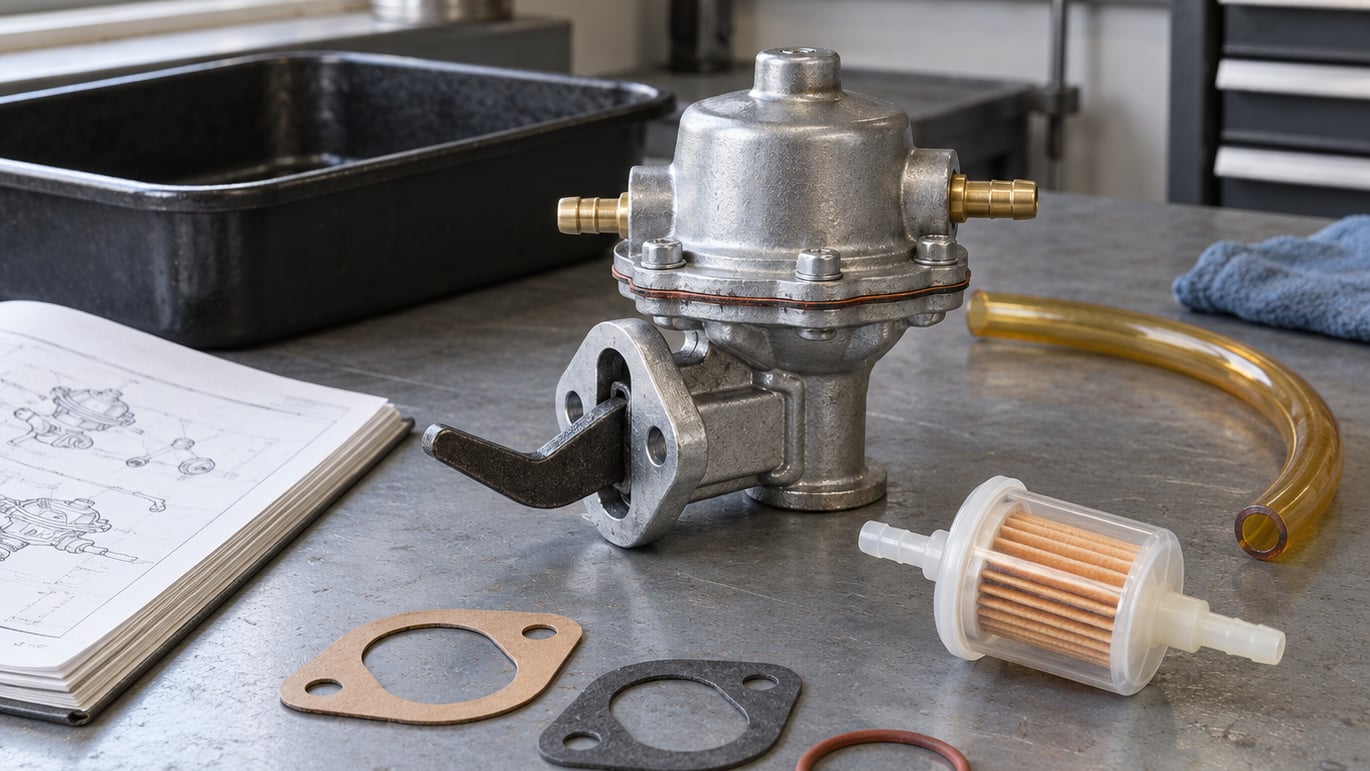
Fuel pump replacement cost in the US runs about USD 400 to USD 1,500 for most cars and light trucks. Parts make up roughly a third of that and labor makes up the rest, which means how a shop has to reach the tank matters more than the pump itself. All figures here are typical US ranges that vary by region and change over time, so treat them as a starting point for your own quote.
The single biggest jump in price comes from dropping the fuel tank. On a sedan with an access panel under the rear seat, a shop reaches the pump in an hour or two. On a truck with a bed-mounted tank, rusted straps, or a tank strap kit that has to be fabricated, the same job takes half a day and the parts bill grows with it.
Table of Contents
- Fuel Pump Replacement Cost at a Glance
- Typical Fuel Pump Replacement Costs by Vehicle
- What Affects the Price?
- How to Get an Accurate Fuel Pump Replacement Estimate
- Ways to Save on Fuel Pump Replacement
- DIY or Shop Replacement?
- Frequently Asked Questions
- How much does fuel pump replacement cost in the US?
- Why are BMW fuel pump replacements more expensive?
- Does a fuel pump replacement quote include a new fuel filter?
- Can I replace a fuel pump myself and save on labor?
- Will the warranty or insurance cover fuel pump replacement?
- What should I ask a repair shop before approving the estimate?
- Conclusion: Start With the Diagnosis
Fuel Pump Replacement Cost at a Glance
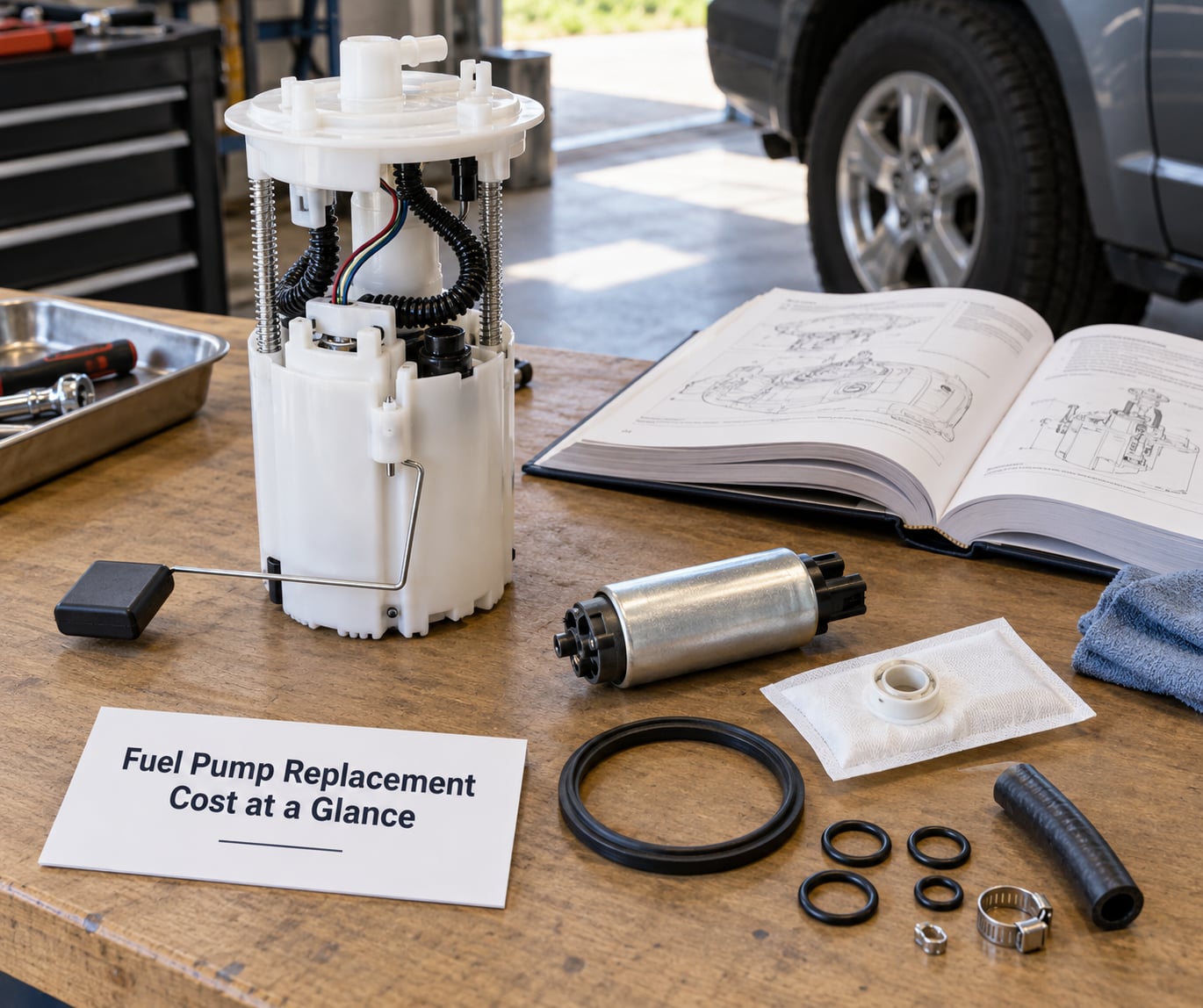
Budget USD 400 to USD 1,500 nationally for a gasoline-powered car, SUV, or light truck. Trucks, luxury sedans, and hybrids cluster near the upper end because of part price and access time, while older economy cars with an easy-access module often land near the bottom.
- Pump or pump module: USD 75 to USD 600+ depending on whether you buy a bare pump, a complete module with the sending unit, or an OEM part from the dealer.
- Labor: USD 150 to USD 900. A simple in-tank swap with an access panel is often 1 to 2 hours. Dropping a tank is commonly 3 to 5 hours, and 6 or more on a vehicle with rust or hard-to-reach hardware.
- Typical total: USD 611 to USD 894 for an average vehicle, with economy comps closer to USD 400 to USD 800 and trucks or European sedans frequently above USD 1,000.
- Diagnostic fee: USD 90 to USD 150 at many shops, often waived if you approve the repair on the spot.
Labor rates are the quiet variable. Independent shops commonly bill USD 90 to USD 160 per hour while dealerships charge USD 150 to USD 220 or more, and that hourly figure multiplies every hour the tank is out of the car.
Typical Fuel Pump Replacement Costs by Vehicle
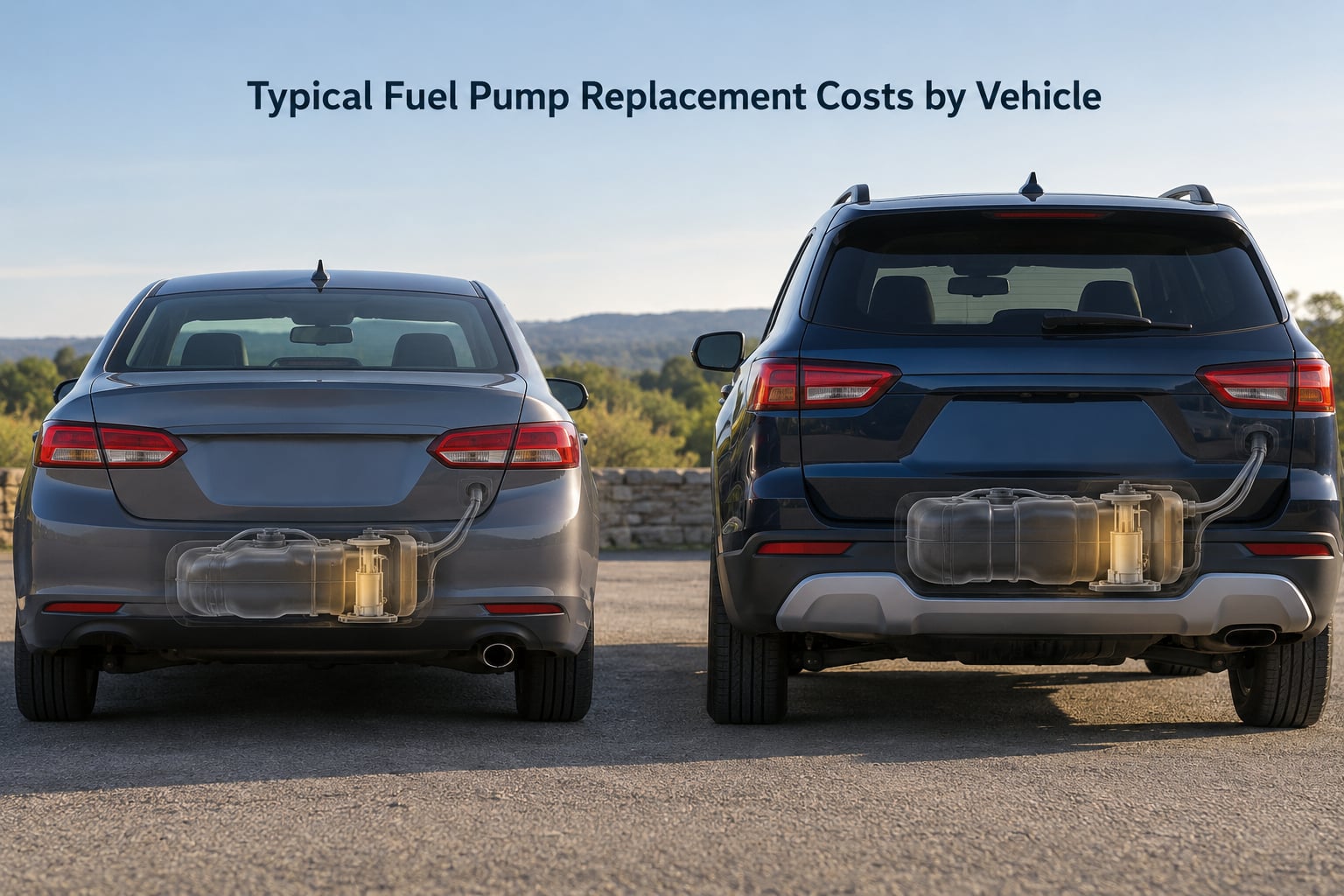
The table below is a planning range, not a quote. Access difficulty does more to move the number than the vehicle’s brand does.
| Vehicle type | Typical part cost | Typical labor | Estimated total | What changes the price |
|---|---|---|---|---|
| Economy or compact sedan | USD 120 to USD 300 | USD 180 to USD 400 | USD 400 to USD 800 | Access panel usually makes this a quick job |
| Mid-size sedan | USD 180 to USD 450 | USD 250 to USD 550 | USD 500 to USD 1,000 | Module price; some need the tank out |
| Full-size sedan | USD 200 to USD 500 | USD 300 to USD 650 | USD 600 to USD 1,150 | Dealer parts push the part cost up |
| Compact SUV or crossover | USD 200 to USD 550 | USD 300 to USD 700 | USD 600 to USD 1,200 | Tank shape and ground clearance |
| Full-size truck or SUV | USD 300 to USD 750 | USD 450 to USD 900 | USD 800 to USD 1,500+ | Tank removal, strap rust, bed liner |
| Performance coupe | USD 350 to USD 800 | USD 400 to USD 900 | USD 900 to USD 1,500+ | High-flow pumps and twin-tank setups |
| Luxury or European sedan | USD 250 to USD 700 | USD 400 to USD 900 | USD 700 to USD 1,400 | Parts availability and dealer-only calibration |
| BMW 3 Series or 5 Series | USD 350 to USD 750 | USD 450 to USD 950 | USD 900 to USD 1,500 | Tank drop under the rear seat plus module cost |
| BMW X3, X5, or 7 Series | USD 400 to USD 900 | USD 550 to USD 1,100 | USD 1,100 to USD 1,800 | Tank removal, transfer case lines, coded service |
| Hybrid or plug-in hybrid | USD 300 to USD 800 | USD 450 to USD 1,000 | USD 800 to USD 1,600 | High-pressure system and extra safety steps |
Older trucks illustrate the spread clearly. A Silverado owner typically faces a USD 300 pump plus two to four hours of labor, and where that job sits in the range depends almost entirely on how rusty the tank straps and bed hardware are. F-150 owners report USD 500 to USD 600 at independent shops and noticeably more at dealers.
What Affects the Price?
Type of pump. A bare pump motor is the cheapest part. A complete in-tank module, which bundles the pump, strainer, sending unit, and often the fuel level sensor and gasket, costs more upfront and saves a return visit later.
Tank access. An access panel under the rear seat can cut one to two hours off the job. No panel means the tank comes out, and that single fact can add several hundred dollars.
Tank condition. Once the tank is out, shops look at the inside. Rust, varnish, a degraded fuel bladder, or debris around the strainer adds cleaning or bladder replacement work, and that is where quotes grow after the job has already started. Ask whether the inspection is included before you authorize anything.
Vehicle age. Fasteners strip, seals crumble, and hoses become brittle. On a 20-year-old vehicle, a shop may plan extra time for seized hardware that would take minutes on a newer one.
Diagnostic time. Confirming the pump is the actual failure takes a fuel pressure test and a look at the relay and wiring. A relay or a corroded connector is a small part and a small bill, and plenty of pump failures turn out to be a wiring fault. Our guide to diagnosing a fuel pump problem walks through that sequence.
Regional labor rates. Coastal metros and high-cost states bill meaningfully more per hour than rural areas, where the trade-off can be fewer shops to compare.
How to Get an Accurate Fuel Pump Replacement Estimate
Give the shop what you have before you call. Year, make, model, engine, mileage, and whether the tank has ever been removed are worth more than a vague description of the noise, and they’ll usually quote from that information alone.
Ask for a written estimate that separates parts from labor and lists every part by name. “Fuel pump assembly” is vague. “Pump module with sending unit, tank seal, new fuel filter, relay” tells you whether the quote covers a complete part or just a motor, which is the difference between a fair price and a surprise.
Get two more written quotes. Compare them line by line rather than by total, because a lower total can still hide a bare pump and a second visit later.
Listen for the pressure test. A shop that quotes a fuel pump without testing fuel pressure first is guessing, and if the real fault is a clogged filter or a failed regulator, you will pay twice to find out. The symptoms of each failure overlap enough that fuel pump failure symptoms are worth reading side by side with filter and regulator symptoms before you book anything.
One more thing to confirm in writing: whether the labor estimate includes the fuel pressure test, the tank inspection, and a road test, or whether those are billed separately.
Ways to Save on Fuel Pump Replacement
Get the diagnosis first. A pressure test that costs less than the pump itself can redirect the entire repair. This is the highest-return move on the list.
Compare an independent shop against the dealer. Dealers quote OEM parts at higher margins and bill higher hourly rates. For most drivers the independent shop is cheaper by a wide margin; the exception is a vehicle still under factory warranty, where dealer work is the requirement.
Let the shop source an OEM-equivalent or quality aftermarket module. Names like Delphi, Airtex, and Bosch build modules that meet the original spec without the dealer markup. Confirm the part is new, not remanufactured, and that it carries a warranty.
Bundle the fuel filter deliberately. The fuel filter is often reached during the same job, so replacing it at the same time is efficient rather than extra work. Ask for it as a line item. Our DIY fuel filter guide covers when doing it separately makes sense.
Schedule it with other work. If the vehicle is in for brakes or a timing belt, the diagnostic fee and shop overhead are already being paid, so the pump job costs less incremental labor.
What not to cut: the pressure test, the new tank seal, a proper fuel line connection, and the final leak check. A cheap fitting that leaks fuel is not a saving, and gasoline in a hot exhaust bay is a fire.
DIY or Shop Replacement?
Replacing a fuel pump yourself saves the labor portion, roughly USD 200 to USD 800 depending on the vehicle. On a car with an access panel and a module that bolts to a flange, that is a realistic weekend job for someone who has handled fuel lines before.
The tools and conditions are specific. You need a fuel line disconnect tool rated for the vehicle, a jack and jack stands, a drain pan that holds several gallons, basic sockets and a torque wrench, and uncut replacement fuel line plus a length of hose and clamps if the hard lines are older than about a decade. You also need to relieve system pressure before opening anything, work with the battery disconnected, keep a fire extinguisher within reach, and never smoke or run an engine in the space.
Dropping a tank is a different category. On many BMW models the tank sits under the rear seat with lines and a fuel pump feed routed nearby, so the job involves moving interior trim and managing lines that cross the frame. That work is where a mistake shows up as a fuel smell, a fuel code, or a leak that is genuinely dangerous.
Two practical reasons people still hand it to a shop: warranty coverage on the labor, and the ability to pressure test the finished system. Many shops offer 12 to 24 months on parts and labor, which is hard to replicate at home even when you do the work cleanly.
Frequently Asked Questions
How much does fuel pump replacement cost in the US?
Most cars and light trucks land between USD 400 and USD 1,500 nationwide. Economy comps with an easy-access module cluster near USD 400 to USD 800, while trucks, European sedans, and hybrids run USD 800 to USD 1,600 because the part costs more and the tank usually has to come out. Parts are roughly a third of the total.
Why are BMW fuel pump replacements more expensive?
Three reasons stack up. The complete pump module is pricier than a bare pump, BMW often places the tank under the rear seat with lines that must be disconnected and moved, and the labor rate at a BMW shop sits above a general repair shop. Owners usually see USD 900 to USD 1,500 on sedans and USD 1,100 to USD 1,800 on SUVs.
Does a fuel pump replacement quote include a new fuel filter?
Sometimes, and that is worth confirming in writing. When the filter sits outside the tank on a frame rail, it is a separate part and a separate line item. When it is inside the module or the tank, replacing it during the pump job is sensible and usually cheap in labor. Ask for it named on the estimate so you can compare quotes fairly.
Can I replace a fuel pump myself and save on labor?
Yes, on many sedans and crossovers with an access panel under the rear seat, where the module bolts to a flange and the job takes an hour or two. You save the labor portion, often USD 200 to USD 500. Tank drops, especially on European models, are a much bigger job and better handled by a shop. If you have never opened a fuel line, pay for the shop.
Will the warranty or insurance cover fuel pump replacement?
A factory or extended warranty covers a fuel pump that failed within its terms, which is why dealers get involved when coverage is active. Standard collision and comprehensive insurance do not cover it, because this is a mechanical wear failure rather than accident damage. Many shops also offer their own 12 to 24 month parts and labor warranty, which is worth asking about.
What should I ask a repair shop before approving the estimate?
Ask whether a fuel pressure test was performed and what the reading was, whether the quoted part is a complete module or just a pump motor, whether the new fuel filter and tank seal are included, whether the shop will inspect the tank interior while it is out, and whether the diagnostic fee is waived if you approve the repair. Get all of that in writing.
Conclusion: Start With the Diagnosis
The typical US range for fuel pump replacement cost is USD 400 to USD 1,500, and most of the spread comes from tank access and hourly labor rate rather than the pump itself.
Before you authorize any work, confirm that the pump has actually failed with a fuel pressure test, then ask for a written estimate that separates parts from labor and names every part. That single request does more to protect your money than any amount of shopping around.