
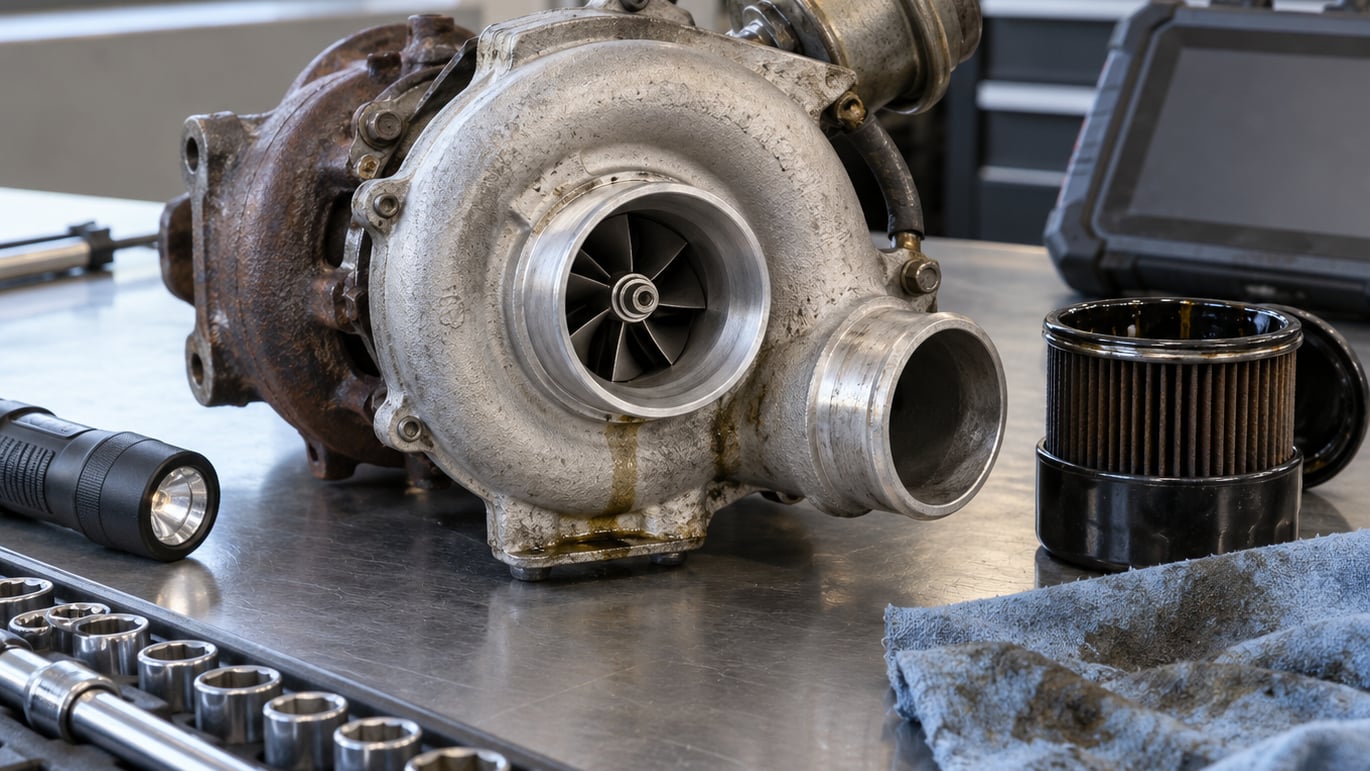
A turbo usually tells you it is dying long before the car stops moving. The tell is usually one of seven things: less power than the car used to make, a whine that turns into a siren, grinding from the housing, blue or grey exhaust smoke, oil in the charge pipe, a check engine light with an underboost code, or throttle response that has gone flat and vague.
Most owners notice one of those in the first few months and then argue about it for a year. Half of the time the turbo is fine and the real fault is a cracked charge pipe, a loose intake clamp or a leak upstream of the turbo. That is why separating the symptom from the cause matters more than guessing at parts.
This guide walks through the checks in the order a technician would use them: what the car is telling you, what you can see and hear cold, then what a scan tool and a boost gauge confirm. Most of it takes an hour and a driveway. Everything below assumes the car is parked, the engine is cold or cool, and your owner’s manual takes priority over anything here.
If you want the honest version of how long you can keep driving: stop immediately for a grinding or scraping noise, heavy blue smoke, an oil pressure light, or knocking under load. Those four mean the turbo can be shedding debris into the engine right now.
Table of Contents
What You Need
You do not need a lift or a shop to screen a turbo. You need access, light, and two tools that turn a guess into a number.
- The owner’s manual for your exact model and engine. It lists where the oil drain and feed lines run, what the boost reference is, and what the oil spec is.
- Vehicle service information. Diagnostic values differ a lot between engines, so a boost figure that is normal on one BMW is underboost on another. Compare readings to the manufacturer specification, not to a forum post about a different car.
- Basic hand tools — ratchet set, sockets, torque wrench for the oil drain fasteners, a trim tool for intake ducting.
- An OBD-II scan tool with live data. A phone app and a cheap Bluetooth dongle will show you commanded boost, actual boost, engine load, fuel trims, intake air temperature and misfire counts. Static code readers cannot.
- A boost gauge if you want a real reading instead of an ECU number. A basic mechanical gauge and a scan tool are consistently the two DIY checks owners wish they had bought sooner.
- Soapy water and a smoke machine. The smoke machine is the one that finds boost leaks nobody can hear.
- A flashlight and a rag. For looking up at the underside of the turbo on a cold engine, oil is far easier to spot than hot.
- Engine oil and coolant so you can top up and re-check levels without a second trip.
- Gloves and eye protection. Exhaust pipes and charge pipes get hot enough to burn you even at idle.
One warning before you start. A seized or worn turbo can spray hot oil and metal fragments out of the compressor inlet when you spin it. Keep your face and hands back, spin it gently with a glove, and do it cold.
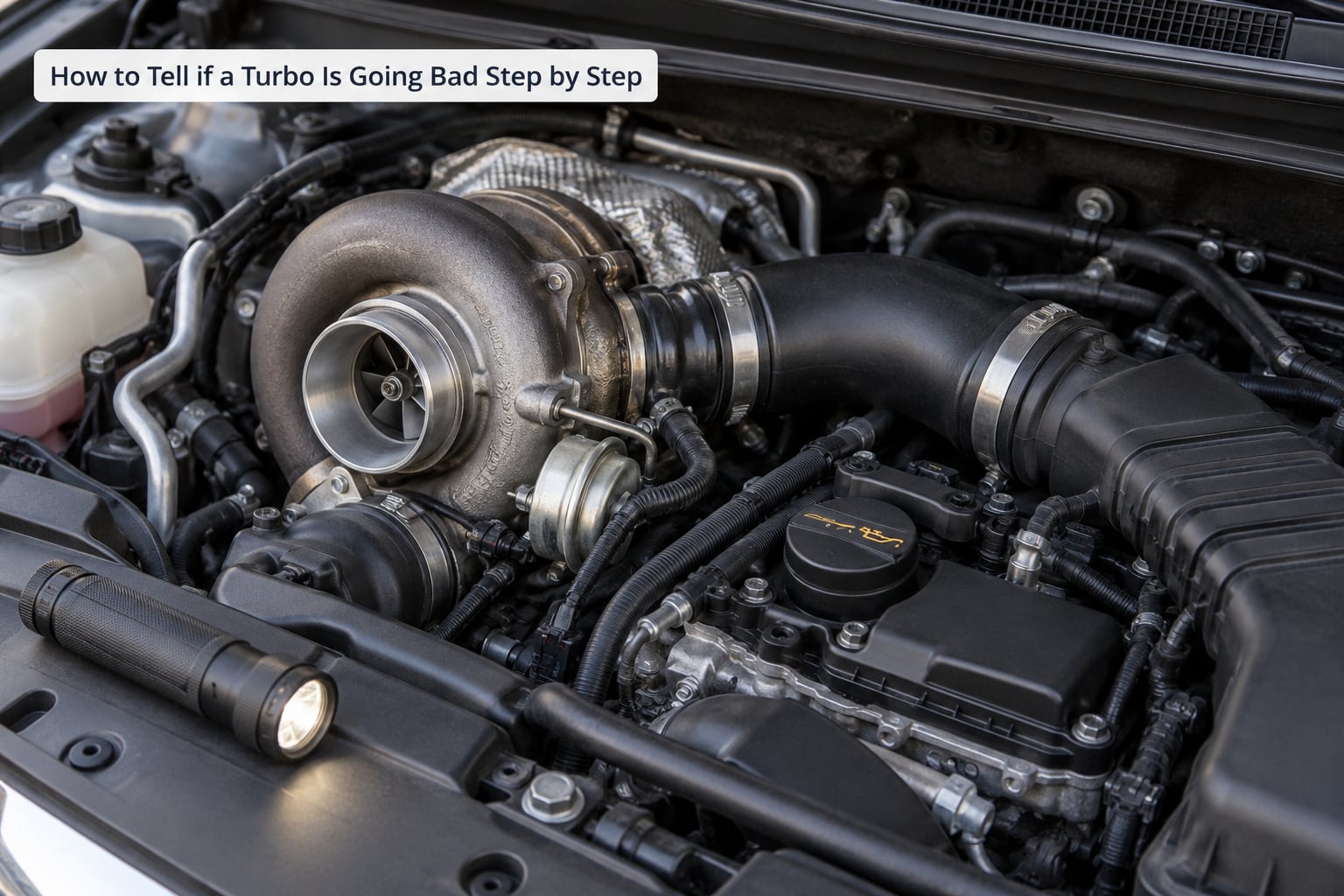
How to Tell if a Turbo Is Going Bad Step by Step
1. Check for loss of power and slow response first
A turbo that is failing usually shows up as reduced power before it shows up as noise. The car pulls, but it pulls like a naturally aspirated one — or it drops back to a low-boost condition and stays there. On a 300 hp car that reads as “a bit slow.” On a diesel it reads as “lugging when the boost gauge needle dies on a hard pull,” which owners describe almost word for word.
What you are looking for is a change from your normal, not from a brochure. Two things to note while you drive: how much throttle it takes to get moving, and whether the boost gauge or commanded-boost value falls away when you ask for full load and stays down.
Before you blame the turbo, check the cheaper suspects. Fuel delivery, ignition, and a plugged or leaking air intake all cost far less than a turbo and mimic the same symptom. Our guide to what causes a car to lose power under load covers that side of the diagnosis.
2. Listen and look at exhaust smoke and new noises
Noise is the most reliable early warning, because it changes before the numbers do. Listen in three states: at key-on before start, at idle, and on a pull.
- Normal whistle. A steady, clean, slightly rising whistle that scales with engine speed and shows up on lift is a healthy turbo spooling. Volume alone means nothing.
- Failing siren. A hollow, warbling siren or growl that keeps going after you lift off, or that changes pitch without the engine speed changing, points at bearing wear or a damaged wheel.
- Grinding or scraping. A dry metallic rasp from the turbine housing, often worse at idle and on a hot engine, is a bearing or thrust washer issue. Treat it as stop-driving.
- Rattling from the exhaust side. Loose heat shields and broken flexplates rattle constantly and are easy to mistake for a turbo problem.
For smoke, colour matters. Blue or thick grey smoke means burning oil. A puff on startup that clears is usually valve stem seals; a steady plume that grows under load is more often worn piston rings or an over-oiled engine. A turbo with failed internal seals adds to that, because oil in the centre section burns in the turbine housing.
White vapour for a moment on a cold start is condensation. A constant white plume with a sweet smell points to coolant, which is a different repair entirely.
3. Check for oil leaks and oil in the charge pipe
This is the check most guides skip, and it is the one that finds a failing turbo without taking anything apart. With the engine cold, look at the turbo centre section, the oil feed and return lines, the oil drain flange, and the charge pipe and intercooler.
You are looking for fresh oil, wetness, or oily residue rather than a drip on the ground. On a lot of cars the charge pipe enters from below, so also check the inside of the pipe where the oil collects after a drive. Oil sitting in the intake or intercooler is a serious finding: it means the compressor side has been taking in oil, and that oil can reach the engine as a detonation risk.
Also look at the exhaust turbine housing. A burnt oil sludge coating the inside of the housing, with only slight up-and-down shaft play, is a seal problem rather than a destroyed turbo — a case where the turbo was not the whole story.
4. Compare commanded boost with actual boost
This is the most objective test and the one that separates a healthy turbo from a slipping one. On a scan tool, watch requested boost and measured boost at the same time, and compare them against the boost specification for your engine.
Three patterns matter. A large gap between requested and actual that stays open means the turbo is not producing — worn compressor wheel, damaged housing, or a leak. A slow build where boost eventually arrives late points at a slow spooling wheel or excess inertia. Boost that is inconsistent or that fades mid-pull is the pattern most owners describe with the gauge dropping to zero on a pull.
P0299 is the code to look for. It means underboost detected — the ECU commanded more boost than the sensors saw. It is not proof of a bad turbo. A boost leak downstream, a failed wastegate actuator, a stuck intake-air temperature sensor, or a MAF reading off can all set P0299 on an otherwise healthy turbocharger. That distinction is the whole ballgame.
5. Use live data to rule out fuel, ignition and airflow faults
Scan data exists to eliminate, not to confirm. Before you call the turbo, watch these channels at idle and on a pull.
- Engine load and calculated engine load. A turbo that is spinning should show high calculated load. Low load with commanded boost present points away from the turbo and toward airflow or fuel.
- Short-term and long-term fuel trims. Large positive trims on a boosted petrol engine mean it is being told to add fuel to correct a lean condition. That is an air or fuel delivery problem, not a turbo.
- Intake air temperature. A sensor reading implausibly high or low corrupts boost calculations. A surprising share of “blown turbo” symptoms trace back to an unsealed air box or a disconnected intake hose.
- Misfire and knock counts. Misfires under boost are a combustion problem worth solving first, and knock is a stop-driving condition.
6. Run a controlled boost test safely
Only do this if your manufacturer’s procedure covers it and you are comfortable doing it. Park level, in gear or in park with the brake on, nothing blocking behind, and never on a public road at full throttle.
- Verify oil and coolant levels, then confirm no warning lights are on.
- With the engine cold, inspect charge pipe clamps, couplers, intercooler fittings and the oil drain for leaks.
- Bring the engine to operating temperature and let the engine idle. Watch intake air temperature and boost on the scan tool until they settle.
- Apply boost in controlled steps rather than one full-throttle stab, watching commanded against actual boost.
- Stop the test immediately if smoke appears, boost stays low, the engine knocks, or any warning light comes on.
If you need a boost leak or exhaust side pressure test beyond what your manual describes, get a technician to do it. The useful hand check is to see whether the cartridge housing rotating assembly moves back and forth — visible front-to-back movement is treated as a failed turbo, while a film of oil on the exhaust blades is normal. If it feels gritty, do not spin it hard.
Common Mistakes
Ordering a turbo before finding the leak. A boost leak, a cracked charge pipe, or a failed wastegate produces the same underboost as a dead turbine. Smoke test the charge side and pressure test the exhaust side first, or you will pay twice.
Ignoring cracked hoses and worn clamps. Charge pipes split at the accordion sections and intercooler hoses go soft at the crimps. This is the cheapest fix in the whole category and the most commonly blamed on the turbo.
Misreading smoke colour. Blue on startup that clears is usually seals or rings elsewhere, not necessarily the turbo. A leak from the valve cover gasket or the crankcase breather can also mist oil into the exhaust.
Working on a hot engine. Oil throws are hard to see when the pipes are too hot to touch, and you will burn your hand on the compressor housing. Wait for it to cool.
Driving on low oil or with knock. A turbo running without oil fails in minutes, and debris from a failed turbine goes straight into the cylinders. Oil pressure warnings, knocking, or heavy blue smoke end the driving.
Assuming every loss of power is the turbo. Fuel pressure, ignition coils, plugs, plugs-in-the-wet, intake restrictions, and exhaust leaks all imitate it. Diagnose the fault before you buy anything.
Frequently Asked Questions
What are the first signs of a turbo going bad?
The first signs are usually loss of power under load, a whine that becomes a siren after you lift off, blue or grey exhaust smoke, oil in the charge pipe, and a check engine light with an underboost code such as P0299. Flatter throttle response and more oil consumption between services often appear first of all. Any one of these can have another cause, so confirm with a scan tool and a smoke test before you replace anything.
How can I diagnose a bad turbocharger myself?
Work in order: drive and note how the car pulls, inspect the turbo, charge pipes and intercooler cold for oil, watch commanded versus actual boost on a scan tool, then smoke test the charge system. Add a hand check of the cartridge housing rotating assembly for excessive front-to-back play. If boost gap, oil in the pipes, and noise all point the same way, the turbo is very likely the fault.
Can I still drive with a bad turbo?
Only gently, and only if you have no warning lights and no unusual noise. Stop immediately for grinding or scraping, heavy blue smoke, an oil pressure light, knocking under load, or a boost gauge that dies on a hard pull. Those mean the unit can be shedding debris into the engine, and a turbo failure that gets into the cylinders usually ends the engine.
Will a bad turbo throw a trouble code?
Often, but not always. P0299 means underboost detected and is the most common one, and there are also boost control and overboost codes. A mechanically failed turbo can run with no code at all if it still makes some boost. Equally, P0299 is frequently caused by a boost leak, a bad actuator, or a faulty intake air temperature sensor on a perfectly healthy turbocharger.
How long does a turbocharger usually last?
On a healthy engine with correct oil and change intervals, a turbocharger can last as long as the engine does, commonly well over 100000 miles. Short service intervals, heat soak from repeated short trips, foreign object intake damage, and oil starvation are what bring failures forward. Change the oil on schedule with the specified specification and check the oil for glitter at every change.
Conclusion
Start with the stop list: grinding or scraping, heavy blue smoke, an oil pressure light, or knocking under load means stop driving and get it looked at. If none of those apply, work through the sequence properly — symptoms first, then a cold look for oil and leaks, then commanded versus actual boost and fuel trim data on the scan tool, then a smoke test of the charge system.
Compare every reading to the service information for your specific engine, not to a generic number. A turbo is the least likely part to be the root cause, and proving that is the difference between a diagnostic afternoon and a very expensive mistake.