
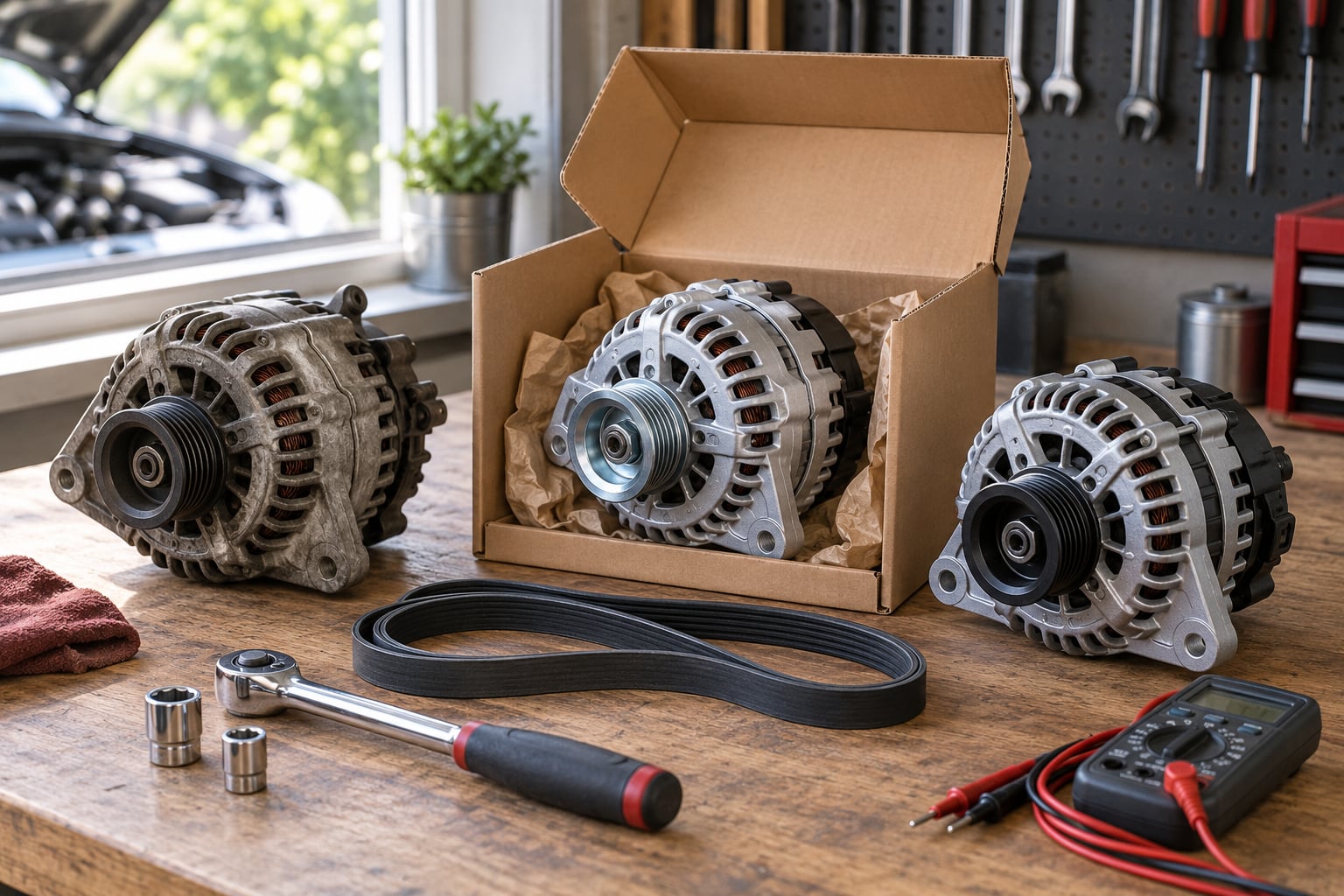
Most alternator replacements cost between $350 and $900 installed in the US, and the typical job lands closer to $400 to $650. The part alone usually runs $100 to $350, and labor adds another $120 to $300 depending on the shop rate near you.
Alternator replacement cost means the part plus installation labor plus anything the job genuinely needs, such as a serpentine belt or a battery that was damaged by the failure. It is not the sticker price of the alternator, and that distinction explains most of the surprises people hit at the counter.
Every figure in this guide is a typical US range. Prices vary by region, shop type, and vehicle, and they change over time, so treat these as benchmarks and confirm them locally before you book anything.
Table of Contents
How Much Does It Cost to Replace an Alternator?
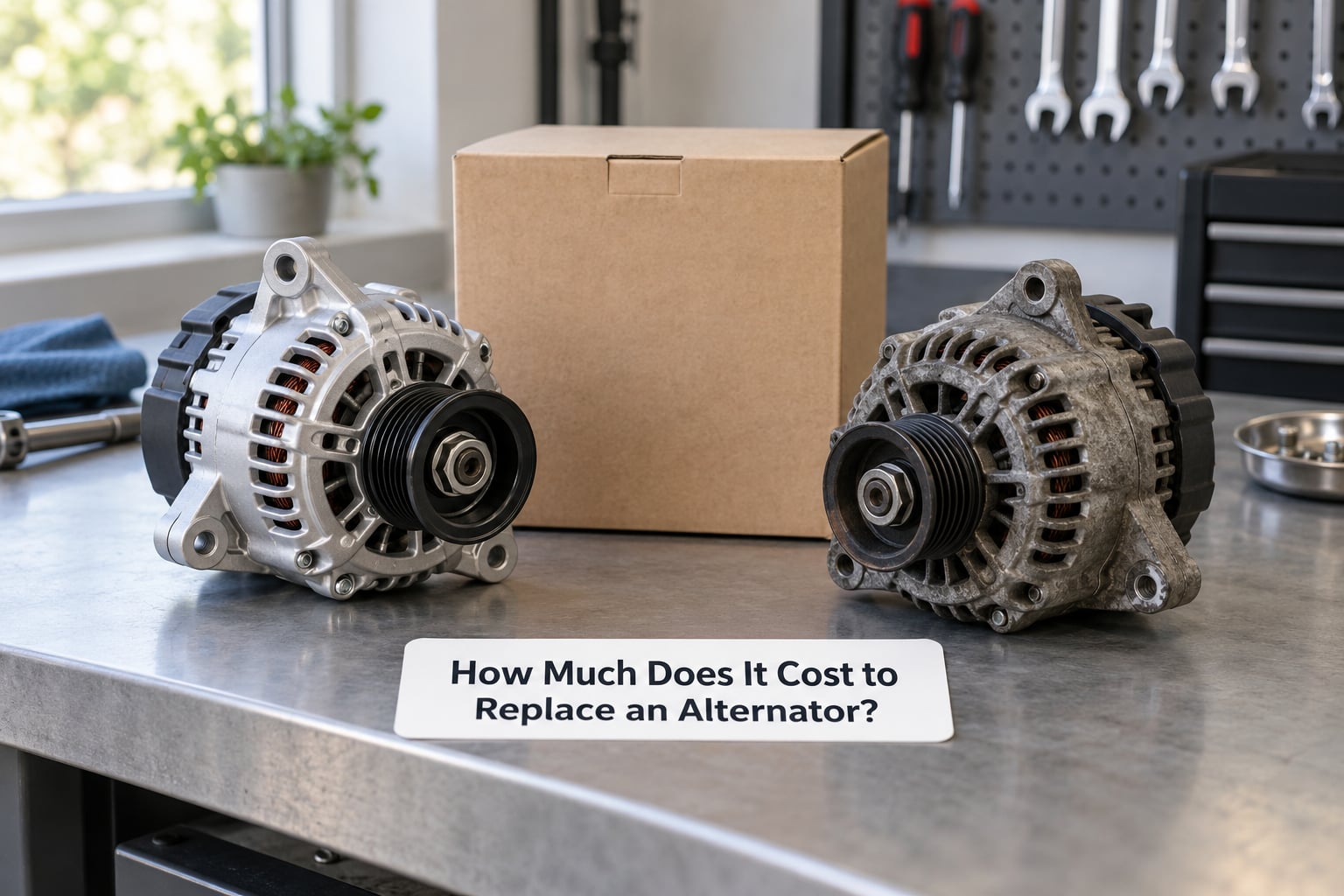
Here is the short version. A straightforward replacement on a mainstream car, done by an independent shop with an aftermarket part, usually comes to $400 to $650 all in. Luxury and European models push toward $900 to $1,500. The line items break down like this.
| Line item | Typical range | When it applies |
|---|---|---|
| Alternator part | $100 to $350 | Every job. Higher for larger output units, pulley clutches, and integrated electronics |
| Removal and installation labor | $120 to $300 | One to three hours at a shop rate of roughly $75 to $150 per hour |
| Diagnostic fee | $0 to $150 | Charged when you arrive with a warning light and no diagnosis. Ask whether it is credited toward the repair |
| Serpentine belt | $25 to $80 | Only if the belt is old, cracked, or came off during removal. Belt labor is usually already included |
| Belt tensioner or idler pulley | $60 to $250 | Only when the tensioner is worn or the belt jumped a groove |
| Battery | $120 to $300 | When the old battery was killed by the failed charging system. This is a fair add-on, not an upsell |
| Wiring harness plug or terminal repair | $60 to $400 | When a shorted alternator melted the connector. Common on higher-mileage vehicles |
| Shop supplies and environmental fees | $0 to $60 | A small percentage line many shops add. Reasonable if it is disclosed up front |
Vehicle type matters as much as the line items do. Here is roughly what a full job runs by class, part and labor included.
| Vehicle class | Typical total | What moves the number |
|---|---|---|
| Economy sedan, older model | $300 to $500 | Simple rear-engine layout, aftermarket part, easy access |
| Modern midsize sedan or hatchback | $400 to $700 | Tighter engine bays, some use a pulley clutch or a sensor-equipped alternator |
| SUV and crossover | $500 to $850 | More mounting work, higher output alternators, more corrosion on connectors |
| Full-size truck or van | $450 to $800 | Heavy-duty output unit, but usually good straight-line access |
| European import and luxury sedan | $800 to $1,500 | Higher part cost, longer access time, dealer-priced electronics |
| Performance or European sports car | $900 to $1,800 | RWD layout, tight packaging, sometimes a dual-mass pulley assembly |
One useful note about lifespan: a healthy alternator typically lasts somewhere around 7 to 10 years or 80,000 to 150,000 miles. Sources disagree because duty cycle matters more than miles. A car that sits with a battery drawing parasitic current cooks its alternator long before the odometer says so.
New, Remanufactured, and Rebuilt Alternators: What You Pay
These three words describe very different parts, and the price gap between them is where a lot of the research time goes.
New aftermarket units are built fresh by a third-party maker and usually carry a one-year or 24-month warranty, sometimes longer on heavier-duty designs. Expect $100 to $300 for most applications.
New OEM units are the ones sold through the dealership with the vehicle’s brand on the box. They cost $250 to $600 on mainstream cars and more on European vehicles. You pay for the brand, the factory warranty paperwork, and the fact that the part number matches what the service manual lists.
Remanufactured means the unit was disassembled, tested, and rebuilt with new brushes, diodes, and bearings, then load-tested by a remanufacturer that is not the same company as the original maker. These run $90 to $250 and typically carry a one-year warranty, though quality varies widely between suppliers. Ask which brand made the reman and what the warranty covers before you buy.
Owner-rebuilt and used units are the cheapest at $30 to $100, and they are the ones I would skip. Warranty coverage is minimal, internal testing is limited, and a weak reman can strand you again in a year. Saving $150 is not worth a second teardown.
A core charge changes the arithmetic on any of these. The seller fronts you the part price and refunds part of it when you hand back the old unit, so the final cost can be lower than the shelf price or higher once shipping and deposit are added.
How Much Does Alternator Labor Cost?
Labor is where shops differ most, and it is where you have the most say. A standard alternator swap is one to three hours of book time, though plenty of owners report it taking under an hour on a car with open access.
Here is how the hours break down:
- Diagnostic time, 0.3 to 1 hour. Confirming the alternator is the actual fault, not the battery, a corroded ground, or a blown fuse.
- Removal and installation, 0.8 to 2 hours. Removing the belt, unbolting the unit, routing and torquing the new wiring, and refitting.
- Electrical checks, 0.2 to 0.5 hours. Verifying charge voltage at idle and under load, and on many newer vehicles re-registering the charging system with the control module.
- Belt or pulley work, 0.3 to 0.8 hours. Only when the belt or tensioner is part of the job.
Multiply those hours by your local shop rate. Independent garages in a rural area often bill $75 to $100 per hour, while metropolitan and dealership shops commonly bill $130 to $200. A hard-to-reach mounting position adds an hour on its own, and wiring damage adds more.
If the belt is going on anyway, follow the routing carefully and check tension by hand after the first few minutes of running. Our guide to replacing a serpentine belt walks through the routing step most people get wrong.
What Affects the Price
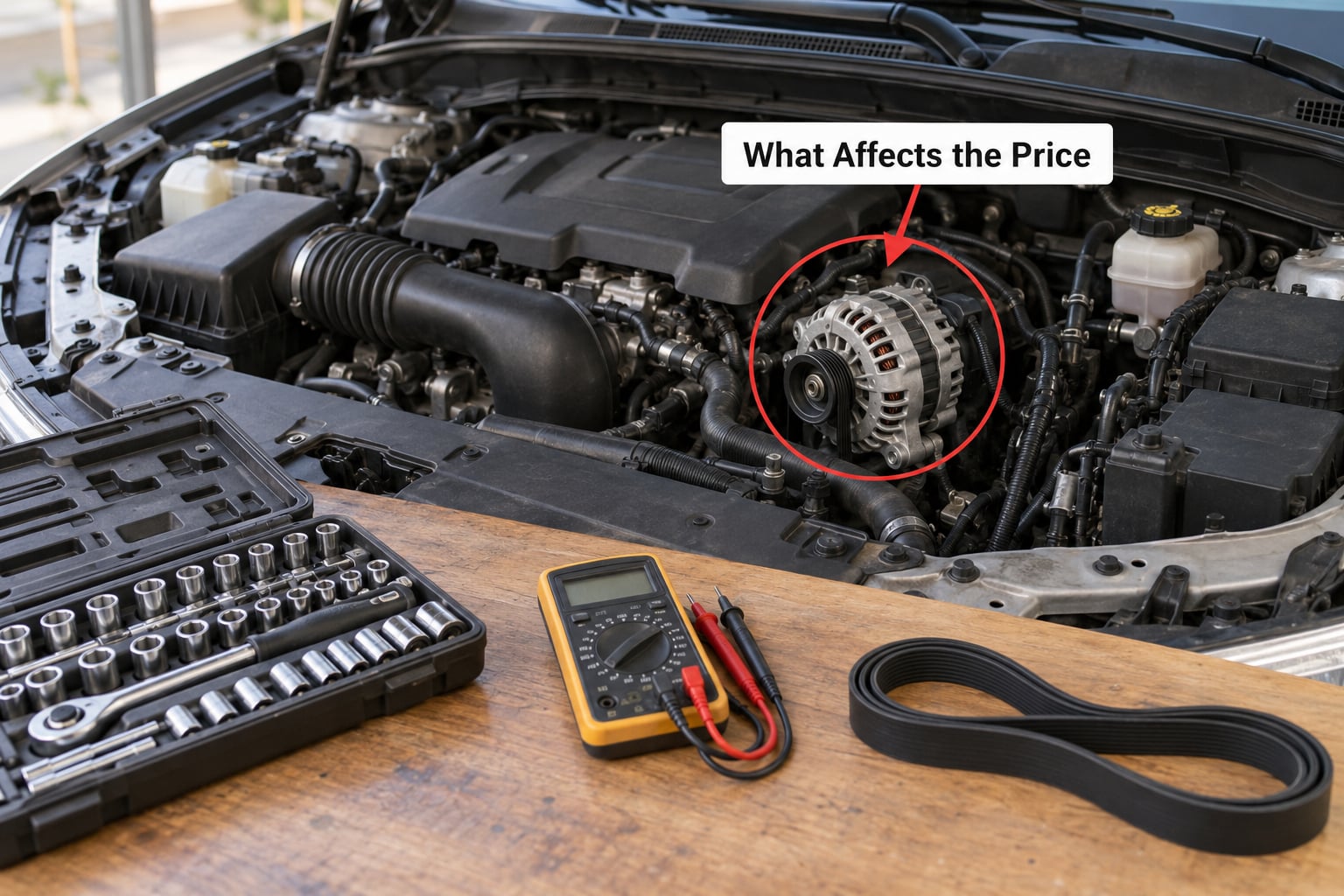
The final number comes down to nine things, and you can influence more of them than most people expect.
- Vehicle and alternator type. Output amperage, copper content, pulley clutch, and integrated voltage sensing all move the part price. A high-output truck unit is not a small hatchback unit.
- Part quality. Aftermarket, remanufactured, and OEM sit on a wide price ladder.
- Shop type. Dealer, franchise, independent garage, mobile mechanic, and your own driveway each price differently.
- Labor rate. Region and shop type, from about $75 to over $200 per hour.
- Access difficulty. Tight engine bays mean more hours for the same part. This is why the same job costs more on an import than on the domestic car parked next to it.
- Electrical damage. A failed alternator can boil the wiring plug or a main cable. Repairing that legitimately adds real cost.
- Belt and tensioner service. Doing them at the same time is cheaper than doing them again in 10,000 miles.
- Core charge. Refundable, but it changes cash at the counter and sometimes the final invoice.
- Warranty length. A longer warranty on the part shifts risk from you to the supplier, and that is worth something when the unit sits in a marginal engine bay.
How Much Does It Cost to Replace an Alternator on a BMW?
On a BMW, the alternator itself commonly runs $400 to $700 depending on the model and whether the unit carries a pulley clutch or an integrated regulator. Labor on many of these engines runs 2 to 3 hours because the unit sits deep in the bay and the belt path is awkward.
Here is the useful part: the expensive part does not make the labor line grow. An independent shop that installs the part you bring bills roughly the same hours as it would on a domestic sedan, so a realistic BMW total runs $650 to $1,100. The dealership version of the same job, with the factory part and a higher rate, can reach $1,300 to $1,600.
If you own a BMW and the shop quote comes back near the top of that band, ask them to quote the job with an aftermarket part. That single question often moves the estimate by several hundred dollars, and it is the difference between a fair repair and the kind of number that shows up in forum threads with hundreds of replies.
Strip that back and the honest answer to how much does it cost to replace an alternator on most cars is that the part drives the total more than the hours do.
Ways to Save on Alternator Replacement
Six moves reliably cut the bill, and none of them involve gambling on a cheap part.
- Get two written quotes. Itemized estimates that separate part, labor, core charge, and fees tell you far more than a single bundled number. Compare the lines, not just the totals.
- Buy the correct part yourself. Look up the alternator part number for your exact year, make, engine, and trim. Ask the shop whether they will install a customer-supplied part, and what the labor charge becomes. Many will, for a higher hourly rate.
- Ask about remanufactured options. A reman from a known brand with a one-year warranty is a reasonable middle choice. Ask who remanufactured it before you agree.
- Return the old unit for the core charge. People skip the core refund constantly because nobody mentions it at drop-off. Ask about the deposit when you book.
- Bundle the belt while the engine is apart. A belt is cheap and the labor is nearly free once everything is already open. Our safe battery replacement steps cover the disconnect routine you need first.
- Rule out the cheap faults first. A dead battery, a corroded ground cable, or a blown fuse looks exactly like a bad alternator. Most parts retailers test charging systems free of charge, and a five-minute test can save you a $400 part.
Do the battery and electrical work the way your owner’s manual describes, and if you are not certain whether the alternator is really the fault, have a qualified technician run the test before the money goes.
Frequently Asked Questions
Can I drive with a bad alternator?
Yes, for a short trip to a shop, in most cases. A failing alternator often charges poorly or not at all, so the car runs on battery power alone and the lights dim as you drive. If the battery or alternator is overcharging instead, voltage climbs above normal and that is when electronics, sensors, and bulbs start getting damaged. Keep the drive short, avoid extra loads like the radio or heated seats, and get it tested first.
How long can my car run with a bad alternator?
On a fully charged battery, most cars will run somewhere around 30 minutes to an hour, sometimes less if the alternator has failed completely rather than just weakening. That number drops fast with headlights, wipers, blower motor, and heated seats switched on. Remember the battery can be recharged or replaced, but a dashboard warning light left on overnight is another story entirely.
Is replacing a car alternator a good DIY job?
For most drivers with a basic set of sockets, a ratchet, and a jack, yes. The mechanic skill involved is modest. The difficulty is access, not complexity: removing a belt from a cramped engine bay and getting a heavy unit down past surrounding brackets takes patience. On a front-wheel-drive car with a transverse engine, expect the job to run a few hours the first time. Always disconnect the negative battery cable first and follow the service procedure for your model.
What is an alternator core charge and how does it work?
A core charge is a deposit the seller adds to a new alternator because the old unit contains valuable metal and rebuildable parts. You pay the full price up front, then hand the old alternator back to get part of that amount refunded. Ask how much the core is and when the refund happens, since some shops credit it to your invoice while others pay you at the counter. Not returning the unit means you forfeit it.
Should I replace the battery when I replace the alternator?
Only if it was damaged. A battery that carried the car through a failed charging system often ends up sulfated and weak, and testing it costs almost nothing. If it still holds a full charge and tests fine, leave it alone and save the money. A battery more than four or five years old is a reasonable thing to replace at the same visit since you already have the job open, but it should be a separate line on the estimate.
How to Budget for Alternator Replacement
Start with the part number. Look up the alternator for your exact year, make, engine, and trim, then take that number to two or three shops and ask for a written quote with the part, core charge, labor hours, and any belt or electrical work listed separately.
Budget $400 to $650 for a mainstream vehicle with an independent shop, and more for a European or luxury car. If a quote lands far outside the ranges in this guide, the number to ask about is usually the part markup or the labor rate, and both are negotiable.
On older, high-mileage vehicles, do the math on the car’s value before you commit. If how much does it cost to replace an alternator approaches what the car is worth, that is a conversation worth having before the parts are ordered. Our guide to how much you should budget for used car repairs covers how to set aside for the other failures that come with age.
Finally, confirm every figure locally before scheduling. Parts pricing, labor rates, and shop policies vary a lot by area and change often, and the numbers here are a benchmark, not a quote.