
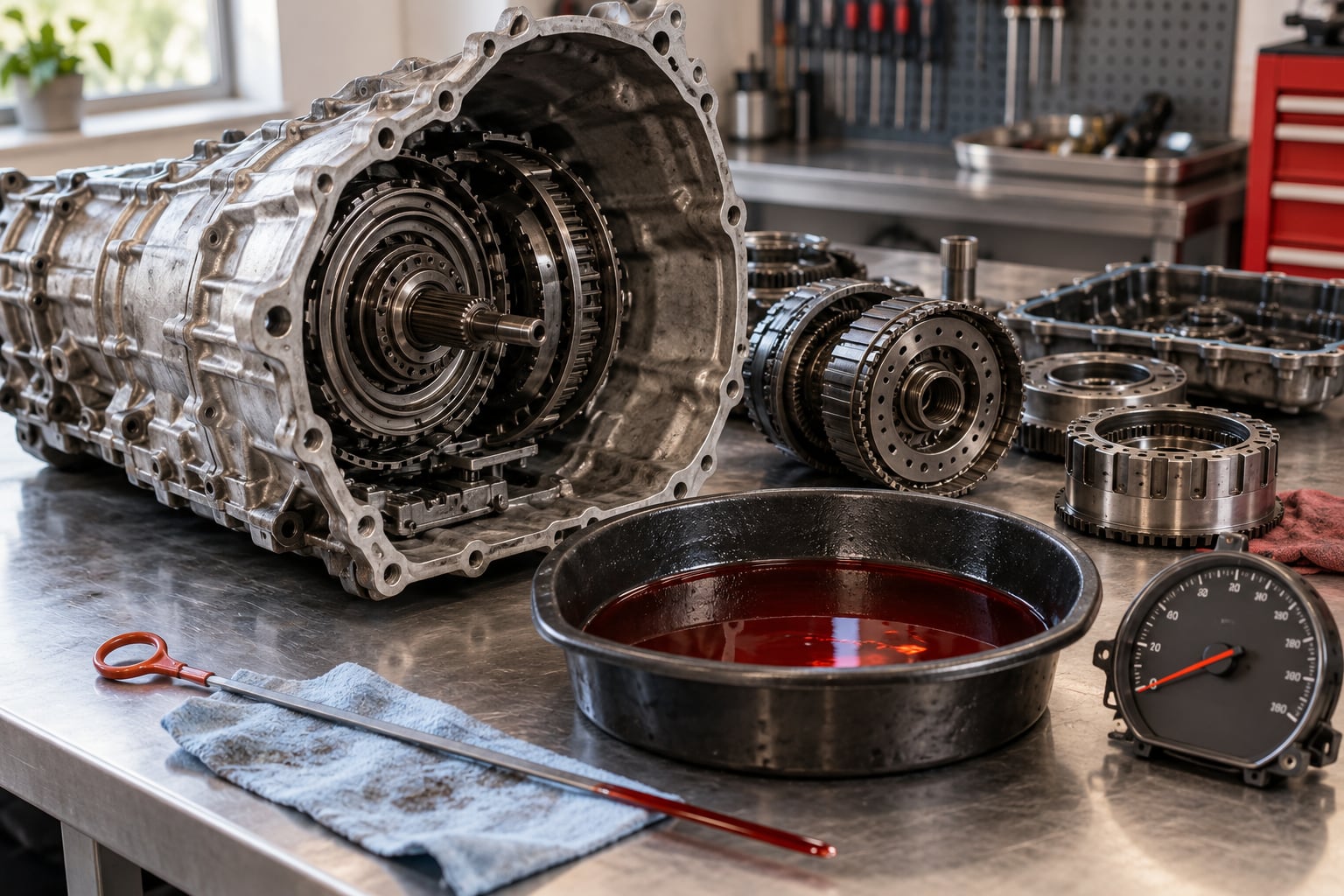
Transmission slipping is what happens when your engine revs up but the car does not accelerate with it, and the transmission slipping symptoms and causes range from a low fluid level to worn clutch packs. The transmission momentarily fails to hold the gear, so power to the wheels drops for a second or two. Ignore it and the damage spreads from a fluid problem to a full rebuild, so here is what to check and in what order.
I have spent enough weekends with jack stands and a scan tool to know how this usually plays out. The car does not die all at once. It revs wrong on one hill, then does it twice a week, then the shift light comes on. Below is the order I would work through myself, including the parts owners argue about most.
Table of Contents
- What Does Transmission Slipping Mean?
- Transmission Slipping Symptoms and Causes: What to Look For
- What Are the Most Common Transmission Slipping Symptoms?
- What Causes a Transmission to Slip?
- How Can You Tell Whether the Transmission or Engine Is Causing the Problem?
- Is It Safe to Drive a Car With Transmission Slipping?
- What Should You Do If You Think Your Transmission Is Slipping?
- Frequently Asked Questions
What Does Transmission Slipping Mean?
Transmission slipping occurs when a gear fails to maintain engine-to-wheel engagement. The engine keeps making power, the tachometer climbs, and for a moment the car keeps going at the same speed. Then the transmission grabs again and the car lurches forward.
For an automatic, the transmission holds itself in a hydraulic balance. Fluid pressure clamps friction plates and bands against their steel counterparts, and a set of valves and solenoids decides which gear that pressure feeds. If pressure is low, or the friction material is worn smooth, the plates start to slip against each other instead of locking. The car is technically in gear, so nothing lights up, but the engine is spinning freely.
A manual works the same way in principle with different hardware. Your clutch is the friction element, and it is either not gripping fully or it is not being asked to. Either way, the gearbox cannot deliver power to the driveshaft.
Some shift behaviour is not a fault. Modern transmissions deliberately delay a shift during light acceleration to hold a lower gear, and torque converters unlock briefly at low speed. You also feel a small kick when the converter locks up around 30 mph. Slipping is different because it happens under load, when you are asking for power, and it repeats.
Transmission Slipping Symptoms and Causes: What to Look For
This table pairs what you notice with what usually explains it. More than one row can be true at the same time, because a low fluid level often shows up as a flare and a shudder in the same drive.
| What you notice | What it usually points to |
|---|---|
| Tachometer climbs past normal on acceleration, speed does not | Low or degraded fluid, worn clutches, slipping torque converter clutch, low line pressure |
| Pause before the car moves when you shift into Drive or Reverse | Fluid level low, worn forward or reverse clutch, failing accumulator or valve body |
| Car surges or jerks forward after the delay | Cold fluid, worn seals, or a clutch that grabs hard once pressure returns |
| Rough shift or shudder, usually between 25 and 45 mph | Worn friction material, warped clutch pack, converter shudder, mount wear |
| Shifting at the wrong time or hunting between gears | Failed shift solenoid, bad sensor, worn valve body bores, failing control module |
| Grinding, whining or clunking | Worn synchronizers or gears, bearing failure, low fluid, damaged pump |
| Sweet or burnt smell, or smoke from under the car | Overheated fluid, slipping clutch packs, leaking cooler line |
| Transmission warning light or a check engine light with a P07 code | Stored ratio or pressure fault, solenoid failure, control module fault |
| Slip only uphill, in tow, or when the car is cold | Pressure loss under high torque, worn seals, insufficient cooling |
One number helps more than any description. If the tachometer is sitting past 3000 rpm while the car is only doing 45 mph, that is a slip, not a shift.
What Are the Most Common Transmission Slipping Symptoms?
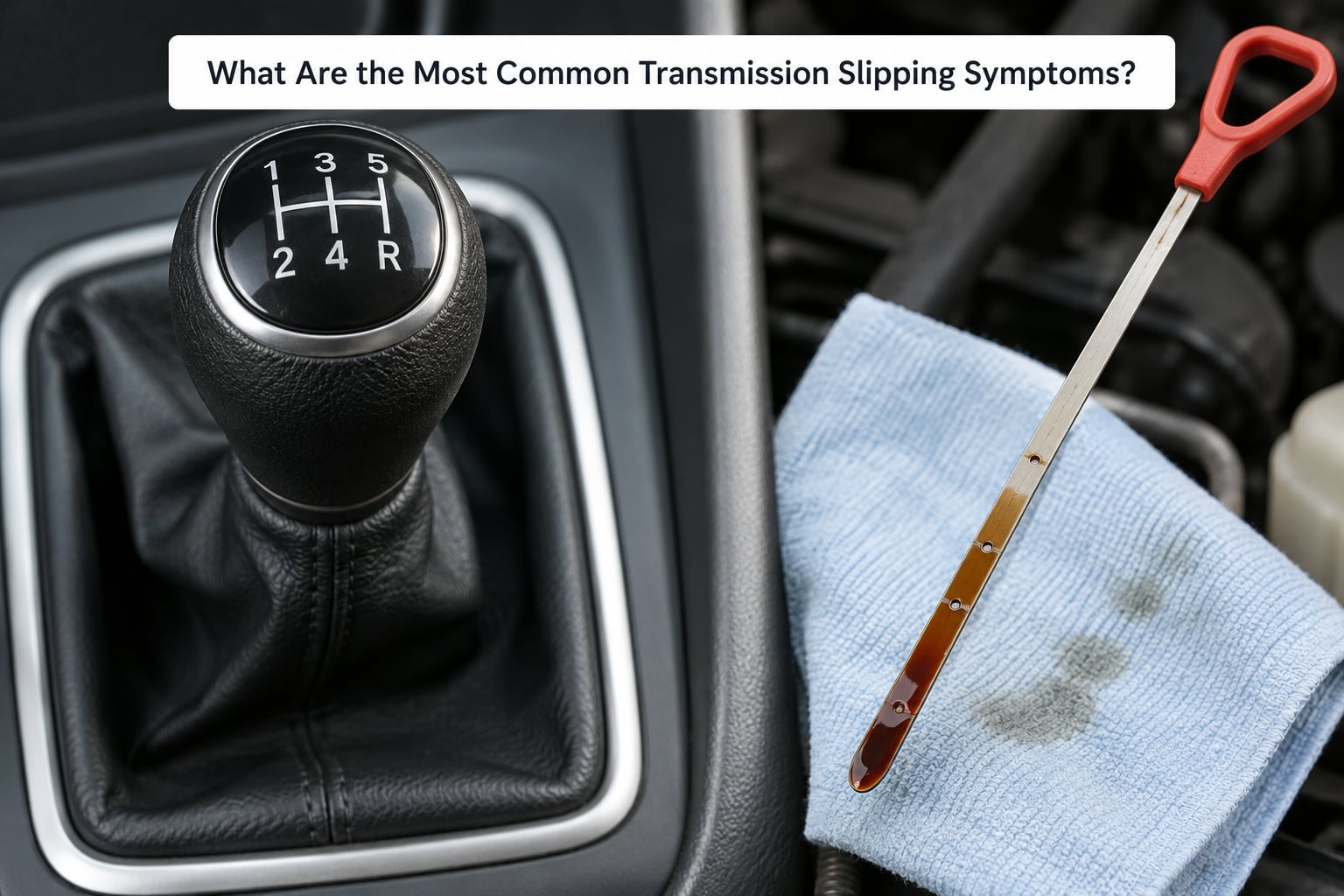
Rev flare with no acceleration
This is the classic one. You press the throttle, the engine note climbs, and the car goes nowhere for a beat. On an automatic it feels like the vehicle is momentarily driving on ice. On a manual the tachometer rises while the car stays at the same speed, or the engine simply bogs down when you go to pull away.
Delayed engagement
There is a gap between selecting Drive and the car actually moving, and a similar gap when you select Reverse. A healthy automatic takes under a second. A long pause followed by a hard jolt means the transmission is filling late or the forward clutch is worn past the point of grabbing smoothly.
Shudder and vibration
A buzz or shake that shows up in one gear and then disappears is a different problem from a general slip. Torque converter shudder is the usual suspect, and drivers regularly mistake it for a slipping transmission. It also shows up in reverse, which a true gear slip rarely does.
Loss of power under load
The car pulls fine on flat ground but bogs on an incline, or it struggles to pass on the highway. If the revs stay low and the engine feels strained rather than free, you may have a torque problem in the engine instead of a slipping transmission.
Unusual noises
Whining that rises with road speed usually points to a bearing. Grinding that appears in one specific gear points to synchronizer or gear wear. A single thud on engagement is a mount, a band, or a clutch pack letting go.
Fluids and smells
Fresh fluid is red or pink and smells sweet. Fluid that has been cooked is dark brown or black and smells sharp and acrid, and you may find metal in it on the dipstick. A red or amber puddle under the car means a leak somewhere along the cooler lines, the pan gasket, or the output shaft seal.
Warning lights
A transmission warning light on the dash is unambiguous. So is a check engine light with a stored P07 code, which covers transmission system and gear ratio faults. Many owners on r/AskAMechanic describe slipping for months with no light at all, because the fault only trips the threshold once the failure is well along.
How it differs by transmission type
An automatic cannot choose to slip into the wrong gear, so its symptoms are delay, flare, shudder, and hunting. A manual gives you a clutch pedal, and the symptom is the pedal. If the pedal goes to the floor and stays there, or the car stalls when you pull away in first, the clutch is worn out. If you have to fight the shifter or hear a grinding clack in second, the synchronizer is the problem. Our guide to how to drive a manual transmission smoothly covers the habits that keep a clutch alive much longer.
The most dangerous moments are the ones nobody planned. Merging onto a fast road, pulling out of a driveway into traffic, and climbing a steep grade in traffic are where a momentary loss of drive becomes a collision.
What Causes a Transmission to Slip?
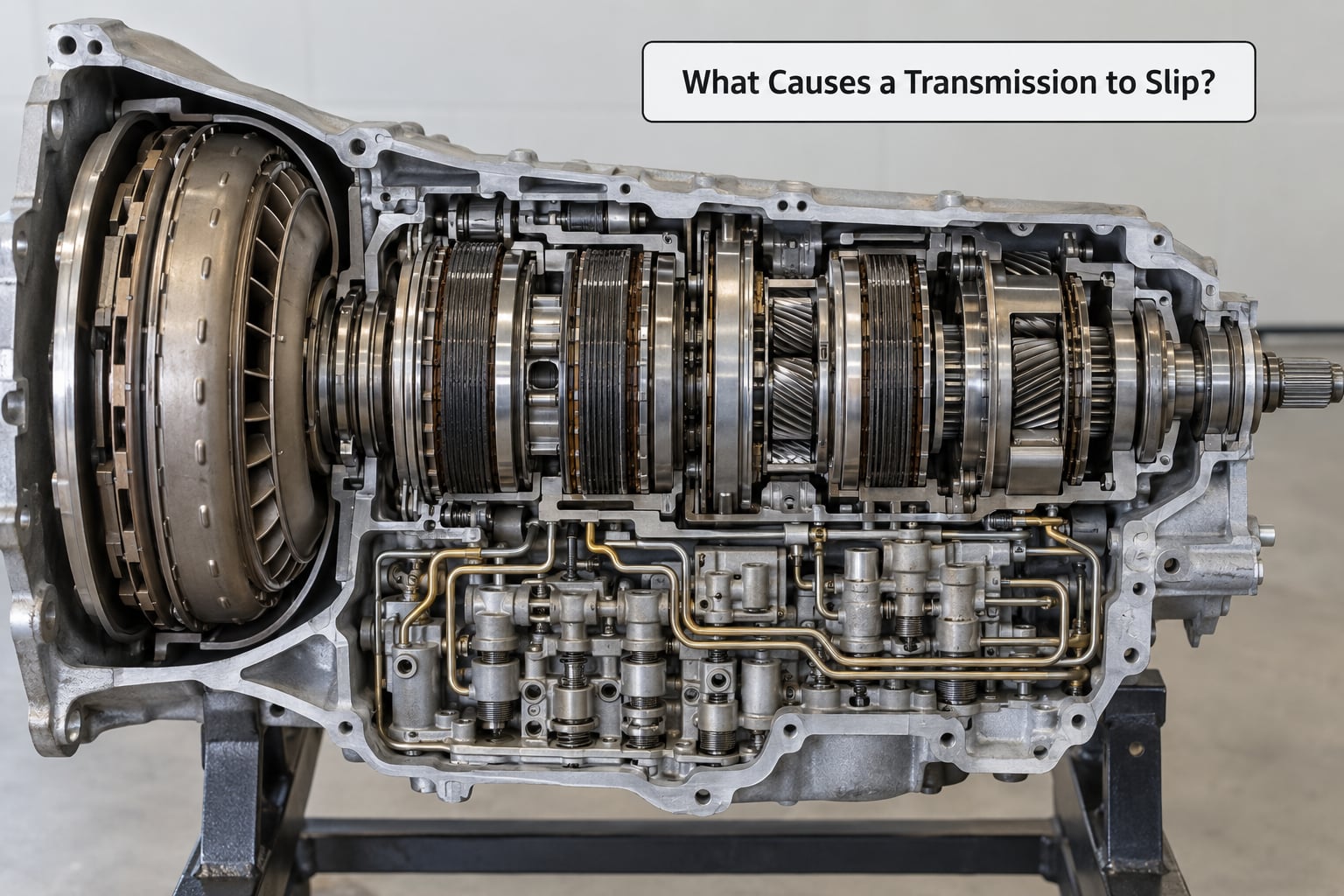
Low or degraded fluid
This is the first cause to rule out because it is the cheapest to fix and the most commonly missed. A transmission needs a specific volume of fluid at a specific temperature, and low level means the pump draws air on the bad side. Aerated fluid does not hold pressure, so the clutches slip. Fluid that is past its service life has lost its friction properties and its anti-foam behaviour, and it carries the debris of whatever has been wearing.
Most late-model cars have no dipstick and require the fluid to be checked through a fill port with the fluid at a set temperature and the engine running. The owner’s manual gives the exact procedure and interval, and it is the only document that knows what your transmission needs. Fluid type matters too, and a fluid that is close but not the specified spec is a real cause of slipping and shudder. We covered the thinking behind lifetime fill claims in our piece on the BMW transmission fluid change lifetime fill myth.
Worn clutches and bands
Inside a typical automatic there are several clutch packs and one or more bands, all of them friction material bonded to steel. That material is designed to wear away, but it should take 100,000 miles or more to do it. When it does, the pack stops holding and you get flare. A band that has stretched or lost its anchor produces the same result in the gear that band controls.
On a manual, the equivalent is the clutch friction disc and pressure plate. Community reports put a worn clutch anywhere from 20,000 miles on a truck to well over 100,000 on a highway car, and the difference is mostly how the car is driven.
Solenoids and valve body wear
Shift solenoids are small electrically controlled valves that direct fluid to each clutch. When one sticks open or shorts out, that gear loses pressure, and the car either flares in that gear or hunts. The valve body is the cast plate full of bores that the solenoids push into. Those bores wear oval with mileage, so even a new solenoid cannot restore the pressure the channel used to hold.
Electronic faults sit in the same family. A failed speed sensor, a bad range sensor, or a wiring problem can make the control module misjudge what gear the transmission is in, which looks exactly like a mechanical slip. Our write-up on what limp mode is and what causes it covers how the module protects itself when it loses confidence in a signal.
Torque converter and mechanical wear
The torque converter is a fluid coupling that multiplies torque at low speed. Its clutch can crack, wear, or fail to hold, and that gives you shudder and delayed engagement. A cracked converter is a common finding on higher-mileage vehicles and is one of the reasons a rebuild quote can be steep.
Harder failures involve the planetary gear set, the sun gear, broken teeth, or metal shavings in the fluid. Once large fragments circulate, they can block the filter and starve the rest of the transmission. A transmission that has lost all gears at once usually points to a pump, a catastrophic internal break, or fluid that is simply gone.
Transmission slipping symptoms and causes side by side
The same fault shows up in different hardware depending on the gearbox, so it helps to line the two side by side. Whatever the answer, the first thing to check is still the fluid.
| Cause | Automatic transmission | Manual transmission |
|---|---|---|
| Fluid | Low, burnt, or wrong spec fluid is a leading cause | Usually not the issue, but wrong oil can damage the gearbox |
| Friction element | Worn clutch packs and stretched bands | Worn clutch disc, pressure plate or flywheel |
| Valves and electronics | Shift solenoids, worn valve body bores, sensors, module | Fewer, but failed synchronizers are the equivalent |
| Coupling | Torque converter clutch failure and shudder | Not applicable, the clutch is the coupling |
| Gears | Planetary gear set, sun gear, broken teeth | Synchro rings, sliding gear pairs, dog teeth |
| Typical trigger | Load, heat, age, towing | Launches, hill starts, resting on the clutch pedal |
Heat, overload and towing
Slipping and heat feed each other. Every second the clutch pack slips generates heat, heat cooks the fluid, and cooked fluid loses the ability to hold the next shift. Towing a vehicle heavier than its rating, running a heavy trailer up long grades, or aggressive stop-and-go driving all accelerate this cycle. A plugged transmission cooler or cooler line that has been leaking unnoticed is a frequent hidden cause.
How Can You Tell Whether the Transmission or Engine Is Causing the Problem?
Work in this order. Each step rules something out, and skipping ahead to the most expensive theory is how people end up replacing parts that were never broken.
Step 1: Read the warning lights and stored codes
A scan tool with bidirectional transmission access is worth more here than any guess. A P0700 is a generic transmission system code, P0730 through P0770 are gear ratio errors pointing at a specific gear, and P0740 points at the torque converter clutch circuit. Codes that come and go with the fault are far more useful than a single static code.
Step 2: Check the fluid level and condition
With the car at operating temperature on level ground, in Park for an automatic, with the engine idling. Fresh fluid is red or pink and clear. Brown, black, or gritty fluid, or any sparkle of metal on the dipstick, means you have internal damage, not a level problem. Checking the level on many modern cars means a fill port and a specified temperature instead of a dipstick, so the manual matters.
Step 3: Road test with a pattern
Drive a loop that includes a firm acceleration from a stop in each gear, a steady highway merge, and a hill. Note the exact conditions. A fault that only appears uphill points to pressure or cooling, a fault that only appears cold points to seals, and a shudder that only appears between 25 and 45 mph points at the converter clutch.
Step 4: Watch fluid temperature
Live data from the scan tool shows transmission fluid temperature during the fault. Fluid that climbs well past normal during mild driving confirms a slipping pack that is cooking itself.
Step 5: Rule out the look-alikes
Torque converter shudder is a vibration, not a loss of drive, and it usually shows in reverse. An engine misfire feels like a stumble with no rev flare and usually throws a misfire code. A failing CV joint clunks on turns and at low speed. Worn motor mounts let the whole car shift under power, which reads as a surge to an unfamiliar driver. A plugged fuel filter or weak fuel pump can mimic a slipping transmission in a manual.
Is It Safe to Drive a Car With Transmission Slipping?
Occasionally, briefly, yes. A single early flare on a mild day with no warning light and no unusual noise is not an emergency, and many owners have driven for months before getting it looked at. What is not reasonable is ignoring a slip that is getting worse, one that happens under load, or one that comes with a warning light or a noise.
Stop and arrange a tow if you notice any of these:
- All gears are lost, or the transmission will not stay in one
- A burning smell, smoke, or fluid pouring out
- Grinding or a hard clunk on every shift
- The vehicle shifts on its own at highway speed
- Transmission fluid temperature warnings, or a light that stays on
- A slip that happens in traffic, on a merge, or on a hill
The risk is loss of propulsion at the moment you need it, plus heat. Continued slipping damages the friction material, contaminates the fluid with metal, and turns a fluid service into a rebuild or a replacement. If you have to drive it to a shop, keep trips short, stay off the highway, avoid towing anything, and do not hold the car in one gear to “get through” a hill.
What Should You Do If You Think Your Transmission Is Slipping?
- Pull over safely. Do not continue testing the symptom on a road where you cannot stop.
- Check the fluid. Level and condition first, since a low level is the most common and cheapest cause.
- Look underneath the car. A puddle of red or amber fluid points at the cooler lines, the pan gasket, or a shaft seal.
- Scan the transmission. Save the codes and the freeze frame data before anything is cleared.
- Document the conditions. Intermittent faults are the hardest to diagnose. Write down road speed, gear, temperature, and whether it was cold. A short video of the tachometer during a flare is more convincing than a description.
- Use a transmission specialist, not a general shop, for the diagnosis. A shop that only reads engine codes will chase the wrong components and you will pay twice.
- Ask for a written diagnosis and a parts list before authorizing work. Owners on r/MechanicAdvice regularly report getting a replacement quote when a solenoid and a fluid service would have done it.
- Fix the fluid before anything else. If it is low, burnt, contaminated, or the wrong type, correct that first and retest. Additives sold as a quick fix buy weeks, not a repair.
Skip internal DIY work. Dropping a pan on a bench top transmission is a project; doing it on a car in a driveway with the wrong fluid, torque spec, or a contaminated bell housing is how a serviceable transmission gets destroyed in an afternoon.
Frequently Asked Questions
What can be mistaken for a transmission slip?
Torque converter shudder is the most common mix-up, because it feels like a slipping sensation but shows up as a vibration between roughly 25 and 45 mph and often appears in reverse. Engine misfires feel like a stumble with no rev flare and usually set a misfire code. Failing CV joints clunk on turns, worn mounts make the whole car shift under power, and a weak fuel pump or plugged filter can mimic a slip in a manual car. A road test plus a scan separates these quickly.
Does transmission slipping mean I need a new transmission?
No. Slipping is a symptom, not a diagnosis, and the most common causes are low fluid, burnt fluid, a failed shift solenoid, or a worn valve body. Those are far less involved than replacing the unit. Metal in the fluid, a noise in one gear, or damage that has spread through the clutch packs is what usually points to a rebuild or replacement, so get the fluid condition and a scan result before you accept either quote.
Why does my transmission slip when it is cold but not when it is warm?
Cold fluid is thicker and holds more air, so line pressure is lower on the first few shifts, and hardened piston seals contract and leak until they warm up. That is why the slip appears on the first drive of the morning and disappears after twenty minutes. Repeated cold slipping is still wear, and the fix is a fluid service with the correct specification plus a seal and clutch inspection, not waiting for it to get better.
How often should transmission fluid be changed?
Follow the interval in the owner’s manual for your specific transmission, which is the only figure that should guide you. Most manuals place it between 60,000 and 100,000 miles under normal use, and closer to 30,000 to 60,000 under severe service, meaning towing, stop-and-go city traffic, or repeated hill climbing. Use only the exact fluid type and specification listed for your model, and change the filter and the pan gasket at the same time.
Can a flush fix a slipping transmission?
Sometimes, and only when the fault is fluid. A transmission with low, contaminated, or degraded fluid, or one with a partially blocked filter, can return to normal after a proper service with the right fluid. A flush will not restore a worn clutch pack, a stretched band, a failed solenoid, or a damaged valve body, and on a high-mileage transmission it can push contamination into the valve body bores. Check the fluid first and expect a retest, not a promise.
The first move is cheap and takes five minutes: check the fluid level and colour, then run a scan. Those two steps separate a fluid and solenoid problem from a transmission that genuinely needs work, and they are the difference between a serviceable fix and a much larger bill. Every cause in this guide, from a low level to a worn valve body, gets diagnosed in that order.